IB Economics question bank
Augment’s own questions for Economics, written in the style of IB exams, each with its markscheme. They are not past papers. One from each topic is below to try.
- IB Economics
- SL and HL
- 1,668 questions
What the Economics question bank holds
Every question has a markscheme.
- Exam-style questions
- 1,668
- For both SL and HL
- 1,116
- HL only
- 552
Counted on
Economics questions by paper
The paper each question is written for, so you can practice one paper at a time.
- Paper 1Extended response.502 questions
- Paper 2Data response.969 questions
- Paper 3HL onlyPolicy paper.197 questions
Economics questions by topic
Each topic in syllabus order, with its subtopics. Lines with notes link to them. Under each topic is one question to try, its markscheme folded until you open it.
1 Introduction to economics
206 questions- 1.1What is economics?137 questions
- 1.2How do economists approach the world?77 questions
One to try · ECON-0000425 marks
Every economy must decide how to use limited resources to satisfy the needs and wants of its population.
- (a)
Using a production possibilities curve (PPC), explain the concepts of scarcity, choice and opportunity cost.
10 marks
- (b)
Using real-world examples, evaluate the view that the price mechanism is the best way to allocate scarce resources.
15 marks
Markscheme (a)
Answers may include:
Terminology: definitions of scarcity (limited resources relative to unlimited needs and wants), choice (selecting between competing alternatives uses of resources), opportunity cost (the value of the next best alternative forgone), production possibilities curve (the maximum combinations of two goods that can be produced with all resources fully and efficiently employed, given technology).
Explanation: because factors of production are limited, the economy cannot produce beyond its PPC, so combinations outside the curve are unattainable (scarcity); society must choose a point on (or within) the curve, deciding which combination of the two goods to produce (choice); moving along the curve to produce more of one good requires resources to be transferred away from the other, so output of that good must be given up (opportunity cost); a concave curve shows that the opportunity cost rises as more of one good is produced because resources are not equally suited to both goods.
Diagram: a PPC with two goods on the axes; a point outside the curve labelled unattainable; a movement along the curve from point A to point B showing the gain in good X (ΔX) and the loss of good Y (ΔY) as the opportunity cost; may show a point inside the curve to contrast with efficient points.
A maximum of [6] should be awarded if only one or two of the three concepts are explained.
Markbands (best fit)
Level | Marks | Descriptor |
|---|---|---|
0 | 0 | The work does not reach a standard described by the descriptors below. |
1 | 1–2 | Little understanding of the specific demands of the question. Relevant economic theory is stated but not relevant. Economic terms are stated but not relevant. |
2 | 3–4 | Some understanding of the specific demands of the question. Relevant economic theory is described. Some relevant economic terms are included. |
3 | 5–6 | The specific demands of the question are understood but only partially addressed. Relevant economic theory is partly explained. Some relevant terms are used appropriately. Where appropriate, relevant diagram(s) are included. |
4 | 7–8 | The specific demands of the question are understood and addressed. Relevant economic theory is explained. Relevant terms are used mostly appropriately. Where appropriate, relevant diagram(s) are included and explained. |
5 | 9–10 | The specific demands of the question are understood and addressed. Relevant economic theory is fully explained. Relevant terms are used appropriately throughout. Where appropriate, relevant diagram(s) are included and fully explained. |
Markscheme (b)
Answers may include:
Terminology: price mechanism, signalling, incentive and rationing functions of price, allocative efficiency, market failure, government intervention, planned economy.
Explanation: in competitive markets, changes in relative prices signal where resources are wanted and give producers an incentive to reallocate them; prices ration goods to those most willing and able to pay; at the competitive equilibrium marginal benefit equals marginal cost, so social surplus is maximized and allocative efficiency is achieved, without the information problems faced by central planners.
Diagram(s): demand and supply diagram showing a rise in demand, a higher price and an extension of supply as resources are reallocated; may show an externalities diagram with a welfare loss where the market over- or under-allocates resources.
Synthesis/evaluation: the price mechanism fails where there are externalities, public goods, common pool resources or (for HL candidates) asymmetric information and market power; it allocates according to ability to pay, so outcomes may be inequitable for necessities such as healthcare or housing; prices may be volatile (agricultural markets); government intervention can itself fail (information gaps, shortages under price controls, inefficiency in state enterprises); most real economies are mixed, suggesting that the price mechanism works best for most private goods while government is needed for others; consideration of the word 'best' and of alternatives such as planning or direct provision; a reasoned judgement.
Examples: shortages and queues in the former Soviet Union under central planning; Venezuela's price controls on food from the 2000s and the resulting shortages; the reallocation of resources towards electric vehicles and batteries as relative prices and demand changed; the failure of markets to provide clean air without carbon pricing, such as the EU Emissions Trading System (EU ETS); state provision of healthcare through the UK National Health Service (NHS).
For 'best' questions, a maximum of [12] should be awarded where no alternative methods of allocation are considered.
N.B. Terminology, theory, diagrams and examples given in part (a) and referred to in part (b) should be rewarded.
Examiners should be aware that candidates may take a different approach which, if appropriate, should be rewarded.
Markbands (best fit)
Level | Marks | Descriptor |
|---|---|---|
0 | 0 | The work does not reach a standard described by the descriptors below. |
1 | 1–3 | Little understanding of the specific demands of the question. Theory is stated but not relevant. Terms are not relevant. No synthesis or evaluation. Real-world examples are identified but not relevant. |
2 | 4–6 | Some understanding of the demands. Relevant theory is described. Some relevant terms are included. Synthesis or evaluation is superficial. A relevant real-world example is identified. |
3 | 7–9 | The demands are understood but only partially addressed. Theory is partly explained. Some terms are used appropriately. Relevant diagram(s) are included where appropriate. Synthesis or evaluation is appropriate but lacks balance. Example(s) are identified and partly developed in context. |
4 | 10–12 | The demands are understood and addressed. Theory is explained. Terms are used mostly appropriately. Diagram(s) are included and explained. Synthesis or evaluation is appropriate and mostly balanced. Example(s) are identified and developed in the context of the question. |
5 | 13–15 | The demands are understood and addressed. Theory is fully explained. Terms are used appropriately throughout. Diagram(s) are included and fully explained. Synthesis or evaluation is effective and balanced. Example(s) are identified and fully developed to support the argument. |
2 Microeconomics
829 questions- 2.1Demand103 questions
- 2.2Supply84 questions
- 2.3Competitive market equilibrium194 questions
- 2.4Critique of the maximising behaviour of consumers and producersHL only76 questions
- 2.5Elasticity of demand137 questions
- 2.6Elasticity of supply63 questions
- 2.7Role of government in microeconomics375 questions
- 2.8Market failure: externalities and common pool resources255 questions
- 2.9Market failure: public goods44 questions
- 2.10Market failure: asymmetric informationHL only41 questions
- 2.11Market failure: market powerHL only104 questions
- 2.12The market’s inability to achieve equityHL only40 questions
One to try · ECON-000018 marks
The diagram shows the market for bus tickets in a city, in equilibrium at price and quantity .
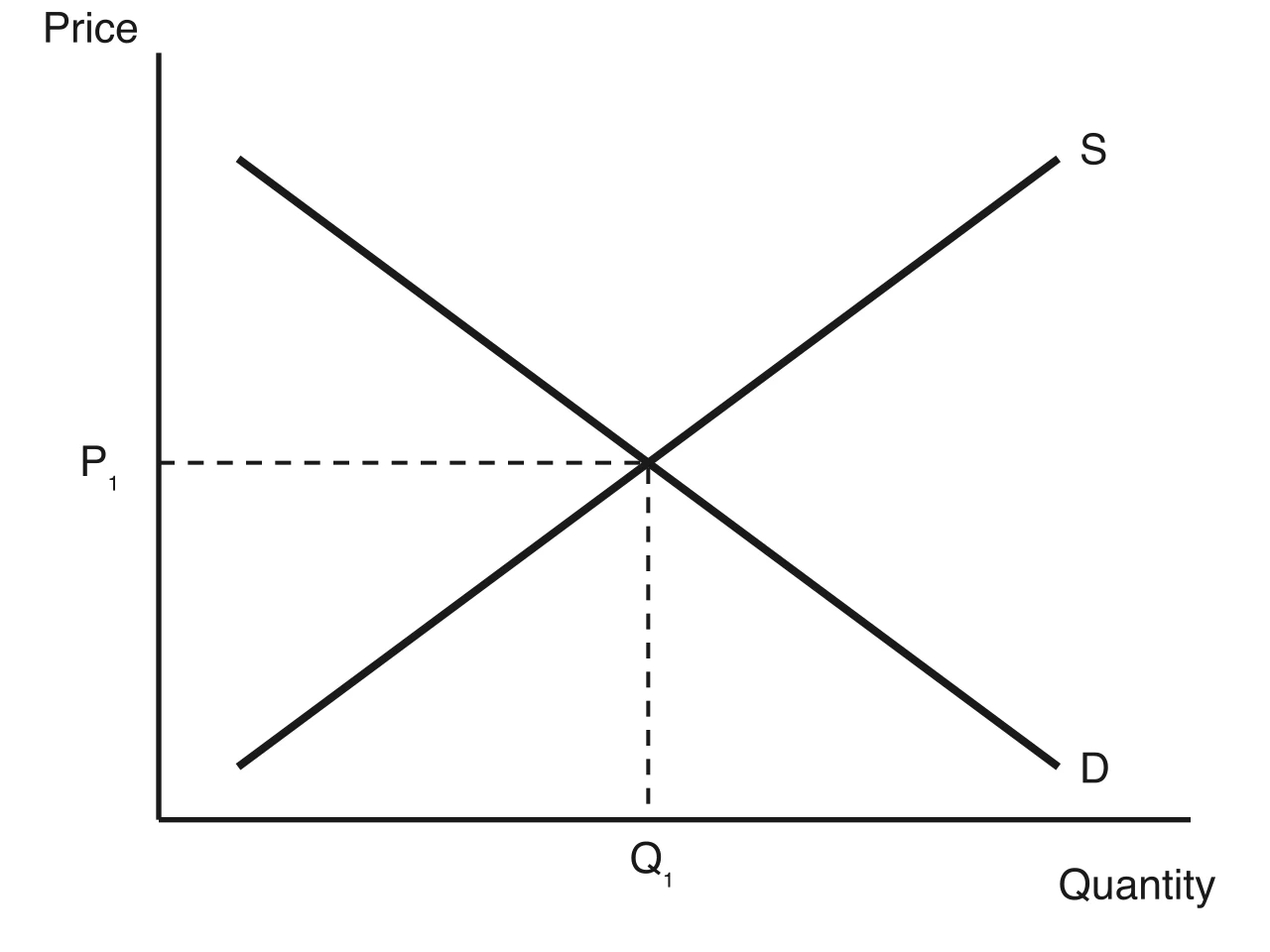
When the bus company raised the ticket price from $2.00 to $2.50, the number of tickets sold per day fell from 40 000 to 36 000.
- (a)
Define price elasticity of demand.
2 marks
- (b)
Calculate the price elasticity of demand for bus tickets.
2 marks
- (c)
Using your answer to (b), explain the effect of the price rise on the bus company’s total revenue.
4 marks
Markscheme (a)
A measure of the responsiveness of quantity demanded to a change in price, ceteris paribus. 2
Award 1 mark for a vague or partial definition.
Markscheme (b)
, 1
1
Markscheme (c)
Demand is price inelastic (|PED| < 1). 1
The percentage fall in quantity is smaller than the percentage rise in price. 1
Total revenue rises from $80 000 to $90 000 per day. 2
3 Macroeconomics
820 questions- 3.1Measuring economic activity139 questions
- 3.2Aggregate demand and aggregate supply324 questions
- 3.3Macroeconomic objectives363 questions
- 3.4Economics of inequality and poverty218 questions
- 3.5Monetary policy147 questions
- 3.6Fiscal policy207 questions
- 3.7Supply-side policies144 questions
One to try · ECON-0000225 marks
Inflation in an economy has risen to 7%, well above the central bank’s target of 2%.
- (a)
Explain how a central bank can use contractionary monetary policy to reduce inflation.
10 marks
- (b)
Using real-world examples, evaluate the effectiveness of monetary policy in reducing inflation.
15 marks
Markscheme (a)
Responses may include:
an accurate AD/AS diagram showing AD shifting left
higher interest rates raising the cost of borrowing
lower consumption and investment, reducing AD
a stronger currency reducing net exports
Level 4 (9–10 marks): a clear explanation with a fully labelled diagram.
Markscheme (b)
Evaluation may consider:
time lags between a rate change and its effect
whether inflation is demand-pull or cost-push
the effect on growth and unemployment
the credibility and independence of the central bank
Level 5 (13–15 marks): balanced evaluation supported by relevant real-world examples.
4 The global economy
681 questions- 4.1Benefits of international trade99 questions
- 4.2Types of trade protection142 questions
- 4.3Arguments for and against trade protection115 questions
- 4.4Economic integration54 questions
- 4.5Exchange rates197 questions
- 4.6Balance of payments110 questions
- 4.7Sustainable development101 questions
- 4.8Measuring development100 questions
- 4.9Barriers to economic growth and development147 questions
- 4.10Growth and development strategies178 questions
One to try · ECON-0119925 marks
Over recent decades the share of imported goods in household spending has risen in most economies.
- (a)
Explain two ways in which international trade may benefit consumers.
10 marks
- (b)
Using real-world examples, discuss the view that free trade benefits all stakeholders in an economy.
15 marks
Markscheme (a)
Answers may include:
Terminology: definitions of international trade (the exchange of goods and services across national borders), imports, world price, consumer surplus, choice.
Explanation:
lower prices: when the world price is below the domestic equilibrium price, consumers buy at the world price; foreign producers with lower costs supply the market, so the price falls, quantity consumed rises and consumers' real incomes rise;
greater choice: imports add varieties, qualities and brands that are not produced domestically (or goods that cannot be produced domestically at all, such as tropical fruit in a temperate country), so consumers can better match purchases to their preferences;
other valid benefits, for example higher quality resulting from greater competition, or access to goods embodying new technology.
Diagram: an international trade diagram with domestic demand and supply, a horizontal world supply curve (Sworld) at Pw below the domestic equilibrium Pe; consumption rising from Qe to Q2, domestic production falling to Q1, imports Q2 − Q1; the gain in consumer surplus may be shown. Or any other relevant diagram.
A maximum of [6] should be awarded if only one benefit is explained.
Markbands (best fit)
Level | Marks | Descriptor |
|---|---|---|
0 | 0 | The work does not reach a standard described by the descriptors below. |
1 | 1–2 | Little understanding of the specific demands of the question. Relevant economic theory is stated but not relevant. Economic terms are stated but not relevant. |
2 | 3–4 | Some understanding of the specific demands of the question. Relevant economic theory is described. Some relevant economic terms are included. |
3 | 5–6 | The specific demands of the question are understood but only partially addressed. Relevant economic theory is partly explained. Some relevant terms are used appropriately. Where appropriate, relevant diagram(s) are included. |
4 | 7–8 | The specific demands of the question are understood and addressed. Relevant economic theory is explained. Relevant terms are used mostly appropriately. Where appropriate, relevant diagram(s) are included and explained. |
5 | 9–10 | The specific demands of the question are understood and addressed. Relevant economic theory is fully explained. Relevant terms are used appropriately throughout. Where appropriate, relevant diagram(s) are included and fully explained. |
Markscheme (b)
Answers may include:
Terminology: free trade, stakeholders, imports, exports, world price, structural unemployment, comparative advantage (HL candidates may refer to it but it is not required).
Explanation/theory:
consumers gain from lower prices and greater choice;
exporting firms gain from access to larger markets, economies of scale and higher revenue; their workers may gain jobs and higher wages;
firms that use imported inputs gain from lower costs;
the economy as a whole gains from more efficient resource allocation and more efficient production as resources move to industries where the country is relatively efficient;
but import-competing producers lose revenue and market share, and their workers may become structurally unemployed;
the government loses tariff revenue when barriers are removed.
Diagram(s): an international trade diagram for an imported good showing the fall in price to Pw, the rise in consumption and fall in domestic production (consumers gain, domestic producers lose); and/or an international trade diagram for an exported good showing a rise in price to Pw, a rise in domestic production and exports (domestic producers gain, domestic consumers pay more).
Synthesis/evaluation:
consideration of the word 'all': trade creates winners and losers, so the claim is too strong;
the gains to winners may exceed the losses to losers, so society could compensate losers (retraining, unemployment benefits), but compensation rarely happens in practice;
short run versus long run: job losses are concentrated and immediate, gains are spread widely and may take time;
occupational and geographical immobility of labour determines how long losses last;
consumers of exported goods may face higher prices (for example when food producers sell abroad at a higher world price);
effects differ by type of economy and by sector; a reasoned conclusion on whether net gains are positive and how widely they are shared.
Examples:
the 'China shock' in the USA after China joined the WTO in 2001: cheaper consumer goods, but large manufacturing job losses concentrated in particular regions;
lower prices and greater variety of clothing in Europe and North America from imports from Bangladesh and Viet Nam;
New Zealand dairy farmers gaining from exports at high world prices, while domestic consumers pay world prices for butter and milk;
the removal of tariffs under NAFTA (1994): gains for US consumers and car makers using Mexican parts, but losses for some US manufacturing workers and Mexican maize farmers.
N.B. Terminology, theory, diagrams and examples given in part (a) and referred to in part (b) should be rewarded.
Examiners should be aware that candidates may take a different approach which, if appropriate, should be rewarded.
Markbands (best fit)
Level | Marks | Descriptor |
|---|---|---|
0 | 0 | The work does not reach a standard described by the descriptors below. |
1 | 1–3 | Little understanding of the specific demands of the question. Theory is stated but not relevant. Terms are not relevant. No synthesis or evaluation. Real-world examples are identified but not relevant. |
2 | 4–6 | Some understanding of the demands. Relevant theory is described. Some relevant terms are included. Synthesis or evaluation is superficial. A relevant real-world example is identified. |
3 | 7–9 | The demands are understood but only partially addressed. Theory is partly explained. Some terms are used appropriately. Relevant diagram(s) are included where appropriate. Synthesis or evaluation is appropriate but lacks balance. Example(s) are identified and partly developed in context. |
4 | 10–12 | The demands are understood and addressed. Theory is explained. Terms are used mostly appropriately. Diagram(s) are included and explained. Synthesis or evaluation is appropriate and mostly balanced. Example(s) are identified and developed in the context of the question. |
5 | 13–15 | The demands are understood and addressed. Theory is fully explained. Terms are used appropriately throughout. Diagram(s) are included and fully explained. Synthesis or evaluation is effective and balanced. Example(s) are identified and fully developed to support the argument. |
Practice every Economics question
A free account opens the whole question bank, keeps a record of what you have marked, and builds worksheets from the topics you pick.