Notes on 2.10 Market failure: asymmetric information
Learning objectives
Explain what asymmetric information is and why it leads to a misallocation of resources.
Distinguish between adverse selection (hidden information before a transaction) and moral hazard (hidden action after it).
Explain the market for lemons and the adverse selection spiral in insurance, using a diagram and a numerical example.
Explain moral hazard in insurance, employment and banking, including the principal–agent problem.
Explain how governments respond to asymmetric information through legislation, regulation and the provision of information.
Explain how buyers and sellers respond privately through signalling and screening.
Evaluate government and private responses to asymmetric information, using real-world examples.
Introduction
In many markets one side knows much more than the other: a used-car seller knows the car’s history, a borrower knows how likely they are to repay, and a food producer knows what went into the product. When information is unequal in this way, markets can misallocate resources, and some markets shrink or disappear altogether.
The topic links closely to the key concepts of efficiency, because good trades fail to happen, and intervention, because governments regulate many markets for this reason. It also involves economic well-being: the most serious cases, such as unsafe food and falsified medicines, damage health as well as incomes.
What asymmetric information is
The model of a competitive market assumes perfect information: buyers and sellers know the price, the quality of what they are trading and the risks involved. In reality information is often imperfect, and frequently it is unevenly shared. The party with more information can use it to its own advantage, and the party with less information, knowing this, changes how it behaves.
Either side may be the better informed. Sellers usually know more about the quality of what they sell, as with used cars, second-hand phones, food and financial products. Buyers sometimes know more, as when a person buying insurance knows more about their own health and driving than the insurer does, or a borrower knows more than the bank about their plans for the loan.
Hidden information and hidden action
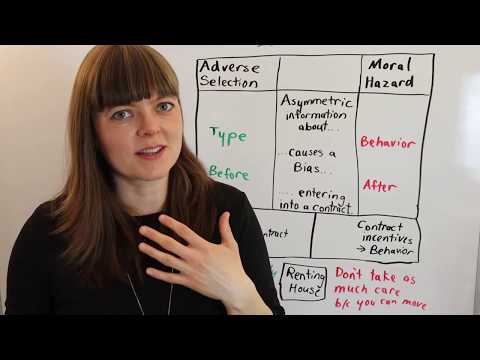
Economists separate two kinds of problem by when the information gap matters. Before a deal is agreed, one side may have hidden information about the quality of the good or the risk it brings. After a deal is agreed, one side may take hidden action: it changes its behaviour in a way the other side cannot observe.
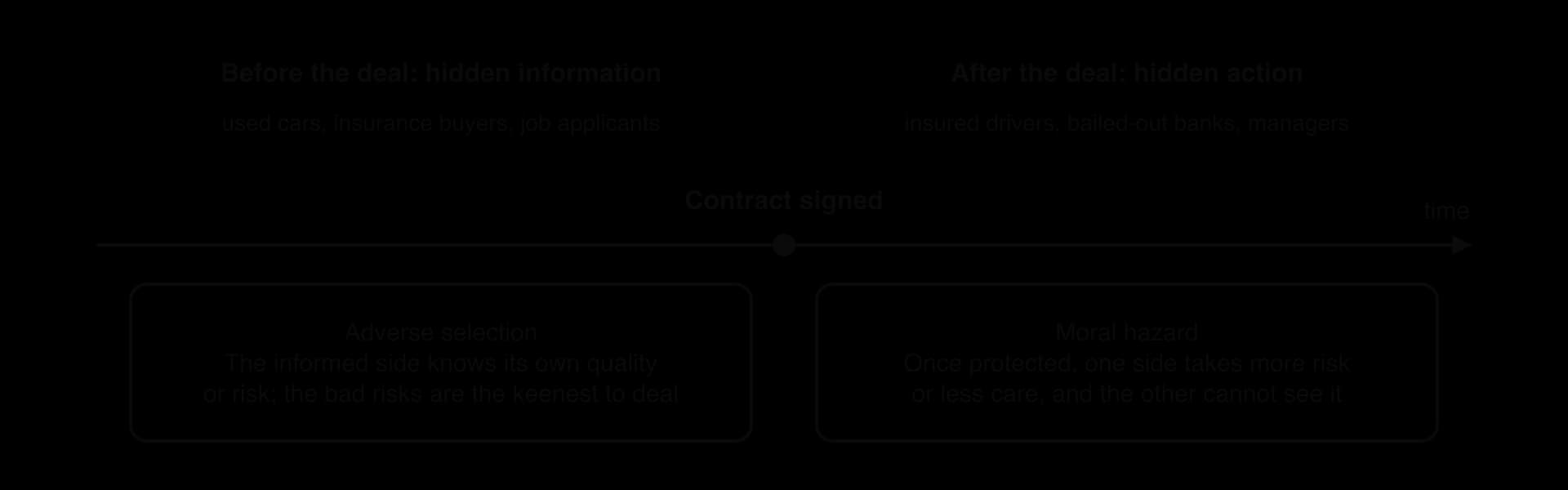
The figure places the two problems on either side of the moment a contract is signed. Hidden information leads to adverse selection, and hidden action leads to moral hazard. Many markets suffer from both: an insurer cannot see how risky a customer is before selling a policy, and cannot see how careful the customer is afterwards.
Market | Better-informed party | Less-informed party | What is hidden |
|---|---|---|---|
Used cars | Seller | Buyer | The car’s condition and accident history |
Health and life insurance | Buyer (the insured) | Insurer | Health, lifestyle and family history |
Bank lending | Borrower | Bank | How risky the borrower’s plans are and how likely they are to repay |
Labour market | Job applicant | Employer | The applicant’s ability and effort |
Food and medicines | Producer | Consumer | Ingredients, safety and whether the product is genuine |
Financial advice | Adviser | Client | Whether advice serves the client or earns the adviser commission |
Adverse selection
Adverse selection occurs when hidden information before a transaction means that the people most eager to trade are the ones the other side would least like to trade with. The less-informed side cannot tell good from bad, so it treats everyone as average. That average price or terms then attract the bad risks and drive away the good ones.
The market for lemons
The idea was set out in 1970 by George Akerlof in a paper on used cars, “The Market for ‘Lemons’”. In American slang, a lemon is a defective car, while a good one is sometimes called a peach. The paper was rejected by three journals before it was published, but it became one of the most cited papers in economics, and Akerlof shared the 2001 Nobel Memorial Prize with Michael Spence and Joseph Stiglitz for their work on asymmetric information.
The argument runs as follows. Sellers know whether their car is good or bad; buyers do not. Buyers know only that some cars on sale are lemons, so they are willing to pay a price that reflects average quality. That price is too low for the owners of good cars, who keep their cars or sell them privately to people who know them. As good cars leave the market, the average quality of the cars on sale falls, buyers lower the price they will pay, and more owners of good cars withdraw.
In the extreme, only lemons are traded. Buyers who would gladly have paid a fair price for a good car, and sellers who would gladly have sold one, cannot find each other. Mutually beneficial trades do not happen, so social surplus is lost, and low-quality goods drive high-quality goods out of the market.
The diagram shows the same result for the market for good used cars. With full information, demand for good cars is D₁ and the market reaches P₁ and Q₁. Because buyers cannot tell good cars from lemons, they are willing to pay only for average quality, so demand for good cars falls to D₂. Fewer good cars are traded, Q₂, at a lower price, P₂.
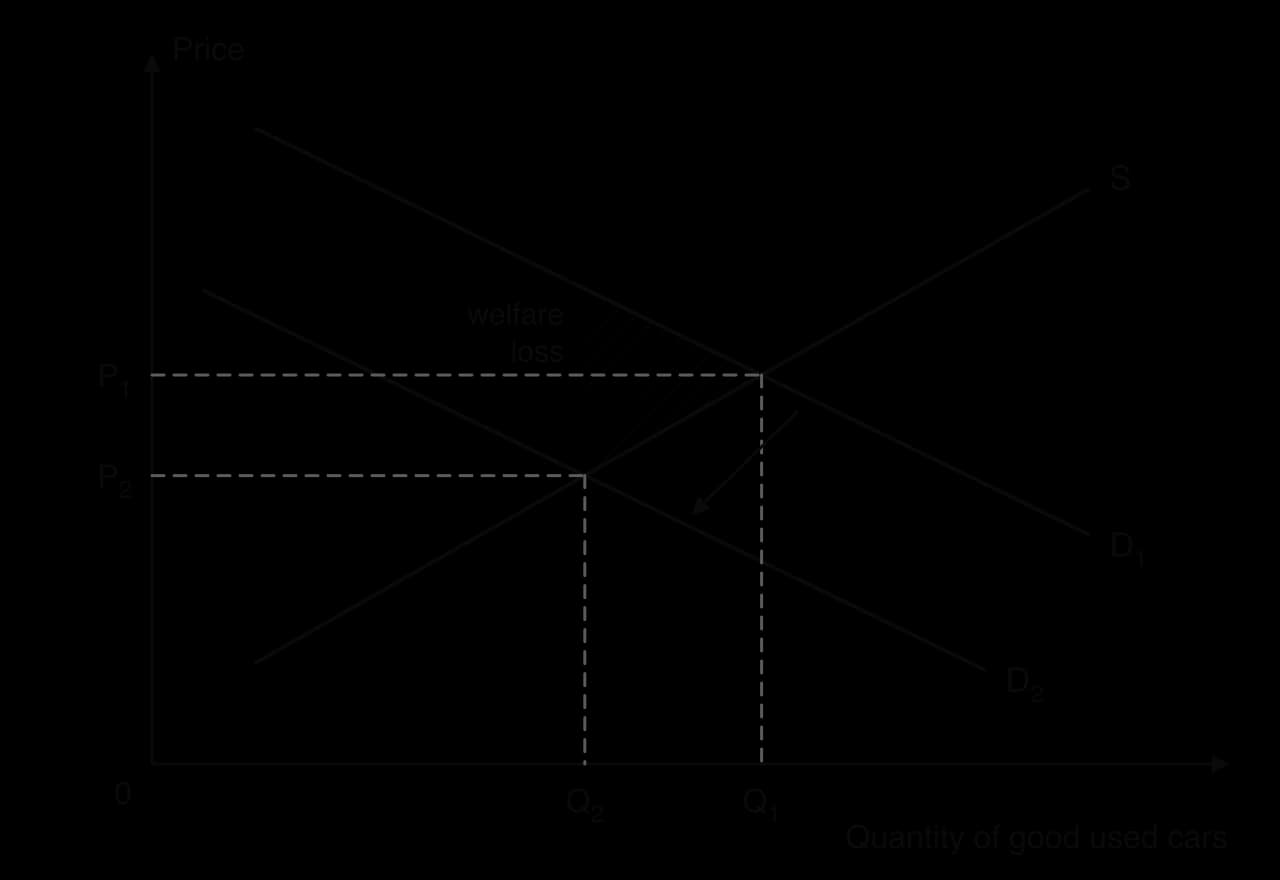
The hatched area is the welfare loss. Between Q₂ and Q₁, each good car is worth more to a fully informed buyer (on D₁) than it costs the seller to part with it (on S). These trades would raise social surplus, but they do not happen. The market under-allocates resources to good-quality cars, so the outcome is not allocatively efficient.
 YouTube

Adverse selection in insurance
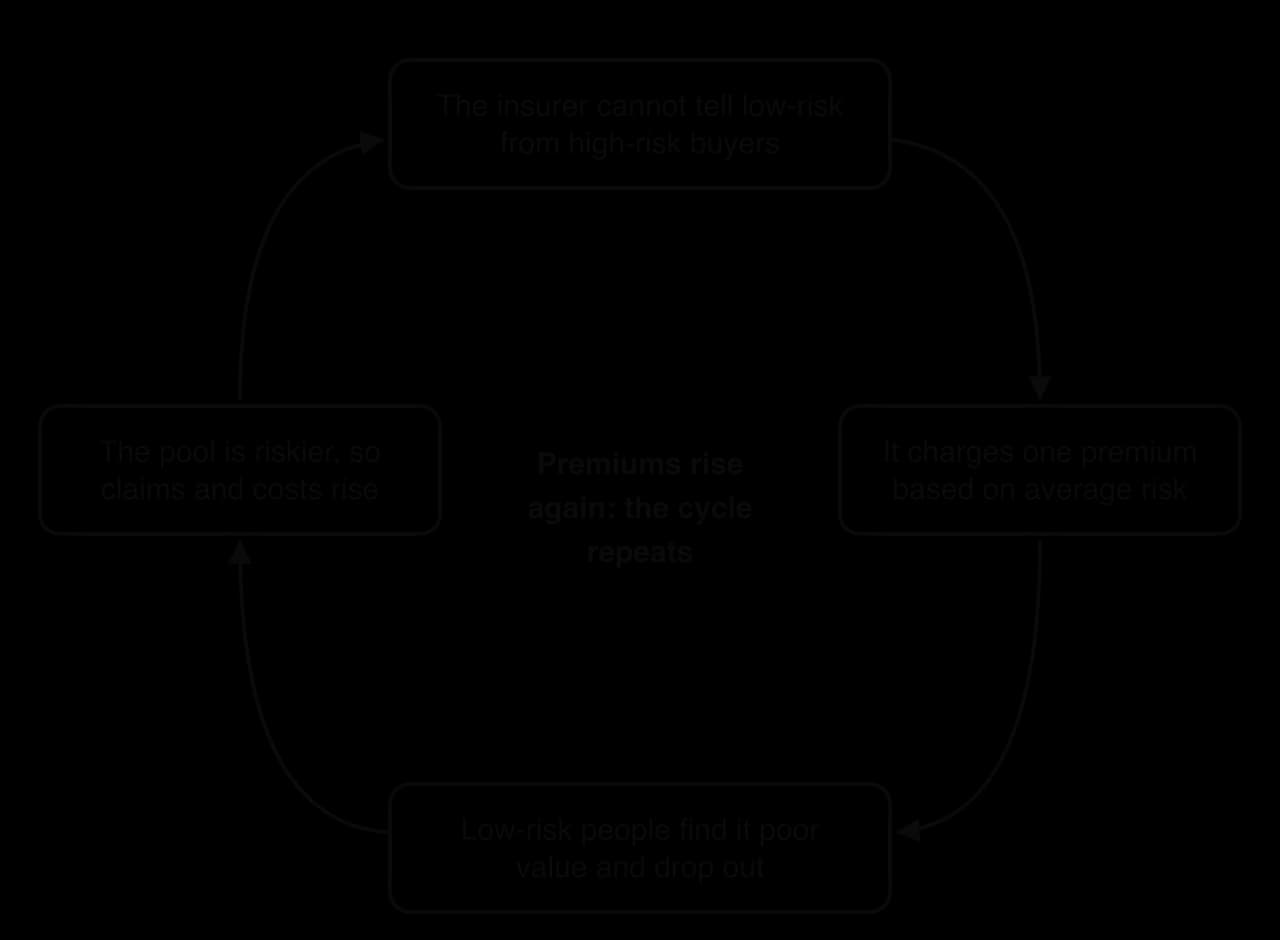
Insurance markets show adverse selection clearly. People know more about their own health, lifestyle and driving than any insurer can. If an insurer charges everyone the same premium, based on the average risk, the policy is a good deal for people at high risk and a poor deal for people at low risk. High-risk people buy the policy eagerly; many low-risk people do not.
The insurer then finds that its customers are riskier than average, so its claims and costs rise. To cover them, it raises the premium. The higher premium drives out the next group of lower-risk customers, the pool becomes riskier again, and premiums rise again. This process is sometimes called an adverse selection spiral, or a death spiral, because in the extreme the market for the policy disappears.
The US health insurance reforms of the Affordable Care Act show how governments try to stop this spiral. The law stopped insurers from setting premiums according to an applicant’s current health, which could have attracted mainly sick buyers. It therefore also included an individual mandate, a tax penalty on people without insurance, to keep healthy people in the pool. The Tax Cuts and Jobs Act of 2017 cut the federal penalty to zero from 2019, while Massachusetts kept its own penalty, and New Jersey and the District of Columbia (2019) and California (2020) introduced their own.
Sources: Wikipedia, “Individual mandate” (2026).
Adverse selection in other markets
Credit markets suffer from the same problem. A bank cannot see how risky each borrower’s plans are. If it raises its interest rate to cover the risk of default, safe borrowers with modest returns may stop borrowing, while risky borrowers, who may not repay anyway, still borrow. Raising the rate can therefore make the pool of borrowers riskier. Banks often ration credit instead, refusing some loans rather than charging more, which is one reason small firms and poor households in many low-income countries find it hard to borrow.
Medicines in low- and middle-income countries are a serious case. Patients cannot test whether a medicine is genuine, and at least 1 in 10 medicines in these countries is substandard or falsified, with an estimated US$30.5 billion a year spent on such products. Sellers of fakes undercut honest suppliers, and patients who cannot tell the difference may pay for medicine that does not work.
Sources: World Health Organization, Substandard and falsified medical products, fact sheet (December 2024).
Moral hazard
Moral hazard arises after a transaction. Once one party is protected from the consequences of its actions, it has less reason to be careful, and the other party, which bears part of the cost, cannot fully observe its behaviour. The word “moral” is historical: moral hazard describes a response to incentives, not dishonesty.
A driver with comprehensive car insurance may park in riskier places or drive less carefully, because the insurer will pay for most of the damage. A person with generous health insurance may visit the doctor more often for minor complaints. A tenant whose deposit has already been spent may take less care of a flat. In each case, the person who decides how careful to be does not bear the full cost of being careless.
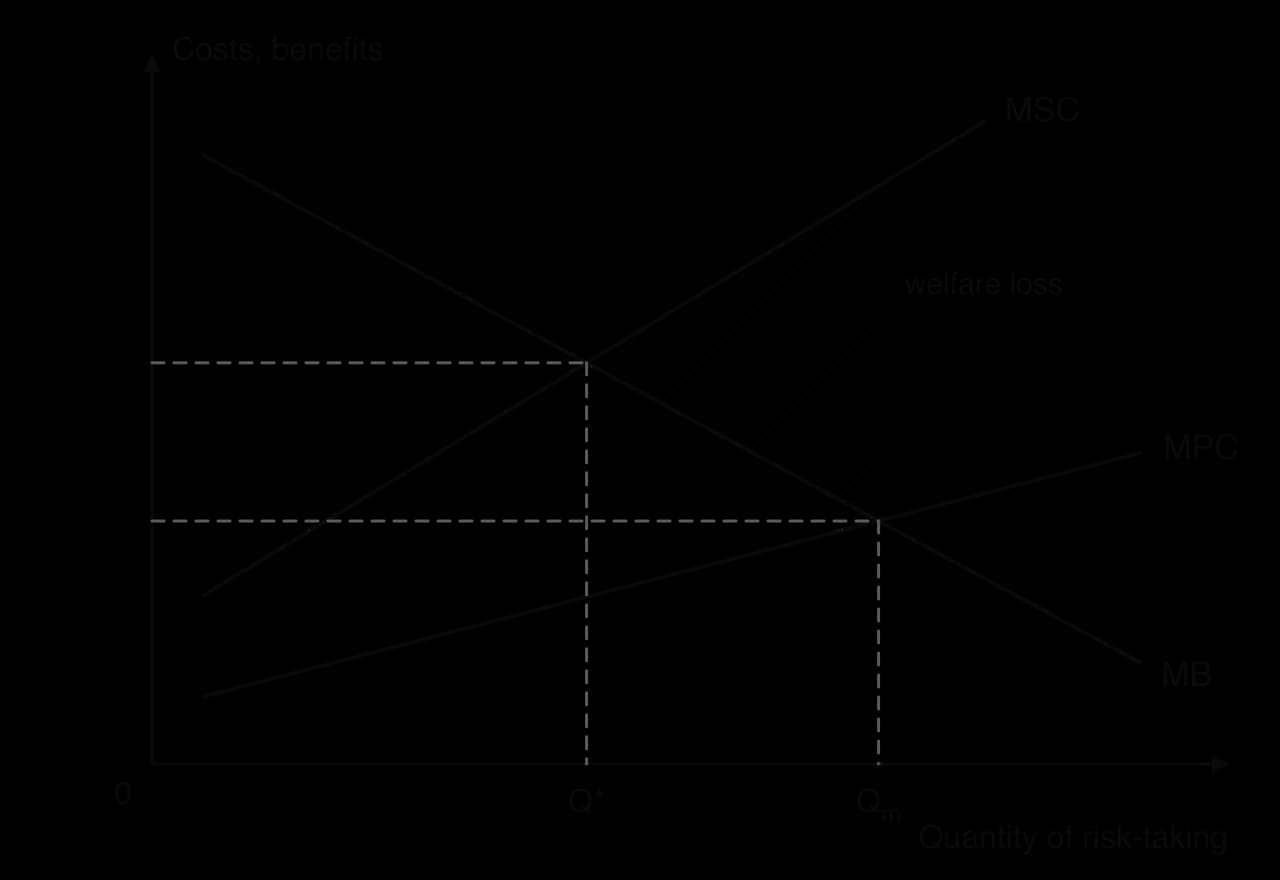
The diagram treats moral hazard like a negative externality. The marginal benefit (MB) curve shows the extra benefit to the decision-maker of taking more risk, such as the extra profit from riskier loans. The decision-maker bears only part of the cost of the risk, shown by the marginal private cost curve (MPC), while the full cost, including the part borne by the insurer, the government or taxpayers, is the marginal social cost (MSC). The decision-maker chooses Qₘ where MB = MPC, which is more risk than the socially optimal Q*, where MB = MSC.
Adverse selection | Moral hazard | |
|---|---|---|
When the problem arises | Before the transaction | After the transaction |
What is hidden | Information about quality or risk | Actions and effort |
Typical example | Only high-risk people buy insurance; only lemons are sold | Insured people take less care; bailed-out banks take more risk |
Effect on the market | Good-quality or low-risk participants leave; the market shrinks | More risk-taking or less effort than is efficient |
Typical responses | Signalling, screening, compulsory insurance, disclosure rules | Excess payments, monitoring, performance pay, regulation of risk-taking |
 YouTube
The principal–agent problem
Moral hazard is common whenever one person acts on behalf of another. The principal (an employer, a shareholder, a client) hires an agent (an employee, a manager, a financial adviser) to act for them, but cannot observe everything the agent does, and the agent has goals of their own. This is the principal–agent problem.
Shareholders own a company but managers run it, and managers may pursue a larger firm, higher pay or an easier life rather than maximum profit. A financial adviser paid by commission may recommend the product that pays the adviser most rather than the one that suits the client. Principals respond by monitoring agents and by tying pay to results, for example through bonuses or share options, although badly designed performance pay can itself encourage short-term risk-taking.
Moral hazard in banking
Banking shows moral hazard on the largest scale. If a bank is so large and so connected to the rest of the financial system that its collapse would damage the whole economy, its managers and lenders may expect the government to rescue it. A bank that is too big to fail keeps the profits when its risky bets succeed, while taxpayers bear much of the loss when they fail, so it has an incentive to take more risk.
During the 2008 global financial crisis, the US Congress authorised $700 billion for the Troubled Asset Relief Program in October 2008 to support banks and other firms, and governments in many other countries also rescued banks. The rescues limited the damage to the economy, but they confirmed that large banks would be saved, which strengthened the incentive problem for the future.
Deposit insurance creates a similar trade-off. It guarantees depositors their money if a bank fails, up to a limit, which stops panicked withdrawals that could bring down healthy banks. Because insured depositors have no reason to check how safe their bank is, banks face less pressure to avoid risk. When Silicon Valley Bank failed in March 2023, US authorities announced that all its depositors would be fully protected, including those with deposits above the insured limit, while shareholders and some unsecured lenders were not protected.
Sources: Federal Reserve, joint statement (12 March 2023); Wikipedia, “Troubled Asset Relief Program” (2026).
Government responses
Governments respond to asymmetric information in two main ways: by legislation and regulation, which change what the better-informed party is allowed to do, and by provision of information, which narrows the information gap directly. Both aim to restore trades that the information gap prevents and to protect the less-informed party.
Legislation and regulation
Command and control regulation sets rules that firms and individuals must follow, with penalties for breaking them. Several kinds of rule address asymmetric information.
Consumer protection laws give buyers the right to a refund or repair if goods are faulty or not as described, which shifts the risk of a lemon from the buyer to the seller and makes sellers less willing to sell bad products.
Minimum quality and safety standards, such as food safety rules, limits on harmful substances and vehicle safety tests, ban the lowest-quality products so buyers need not check for them.
Licensing requires doctors, pharmacists, lawyers, taxi drivers and food businesses to meet set standards before they may trade, which assures buyers of minimum quality.
Compulsory insurance, such as third-party motor insurance or a health insurance mandate, keeps low-risk people in the insurance pool and so prevents the adverse selection spiral.
Financial regulation limits the risks banks can take, for example by requiring them to hold more capital, which reduces the moral hazard created by deposit insurance and rescues.
Regulation works only if it is enforced. The Volkswagen emissions scandal shows what can happen when firms know more than the regulator. In September 2015 the US Environmental Protection Agency found that software in Volkswagen diesel cars detected when the car was being tested and switched on full emissions controls, while in normal driving the cars emitted up to 40 times the legal limit of nitrogen oxides. About 11 million cars worldwide were affected, and by June 2020 the scandal had cost Volkswagen $33.3 billion in fines, penalties, settlements and buybacks.
Sources: Wikipedia, “Volkswagen emissions scandal” (2026).
Provision of information
The second approach is to close the information gap itself. Governments can require firms to disclose information or can publish it themselves. This provision of information lets buyers make better choices and rewards sellers of good-quality products.
Examples include compulsory food labelling of ingredients, allergens and nutritional content; published hygiene ratings for restaurants; energy-efficiency labels on appliances; vehicle history records that show past accidents and mileage; and standard formats for showing the interest rate and total cost of a loan. Financial regulators also require companies that sell shares to publish audited accounts.
Private responses: signalling and screening
Buyers and sellers also respond to asymmetric information without government action. Because the information gap prevents valuable trades, both sides have an incentive to find ways round it. The better-informed side can try to show its quality, which is signalling, and the less-informed side can try to find out the hidden information, which is screening.
Signalling
Signalling works when a high-quality seller can do something that a low-quality seller would find too costly to copy. A used-car dealer that offers a one-year warranty on its good cars expects few claims; a dealer selling lemons would face many claims, so it cannot afford the same warranty. The warranty therefore tells buyers something real about quality.
Michael Spence showed that education can act as a signal in the labour market. Employers cannot see an applicant’s ability, but able people find it easier to complete a demanding degree, so a degree signals ability even if some of what was studied is never used at work. Brands and reputations work in a similar way: a firm that has spent years building a brand has much to lose from selling a bad product, so the brand itself is a signal.
Other signals include independent certification, such as organic or safety marks, money-back guarantees, and online ratings built up over many sales. Signals can mislead when they are cheap to fake: false certification marks, fake reviews and counterfeit branded goods all exploit the trust that real signals create.
Screening
Screening is the response of the less-informed party. An insurer asks applicants about their health and may require a medical check before selling life insurance. A bank checks a borrower’s credit history and asks for collateral. An employer sets tests, holds interviews and offers a probation period. A used-car buyer pays a mechanic to inspect the car or buys a vehicle history report.
Screening can also work by offering a menu of contracts and letting people show their type by their choice. An insurer can offer a cheap policy with a large excess (the amount the customer pays towards each claim) and an expensive policy with a small one. Low-risk customers, who expect few claims, tend to choose the large excess, while high-risk customers choose full cover. A large excess also reduces moral hazard, because the customer bears part of every loss.
Evaluating responses to asymmetric information
No response removes asymmetric information completely, and each has costs. A good evaluation weighs how effective each one is, who gains and who loses, and what the outcome depends on.
Strengths and limitations of government responses
Regulation and licensing can protect buyers who could never check quality for themselves, such as parents buying infant formula or patients buying medicines. Where the harm from a bad product is severe or irreversible, setting minimum standards is often more effective than relying on information, because buyers cannot learn from experience when the first mistake is fatal. Compulsory insurance can keep insurance markets alive that would otherwise collapse.
Regulation has limitations. Regulators also lack information, and firms may know more than the regulator, as the Volkswagen case showed. Enforcement costs money, and penalties deter only if cheating is likely to be caught. Licensing can be used by existing professionals to restrict entry and raise their own incomes, which creates a barrier to entry. Compulsory insurance forces low-risk people to pay premiums above their own expected costs, which some see as unfair.
Provision of information is cheaper and leaves choice with consumers, but it works only if people read and understand it. Labels can be long and technical, and people with less time or education may gain least from them. Behavioural economics adds that people may ignore information because of bounded rationality, so presentation matters as much as content.
Strengths and limitations of private responses
Signalling and screening are flexible, cost the government nothing and often work well: warranties, brands, credit checks and medical checks keep many markets for used goods, credit and insurance functioning. Firms have a strong incentive to develop them because better information creates profitable trades.
Their limits are also real. Signals can be expensive: if a degree is mainly a signal, society spends years of study partly to sort people rather than to raise their productivity. Signals can be faked. Screening raises equity issues: if insurers can screen perfectly, people who are ill or have a high genetic risk face very high premiums or cannot buy insurance at all, which is why some countries limit the use of genetic tests in insurance. Screening also excludes people with no credit history, often the poor and the young, from borrowing.
Response | Main strength | Main limitation |
|---|---|---|
Consumer protection law | Shifts the risk of bad quality to the seller | Buyers must know their rights and be able to use them |
Minimum standards and licensing | Protects buyers who cannot judge quality; vital where harm is severe | Costly to enforce; can be captured by the industry; may restrict entry |
Compulsory insurance | Prevents the adverse selection spiral | Low-risk people pay more than their own expected cost |
Provision of information | Cheap; leaves choice with consumers | Only works if information is read and understood |
Signalling | Lets good sellers prove quality; no cost to government | Signals can be costly or faked |
Screening | Lets the uninformed side price risk accurately | Can exclude high-risk or poorer people; raises equity concerns |
What the outcome depends on
Which response works best depends on how serious the harm from bad quality is, how easily quality can be checked after purchase, whether buyers buy repeatedly (repeat purchases build reputations), and how capable and honest the regulator is. In markets where buyers buy often and can judge quality quickly, such as restaurants, reputation and reviews may be enough. In markets where a mistake is rare, costly and hard to detect, such as infant food, medicines and banking, governments usually regulate.
Responses also interact. Private signals such as brands only work when trademark law stops others copying them, and certification only means something if fraud is punished. In practice, government and private responses usually work together. The key concepts of equity and change are both involved: technology, from online reviews to vehicle-history databases, keeps changing how much information each side has, and with it who gains from the information gap.
Case study: China’s 2008 melamine milk scandal
Infant formula is a product whose quality parents cannot check. They cannot test its protein content at home, and harm may appear only after weeks of feeding. Parents must rely on the producer’s honesty, on brands and on government testing: an extreme case of hidden information.
What happened
In 2008 it emerged that milk collected for Chinese dairy firms had been mixed with melamine, an industrial chemical rich in nitrogen. Standard protein tests measure nitrogen and cannot tell melamine from real protein, so watered-down milk with melamine added passed as normal. Sanlu, a leading producer of infant formula partly owned by New Zealand’s Fonterra, had received complaints from December 2007, and melamine was first found in its tests on 1 August 2008. Fonterra alerted the New Zealand government in early September, and the scandal became public in mid-September 2008.
Testing found contaminated formula from 22 companies. Sanlu’s products had the highest level, 2,563 mg of melamine per kg. By January 2009 about 300,000 children had been affected, 54,000 had been treated in hospital, and six deaths were officially linked to the milk. Sanlu was declared bankrupt, and two people involved in the supply chain were executed in November 2009.
How theory explains it
The scandal combined hidden information with hidden action along a supply chain. Milk collectors knew they were adding melamine; the dairy firms buying from them did not check properly; and parents could not see any of it. Each link was a principal–agent problem in which the agent’s incentive, to raise measured protein and get a better price, conflicted with the principal’s interest. The regulator’s tests, which measured nitrogen, were themselves exploited.
Once the scandal broke, buyers responded as the lemons model predicts. Unable to tell safe domestic formula from unsafe, many parents treated all domestic brands as possible lemons. Sales of Chinese dairy products fell by 30–40%, and parents turned to imported formula, whose foreign brands acted as a signal of quality. Demand from mainland buyers became so strong in Hong Kong that from 1 March 2013 Hong Kong banned travellers from taking more than 1.8 kg of powdered formula, about two large cans, out of the territory without a licence.

The chart shows China’s imports of infant food preparations rising from about US$0.4 billion in 2008 to a peak of US$5.3 billion in 2019, before falling to US$4.3 billion in 2023. The rise is consistent with a lasting loss of trust in domestic formula, although rising incomes and changes in the number of births also affected demand, so the scandal cannot explain all of it.
The government response
The government responded with regulation and provision of information. About 7,000 tonnes of products were removed from shops. The quality regulator revoked the inspection exemptions it had previously granted to dairy producers, set legal limits for melamine (1 mg per kg in infant formula), issued new regulations on dairy quality in October 2008, and planned nearly 400 new testing centres. A new Food Safety Law took effect on 1 June 2009.
What the case shows, and its limits
The case shows that asymmetric information can do far more than lower prices: it can damage health and destroy trust in a whole industry. It also shows that regulation is only as good as its testing: a test that measures the wrong thing invites cheating. Signals such as foreign brands helped consumers, but they also moved demand, and income, from domestic producers and more than 2 million dairy farmers to foreign firms.
The limits of the response are also clear. In 2010 melamine-contaminated milk powder that should have been destroyed after 2008 was found back on the market, showing that rules need enforcement. Trust lost in a few months can take years to rebuild, so strong inspection that prevents a scandal is likely to cost far less than rebuilding a market afterwards.
Sources: Wikipedia, “2008 Chinese milk scandal” (citing WHO and official Chinese reports) and “Food safety in China” (2026); Wikipedia, “Parallel trading in Hong Kong” (2026); UN Comtrade (2026).
Exam practice
Asymmetric information is HL-only, so it appears in HL Paper 1 and in Paper 3, but not in Paper 2. Paper 1 questions usually ask you to explain adverse selection or moral hazard in part (a) and to evaluate responses in part (b). Paper 3 can ask for definitions, short explanations and a policy recommendation in part (b).
A diagram is not essential here, but a lemons diagram (demand for good-quality products falling from D₁ to D₂, with the welfare loss) or the moral hazard diagram (MPC below MSC) can support an explanation if it is fully labelled and referred to in the text.
A part (b) question widens the analysis to policy. The strongest answers compare government and private responses in one well-developed market rather than listing every response briefly.
Paper 3 questions combine short calculations from data with a policy recommendation. In the recommendation, the data given in the question should be used as evidence, not only quoted.
Summary
Asymmetric information exists when one party to a transaction knows more than the other; it misallocates resources by preventing beneficial trades or encouraging excessive risk.
Adverse selection arises from hidden information before a transaction: average pricing drives out good-quality sellers or low-risk buyers, as in the market for lemons and the insurance death spiral.
Moral hazard arises from hidden action after a transaction: protected parties take more risk or less care, as with insured drivers, principal–agent problems and banks that are too big to fail.
Governments respond with legislation and regulation (consumer protection, standards, licensing, compulsory insurance, financial regulation) and with provision of information (labelling, ratings, disclosure).
Private agents respond by signalling (warranties, brands, qualifications) and screening (inspections, medical checks, credit checks, menus of contracts).
Every response has costs and limits; the best choice depends on how severe the harm is, whether quality can be checked and how capable the regulator is.
Self-check
- To do:
I can define asymmetric information and explain why it is a market failure.
- To do:
I can distinguish adverse selection from moral hazard by when the problem arises.
- To do:
I can explain the market for lemons with a numerical example and a diagram.
- To do:
I can explain the adverse selection spiral in insurance.
- To do:
I can explain moral hazard in insurance, employment (principal–agent) and banking.
- To do:
I can explain legislation, regulation and the provision of information as government responses.
- To do:
I can explain signalling and screening with examples.
- To do:
I can evaluate the responses using the melamine scandal or another real case, and reach a judgment.