2 Microeconomics
An overview of microeconomics: how consumers and producers make choices in markets, when markets fail, and how governments intervene, with a map of the twelve subtopics and the SL/HL split.
- IB Economics
- SL and HL
What 2 covers
From the subject guide: what you need to know and be able to do.
How individual markets work, and what happens when they fail. HL adds the theory of the firm and market power.
Demand, supply, equilibrium and elasticities, with diagrams you will draw in every paper
Government intervention: taxes, subsidies, price controls and their welfare effects
Market failure: externalities, common pool resources and public goods
HL: costs, revenues and profit; perfect competition, monopoly and oligopoly
12 subtopics in Microeconomics
Each one has its own page once something is published for it.
- 2.1Demand103 questions · notes · 57 quick fire
- 2.2Supply84 questions · notes · 56 quick fire
- 2.3Competitive market equilibrium194 questions · notes · 56 quick fire
- 2.4Critique of the maximising behaviour of consumers and producersHL only76 questions · notes · 40 quick fire
- 2.5Elasticity of demand137 questions · notes · 56 quick fire
- 2.6Elasticity of supply63 questions · notes · 40 quick fire
- 2.7Role of government in microeconomics375 questions · notes · 60 quick fire
- 2.8Market failure: externalities and common pool resources255 questions · notes · 66 quick fire
- 2.9Market failure: public goods44 questions · notes · 41 quick fire
- 2.10Market failure: asymmetric informationHL only41 questions · notes · 40 quick fire
- 2.11Market failure: market powerHL only104 questions · notes · 71 quick fire
- 2.12The market’s inability to achieve equityHL only40 questions · notes · 40 quick fire
An overview of 2 Microeconomics
Microeconomics studies the decisions of individual consumers, firms and governments, and how those decisions interact in the markets for particular goods, services and factors of production. It explains how prices are set, why they change, and when the outcome a market produces is efficient, sustainable or fair, and when it is not.
The questions that frame microeconomics
The unit is built around two real-world questions. The first is how consumers and producers make choices in trying to meet their economic objectives: why people buy more of a good when its price falls, why firms supply more when it rises, and how far people really behave in the calculating way the basic model assumes.
The second is when markets fail to meet important economic objectives, and whether government intervention helps. Markets can overproduce goods that damage the environment, underproduce goods that benefit everyone, let firms with market power raise prices, and leave some households unable to afford essentials. Government responses to these failures help some groups and impose costs on others, so each one has to be evaluated.
Behind both questions lies the problem of scarcity. Because resources are limited, every market answers the basic economic questions of what to produce, how to produce it and for whom, and every intervention involves a choice with an opportunity cost.
The subtopics
Subtopic | The question it answers | Level |
|---|---|---|
2.1 Demand | Why do consumers buy more of a good when its price falls, and what else changes how much they buy? | SL and HL |
2.2 Supply | Why do producers offer more when the price rises, and what else changes how much they offer? | SL and HL |
2.3 Competitive market equilibrium | How do demand and supply set a price, and why is the competitive outcome efficient? | SL and HL |
2.4 Critique of the maximising behaviour of consumers and producers | Do people and firms really behave as the rational model assumes, and how can choices be nudged? | HL only |
2.5 Elasticity of demand | How strongly does quantity demanded respond to changes in price and income? | SL and HL |
2.6 Elasticity of supply | How quickly and strongly can producers respond to a change in price? | SL and HL |
2.7 Role of government in microeconomics | Why and how do governments intervene in markets, and who gains and loses? | SL and HL |
2.8 Market failure: externalities and common pool resources | Why do markets produce too much pollution and too little education, and how can this be corrected? | SL and HL |
2.9 Market failure: public goods | Why will markets not provide goods such as street lighting or national defence? | SL and HL |
2.10 Market failure: asymmetric information | What goes wrong when one side of a deal knows more than the other? | HL only |
2.11 Market failure: market power | How do monopolies and oligopolies behave, and why can they be inefficient? | HL only |
2.12 The market’s inability to achieve equity | Why does a free market distribute income and wealth unequally? | HL only |
How the subtopics connect
The unit has two halves. The first half builds the model of a competitive market. Demand and supply together determine the market equilibrium, elasticity measures how strongly each side responds to price, and at the competitive equilibrium marginal benefit equals marginal cost, which is the condition for allocative efficiency.
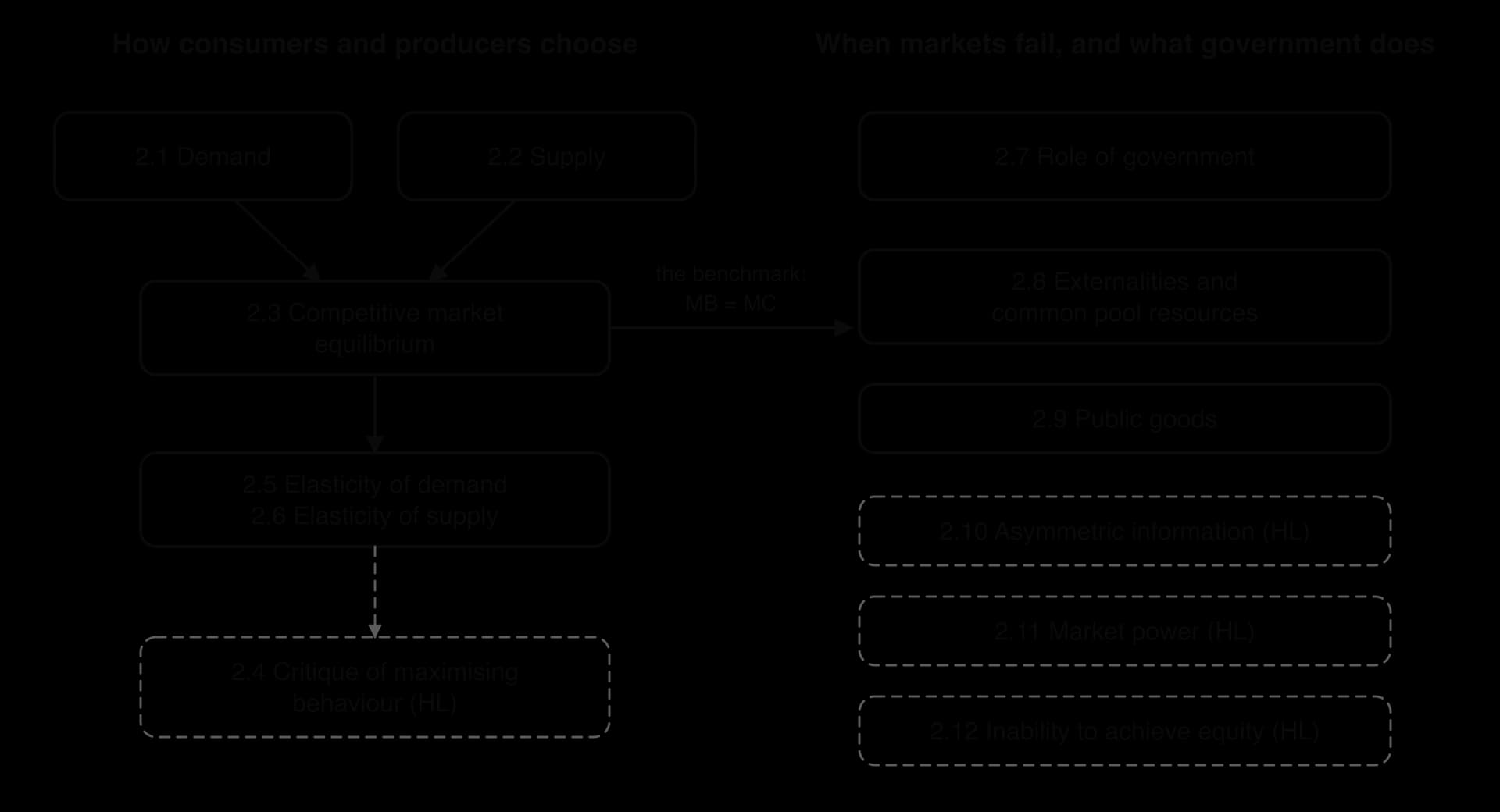
The second half uses that competitive outcome as a benchmark. Each form of market failure is a way in which real markets depart from it: externalities and common pool resources, public goods, asymmetric information, market power, and an unequal distribution of income. The role of government ties the two halves together, because the same intervention tools (price controls, indirect taxes, subsidies, regulation and provision) are analysed first as changes to a market and then as possible remedies for its failures.
One market through the whole unit: cocoa
The world cocoa market from 2023 to 2026 shows most of the unit’s ideas at work. Côte d’Ivoire and Ghana, which grew more than half of the world’s cocoa in 2022, suffered heavy rain followed by drought in the 2023/24 season, together with black pod disease, the spread of cocoa swollen shoot virus and ageing trees. Global cocoa production fell by 11% in 2023/24, and Ghana’s harvest was expected to fall about 40% short of its target.
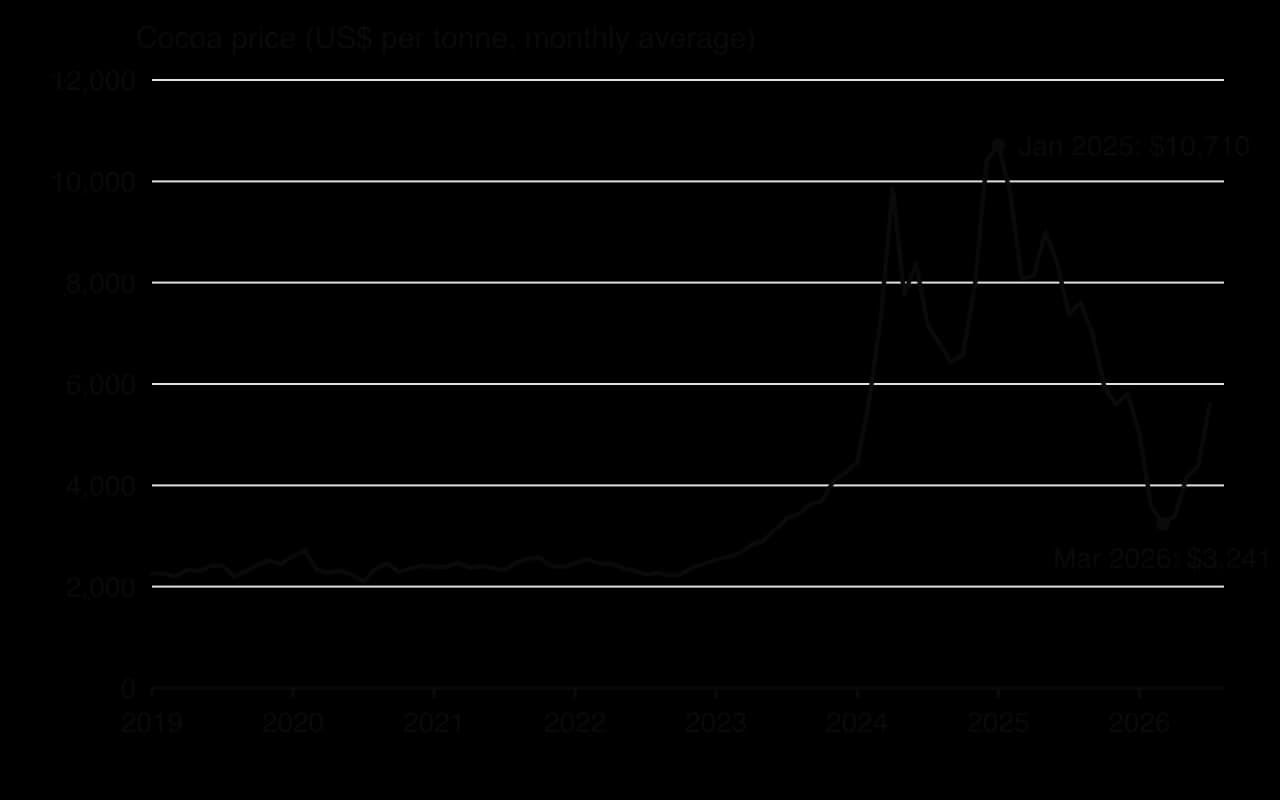
The chart shows the result. A fall in supply, meeting demand that changes little when the price rises, more than quadrupled the monthly average price between 2022 and January 2025, which illustrates supply shifts and low price elasticity of demand and supply. Because new cocoa trees take several years to bear fruit, supply could not respond quickly. The price then fell back sharply during 2025 and early 2026, as the theory of the price mechanism predicts: high prices reduce the quantity demanded and give farmers an incentive to produce more.
Governments were involved throughout. In both Côte d’Ivoire and Ghana the state sets the farmgate price paid to cocoa farmers each season, a form of price control intended to give farmers a stable income. Whether farmers gain enough of the high world price raises questions of equity and intervention, while clearing forest for new plantations raises questions of sustainability.
Sources: FAO production data (2022), via Wikipedia; NTU Centre for African Studies, “Cocoa production in Ghana and Côte d’Ivoire collapses” (2024); IMF primary commodity prices, via FRED (2026).
 YouTube
Key concepts in microeconomics
All nine key concepts appear in the unit, but five carry most of the weight:
Scarcity and choice. Markets ration scarce goods through prices, and every purchase, production decision and policy has an opportunity cost.
Efficiency. The competitive equilibrium maximises social surplus where marginal benefit equals marginal cost; market failures are judged against it.
Equity. Markets distribute output by ability to pay, which can be unfair; price controls, subsidies and redistribution are often justified on grounds of equity.
Sustainability. Externalities and common pool resources show how markets can use up resources faster than they can be replaced.
Intervention. Governments intervene to raise revenue, support firms and households, and correct market failure, but intervention can also fail.
Change and interdependence run through the unit too: a shock in one market, such as a poor cocoa harvest, affects farmers, manufacturers and consumers in many countries.
How SL and HL differ
SL and HL students study the same core of the unit: demand, supply, equilibrium, elasticity, the role of government, externalities, common pool resources and public goods. HL students study four additional subtopics in full and several HL-only extensions within the shared subtopics.
HL-only subtopics
2.4 Critique of the maximising behaviour of consumers and producers: behavioural economics, choice architecture and nudges, and business objectives other than profit maximisation.
2.10 Market failure: asymmetric information: adverse selection, moral hazard, and the responses of governments and private firms.
2.11 Market failure: market power: costs and revenues, profit maximisation, the four market structures, game theory, and regulation of market power. This is the largest HL subtopic in the unit and has many diagrams.
2.12 The market’s inability to achieve equity: why a free market produces an unequal distribution of income and wealth, shown with the circular flow model.
HL extensions within shared subtopics
Subtopic | What HL adds |
|---|---|
2.1 Demand | The income and substitution effects and diminishing marginal utility, as reasons for the law of demand. |
2.2 Supply | Diminishing marginal returns and increasing marginal costs, as reasons for the law of supply. |
2.3 Competitive market equilibrium | Calculating consumer and producer surplus from a diagram. |
2.5 Elasticity of demand | PED along a straight-line demand curve (with diagram); why primary commodities have low PED; why YED matters for firms and for changes in the structure of the economy. |
2.6 Elasticity of supply | Why primary commodities have low PES. |
2.7 Role of government | Consumer nudges as a form of intervention; calculating the effects of price controls, indirect taxes and subsidies on markets and stakeholders. |
2.8 Externalities and common pool resources | Calculating welfare loss from a diagram. |
Most of the HL extensions are calculations that read prices and quantities off a labelled diagram or a table, such as consumer and producer surplus, tax revenue and welfare loss. These calculations, together with the HL-only subtopics, are examined in HL Paper 3.
Assessment
Microeconomics is examined in every external paper:
Paper 1 (SL and HL): an extended-response question on microeconomics is normally one of the three choices. HL questions can include HL-only material.
Paper 2 (SL and HL): data-response questions often include microeconomic parts, such as definitions, elasticity calculations and demand and supply diagrams. Paper 2 does not include HL-only material.
Paper 3 (HL only): the policy paper can use any microeconomic content, including HL calculations such as consumer and producer surplus, tax incidence, welfare loss and a firm’s costs and revenues.
One of the three commentaries in the internal assessment portfolio must be based on a news article linked to microeconomics.
Flashcards for 2
The official decks for this part of the syllabus.
- 2.1 Demand200 cards
- 2.10 Market failure: asymmetric information170 cards
- 2.11 Market failure: market power408 cards
- 2.12 The market’s inability to achieve equity184 cards
- 2.2 Supply199 cards
- 2.3 Competitive market equilibrium201 cards
- 2.4 Critique of the maximising behaviour of consumers and producers225 cards
- 2.5 Elasticity of demand217 cards
- 2.6 Elasticity of supply181 cards
- 2.7 Role of government in microeconomics241 cards
- 2.8 Market failure: externalities and common pool resources267 cards
- 2.9 Market failure: public goods168 cards
Carry on with 2 in Augment
With a free account, Augment remembers where you stopped and what you have practiced.