Distinguish the types of trade agreement and trading bloc, evaluate their advantages and disadvantages, explain monetary union and the role of the WTO, and (HL) analyse trade creation, trade diversion and the euro.
Each is in the Economics glossary, with every other term in the subject.
A trade agreement between two countries, or between two trading blocs, that reduces barriers to trade between them.
The single set of tariffs that all members of a customs union apply to imports from countries outside the union.
A customs union that also allows the free movement of factors of production, mainly labour and capital, between member countries.
A trading bloc whose members eliminate trade barriers between themselves and apply a common external tariff to imports from non-members.
The process by which countries reduce or remove barriers to the movement of goods, services, capital and labour between them and coordinate their economic policies.
The right of workers from one member country of a common market to live and work in any other member country without needing a work permit.
A trading bloc whose members eliminate tariffs and quotas on trade between themselves, while each member keeps its own separate trade barriers against non-members.
The reduction in a country’s ability to make its own economic decisions, such as setting tariffs, standards or monetary policy, when it accepts the shared rules of a trading bloc or monetary union.
Describe bilateral, regional and multilateral preferential trade agreements, with real examples.
Distinguish between a free trade area, a customs union and a common market.
Evaluate the advantages and disadvantages of trading blocs for member and non-member countries.
Explain trade creation and trade diversion using diagrams, and calculate their effects from a diagram (HL).
Explain what a monetary union is, and evaluate the advantages and disadvantages of joining one (HL).
Explain the objectives and functions of the World Trade Organization and the factors that limit its influence.
Evaluate economic integration as a route to higher welfare, using real-world examples.
Economic integration is the process by which countries reduce the barriers between their economies, so that goods, services, capital and people move between them more freely. It ranges from a simple agreement to cut some tariffs to a full monetary union such as the euro area, and it shapes most of the world’s trade: Mexico, for example, sends most of its exports to its partners in a North American trade agreement.
Integration is a direct expression of interdependence: members agree to share rules and give up some national control in return for wider markets. It can raise efficiency and economic well-being, but it raises questions of equity for the regions and workers that lose, and of change, because agreements are made, deepened and sometimes reversed, as Brexit showed.
54 exam-style questions on this subtopic, written in the style of the IB papers. The first has its markscheme open. Counted on
Firms in small economies often argue that international trade is essential if they are to produce efficiently.
Explain how international trade may allow firms to benefit from economies of scale and to produce more efficiently.
10 marks
Answers may include:
Terminology: definitions of economies of scale (falling average costs as the scale of production increases), international trade, access to larger markets, productive efficiency, competition.
Explanation:
a small domestic market limits output; trade gives firms access to much larger foreign markets, so they can expand output;
at larger output firms gain economies of scale (specialized machinery, bulk buying of inputs, spreading high fixed costs such as research or design over more units, cheaper finance), so average costs fall;
lower costs allow lower prices, which raises international competitiveness and sales further;
foreign competition gives firms an incentive to cut waste, adopt new technology and innovate, so production becomes more efficient;
access to cheaper or better imported inputs and technology lowers costs further;
resources move towards industries in which the economy is relatively efficient, raising output from given resources.
Diagram: a diagram showing how larger output lowers average costs, or an international trade diagram showing exports at the world price, or any other relevant diagram. A diagram is not essential for full marks if the explanation is complete.
One of 41 short multiple-choice questions on 4.4. Pick an answer to see why it's right or wrong.
Why is it hard for the WTO to reach new agreements on agriculture?
The official deck for this part of the syllabus.
What is economic integration?
Which term describes: the process by which countries reduce or remove barriers to the movement of goods, services, capital and labour between them and coordinate their economic policies?
With a free account, Augment remembers where you stopped and what you have practiced.
A group of countries that share a single currency and a common central bank that sets one monetary policy, including one interest rate, for all members.
The WTO rule that any trade advantage a member gives to one country, such as a lower tariff, must be given immediately to all other WTO members.
A trade agreement among many countries across the world, usually negotiated through the World Trade Organization, whose terms apply equally to all of them.
An agreement between countries to give each other’s goods preferential access to their markets, usually through lower tariffs, compared with the access given to non-members.
A trade agreement between several countries, usually in the same region of the world, that reduces barriers to trade between them.
The criteria used to decide which country a good comes from, such as a minimum share of its value produced inside a trading bloc, so that only members’ goods receive tariff preferences.
The replacement of higher-cost domestic production by lower-cost imports from a partner country when a trading bloc removes tariffs between its members, raising efficiency.
The switch of imports from a lower-cost producer outside a trading bloc to a higher-cost producer inside it, caused by removing tariffs only between members, reducing efficiency.
A group of countries that agree to reduce or eliminate tariffs and other barriers to trade between them, such as a free trade area, a customs union or a common market.
The international organisation that sets and enforces the rules of trade between its member countries, provides a forum for trade negotiations and settles trade disputes.
Scope: Preferential trade agreements, the types of trading bloc and their advantages and disadvantages, monetary union and the World Trade Organization are studied at SL and HL. HL adds trade creation and trade diversion, and the evaluation of the advantages and disadvantages of monetary union.
Under free trade, goods would move between all countries without barriers. In practice, every country keeps some trade protection. Economic integration is a way of removing barriers between a group of countries while keeping them, at least partly, against the rest of the world. It can also be global, when all countries agree to lower barriers together.
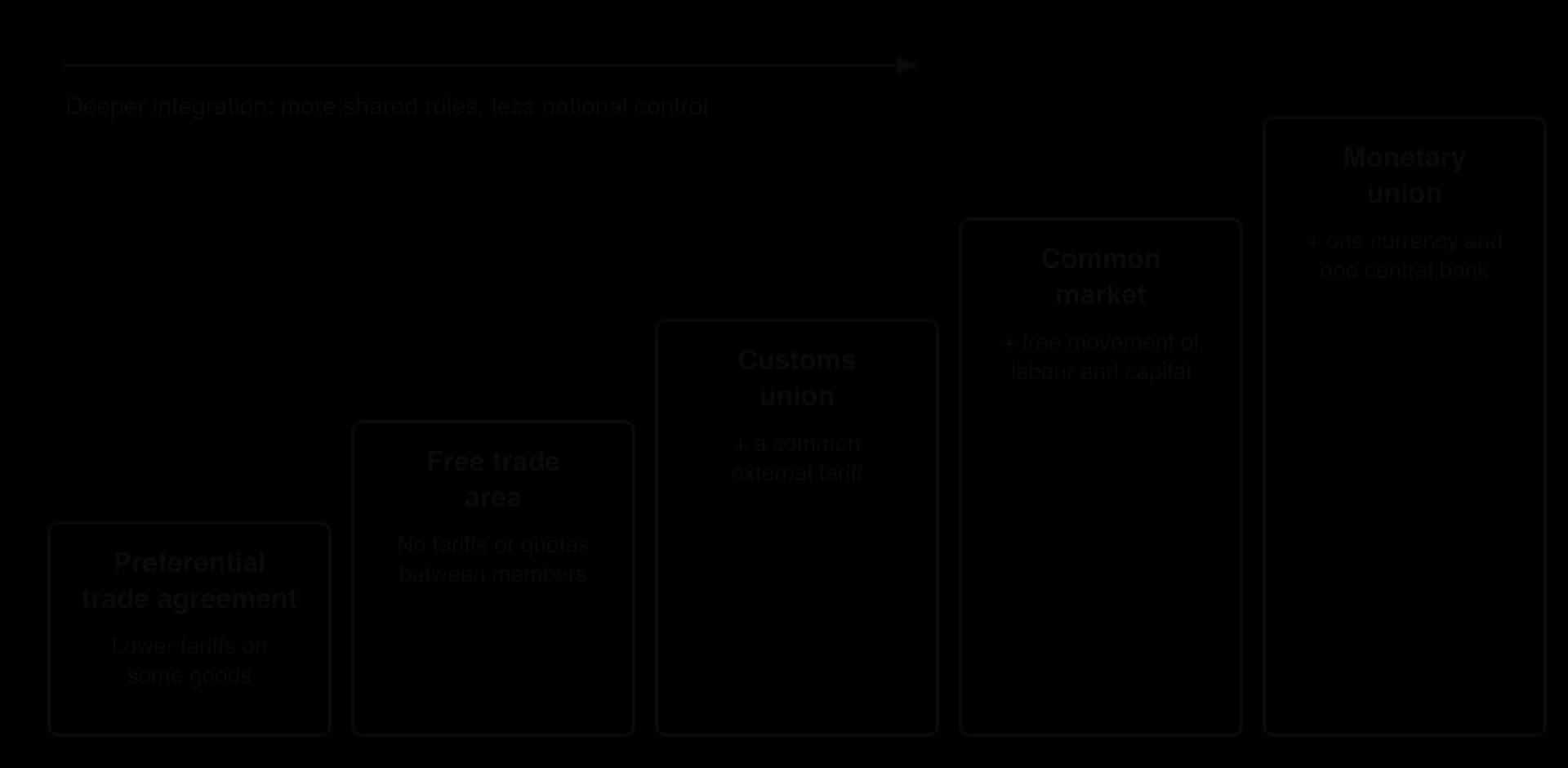
Integration happens in stages. Each stage keeps everything the one before it had and adds something more. At each step the members gain more access to each other’s markets, but they also accept more common rules and give up more control over their own economic policy.
The diagram shows the five stages, from a preferential trade agreement to a monetary union. Few groups follow the stages in a strict order, and some agreements mix features of different stages, but the staircase is a useful way to classify any agreement by asking what it removes and what it shares.
The simplest form of integration is a preferential trade agreement (PTA). The countries that sign it give each other better access to their markets than they give to other countries, usually by lowering tariffs on some goods. The word “preferential” means that the partners are treated better than everyone else.
Trade agreements are classified by how many countries sign them. A bilateral trade agreement is between two countries or two trading blocs: the EU–Japan Economic Partnership Agreement, in force since 1 February 2019, removed most tariffs between the European Union and Japan. A regional trade agreement links several countries in a region: the Regional Comprehensive Economic Partnership (RCEP), in force since 1 January 2022, joins 15 Asia-Pacific countries, including China, Japan and South Korea, with about 30% of the world’s population and output.
A multilateral trade agreement is signed by many countries across the world at once, usually through the World Trade Organization (WTO). The Trade Facilitation Agreement, which entered into force in 2017, commits all WTO members to simplify and speed up customs procedures. Multilateral agreements are not preferential in the same way, because they apply equally to all members.
Multilateral agreements are the hardest to reach, because so many countries must agree, but they cover the most trade and do not discriminate between countries. Bilateral agreements are the easiest to reach, but they cover only one pair of countries, and a country with many bilateral agreements ends up with a different set of tariffs and rules for each partner.
Type | Who signs | Example | Main feature |
|---|---|---|---|
Bilateral | Two countries (or two blocs) | EU–Japan Economic Partnership Agreement (2019) | Easiest to agree; terms differ partner by partner. |
Regional | Several countries in a region | RCEP, in force since 2022; African Continental Free Trade Area, trading since 2021 | Builds regional supply chains; excludes the rest of the world. |
Multilateral | Many countries worldwide, usually all WTO members | WTO Trade Facilitation Agreement (2017) | Hardest to agree; applies equally to all members. |
The WTO’s basic rule is non-discrimination. Under the most-favoured-nation principle (MFN), a country that lowers a tariff for one WTO member must lower it for all members. Preferential agreements break this rule, because they give partners lower tariffs than everyone else.
WTO rules allow an exception for free trade areas and customs unions, provided they remove barriers on “substantially all” trade between the members and do not raise barriers against non-members. The exception exists because deeper regional integration was seen as a step towards freer trade overall. As a result, most of the world’s trade now takes place under some kind of regional or bilateral agreement as well as under WTO rules.
A trading bloc is a group of countries that have agreed to reduce or remove barriers to trade between them. There are three types, each deeper than the last: free trade areas, customs unions and common markets. A monetary union adds a single currency to a common market.
In a free trade area, members remove tariffs and quotas on goods traded between them, but each member keeps its own tariffs and trade policy towards non-members. The United States–Mexico–Canada Agreement (USMCA), the successor to the North American Free Trade Agreement (NAFTA), and the African Continental Free Trade Area (AfCFTA), which covers about 1.3 billion people, are free trade areas.
Because each member sets its own external tariffs, a free trade area has a problem. Suppose member A charges a 10% tariff on a good from outside the area and member B charges 2%. Firms could import the good into B, paying 2%, and then send it on to A tariff-free, avoiding A’s higher tariff. This is called trade deflection.
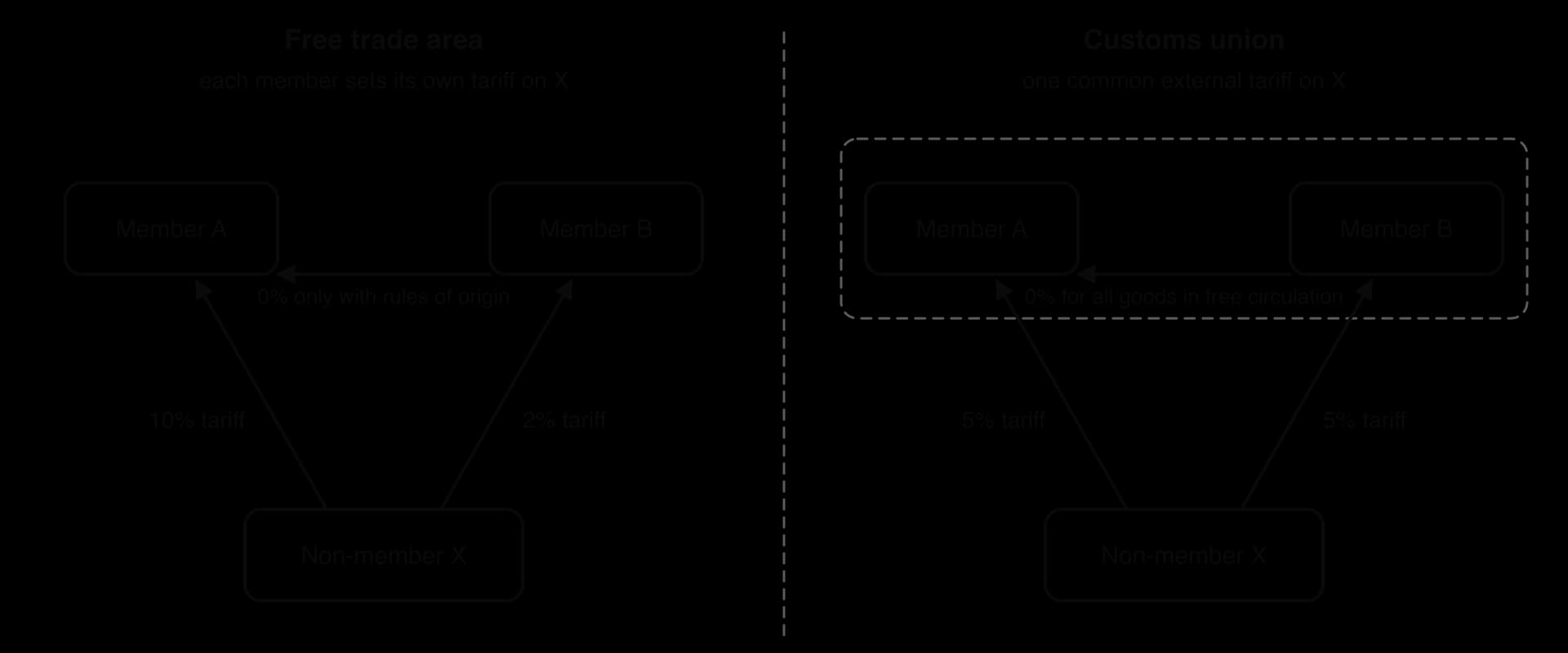
To stop trade deflection, free trade areas use rules of origin. Only goods that are made in a member country, or that contain a minimum share of content from member countries, qualify for zero tariffs. Under USMCA, for example, a car must have 75% of its value produced in North America to cross the border tariff-free, up from 62.5% under NAFTA.
Rules of origin are a cost of free trade areas. Firms must keep records to prove where their inputs came from, and some firms find it cheaper to pay the normal tariff than to comply. Strict rules can also push firms to buy inputs from inside the area even when outside suppliers are cheaper.
A customs union is a free trade area whose members also adopt the same tariffs on imports from non-members, called a common external tariff. Because the external tariff is the same at every border, a good that has entered one member can move to any other without further duties, and rules of origin are not needed for trade between members.
The European Union has been a customs union since 1968, and Mercosur, formed by Argentina, Brazil, Paraguay and Uruguay in 1991, applies a common external tariff to most goods. A customs union must also negotiate trade agreements with other countries as a single group, because members cannot change their tariffs on their own.
A common market is a customs union that also allows the free movement of factors of production: labour and capital. Workers can live and work in any member country, and firms can invest anywhere in the bloc. Many common markets also aim for free movement of services, which requires shared rules on product standards, professional qualifications and competition.
The European Union’s single market, completed on 1 January 1993, is the leading example. It provides the “four freedoms”: free movement of goods, services, capital and people. Common rules on product standards mean that a good legally sold in one member can be sold in all of them, which removes many administrative barriers as well as tariffs.

The UK left the EU’s single market and customs union on 1 January 2021. Its new agreement with the EU kept zero tariffs and zero quotas on goods that meet rules of origin, but trade between the UK and the EU now needs customs declarations, proof of origin and checks on food and animal products. These new administrative barriers raised the cost of trade even without any tariffs, which shows how much of the value of a common market lies in removing barriers other than tariffs.
Feature | Free trade area | Customs union | Common market |
|---|---|---|---|
No tariffs or quotas between members | Yes | Yes | Yes |
Common external tariff | No | Yes | Yes |
Rules of origin needed for internal trade | Yes | No | No |
Free movement of labour and capital | No | No | Yes |
Trade deals with other countries | Each member separately | As a group | As a group |
Example | USMCA, AfCFTA | Mercosur | EU single market |
 YouTube
Trading blocs bring many of the benefits of free trade to their members, and some benefits that come specifically from deeper cooperation. The size of the gains depends on how much trade the members already had, how different their costs are, and how deep the integration goes.
When a country joins a trading bloc, it removes its tariffs on goods from the other members. If a partner country is the lowest-cost producer of a good, removing the tariff lets consumers buy more of it at a lower price, and higher-cost domestic production is replaced by cheaper imports. This is trade creation.
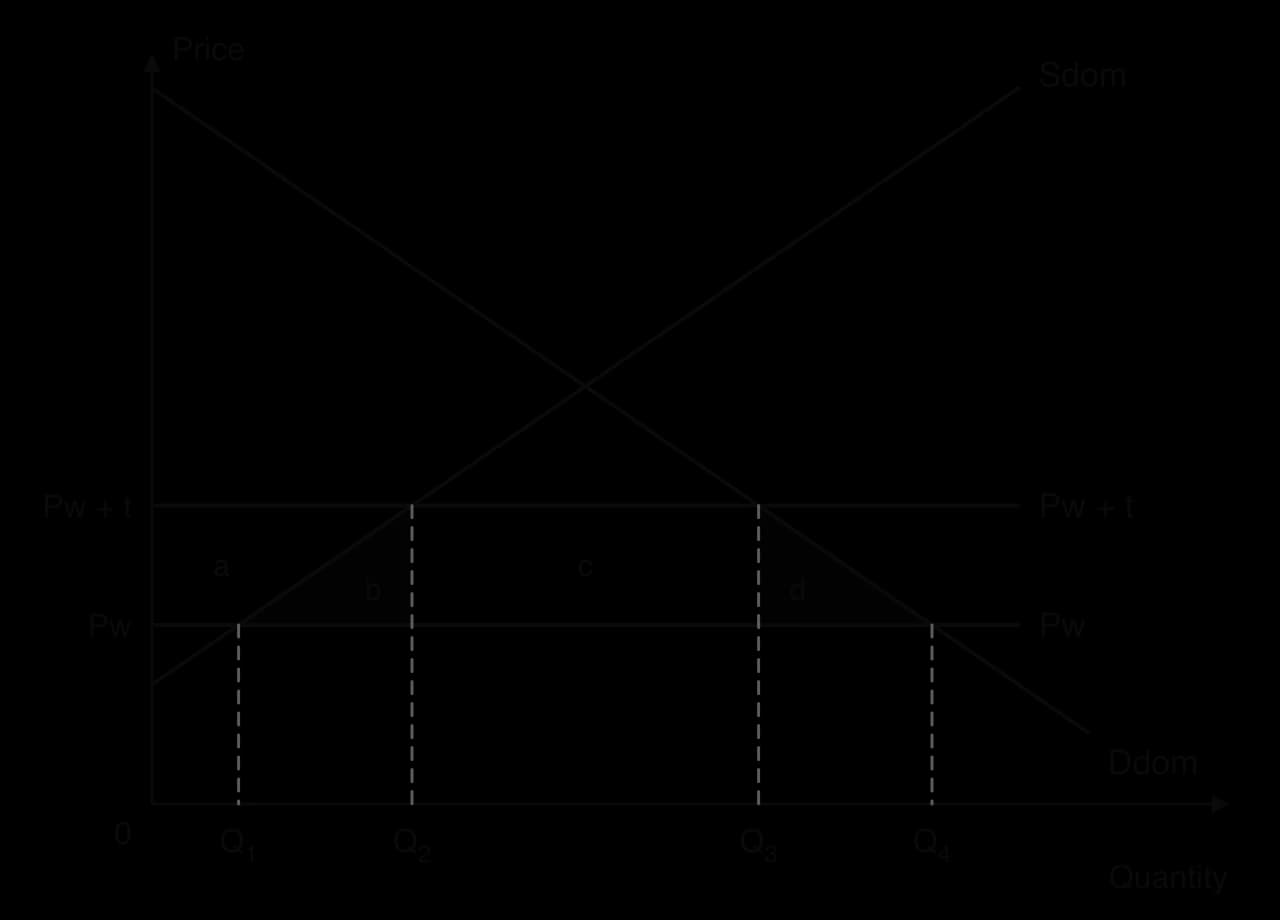
The diagram shows a country importing a good from a partner that is also the world’s lowest-cost producer, at price Pw. Before the bloc, a tariff t raises the domestic price to Pw + t: domestic firms produce Q₂, consumers buy Q₃, and the government collects tariff revenue on the imports Q₃ − Q₂.
When the bloc removes the tariff, the price falls to Pw. Consumers gain consumer surplus equal to areas a + b + c + d. Domestic producers lose producer surplus equal to area a, and the government loses the tariff revenue c. Areas a and c are transfers to consumers, so the net gain is b + d.
Area b is the production gain: the units between Q₁ and Q₂ were produced at home at a cost above Pw; they are now imported more cheaply, so fewer resources are used to obtain them.
Area d is the consumption gain: consumers who value the good above Pw but below Pw + t now buy it, so consumption rises from Q₃ to Q₄.
Trade creation is the reason why trading blocs can raise welfare. It is largest when member countries have very different costs, so that removing barriers moves production to the lowest-cost producer inside the bloc, and when tariffs before the bloc were high.
A trading bloc gives firms access to a much larger market without tariffs. A firm in a small country can sell to the whole bloc, which lets it produce on a larger scale and achieve economies of scale: lower average costs from bulk buying, specialised machinery and spreading fixed costs such as research and development over more units. Larger markets also increase competition, which pushes firms to cut costs and innovate.
These gains are especially important for small economies. Before NAFTA, firms in Mexico produced mainly for a domestic market of about 90 million people; access to the United States and Canada allowed car and electronics plants to be built for the whole North American market, with production of some parts concentrated in a single plant serving all three countries.
In a common market, workers can move to wherever their skills are most in demand. Unemployed workers in a region with weak demand can find jobs in another member country, and firms facing labour shortages can recruit from across the bloc. This raises employment and output, and it can reduce structural unemployment by matching workers and jobs over a wider area.
Free movement also has costs. Regions that lose young and skilled workers may lose part of their tax base and their capacity to grow, and some workers in receiving countries fear competition for jobs and housing. Opposition to free movement of labour was one of the main issues in the UK’s 2016 vote to leave the EU.
A group of countries negotiating together has more weight than each country alone. The European Union negotiates trade agreements for all its members, so it can offer access to a market of about 450 million consumers and obtain better terms than any single member could. Smaller groups also gain: a regional bloc of low-income countries has a stronger voice in WTO negotiations than its members acting separately.
Countries that trade heavily with each other have strong reasons to stay at peace and to cooperate on other issues. Economic integration in Europe began after the Second World War with the explicit aim of making another war between France and Germany impossible, by tying together their coal and steel industries. Trading blocs also create regular meetings and shared institutions that help members cooperate on issues from the environment to migration.
Trading blocs remove barriers between members, but they also discriminate against non-members, require members to share rules and can slow down global agreements. Whether a bloc raises world welfare depends on the balance between these costs and its benefits.
A bloc removes tariffs only on goods from member countries. If the lowest-cost producer in the world is outside the bloc, its goods still pay the tariff, while a higher-cost partner’s goods now enter tariff-free. Imports can switch from the efficient outside producer to the less efficient partner, simply because the partner no longer pays the tariff. This is trade diversion.
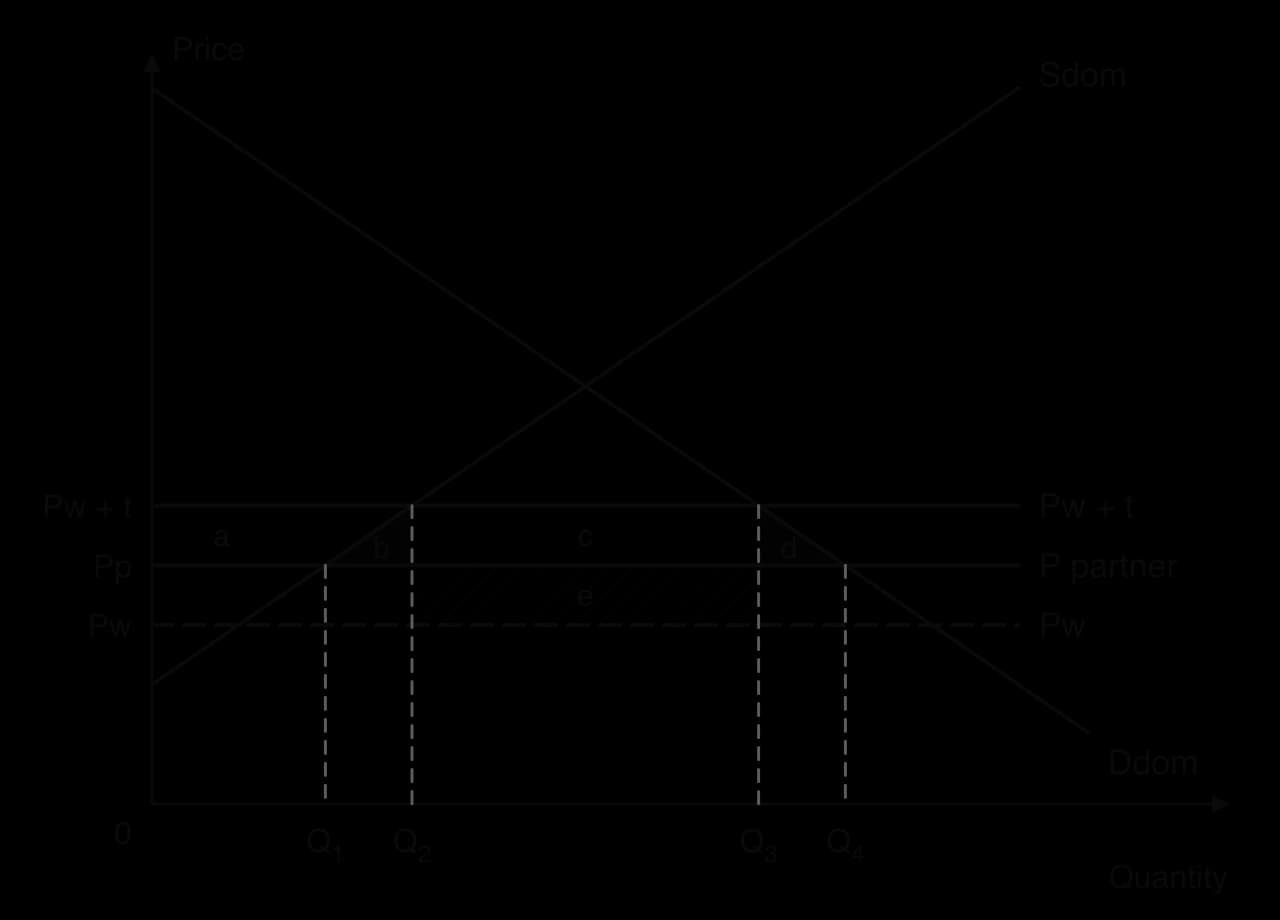
The diagram shows a country that, before joining the bloc, imports from the world’s lowest-cost producer, outside the bloc, at Pw. With its tariff t, the domestic price is Pw + t, domestic output is Q₂, consumption Q₃ and imports Q₃ − Q₂. The government collects tariff revenue equal to areas c + e.
After the bloc forms, a partner country can sell at price Pp. Pp is higher than Pw, but lower than Pw + t, because the partner no longer pays the tariff. Imports switch to the partner and the domestic price falls to Pp. Consumers gain areas a + b + c + d, producers lose area a, and the government loses all its tariff revenue, c + e.
The net effect on the importing country is (b + d) − e. Areas b and d are gains, as with trade creation, from lower domestic production and higher consumption. Area e is a loss: the country now pays the partner Pp for each imported unit instead of paying the outside producer Pw, so it uses more resources to obtain the same imports. If e is larger than b + d, the bloc makes the country worse off.
A classic example is the UK’s entry into the European Economic Community in 1973. Before joining, the UK imported much of its butter and lamb tariff-free from New Zealand, a very low-cost producer. After joining, it had to apply the community’s common external tariff to New Zealand produce, while produce from other members entered freely, so imports shifted towards higher-cost European suppliers.
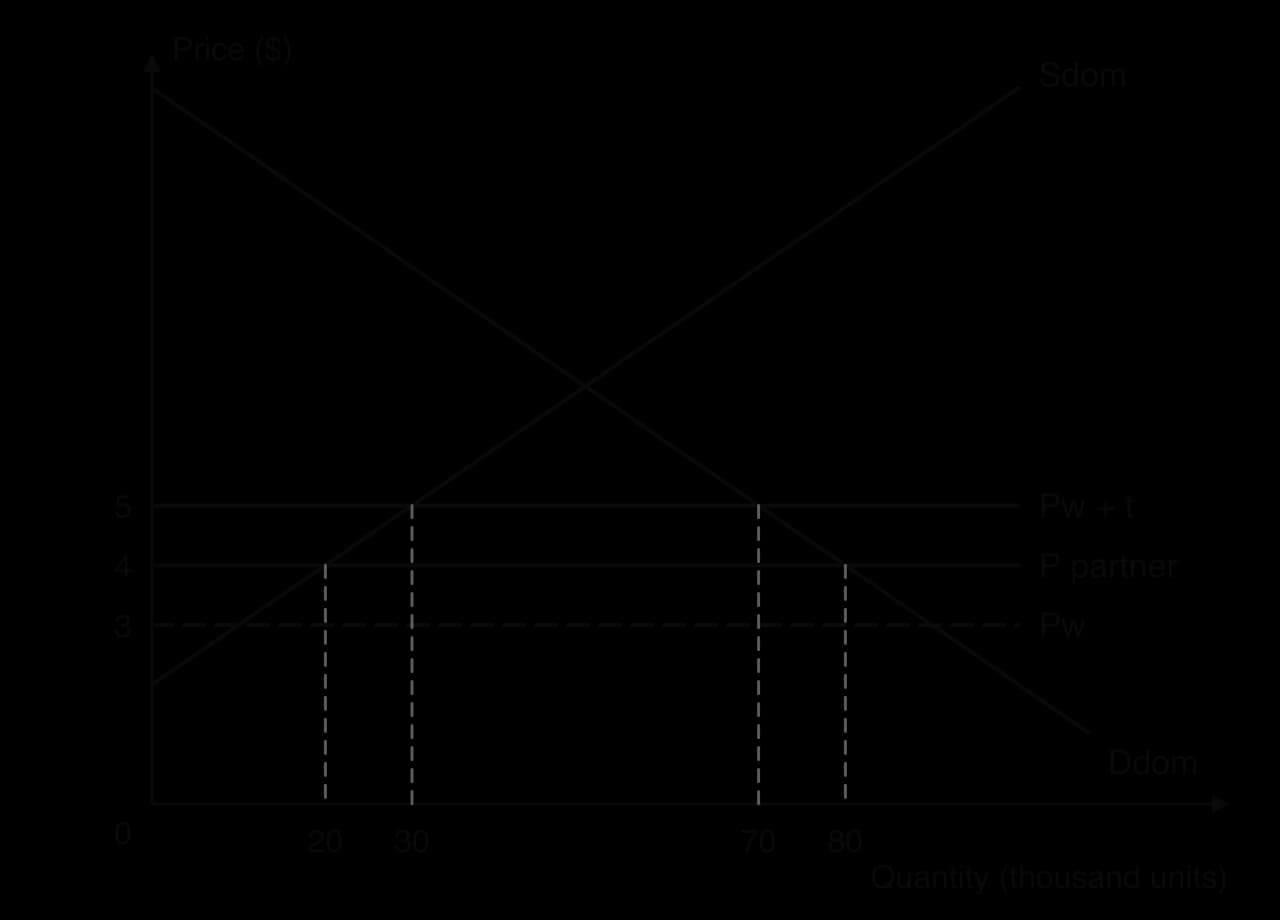
Whether a bloc is mainly trade-creating or trade-diverting is an empirical question. Trade creation is more likely when members are each other’s natural trading partners, with low costs and short distances between them, and when the common external tariff is low. Trade diversion is more likely when the external tariff is high and the world’s lowest-cost producers are outside the bloc.
Joining a bloc means giving up some control over economic policy. Members of a free trade area give up the right to place tariffs on each other’s goods; members of a customs union also give up control of their external tariffs; members of a common market must accept common rules on product standards, competition and the free movement of people. Decisions are made jointly, often by institutions in which each country is outvoted on some issues.
The loss of sovereignty is the trade-off at the centre of integration. Common rules are what make deep integration possible, because they remove the administrative barriers that differences in national rules create. The UK’s decision to leave the EU, on 31 January 2020, was largely presented as regaining sovereignty: control over its own trade agreements, regulations and immigration. The cost was new barriers to trade with its largest trading partner from 1 January 2021.
Regional and bilateral agreements can make global agreements harder. Governments put their limited negotiating effort into regional deals, and members of a bloc may have less interest in multilateral liberalisation, because it would reduce the advantage they hold over non-members. Firms that benefit from preferential access lobby against wider opening.
The spread of bilateral and regional agreements also creates a complicated web of different tariffs and rules of origin, sometimes called a “spaghetti bowl”. Firms that trade with many countries must follow different rules for each agreement, which raises costs and favours large firms that can afford to manage the complexity. Supporters reply that regional agreements are “building blocks” rather than “stumbling blocks”, because they show what deeper liberalisation can achieve and later become models for global rules.
Stakeholder | Likely gains | Likely losses |
|---|---|---|
Consumers in member countries | Lower prices and more choice from tariff-free imports. | Can lose where imports switch from cheaper non-member suppliers to dearer partners. |
Efficient firms in member countries | Larger market, economies of scale, cheaper inputs. | Costs of meeting rules of origin and common standards. |
Inefficient firms and their workers | — | Lose sales to more efficient partners; jobs may move. |
Governments of members | More bargaining power, political cooperation. | Lost tariff revenue and loss of sovereignty. |
Non-member countries | Possible growth in demand if the bloc grows faster. | Lose export sales to firms inside the bloc that no longer pay tariffs. |
A monetary union is the deepest stage of economic integration. Its members share a single currency and a single central bank, which sets one interest rate for the whole union. Members also give up the right to change the value of their currency against each other, because there is only one currency.
The euro area is the main example. The euro was introduced on 1 January 1999 for 11 countries, with notes and coins from 1 January 2002, and Bulgaria became the 21st member on 1 January 2026. The European Central Bank sets the interest rate for the whole euro area. Members also agree to limits on their government budget deficits and debt, because one member’s borrowing can affect confidence in the shared currency.
Sources: European Central Bank; European Commission (2026).
No transaction costs. Firms and tourists no longer pay to change currencies when trading within the union, which lowers the cost of trade.
No exchange rate uncertainty between members. Exporters and investors know the price they will receive, so trade and foreign direct investment between members become less risky and increase.
Price transparency. Prices in all member countries are quoted in the same currency, so consumers and firms can compare them easily, which increases competition.
Lower interest rates and inflation for some members. Countries with a history of high inflation can gain the credibility of a strong, independent central bank, which can lower their inflation and borrowing costs.
A larger, more stable currency. A currency used across a large economy is less vulnerable to speculation than the currency of a single small country.
Loss of independent monetary policy. A member cannot set its own interest rate to fight a recession or high inflation; the central bank sets one rate for the whole union, which may not suit every member.
Loss of the exchange rate as a tool. A member whose costs have risen cannot regain competitiveness through a depreciation or devaluation of its own currency; it must instead cut wages and prices, which is slow and painful.
One size does not fit all. Members may be at different points in the business cycle. An interest rate that is right for a booming member is too high for one in recession.
Limits on fiscal policy. Rules on deficits and debt restrict a member’s use of fiscal policy at the moment it may need it most.
Costs of changeover and loss of sovereignty. Changing the currency costs money, and handing monetary policy to a shared central bank is a major loss of national control.
Greece shows how serious these disadvantages can be. When Greece entered a deep crisis after 2009, with government debt equal to about 146% of GDP in 2010, it could neither cut its own interest rates nor let its currency fall to make its exports cheaper. It received three international rescue packages from 2010 in return for deep spending cuts and tax rises. Its unemployment rate rose to 27.7% in 2013, while Germany’s fell, under the same interest rate.
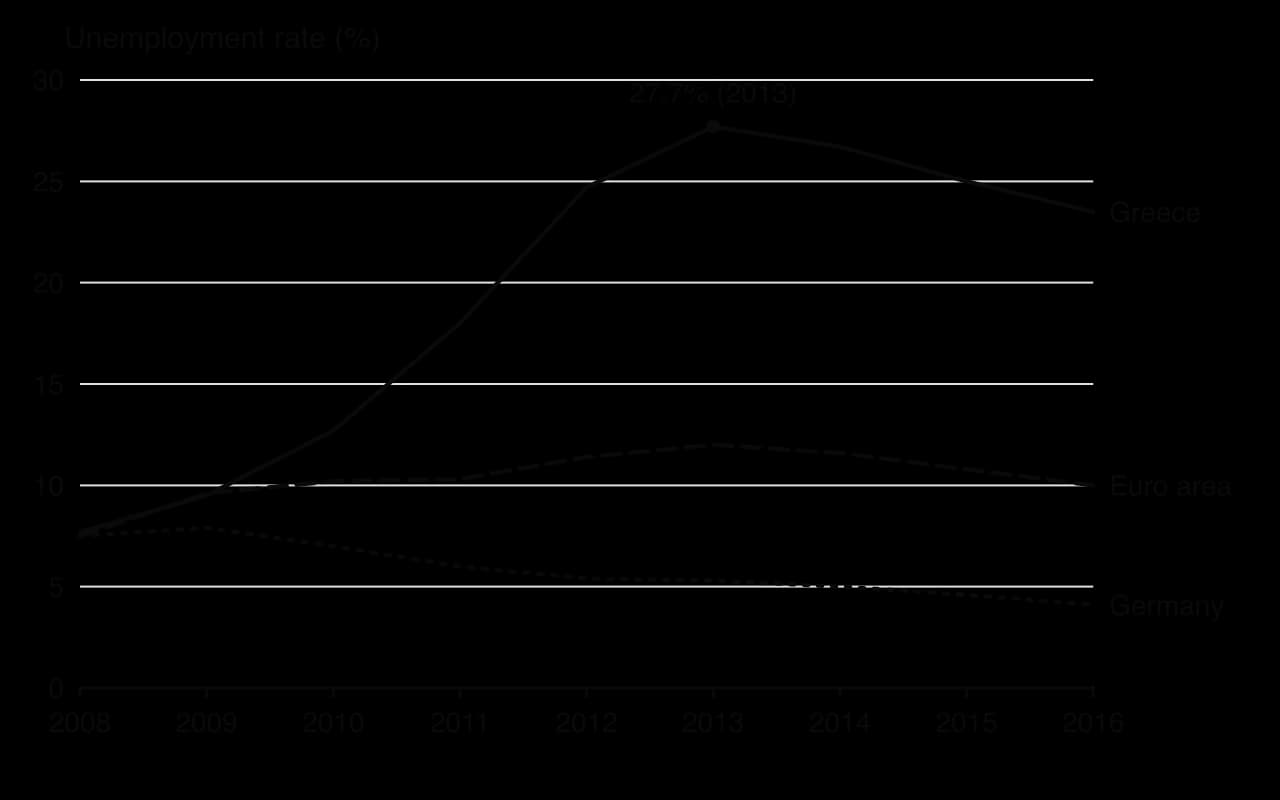
The chart shows the two economies moving in opposite directions under the same monetary policy. Greece needed lower interest rates and a weaker currency; Germany, with low unemployment, did not. With no exchange rate to adjust, Greece could restore its competitiveness only through falling wages and prices, a process often called internal devaluation, which took years and kept unemployment above 20% until 2017.
Sources: World Bank WDI, SL.UEM.TOTL.ZS (2026); Eurostat government debt data, compiled in Wikipedia “Eurozone” (2026).
A monetary union works best when its members have similar economic cycles, so that one interest rate suits them all; when workers can move easily from regions with high unemployment to regions with jobs; when wages and prices are flexible; and when there is a system of fiscal transfers, such as a shared budget, to support members hit by a downturn. The United States, a monetary union of 50 states, has high labour mobility and a large federal budget; the euro area has much less of both, which helps to explain why the euro crisis was so severe.
A reasoned judgment is that monetary union brings real gains in lower trade costs and stability, but only for countries whose economies move together or that can adjust through flexible wages and mobile labour. For countries with very different structures or cycles, the loss of monetary policy and the exchange rate can be costly, as Greece’s experience shows. Since the crisis, the euro area has added a permanent rescue fund and a banking union, and countries have continued to join, which suggests that members judge the benefits to outweigh the costs.
The World Trade Organization (WTO) is the international organisation that sets the rules for trade between its members. It was founded on 1 January 1995, replacing the General Agreement on Tariffs and Trade (GATT), which had governed trade since 1948. Based in Geneva, it has 166 members, which account for over 98% of world trade.
The WTO’s main objective is to help trade flow as freely, smoothly and predictably as possible, in order to raise living standards, create jobs and support sustainable development. It works through a few core principles:
Non-discrimination. Under the MFN principle, members treat all other members equally; under national treatment, imported goods are treated the same as domestic goods once they have entered the market.
Freer trade through negotiation. Barriers are reduced gradually through rounds of negotiation.
Predictability. Members “bind” their tariffs at agreed maximum levels, so traders know the highest tariff they can face.
Fair competition. Rules limit unfair practices such as export subsidies and dumping, while allowing measures such as anti-dumping duties.
Special treatment for developing countries. Less developed members receive longer periods to implement agreements and technical help.
Function | What it involves |
|---|---|
A forum for negotiations | Members meet to negotiate new agreements, such as the Trade Facilitation Agreement (2017) and agreements on fisheries subsidies. |
Administering trade agreements | Overseeing the agreements on goods (GATT), services (GATS) and intellectual property (TRIPS). |
Settling disputes | A member that believes another has broken the rules can bring a case; panels rule on it and the winner may retaliate if the loser does not comply. |
Monitoring trade policies | Regular trade policy reviews of each member, to keep policies transparent. |
Helping developing countries | Technical assistance and training so that lower-income members can take part in negotiations and apply the rules. |
Dispute settlement is the function that most distinguishes the WTO from other international bodies, because its rulings can be enforced. In the case of Indonesia’s nickel ore export ban, for example, a WTO panel ruled in 2022 that the ban broke the rules after a complaint by the European Union.
 YouTube
The WTO has helped to keep tariffs low across most of the world, and its existence made the trade conflicts of recent years less damaging than they might have been. Its influence has nonetheless declined, for several reasons.
The WTO takes decisions by consensus, so every member effectively has a veto. This was manageable when negotiations were about cutting tariffs on manufactured goods, but agreement is much harder on services and on primary products. The Doha Development Round, launched in 2001, stalled mainly over agriculture: developing countries wanted rich countries to cut their large subsidies to farmers, which lower world prices for crops such as cotton and harm poor farmers elsewhere, while rich countries wanted developing countries to open their markets for manufactured goods and services.
Trade in services is hard to liberalise because the barriers are not tariffs but national regulations, such as licensing rules for banks, lawyers and doctors, which governments see as protecting consumers. Agreement on primary products is hard because farming is politically sensitive in rich and poor countries alike. The WTO’s ministerial conference in Yaoundé, Cameroon, in March 2026 ended with only three decisions and no agreed declaration.
Sources: World Trade Organization; “World Trade Organization”, Wikipedia (2026).
All members have an equal formal vote, but they do not have equal power. Large economies such as the United States, the EU and China can offer or withhold access to huge markets, and they have large teams of trade lawyers. Many low-income countries cannot afford to follow every negotiation or bring dispute cases. In 2003, four West African cotton producers, Benin, Burkina Faso, Chad and Mali, asked the WTO to end the cotton subsidies paid by rich countries; years of negotiation brought only limited change.
Bringing a dispute case is also less useful for a small country. If a small economy wins a case against a large one that does not comply, retaliation by the small economy hurts its own consumers and does little damage to the large economy.
The WTO’s dispute system includes an Appellate Body that hears appeals against panel rulings. The United States blocked the appointment of new members, and by December 2019 the Appellate Body no longer had enough members to hear cases. A country that loses a panel case can now appeal “into the void”, so the ruling never becomes final; by April 2025, 32 panel rulings had been appealed in this way, including Indonesia’s nickel case. Some members, led by the EU, created a temporary appeal arrangement in 2020, but many large members, including the United States, have not joined it.
Sources: WTO; “Appellate Body”, Wikipedia (2026).
Together with the rise of regional agreements and the growing use of tariffs for security and political goals, these problems have weakened the WTO. Its rules still govern most world trade, and most members still comply with them, but it now struggles to make new rules or enforce old ones against the largest members.
The North American Free Trade Agreement (NAFTA) between the United States, Canada and Mexico came into force on 1 January 1994. It removed most tariffs between the three countries over the following years. For Mexico, a middle-income economy next to the world’s largest market, it was a decision to integrate its economy with the United States and to base its growth on manufacturing exports.
Mexico became a manufacturing base for North America, especially for cars, car parts and electronics. Its exports of goods and services rose from about 13% of GDP in 1994 to about 40% in 2025. US imports of goods from Mexico grew from about $49 billion in 1994 to $534 billion in 2025. In 2023 Mexico overtook China, and also Canada, to become the largest source of US goods imports.
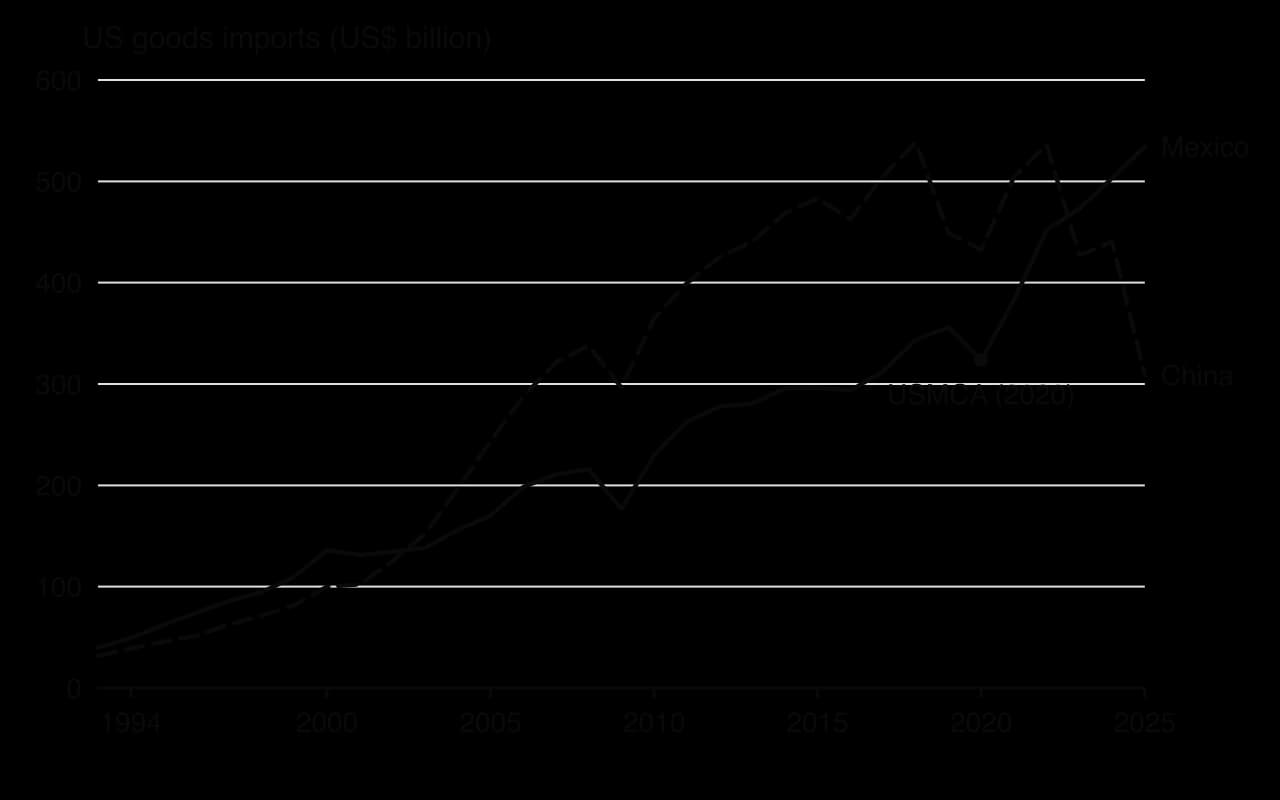
The chart shows two phases. From 1994 to 2017, imports from both countries grew, but imports from China grew faster after China joined the WTO in 2001. After the United States placed tariffs on Chinese goods from 2018, imports from China stopped growing: they were $539 billion in 2018 and $536 billion in 2022, then fell to $309 billion in 2025, while imports from Mexico kept rising. Some production moved from China to Mexico to serve the US market from inside the trade agreement, a process called nearshoring.
Sources: US Census Bureau, Trade in Goods with Mexico and with China (2026); World Bank WDI, NE.EXP.GNFS.ZS (2026).
In 2018 the three countries renegotiated NAFTA as the United States–Mexico–Canada Agreement (USMCA), which came into force on 1 July 2020. It kept tariff-free trade but tightened the rules of origin for cars: 75% of a car’s value must now come from North America, against 62.5% under NAFTA, and 40–45% of its content must be made by workers earning at least US$16 an hour, a rule aimed at moving some production from Mexico to the United States and Canada.
The case shows the advantages of a free trade area. Market access allowed firms to build plants for the whole continent and gain economies of scale. Car production was organised across the three countries, with parts crossing the borders several times, so each stage could be located where it was cheapest. US imports from Mexico partly replaced higher-cost US production, which is trade creation; some may also have replaced imports from lower-cost Asian producers, which would be trade diversion, encouraged by rules of origin that reward North American content.
It also shows the costs. Some US manufacturing workers lost their jobs as production moved to Mexico, which made NAFTA politically controversial and led to its renegotiation. Mexico gave up some sovereignty: its trade policy towards the rest of the world is shaped by the need to keep access to the United States, and USMCA’s rules of origin and labour provisions limit its choices.
In March 2025 the United States placed 25% tariffs on imports from Mexico, but two days later exempted goods that met USMCA’s rules of origin. In 2024 only about half of US imports from Mexico had been declared under USMCA, because many firms had not bothered with the paperwork when ordinary tariffs were low. The exemption made compliance with the rules of origin far more valuable. The US Supreme Court struck down these tariffs in February 2026.
At the first joint review on 1 July 2026, six years after USMCA came into force, the United States did not agree to renew the agreement in its current form, so its term was not extended. USMCA remains in force, and the three countries now review it every year, with the next review in 2027; unless all three agree to extend it, it will expire on 1 July 2036. This uncertainty affects investment decisions, since firms that build plants in Mexico need confidence that access to the US market will last.
The case shows that a free trade area can transform a middle-income economy’s trade, but also that its gains are uneven and depend on politics in the largest member. For Mexico, integration brought exports, investment and jobs, yet real income per capita grew by an average of only about 0.6% a year between 1994 and 2025, which shows that trade access alone does not guarantee rapid development. About 81% of Mexico’s goods exports went to the United States in 2024, so Mexico’s gains from integration are highly exposed to changes in US trade policy.
Sources: UN Comtrade (2026); World Bank WDI, NY.GDP.PCAP.KD.ZG (2026); USTR, statement on the USMCA joint review (1 July 2026) and notice of the 2027 joint review (2 October 2026); US Supreme Court, _Learning Resources v. Trump (2026); “2025–2026 United States trade war with Mexico”, Wikipedia (2026); “United States–Mexico–Canada Agreement”, Wikipedia (2026)._
Economic integration appears in Paper 1 essays, in Paper 2 data questions on a country that joins or leaves a bloc, and, for HL, in Paper 3 questions that ask for calculations of trade creation and diversion or a recommendation on joining a bloc or a monetary union. Definitions of the types of bloc are common 2-mark items.
Paper 1 questions combine theory with evaluation and real examples.
Paper 2-style items. Short items test definitions, calculations from data and explanation.
A Paper 3-style policy item (HL). “Using the information provided and your knowledge of economics, recommend whether Country X should join the proposed customs union.” A strong answer calculates the trade creation and diversion from the data, considers the common external tariff compared with Country X’s current tariffs, the share of its trade with the proposed members, the loss of sovereignty and tariff revenue, and then makes one clear recommendation with conditions.
Economic integration reduces barriers between countries in stages: preferential trade agreements, free trade areas, customs unions, common markets and monetary unions.
Trade agreements can be bilateral, regional or multilateral; preferential agreements are an exception to the WTO’s most-favoured-nation principle.
A free trade area needs rules of origin; a customs union adds a common external tariff; a common market adds free movement of labour and capital.
Trading blocs offer wider markets and economies of scale, jobs through labour mobility, bargaining power and political cooperation, but cost sovereignty and can weaken multilateral negotiations.
HL: trade creation replaces higher-cost production with cheaper partner imports (gains b + d); trade diversion replaces cheaper non-member imports with dearer partner imports (loss e).
A monetary union removes currency costs and risk but takes away independent monetary policy and the exchange rate, as Greece’s crisis showed (HL evaluation).
The WTO sets and enforces trade rules for 166 members, but consensus, disputes over services and agriculture, unequal power and the Appellate Body breakdown limit its influence.
Mexico’s experience under NAFTA and USMCA shows the gains from market access and the risks of depending on one large partner.
I can describe bilateral, regional and multilateral trade agreements and give an example of each.
I can distinguish a free trade area, a customs union and a common market, and explain why free trade areas need rules of origin.
I can explain the advantages and disadvantages of trading blocs, with real examples.
I can draw trade creation and trade diversion diagrams and calculate their effects on stakeholders (HL).
I can explain what a monetary union is and evaluate the advantages and disadvantages of joining one (HL).
I can explain the objectives and functions of the WTO and the factors that limit its influence.
I can evaluate economic integration for member and non-member countries and reach a justified judgment.
A maximum of [6] should be awarded if only economies of scale or only more efficient production is explained.
Markbands (best fit)
Level | Marks | Descriptor |
|---|---|---|
0 | 0 | The work does not reach a standard described by the descriptors below. |
1 | 1–2 | Little understanding of the specific demands of the question. Relevant economic theory is stated but not relevant. Economic terms are stated but not relevant. |
2 | 3–4 | Some understanding of the specific demands of the question. Relevant economic theory is described. Some relevant economic terms are included. |
3 | 5–6 | The specific demands of the question are understood but only partially addressed. Relevant economic theory is partly explained. Some relevant terms are used appropriately. Where appropriate, relevant diagram(s) are included. |
4 | 7–8 | The specific demands of the question are understood and addressed. Relevant economic theory is explained. Relevant terms are used mostly appropriately. Where appropriate, relevant diagram(s) are included and explained. |
5 | 9–10 | The specific demands of the question are understood and addressed. Relevant economic theory is fully explained. Relevant terms are used appropriately throughout. Where appropriate, relevant diagram(s) are included and fully explained. |
Using real-world examples, evaluate the view that membership of a trading bloc is the best way for a small economy to gain access to larger markets.
15 marks
Answers may include:
Terminology: trading bloc, free trade area, customs union, common market, preferential trade agreement, World Trade Organization (WTO), economies of scale, loss of sovereignty.
Explanation/theory:
a trading bloc removes tariffs and quotas between members, giving firms in a small economy tariff-free access to a much larger market, allowing economies of scale and higher export revenue;
a common market adds the free movement of labour and capital, raising employment opportunities and investment;
members gain stronger bargaining power in multilateral negotiations and greater political cooperation;
HL candidates may refer to trade creation and trade diversion.
Diagram(s): an international trade diagram showing the effect of removing a tariff on a member's imports and/or exports.
Synthesis/evaluation:
disadvantages of bloc membership: loss of sovereignty (a customs union imposes a common external tariff), a challenge to multilateral negotiations, possible trade diversion towards less efficient members, competition that may close small domestic firms;
alternatives: bilateral agreements with large economies; multilateral liberalization through the WTO, which offers access to all members' markets on most-favoured-nation terms; unilateral removal of the country's own barriers; export promotion policies; inward FDI by multinational firms that already serve global markets;
the benefit depends on the size and income of the other members and on whether the economy's goods are competitive;
consideration of 'the best way'; a reasoned conclusion.
Examples:
Ireland, Estonia or Slovenia in the EU single market;
Singapore's network of bilateral free trade agreements as an alternative to relying on a single bloc;
the African Continental Free Trade Area (AfCFTA, trading from 2021) intended to give small African economies access to a continental market;
Mexico's car industry growth after NAFTA (now USMCA);
the UK after leaving the EU single market in 2021, facing new non-tariff barriers.
A maximum of [12] should be awarded where no alternative to trading-bloc membership is considered, as the question would not be fully addressed.
N.B. Terminology, theory, diagrams and examples given in part (a) and referred to in part (b) should be rewarded.
Examiners should be aware that candidates may take a different approach which, if appropriate, should be rewarded.
Markbands (best fit)
Level | Marks | Descriptor |
|---|---|---|
0 | 0 | The work does not reach a standard described by the descriptors below. |
1 | 1–3 | Little understanding of the specific demands of the question. Theory is stated but not relevant. Terms are not relevant. No synthesis or evaluation. Real-world examples are identified but not relevant. |
2 | 4–6 | Some understanding of the demands. Relevant theory is described. Some relevant terms are included. Synthesis or evaluation is superficial. A relevant real-world example is identified. |
3 | 7–9 | The demands are understood but only partially addressed. Theory is partly explained. Some terms are used appropriately. Relevant diagram(s) are included where appropriate. Synthesis or evaluation is appropriate but lacks balance. Example(s) are identified and partly developed in context. |
4 | 10–12 | The demands are understood and addressed. Theory is explained. Terms are used mostly appropriately. Diagram(s) are included and explained. Synthesis or evaluation is appropriate and mostly balanced. Example(s) are identified and developed in the context of the question. |
5 | 13–15 | The demands are understood and addressed. Theory is fully explained. Terms are used appropriately throughout. Diagram(s) are included and fully explained. Synthesis or evaluation is effective and balanced. Example(s) are identified and fully developed to support the argument. |
Read the extract and answer the questions that follow.
Text A — Calvesh joins the Coastal Economic Community
[1] Calvesh is a small upper-middle-income economy in the Caribbean with a population of 6 million. In 2024 it joined the Coastal Economic Community (CEC), a free trade area of five countries with a combined population of 210 million. Tariffs on trade between members are being removed over three years.
[2] Calvesh's furniture makers and fish processors expect to gain most. Previously they faced tariffs of up to 20 % in CEC markets. The largest furniture manufacturer plans to double its factory size, which it says will lower its costs per unit through economies of scale. Table 1 shows Calvesh's exports.
[3] Consumers in Calvesh are expected to benefit from cheaper imported processed foods, clothing and building materials, and from a wider range of products.
[4] Not everyone is optimistic. Calvesh's dairy farmers have been protected by a 30 % tariff on imported dairy products. Dairy farms in two CEC members are much larger and have lower costs. The dairy industry employs 22 000 people in rural areas where few other jobs are available. Calvesh will also lose tariff revenue, which provided 9 % of government revenue in 2023.
Table 1: Exports of goods from Calvesh (US$ million)
2023 | 2025 | |
|---|---|---|
Exports to CEC members | 1 225 | 1 610 |
Exports to the rest of the world | 2 350 | 2 415 |
Total exports | 3 575 | 4 025 |
Define the term free trade area indicated in bold in the text (Text A, paragraph 1).
2 marks
Using Table 1, calculate the percentage of Calvesh's total exports that went to CEC members in 2025.
2 marks
Using Table 1, calculate the percentage increase in Calvesh's exports to CEC members between 2023 and 2025.
2 marks
Using an international trade diagram, explain the likely effect on Calvesh's dairy farmers of removing the tariff on dairy imports from CEC members (Text A, paragraph 4).
4 marks
Using information from the text/data and your knowledge of economics, evaluate the likely effects of membership of the CEC on firms and consumers in Calvesh.
15 marks
Governments sometimes pay subsidies to domestic firms that compete with imports.
Using a diagram, explain the effects of a production subsidy on the revenue of domestic producers and the revenue of foreign producers.
10 marks
Using real-world examples, discuss the effects of government subsidies to domestic firms on international trade relations.
15 marks