4 The global economy
An overview of the global economy unit: international trade and protection, economic integration, exchange rates and the balance of payments, and why economic development is uneven, with how the subtopics connect.
- IB Economics
- SL and HL
What 4 covers
From the subject guide: what you need to know and be able to do.
How countries trade and develop, and the barriers that stand in the way.
Benefits of trade, and protectionism: tariffs, quotas and subsidies
Exchange rates and the balance of payments
Economic integration and sustainable development
Measuring development, and the strategies used to promote it
10 subtopics in The global economy
Each one has its own page once something is published for it.
- 4.1Benefits of international trade99 questions · notes · 50 quick fire
- 4.2Types of trade protection142 questions · notes · 41 quick fire
- 4.3Arguments for and against trade protection115 questions · notes · 40 quick fire
- 4.4Economic integration54 questions · notes · 41 quick fire
- 4.5Exchange rates197 questions · notes · 61 quick fire
- 4.6Balance of payments110 questions · notes · 65 quick fire
- 4.7Sustainable development101 questions · notes · 40 quick fire
- 4.8Measuring development100 questions · notes · 40 quick fire
- 4.9Barriers to economic growth and development147 questions · notes · 50 quick fire
- 4.10Growth and development strategies178 questions · notes · 60 quick fire
An overview of 4 The global economy
The global economy unit studies how countries are connected through trade, investment, migration and money, and why some countries have developed much further than others. It applies the tools of microeconomics and macroeconomics to the relationships between economies.
The questions behind the unit
Two broad questions frame the unit. The first is who gains and who loses when the world’s economies become more integrated. International trade lets countries specialise and buy goods more cheaply, but it also closes factories, shifts jobs between countries and exposes economies to shocks from abroad. Governments respond with trade protection, trade agreements and policies towards their currencies, and each choice helps some groups at the expense of others.
The second question is why economic development is so uneven. Some countries have grown rich within two or three generations while others remain poor, and within countries the gains from growth are often shared unequally. The unit asks how development can be measured, what holds it back, and which strategies, from trade and foreign direct investment to aid and institutional reform, have helped countries develop sustainably.
Average incomes show how uneven development is. In 2024, GDP per capita at purchasing power parity averaged about $58,600 in high-income countries and about $2,400 in low-income countries, a gap of roughly 24 to 1. Upper-middle-income countries, a group that includes China, more than tripled their average income between 1990 and 2024, while average income in low-income countries has hardly changed since 2010.

 YouTube
The subtopics of the unit
Subtopic | The question it answers | Level |
|---|---|---|
4.1 Benefits of international trade | Why do countries trade, and how does trade raise efficiency and living standards? | SL and HL (HL adds comparative advantage and calculations) |
4.2 Types of trade protection | How do tariffs, quotas, subsidies and administrative barriers affect markets and stakeholders? | SL and HL (HL adds calculations) |
4.3 Arguments for and against trade protection | When, if ever, is protection justified? | SL and HL |
4.4 Economic integration | What are trading blocs, monetary unions and the WTO, and who gains from them? | SL and HL (HL adds trade creation and diversion, and monetary union evaluated) |
4.5 Exchange rates | What determines the value of a currency, and what happens when it changes? | SL and HL (HL adds fixed vs floating evaluated) |
4.6 Balance of payments | How does a country record its transactions with the rest of the world, and do deficits matter? | SL and HL (HL adds deficits, surpluses, Marshall–Lerner and the J-curve) |
4.7 Sustainable development | What does sustainable development mean, and what are the Sustainable Development Goals? | SL and HL (HL adds sustainability and poverty) |
4.8 Measuring development | How can development be measured, and how does it relate to growth? | SL and HL |
4.9 Barriers to economic growth and development | What keeps countries poor? | SL and HL |
4.10 Growth and development strategies | Which strategies promote growth and development, and how well do they work? | SL and HL |
How the subtopics connect
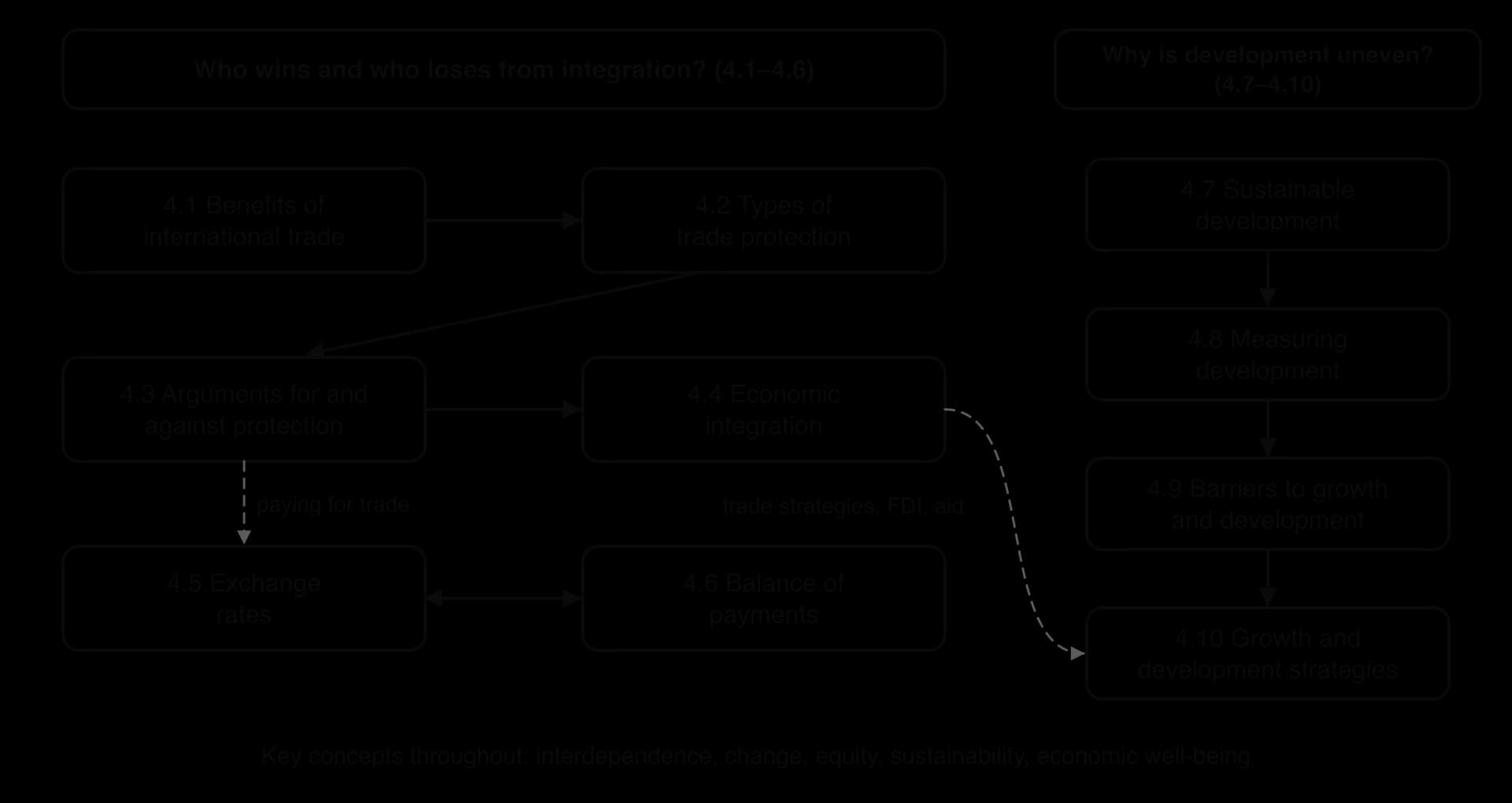
The first six subtopics form one argument. The gains from trade explain why countries specialise; protection and its arguments explain why governments still restrict trade; integration shows how groups of countries remove barriers among themselves. Every international transaction needs foreign currency, so trade and investment flows determine exchange rate movements, which are recorded in the balance of payments and in turn change the competitiveness of exports and imports.
The development subtopics then use these tools. Economic development is measured with indicators such as the Human Development Index, held back by barriers such as dependence on primary commodities and weak institutions, and promoted through strategies that include export promotion, trade liberalisation, FDI and aid, each of which was analysed in the first half of the unit. Many diagrams return from earlier units: demand and supply for tariffs and currencies, AD/AS for the effects of exchange rate changes, and the PPC for comparative advantage.
One product, the whole unit: iPhones made in India
For most of their history iPhones were assembled almost entirely in China. From the late 2010s Apple’s contract manufacturers began assembling iPhones in India, helped by India’s production incentives for smartphone makers. The move sped up in 2025, when the United States raised tariffs on Chinese goods to 145% and China retaliated with tariffs of 125% on US goods, before a truce on 12 May 2025 cut them to 30% and 10%.
On 1 May 2025 Apple’s chief executive said the company expected “the majority of iPhones sold in the US” in the following quarter to have India as their country of origin, and Vietnam to be the origin of almost all its iPads, Macs, Apple Watches and AirPods sold in the US. India’s smartphone exports grew quickly as a result, making smartphones one of its largest exports.
Sources: PTI report of Apple’s earnings call, The Week (2 May 2025); “China–United States trade war”, Wikipedia (accessed October 2026).
The table links the case to the subtopics.
Subtopic | What the iPhone shift illustrates |
|---|---|
4.1 Benefits of international trade | Specialisation along global supply chains, and comparative advantage in labour-intensive assembly |
4.2–4.3 Protection | Tariffs and retaliation, and firms moving production to avoid them |
4.4 Economic integration | The weakening of multilateral trade rules when large economies act alone |
4.5–4.6 Exchange rates and the balance of payments | Export earnings raising demand for the rupee and improving India’s trade balance |
4.10 Growth and development strategies | FDI and export promotion: new jobs, but limited gains while most components are imported |
Key concepts in the global economy
Interdependence is the central concept: decisions by one government, such as a tariff or an interest rate change, affect firms, workers and governments in other countries.
Equity: integration can raise total welfare while leaving some groups, regions or countries worse off; development is about who shares in the gains.
Sustainability: growth based on using up natural resources or damaging the environment cannot last, and the poorest people often suffer most from environmental damage.
Economic well-being and change: development means improvements in health, education and freedom of choice, not only in income, and ideas of what development means change over time and differ between cultures.
Intervention and efficiency: governments, international organisations and NGOs intervene in trade, currencies and development, and the debate is often about whether intervention or freer markets allocate resources more efficiently.
 YouTube
How SL and HL differ
None of the ten global economy subtopics is HL-only. HL students study extra material inside six of them, listed in the table, including several calculations and three diagrams (linear PPCs, the current account and the exchange rate, and the J-curve).
Subtopic | What HL adds |
|---|---|
4.1 | Calculating the quantity of exports and imports, import expenditure and export revenue from the free trade diagrams; absolute and comparative advantage, with linear PPC diagrams and opportunity cost calculations; the limitations of the theory of comparative advantage |
4.2 | Calculating the effects of tariffs, quotas and subsidies on stakeholders from diagrams (the diagrams themselves are SL) |
4.4 | Trade creation and trade diversion; the advantages and disadvantages of monetary union, evaluated |
4.5 | Evaluating fixed against floating exchange rate systems |
4.6 | The links between the current account, the financial account and the exchange rate (with a diagram); the implications of persistent current account deficits and surpluses; methods of correcting a deficit and their effectiveness; the Marshall–Lerner condition and the J-curve (with a diagram) |
4.7 | The two-way relationship between sustainability and poverty |
4.3, 4.8, 4.9, 4.10 | No HL extension |
HL students also sit Paper 3, the policy paper, which can draw on the whole syllabus. Global economy material features strongly there because it lends itself to calculations (tariff revenue, comparative advantage, currency conversions, balance of payments items) and to policy recommendations, for example on correcting a current account deficit or promoting development.
Assessment
The global economy is assessed in every external paper. In Paper 1 one question usually comes from this unit, asking for an explained diagram in part (a) and an evaluation with real-world examples in part (b). Paper 2, the same paper at SL and HL, often uses a country case study on trade, exchange rates or development, with calculations such as converting prices between currencies, percentage changes in exchange rates and balance of payments items. HL Paper 3 can examine both the SL and HL material of the unit.
The unit also supplies one of the three commentaries in the internal assessment portfolio, which must be based on a news article about the global economy, such as a change in tariffs, a currency’s fall or a development project.
Flashcards for 4
The official decks for this part of the syllabus.
- 4.1 Benefits of international trade221 cards
- 4.10 Growth and development strategies275 cards
- 4.2 Types of trade protection236 cards
- 4.3 Arguments for and against trade protection207 cards
- 4.4 Economic integration236 cards
- 4.5 Exchange rates249 cards
- 4.6 Balance of payments265 cards
- 4.7 Sustainable development214 cards
- 4.8 Measuring development195 cards
- 4.9 Barriers to economic growth and development227 cards
Carry on with 4 in Augment
With a free account, Augment remembers where you stopped and what you have practiced.