Explain what makes a good public, why the free rider problem stops markets from providing public goods, and evaluate direct government provision and contracting out to private firms.
Each is in the Economics glossary, with every other term in the subject.
A good that is excludable but non-rivalrous, at least until it becomes congested, so it can be sold to members or subscribers, for example a streaming service.
An arrangement in which the government pays a private firm, usually chosen by competitive tender, to supply a good or service that the government still funds and is responsible for.
A method of appraising a project by placing money values on all its expected private and external costs and benefits over time, used to decide whether, and how much of, a public good to provide.
The situation in which people benefit from a good without paying for it, because they cannot be excluded, so private firms cannot collect enough revenue and the good is under-provided or not provided.
A characteristic of a good when it is impossible, or too costly, to prevent people who have not paid for it from using it.
A characteristic of a good whose consumption by one person does not reduce the amount available for others to consume, so the marginal cost of an extra user is zero.
A good that is both rivalrous and excludable: one person’s consumption leaves less for others, and people who do not pay can be prevented from consuming it.
Define rivalry and excludability, and use them to distinguish private goods, public goods, common pool resources and club goods.
Explain why public goods are non-rivalrous and non-excludable, and why a good provided by the government is not necessarily a public good.
Explain the free rider problem and why it leads markets to under-provide public goods or not provide them at all.
Draw and explain a diagram showing the welfare loss when the market fails to provide a public good.
Explain how governments respond to public goods through direct provision and through contracting out to the private sector.
Evaluate direct provision and contracting out, using real-world examples.
Discuss why some public goods are still provided privately or voluntarily.
Some goods benefit everyone in an area at once, and nobody can be stopped from enjoying them: a flood barrier, a storm warning, a country’s defence. Markets supply such goods badly or not at all, which makes them one of the clearest cases of market failure and one of the oldest reasons for governments to spend taxpayers’ money.
Public goods connect several key concepts. Because resources are scarce, a society must choose how much of them to devote to goods that no firm would sell, which is a question of efficiency. Most answers involve intervention, and many public goods, such as flood defences and disaster warnings, are central to sustainability and economic well-being.
44 exam-style questions on this subtopic, written in the style of the IB papers. The first has its markscheme open. Counted on
An economy's use of its resources can be represented using a production possibilities curve (PPC).
Using a PPC, explain the difference between points on the curve, points inside the curve and points outside the curve.
10 marks
Answers may include:
Terminology: definitions of PPC, productive efficiency, unemployment (underutilization) of resources, scarcity, unattainable combinations.
Explanation: points on the curve show the maximum combinations of the two goods that can be produced when all resources are fully and efficiently employed (productive efficiency), so more of one good can only be obtained by giving up some of the other; points inside the curve show that some resources are unemployed or used inefficiently, so more of both goods could be produced; points outside the curve are unattainable with current resources and technology, reflecting scarcity, and can only be reached through an increase in the quantity or quality of resources or trade.
Diagram: a PPC with a point A on the curve, B inside and C outside, each labelled.
A maximum of [6] should be awarded if only two of the three positions are explained.
N.B. Candidates who describe a point inside the curve as unattainable should not be rewarded for that point.
Markbands (best fit)
Level | Marks | Descriptor |
|---|---|---|
One of 41 short multiple-choice questions on 2.9. Pick an answer to see why it's right or wrong.
Which statement about public goods is correct?
The official deck for this part of the syllabus.
Explain, in one chain, why public goods are a case of market failure.
State three IB key concepts that public goods link to, with the link for each.
With a free account, Augment remembers where you stopped and what you have practiced.
A long-term contract in which a private firm finances, builds and often operates public infrastructure, such as a hospital, and the government pays it over many years.
A good that has some, but not all, of the characteristics of a public good, for example a road that is non-excludable but becomes rivalrous when congested.
Scope: Public goods are taught in the same way at SL and HL: the two characteristics that make a good public, the free rider problem, and the evaluation of direct provision and contracting out. HL adds no further material.
Economists classify goods by two questions. The first is whether one person’s use of the good leaves less for anyone else. The second is whether the seller can stop people who have not paid from using it. The answers decide whether a market can supply the good efficiently.
A good is rivalrous when consumption by one person reduces the amount available to others. A sandwich eaten by one student cannot be eaten by another; a seat on a full flight sold to one passenger cannot be sold again. Most goods bought in shops are rivalrous.
Other goods can be enjoyed by one more person without anyone else getting less. A lighthouse’s beam guides the hundredth ship as clearly as the first, and a radio weather warning reaches every listener in range at once. These goods are non-rivalrous.
Non-rivalry has a precise meaning. Producing the good still costs money: building a lighthouse is expensive. What costs nothing is letting one more person use the good once it exists. The cost of the lighthouse is the same whether ten ships or ten thousand ships see the light.
A good is excludable when the seller can prevent people who have not paid from consuming it. A cinema checks tickets at the door, a streaming service asks for a password, and a shop does not hand over goods without payment. Excludability is what allows a firm to charge a price.
Excludability often depends on technology and on cost, not only on the nature of the good. Television broadcasts were once non-excludable, because anyone with an aerial could receive them; encryption and subscription boxes made them excludable. Fencing a large national park is possible in principle but may cost more than the entry fees would raise, so in practice it stays non-excludable.
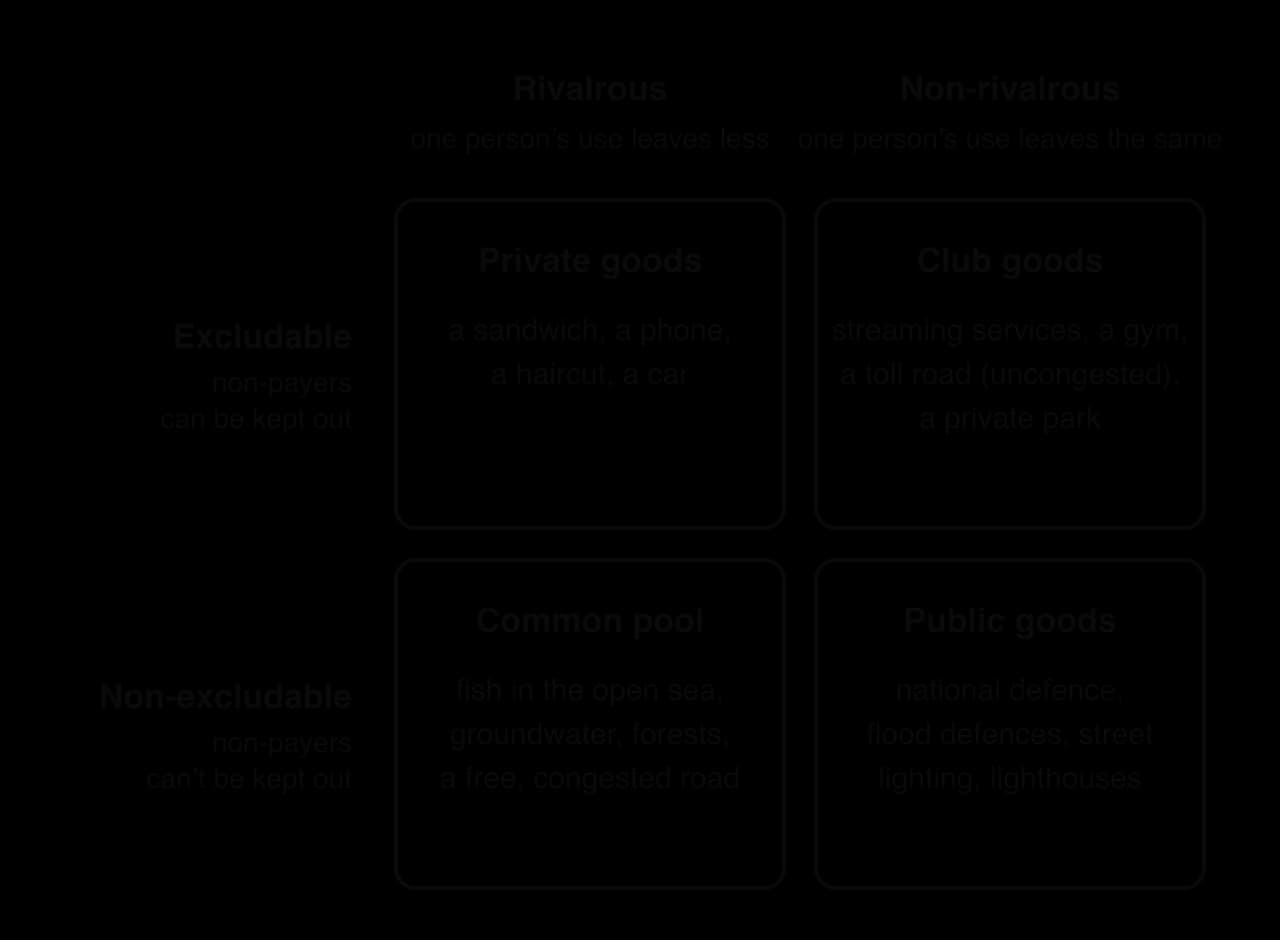
Combining the two characteristics gives four types of goods. The figure places each type in a two-by-two grid, with an example of each.
A private good is rivalrous and excludable. Markets supply private goods well: the seller can charge each buyer, and each unit sold is a unit that someone else cannot use, so the price rations the good between buyers.
A common pool resource is rivalrous but non-excludable: fish in the open sea, groundwater, an unregulated forest. Because nobody can be excluded, each user takes as much as they can, and because the resource is rivalrous, every fish caught is one less for others. The result is overuse, the tragedy of the commons. A club good is the opposite combination: excludable but non-rivalrous until it becomes crowded, such as a streaming service or an uncongested toll road.
The fourth type, non-rivalrous and non-excludable, is the public good. National defence protects every resident of a country at once, and an enemy cannot be kept away from some households because they did not pay their share. A flood wall protects every building behind it, and a lighthouse’s light reaches every passing ship.
Type of good | Rivalrous? | Excludable? | Examples | How the market performs |
|---|---|---|---|---|
Private good | Yes | Yes | Food, clothing, phones, haircuts | Supplies it efficiently if there are no externalities or market power |
Club good | No (until congested) | Yes | Streaming services, gyms, toll roads | Supplies it, but a price above zero excludes some users whose extra use would cost nothing |
Common pool resource | Yes | No | Ocean fish, groundwater, grazing land | Overuses it: the tragedy of the commons |
Public good | No | No | Defence, flood barriers, street lighting, storm warnings | Under-provides it or does not provide it at all |
 YouTube
A public good is defined by its characteristics, not by who supplies it. Many goods that governments provide are private goods: a place in a state school or a bed in a public hospital is rivalrous, since one pupil’s place cannot be given to another, and excludable, since access can be limited to enrolled pupils or registered patients. Governments provide education and health care mainly because they are merit goods with positive externalities, and for reasons of equity.
Few goods are perfectly non-rivalrous and non-excludable in every situation. Economists call a good that meets both conditions fully a pure public good. National defence and a nationwide storm warning come close. Many other goods meet the conditions only partly or only under some conditions.
A free road at 3 a.m. is non-rivalrous: one more car slows nobody down. At rush hour the same road is rivalrous, because every extra car adds to the queue. A public beach, a city park and a footbridge behave in the same way. Some quasi-public goods can also be made excludable, for example a road with tolls or a bridge with a gate, which turns them into club goods while they are uncongested.
The distinction matters for policy. A pure public good can only be financed collectively. A quasi-public good may be financed partly by charges, such as road tolls or congestion charges, which also ration the good when it becomes rivalrous.
In a competitive market, firms supply a good when buyers pay a price that covers its cost. The price mechanism relies on excludability: a firm can earn revenue only if it can refuse the good to people who do not pay. Public goods break this link, and the result is that markets supply too little of them, often nothing at all.
Suppose a private firm offers to build a flood wall along a river and asks each household behind it to pay. Once the wall is built, it protects every house behind it, whether the owner paid or not. Each household therefore has an incentive to refuse to pay and hope that its neighbours pay instead. A person who enjoys the benefit of a good without paying for it is a free rider.
If enough households free ride, the firm cannot raise enough revenue to cover the cost of the wall, and it is never built, even though the households together value it at far more than it costs. Every household is worse off than if all had paid. The free rider problem is a direct result of non-excludability, and it means that the willingness to pay shown in a market understates how much people really value the good.
People also have a reason to hide how much they value a public good. If a household says the wall is worth a great deal to it, it may be asked to pay more. Understating its true benefit costs it nothing, because it will be protected anyway. Because of this, the true benefits of public goods are hard to measure, both for firms and for governments.
Non-rivalry adds a second reason why markets perform badly. Even when exclusion is possible, as with a toll on an uncongested bridge, any price above zero stops some people from crossing whose crossing would cost society nothing. Some benefit is lost for no saving in cost. For a public good, the efficient price for an extra user is zero, and no profit-seeking firm can survive by charging zero.
 YouTube
The failure can be shown on a diagram with costs and benefits on the vertical axis. The marginal social benefit (MSB) curve shows the value of each extra unit of the good to society as a whole. The supply curve shows the marginal social cost (MSC) of producing it, assuming there are no external costs. The socially optimal output is where MSB = MSC, the condition for allocative efficiency.
Because of free riding, the demand that firms observe is far below the MSB curve. The curve D = marginal private benefit (MPB) shows how much individual buyers are actually willing to pay, which is only a small part of the good’s value to society. When this demand lies below the supply curve at every quantity, no firm can sell any of the good at a price that covers its cost, and market output is zero.

The diagram shows the socially optimal quantity Q*, where the MSB curve crosses the MSC curve. At every quantity between zero and Q*, the benefit to society of one more unit is greater than its cost, so producing it would add to social surplus. When the market produces nothing, all of this surplus is lost. The hatched triangle between MSB and MSC, from zero to Q*, is the welfare loss.
This is sometimes called a missing market: the market for the good does not exist at all. In less extreme cases, some private provision takes place but at a quantity well below Q*, and the welfare loss is the smaller triangle between MSB and MSC from the market quantity to Q*. In both cases the market leads to an underallocation of resources to the good.
For a private good, market demand is found by adding the quantities each buyer wants at each price (horizontal summation), because every buyer consumes different units. For a public good, every person consumes the same units at once: the same flood wall protects every house. So the marginal social benefit of each unit is the sum of the marginal benefits of all the people who enjoy it, found by adding the individual curves vertically.
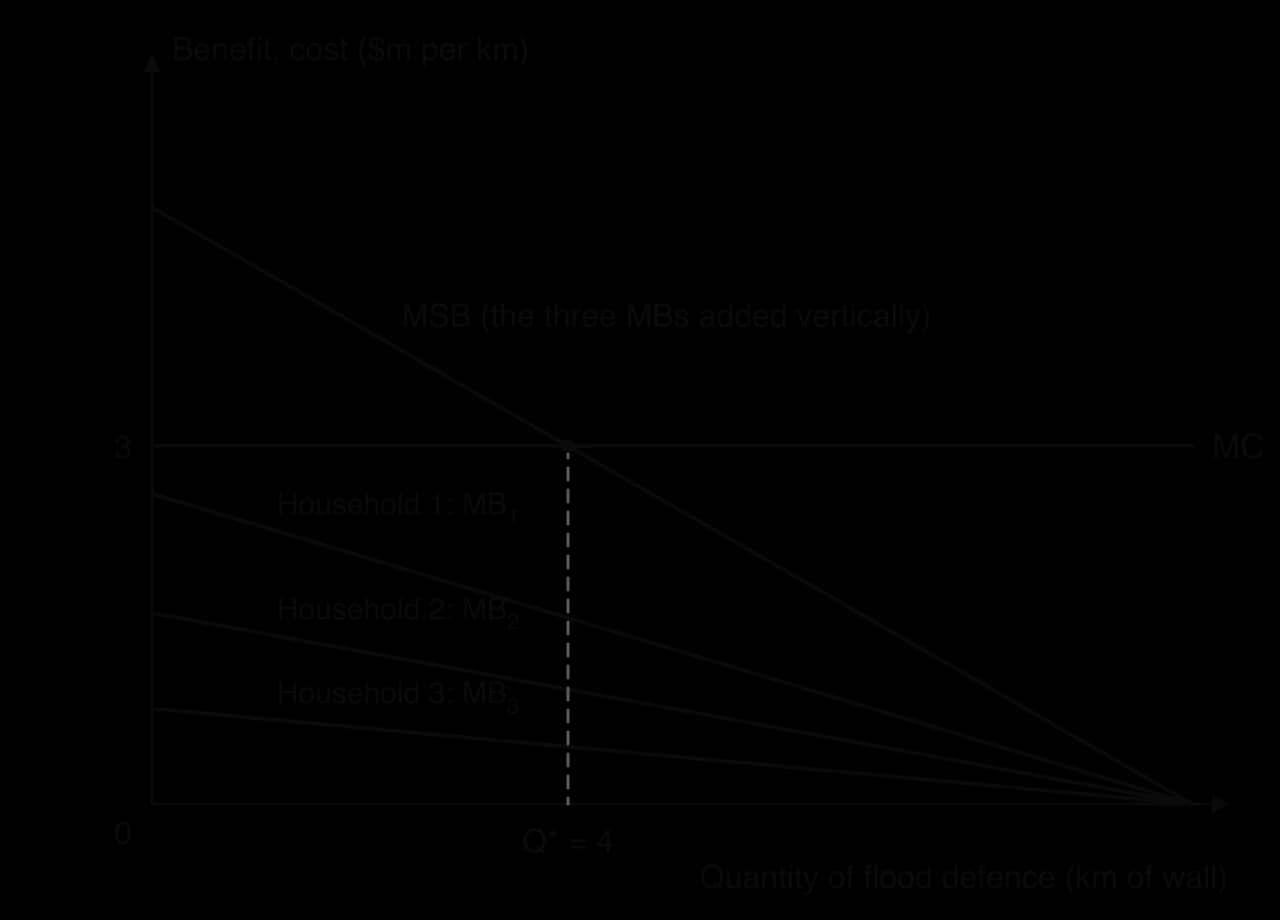
This explains why public goods are so often worth providing even when no single person would buy them. Every individual benefit in the figure lies below the marginal cost, so no household acting alone would pay for a single kilometre of wall. Together, their benefits cover the cost of each of the first four kilometres.
The table gives hypothetical data for three households behind a river bank: the marginal benefit to each household of each extra kilometre of flood wall, in $ million. Building the wall costs $3 million per km, whatever its length. It is used in the worked example that follows.
Kilometre of wall (Q) | 1st | 2nd | 3rd | 4th | 5th | 6th |
|---|---|---|---|---|---|---|
Household 1: MB₁ ($m) | 2.34 | 2.08 | 1.82 | 1.56 | 1.30 | 1.04 |
Household 2: MB₂ ($m) | 1.44 | 1.28 | 1.12 | 0.96 | 0.80 | 0.64 |
Household 3: MB₃ ($m) | 0.72 | 0.64 | 0.56 | 0.48 | 0.40 | 0.32 |
The free rider problem also arises between countries. A military alliance protects all its members at once, so each member has an incentive to spend less on defence and rely on the others. Members of NATO agreed a guideline of spending 2% of GDP on defence, and for many years several large members spent well below it while the United States spent far more. In June 2025 NATO members committed to raise spending to 5% of GDP by 2035, of which at least 3.5% is for core defence.
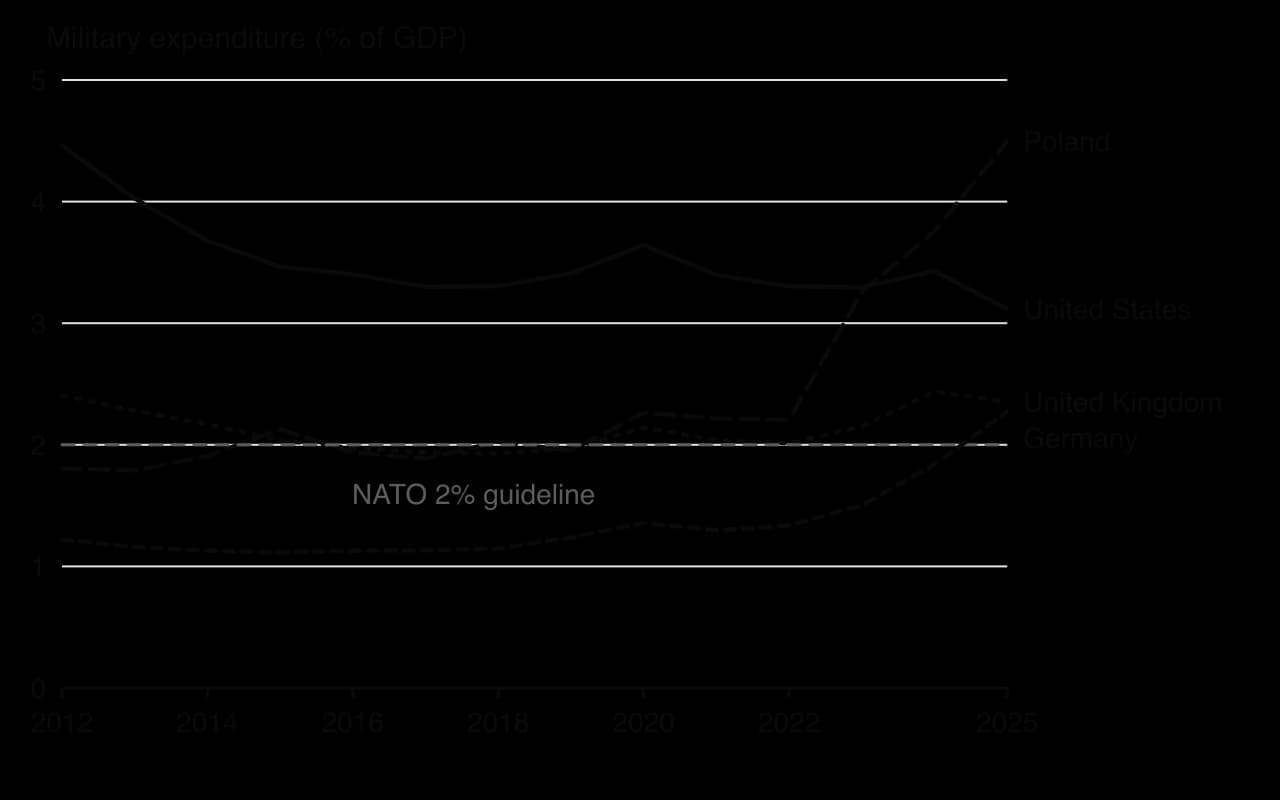
Free riding is only part of the explanation for the differences in the chart. Countries also differ in how threatened they feel, in their history and in their other spending priorities, which is why Poland raised its spending much faster than countries further from Russia after Russia’s full-scale invasion of Ukraine in 2022.
Sources: NATO, The Hague Summit Declaration (25 June 2025); SIPRI Military Expenditure Database via World Bank (2026).
Because the market under-provides public goods, governments usually decide how much of them to supply and pay for them out of tax revenue. Taxation removes the free rider problem: households and firms cannot choose not to pay. Governments then choose between two ways of supplying the good: producing it themselves or paying a private firm to produce it.
Under direct provision, a government agency builds and runs the good itself, employing public-sector workers, and finances it from general taxation. Users pay nothing at the point of use. National defence is the clearest example: armed forces are almost always run directly by the state. Storm warnings, lighthouses in many countries and flood defences are also often provided directly.
London’s Thames Barrier is a large example. After the North Sea flood of 1953, a government committee recommended a movable barrier across the River Thames that could close against storm surges. It has been operational since 1982, is run by the Environment Agency, and by July 2026 had been closed 221 times to protect London. Every person and building in the protected floodplain benefits, and nobody could be excluded.

Sources: Wikipedia, “Thames Barrier” (citing the Environment Agency), accessed 2026.
A government that provides a public good still faces the question of how much to provide. With no market price, it has no direct measure of how much people value the good. Governments therefore use cost-benefit analysis: they estimate in money terms all the expected costs and benefits of a project over its life, including external ones, and go ahead if the benefits exceed the costs.
For a flood defence, the benefits include the expected damage avoided to homes, businesses and infrastructure, and lives saved. Putting money values on these involves estimates and value judgments, such as the value of a statistical life or of a protected wetland, so two careful analyses can reach different answers. Cost–benefit analysis improves decisions, but it cannot remove the measurement problem caused by free riding.
Under contracting out, the government still decides what is to be provided and still pays for it from taxes, but a private firm produces it. Firms compete in a tender, the winner signs a contract that sets out the service, its quality and the price, and the government monitors whether the firm meets the terms. Users are not charged, so the good stays free at the point of use.

Contracting out is common for street lighting, road maintenance, refuse collection and the maintenance of flood defences. A local authority might own its street lights but pay a lighting firm to install, repair and run them for ten years. The good itself has not changed: street lighting is still non-excludable, which is why the authority, not the firm, pays for it.
A larger form of contracting out is the public–private partnership (PPP), in which a private firm also finances the investment. The firm borrows to build a hospital, school or road, then runs or maintains it for twenty to thirty years, and the government pays it an annual charge. The United Kingdom used this model, the Private Finance Initiative (PFI), widely from the 1990s.
In 2018 the UK’s National Audit Office reported that there were over 700 operational PFI and PF2 deals with a capital value of around £60 billion. Annual charges paid by the public sector were £10.3 billion in 2016–17, and future charges of £199 billion would continue into the 2040s even if no new deals were signed. Long-term payments of this size limit what future governments can spend on other priorities.
Sources: National Audit Office, PFI and PF2 (January 2018).
Direct provision | Contracting out | |
|---|---|---|
Who decides what is provided | Government | Government |
Who pays | Taxpayers | Taxpayers |
Who produces | A state agency with public employees | A private firm that wins a tender |
Main source of efficiency | Direct control; no profit margin; no contract costs | Competition for the contract; the profit motive to cut costs |
Main risks | Weak incentives to control costs; political interference | Cost-cutting that lowers quality; incomplete contracts; monitoring costs; long-term commitments |
Typical examples | National defence, storm warnings, national flood barriers | Street lighting, road maintenance, PFI hospitals |
Public goods are not always left unprovided by the private sector. Several mechanisms allow private or voluntary provision, and they show that the textbook model is a simplification.
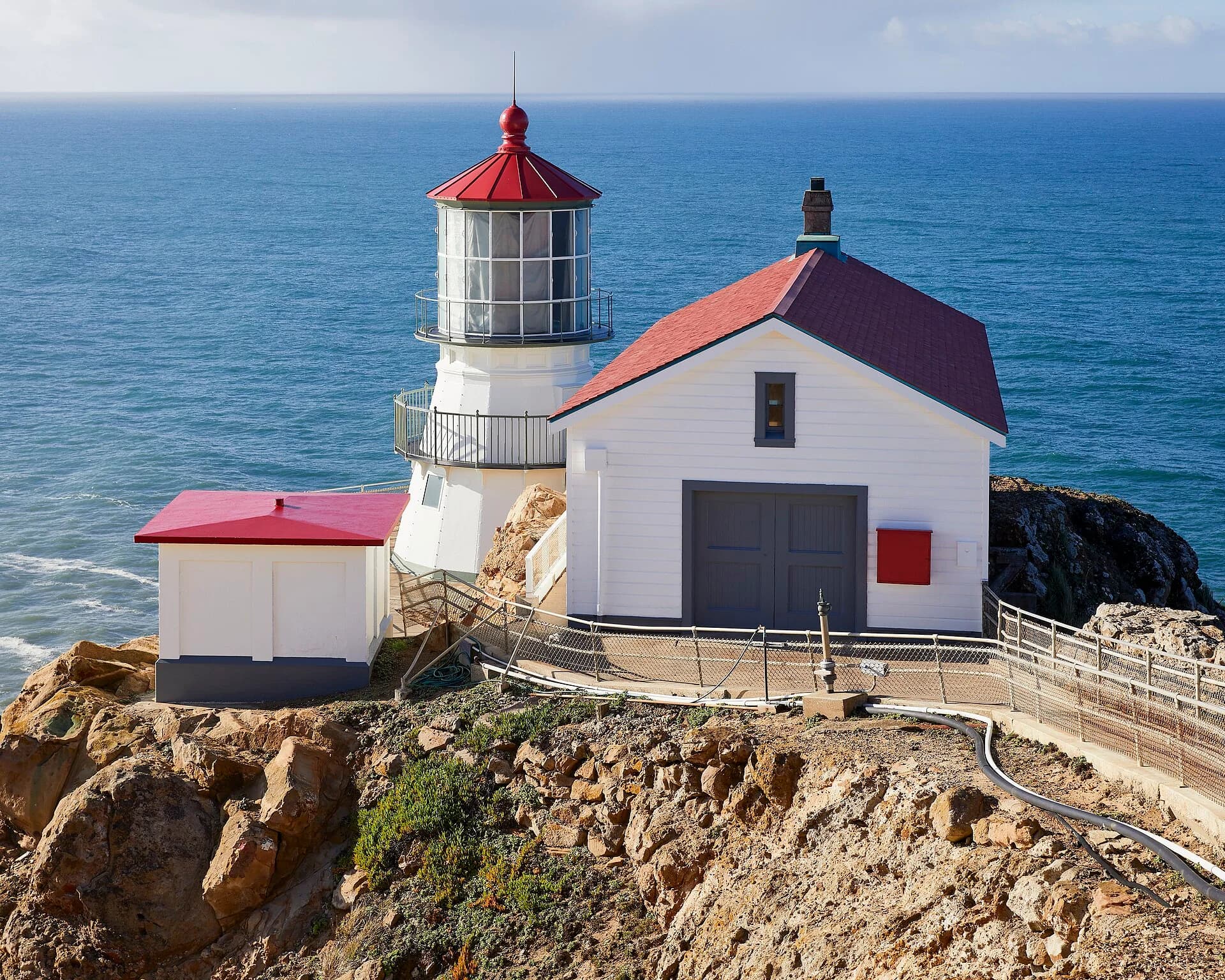
Lighthouses are the standard textbook example of a public good, but in 1974 the economist Ronald Coase showed that many lighthouses in England and Wales had been built and run privately. Their owners did not charge ships at sea; they collected “light dues” from ships in port, where payment could be enforced. Linking the non-excludable good to an excludable one, the use of the port, made the good financially viable.
Other mechanisms work in similar ways. Free-to-air television and radio are paid for by advertising: viewers free ride, but advertisers pay to reach them. Encryption has made broadcasting excludable, turning it into a club good. Voluntary contributions also play a role: Wikipedia and much open-source software are written by volunteers and funded by donations, even though anyone can use them without paying.
Satellite navigation shows that a government can also choose to keep a good non-excludable. The United States’ Global Positioning System (GPS) has been free for civilian use since a 1983 decision to open it to the world. It is owned by the US Space Force and cost about $1.84 billion a year to operate in 2023, paid by US taxpayers, while users all over the world free ride on it. Its signal is non-rivalrous and, by policy, non-excludable.
Sources: Coase, “The Lighthouse in Economics”, Journal of Law and Economics (1974); Wikipedia, “Global Positioning System” (2026).
The case for government involvement in public goods is strong, because without it the welfare loss can be very large. The harder question is how governments should supply them and how much they should supply. Both direct provision and contracting out have strengths and limitations.
Direct provision solves the free rider problem completely, because everyone pays through taxes. It gives the government full control over quality and over sensitive services, which matters for defence, policing and emergency warnings, where a failure could cost lives and where a private firm’s incentives might differ from the public interest. It also avoids the cost of writing, tendering and monitoring contracts, and there is no profit margin to pay.
Its limitations come from the absence of market discipline. A state agency does not face competition and cannot go out of business, so it may have weak incentives to control costs or to innovate. Decisions may be influenced by political considerations, such as building flood defences in marginal constituencies rather than where the cost–benefit ratio is highest. When government action itself leads to a misallocation of resources, economists speak of government failure.
Direct provision also has an opportunity cost. Tax revenue spent on one public good cannot be spent on schools, hospitals or lower taxes, and raising taxes has its own costs, since taxes can reduce incentives to work and invest. Because the true value of a public good is hard to measure, governments may provide too much of it as well as too little.
Contracting out tries to combine public finance with private efficiency. Firms compete to win the contract, which can push down costs, and the winner has a profit incentive to deliver the service cheaply. Specialist firms may have expertise and technology that a government agency lacks. With a PPP, a large project can start without the government borrowing the full cost up front.
The limitations are serious. A firm paid a fixed price has an incentive to cut costs by cutting quality, so contracts must specify quality in detail and the government must monitor them, which is costly. No contract can foresee every situation, and when something unexpected happens the firm and the government may disagree about who must pay. If few firms bid, the competition that is supposed to lower costs is weak.
Long contracts also lock in future spending. The UK’s PFI charges of £199 billion stretching into the 2040s are a commitment that future governments cannot easily change. Private firms usually borrow at higher interest rates than governments, so financing a project privately can cost taxpayers more in total even if construction is cheaper. If a contractor collapses, the government must step in, because the service must continue.
Whether direct provision or contracting out is better depends on the type of good and the situation. Contracting out works best for services whose quality is easy to specify and measure, such as whether street lights are working or bins are emptied, and where many firms can bid. Direct provision is usually preferred where quality is hard to measure, where reliability is critical, or where national security is involved.
Factor | Favours direct provision | Favours contracting out |
|---|---|---|
Ease of measuring quality | Hard to measure (defence, emergency warnings) | Easy to measure (street lighting, refuse collection) |
Number of potential suppliers | Few or none | Many firms able to bid |
Risk if the supplier fails | High: lives or national security at stake | Low: another firm can take over |
Government capacity | Strong civil service and expertise | Weak in-house expertise; specialist technology needed |
Time horizon | Long-lived, uncertain needs | Short, clearly defined contracts |
Key concepts help to structure a judgment. Providing public goods is an intervention that raises efficiency by removing a welfare loss, but only if the government chooses the right quantity. Flood barriers, storm warnings and climate adaptation link public goods to sustainability, since many of their benefits fall on future generations who cannot pay today. Equity matters too: public goods are often of greatest value to low-income households, who cannot afford private alternatives such as moving to higher ground.
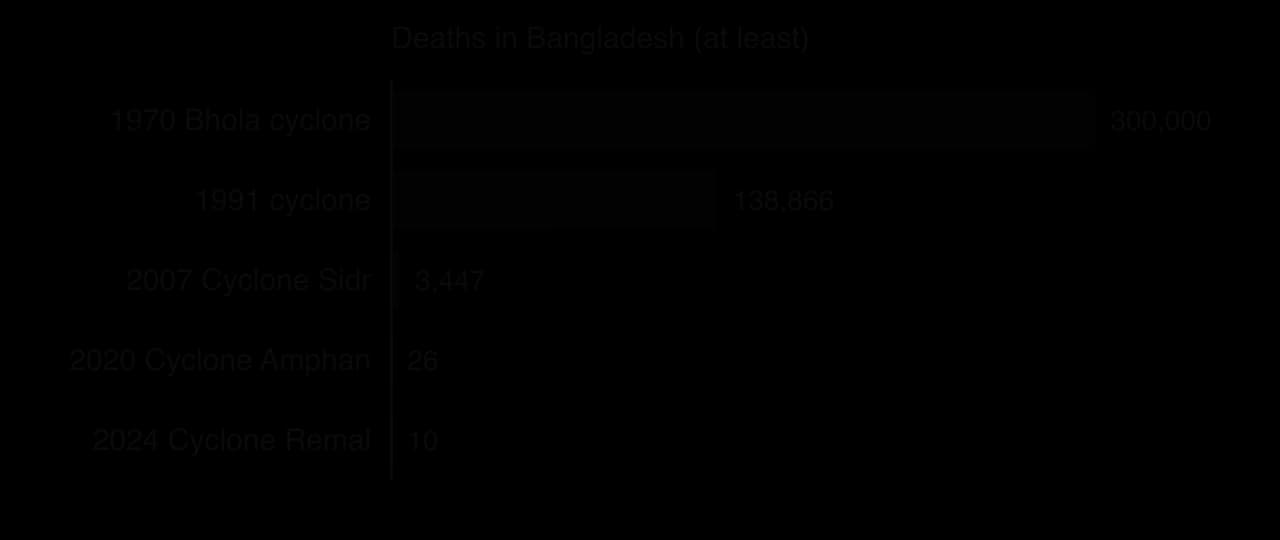
Bangladesh’s low-lying coast lies at the top of the Bay of Bengal, where cyclones drive storm surges inland. On 12 November 1970 the Bhola cyclone struck the coast of what was then East Pakistan and killed at least 300,000 people, possibly as many as 500,000. Many died in the storm surge. Warnings were broadcast, but survivors reported that the signals meant little to them, and there were few places to shelter.
A Red Crescent-supported warning system developed after the disaster into the Cyclone Preparedness Programme (CPP), established in 1972 and made a government programme in July 1973. It is run jointly by the Ministry of Disaster Management and Relief and the Bangladesh Red Crescent Society. Forecasts from the Bangladesh Meteorological Department pass down to trained village volunteers, who go door to door, sometimes using megaphones from mosque towers, to warn households and lead them to shelters.
The programme has grown steadily. It had 49,365 volunteers in 2015, about a third of them women, and more than 76,000 by 2022, half of them women. The number of cyclone shelters rose from fewer than 100 in the 1970s to over 5,000 by 2022, able to hold nearly five million people. Many double as schools, and a World Bank-financed project is building or rehabilitating more than 1,000 shelters and 550 km of access roads.
A cyclone warning is a near-pure public good. One more household hearing it does not reduce the warning available to anyone else, so it is non-rivalrous, and it is impossible to warn one village while keeping the information from the next, so it is non-excludable. No private firm could sell warnings to poor coastal households, since anyone who heard the warning from a neighbour would free ride. The market would supply almost nothing, and the welfare loss, counted in lives, was enormous.
Shelters are better described as quasi-public goods. They are non-excludable in an emergency, since nobody is turned away, but they are rivalrous once full, which is why the number and capacity of shelters matter. Both are provided directly by the state, with volunteers and donor finance: a mix of direct provision and voluntary provision that relies on international interdependence.
Deaths have fallen sharply. The 1991 cyclone killed 138,866 people. Cyclone Sidr in 2007, one of the strongest storms to hit the country, killed at least 3,447, while about 2 million people were evacuated to shelters. For Cyclone Amphan in 2020, about 2.2 million people were evacuated and more than 12,000 shelters were opened, and 26 people died in Bangladesh. When Cyclone Remal struck in May 2024, 78,000 CPP volunteers were put on standby, about 800,000 people moved to shelters, and at least 10 died.
The case supports the theory: a good that the market would not supply has been provided collectively, at a cost far below the value of the lives saved. It also shows that collective provision need not mean only paid state employees. The CPP’s volunteers are a form of voluntary provision that works because communities are small and people value protecting their neighbours.
The comparison of death tolls has limits. Storms differ in strength, track and the height of the surge: Amphan made landfall in India, and Bangladesh felt mainly its outer rain and wind. Better satellite forecasting, roads, mobile phones and higher incomes have also reduced deaths. The CPP is one of several causes, though its warnings and shelters are widely credited with much of the improvement.
Warnings and shelters protect lives far better than they protect livelihoods. Cyclones still destroy homes, crops, livestock and fishing boats, and many coastal households fall back into poverty after a storm. Protecting assets requires further public goods, such as embankments, which are far more expensive. As climate change raises sea levels, the cost of protection will rise, which makes the choice of how much to provide, and how to finance it, more pressing.
Sources: Wikipedia, “1970 Bhola cyclone”, “1991 Bangladesh cyclone”, “Cyclone Sidr”, “Cyclone Amphan” and “Cyclone Remal” (accessed 2026); ODI Humanitarian Practice Network (2015); World Bank, “How Bangladesh can protect its development gains through coastal resilience” (2022).
Public goods appear in Paper 1 as part (a) or part (b) questions on market failure, and in Paper 2 as definitions, short explanations and as part of a 15-mark evaluation. Because there is no calculation or required diagram, marks depend on precise definitions, a clear chain of reasoning and well-developed real-world examples.
Many answers lose marks by explaining that public goods are not provided “because they are not profitable” and stopping there. The reasoning must run from non-excludability to free riding to the firm’s inability to collect revenue, and then to the consequence: under-provision or no provision, and a welfare loss.
A part (b) question usually asks for an evaluation of the government’s response. A strong answer weighs the two methods against each other and uses one developed example rather than a list of names.
Goods are classified by rivalry and excludability into private goods, club goods, common pool resources and public goods.
A public good is non-rivalrous and non-excludable; a good provided by the government is not necessarily a public good.
Non-excludability creates the free rider problem: firms cannot collect revenue, so the market under-provides public goods or does not provide them, causing a welfare loss.
Because everyone consumes the same units, the MSB of a public good is the vertical sum of individual marginal benefits, often far above what any one person would pay.
Governments finance public goods through taxation and supply them by direct provision or by contracting out to private firms, including public–private partnerships.
Direct provision gives control but weak cost incentives; contracting out can lower costs but risks lower quality, incomplete contracts and long-term commitments.
Some public goods are provided privately or voluntarily, by linking them to excludable goods, through advertising or through donations.
I can define rivalry and excludability and classify any good as private, public, club or common pool.
I can define a public good precisely and explain why government provision does not make a good public.
I can explain the free rider problem and why it leads to under-provision by the market.
I can draw a diagram of a public good with MSB, MSC, MPB, Q* and the welfare loss, and explain it.
I can explain why the MSB of a public good is the vertical sum of individual benefits.
I can explain direct provision and contracting out, with a real example of each.
I can evaluate the two methods and reach a judgment that depends on the type of good.
I can use the Bangladesh cyclone warning system as a developed real-world example.
0
0 |
The work does not reach a standard described by the descriptors below. |
1 | 1–2 | Little understanding of the specific demands of the question. Relevant economic theory is stated but not relevant. Economic terms are stated but not relevant. |
2 | 3–4 | Some understanding of the specific demands of the question. Relevant economic theory is described. Some relevant economic terms are included. |
3 | 5–6 | The specific demands of the question are understood but only partially addressed. Relevant economic theory is partly explained. Some relevant terms are used appropriately. Where appropriate, relevant diagram(s) are included. |
4 | 7–8 | The specific demands of the question are understood and addressed. Relevant economic theory is explained. Relevant terms are used mostly appropriately. Where appropriate, relevant diagram(s) are included and explained. |
5 | 9–10 | The specific demands of the question are understood and addressed. Relevant economic theory is fully explained. Relevant terms are used appropriately throughout. Where appropriate, relevant diagram(s) are included and fully explained. |
Using real-world examples, evaluate the view that public goods should always be provided directly by the government.
15 marks
Answers may include:
Terminology: public goods (non-rivalrous and non-excludable), free-rider problem, market failure, direct provision, contracting out, private provision.
Explanation: because public goods are non-excludable, consumers can benefit without paying, so private firms cannot earn revenue and the market fails to provide them (missing market); direct government provision financed by taxation overcomes the free-rider problem and ensures provision of goods such as national defence, street lighting and flood defences.
Diagram(s): a PPC showing the opportunity cost of providing public goods in terms of private goods; may show a demand and supply diagram in which no market quantity exists.
Synthesis/evaluation: governments may lack the information to decide the right quantity; provision has an opportunity cost and requires taxation; contracting out to private firms may lower costs while the government still finances the good; some public goods can be partly excludable with technology (toll roads, subscription broadcasting) and thus provided privately; quasi-public goods may be provided by markets or charities; consideration of the word 'always'; a reasoned conclusion.
Examples: national defence provided by governments everywhere; the Netherlands' Delta Works flood defences built by the state; lighthouses in England and Wales funded historically through 'light dues' charged to ships (Trinity House); toll roads built under public–private partnerships; contracting out of street lighting maintenance to private firms.
N.B. Terminology, theory, diagrams and examples given in part (a) and referred to in part (b) should be rewarded.
Examiners should be aware that candidates may take a different approach which, if appropriate, should be rewarded.
Markbands (best fit)
Level | Marks | Descriptor |
|---|---|---|
0 | 0 | The work does not reach a standard described by the descriptors below. |
1 | 1–3 | Little understanding of the specific demands of the question. Theory is stated but not relevant. Terms are not relevant. No synthesis or evaluation. Real-world examples are identified but not relevant. |
2 | 4–6 | Some understanding of the demands. Relevant theory is described. Some relevant terms are included. Synthesis or evaluation is superficial. A relevant real-world example is identified. |
3 | 7–9 | The demands are understood but only partially addressed. Theory is partly explained. Some terms are used appropriately. Relevant diagram(s) are included where appropriate. Synthesis or evaluation is appropriate but lacks balance. Example(s) are identified and partly developed in context. |
4 | 10–12 | The demands are understood and addressed. Theory is explained. Terms are used mostly appropriately. Diagram(s) are included and explained. Synthesis or evaluation is appropriate and mostly balanced. Example(s) are identified and developed in the context of the question. |
5 | 13–15 | The demands are understood and addressed. Theory is fully explained. Terms are used appropriately throughout. Diagram(s) are included and fully explained. Synthesis or evaluation is effective and balanced. Example(s) are identified and fully developed to support the argument. |
Read the extract and answer the questions that follow.
Text A — Clinics or aircraft? Mirelland's budget dilemma
[1] Mirelland is an upper-middle-income economy in South America. Its government has set aside MRL 480 million (Mirelland lira) for new capital spending in 2026, to be divided between rural health clinics and military aircraft. Scarcity of public funds means that it cannot satisfy both the health ministry and the defence ministry in full.
[2] Each new rural clinic, fully equipped, costs MRL 12 million. Each military aircraft costs MRL 96 million. The defence ministry has requested three aircraft.
[3] Health campaigners point out that infant mortality in rural districts is twice the national average, while the defence ministry argues that national security is a public good that only the government can provide.
Define the term scarcity indicated in bold in the text (Text A, paragraph 1).
2 marks
Using information from Text A, paragraph 2, calculate the opportunity cost, in rural clinics, of buying the three aircraft requested by the defence ministry.
2 marks
Using information from Text A, determine the maximum number of rural clinics that could be built if no aircraft were bought.
1 mark
Using a production possibilities curve (PPC) diagram, explain the choice faced by Mirelland's government (Text A, paragraphs 1 and 2).
4 marks
Explain two reasons why national security may be provided by the government rather than by the market (Text A, paragraph 3).
4 marks
Read the extract and answer the questions that follow.
Text A — The state and the market in Lunavia
[1] Lunavia is a high-income economy in northern Europe, often described as a mixed economy. Private firms produce most manufactured goods, food and retail services, and prices in these markets are set by demand and supply.
[2] The government owns the national railway and the electricity grid, provides free healthcare and schooling, and pays for street lighting and national defence. It also subsidizes rail fares, arguing that rail travel reduces road congestion and air pollution.
[3] In 2025, Lunavia's GDP was LNV 640 billion. Goods and services produced by the public sector were valued at LNV 172.8 billion.
Define the term mixed economy indicated in bold in the text (Text A, paragraph 1).
2 marks
Using information from Text A, paragraph 3, calculate the percentage of Lunavia's GDP produced by the private sector in 2025.
2 marks
Explain two reasons why the government of Lunavia, rather than private firms, pays for street lighting and national defence (Text A, paragraph 2).
4 marks
Using an externalities diagram, explain why the government of Lunavia subsidizes rail fares (Text A, paragraph 2).
4 marks