Notes on 2.4 Critique of the maximising behaviour of consumers and producers
Learning objectives
Explain the assumptions of rational consumer choice: consumer rationality, utility maximisation and perfect information.
Explain how biases (rules of thumb, anchoring, framing, availability) lead consumers to depart from rational choice.
Explain bounded rationality, bounded self-control, bounded selfishness and imperfect information, with real examples.
Evaluate the rational consumer model in the light of evidence from behavioural economics.
Explain default, restricted and mandated choices as forms of choice architecture, and nudge theory.
Evaluate the use of nudges by governments and firms to change behaviour.
Explain profit maximisation and the alternative business objectives of corporate social responsibility, market share, satisficing and growth.
Evaluate the assumption that firms aim to maximise profit.
Introduction
Most of microeconomics rests on two assumptions about behaviour: consumers act rationally to get the greatest satisfaction from their spending, and firms act to make the greatest possible profit. These assumptions explain why demand curves slope downwards and supply curves slope upwards, and they lie behind the result that competitive markets are allocatively efficient.
Behavioural economics tests these assumptions against how people and firms actually behave. It finds that consumers use shortcuts, are influenced by how choices are presented, struggle to stick to their plans and care about others, and that many firms pursue goals other than profit. These findings matter for choice and for economic well-being, and they have given governments a new kind of intervention: the nudge.
The rational consumer choice model
Standard economic theory models the consumer as a decision-maker who knows what they want, knows what is available and always chooses the option that is best for them. This model, sometimes called homo economicus (“economic human”), is a simplification, like every economic model. It is useful because it makes clear, testable predictions about how people respond to changes in prices and incomes.
The model rests on three assumptions, each of which behavioural economics questions.
Consumer rationality
A rational consumer has clear and consistent preferences. They can rank every possible bundle of goods, their rankings do not contradict each other (if they prefer A to B and B to C, they prefer A to C), and their choices do not depend on irrelevant details, such as the order in which options are listed. They weigh the costs and benefits of each option, including future costs and benefits, and do not make the same mistake twice.
Consumer rationality also implies that people respond to prices in a predictable way. A rise in the price of a good raises its opportunity cost, so a rational consumer buys less of it, which is the basis of the law of demand.
Utility maximisation
Utility is the satisfaction a consumer gets from consuming goods and services. The model assumes that consumers aim to make their total utility as large as possible, given their limited income. In practice this means they keep adjusting their spending until the extra utility from the last dollar spent on each good is the same across all goods; if it were higher for one good, moving a dollar to it would raise total utility.
Utility maximisation also assumes that consumers are self-interested: the utility that counts is their own. Behaviour that helps others is explained only if it raises the consumer’s own satisfaction.
Perfect information
To choose the best option, a consumer must know every option. The model assumes consumers know the prices of all goods in all shops, their quality and their consequences, now and in the future, and that finding this information costs nothing.
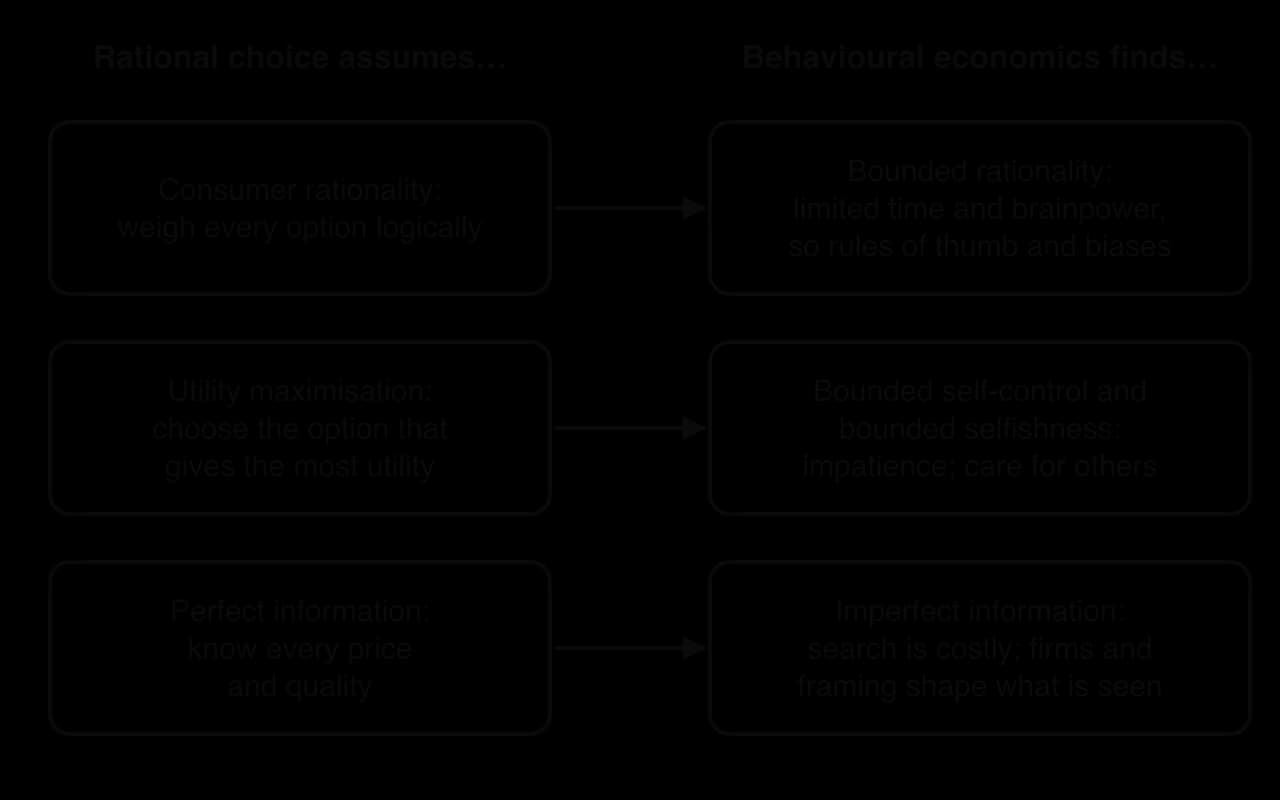
The diagram summarises the behavioural critique. On the left are the three assumptions of rational consumer choice; on the right, the behavioural findings that limit each one. Bounded rationality limits consumer rationality; bounded self-control and bounded selfishness limit utility maximisation; and imperfect information limits the assumption of perfect information.
Why economists use the rational model
The rational model is used because it predicts many things well. People do buy less of most goods when prices rise, they do switch to cheaper substitutes, and firms do respond to changes in costs. A model does not need realistic assumptions to make useful predictions; it needs to capture the forces that matter most for the question being asked. The rational model also gives a benchmark: by showing what a fully informed, self-interested consumer would do, it makes departures from that behaviour easy to identify and measure.
Its weakness is that some predictions fail systematically, not randomly. If people’s errors cancelled each other out, a model of the average rational consumer would still work. Behavioural economists showed that many errors are predictable and push in the same direction, so they do not cancel out and they change market outcomes.
Behavioural economics: the limits of rational choice
Behavioural economics combines economics with psychology to study how people actually make decisions. Its starting point is that the human brain has limited time, attention and memory, so people rely on mental shortcuts that usually work well but sometimes lead to predictable mistakes. Daniel Kahneman, a psychologist, and Richard Thaler, an economist, both received the Nobel Prize in Economic Sciences for work in this field.
Cognitive biases
Biases are not random mistakes. They arise from the way the brain processes information, so many people make the same error in the same situation, and firms and governments can predict them. Behavioural economists have identified many biases; four are central.
Rules of thumb
A rule of thumb (or heuristic) is a simple guide that saves the effort of working out the best choice every time: “buy the brand I bought last time”, “never pay full price”, “choose the second-cheapest wine on the menu”, “save 10% of my income”. With thousands of decisions to make, rules of thumb are often sensible: the time and effort saved can be worth more than the small gain from always choosing the very best option.
Rules of thumb lead to mistakes when circumstances change but the rule does not. A shopper who always buys the brand bought last time may keep paying more after a cheaper and better product appears. Firms know this, which is why they work hard to win a customer’s first purchase and make it easy to repeat it, for example with subscriptions that renew automatically.
Anchoring
When people estimate a value, they often start from a number that is already in their mind, the “anchor”, and adjust from it, usually not far enough. In a well-known experiment by Amos Tversky and Daniel Kahneman, people first saw a number produced by a spinning wheel and were then asked to estimate the percentage of African countries in the United Nations. Those who saw a higher number on the wheel gave higher estimates, even though the number was obviously random.
Retailers use anchoring when they show a “was” price next to a sale price: the higher original price acts as an anchor that makes the sale price look like a bargain, whether or not the good ever really sold at the higher price. Menus that list one very expensive dish make the other dishes seem reasonably priced, and a high opening offer in a negotiation pulls the final price upwards. In a rational model, none of these anchors would change behaviour, because the value of a good to the buyer does not depend on other numbers on the page.
Framing
The same information can be presented, or “framed”, in different ways, and this framing changes the choice people make. A yoghurt labelled “90% fat-free” is more attractive to many shoppers than one labelled “10% fat”, although the two descriptions are identical. People respond more strongly to a frame that presents an outcome as a loss than to one that presents the same outcome as a gain, which reflects loss aversion: losses feel worse than equal-sized gains feel good.
A related finding is that people judge gains and losses relative to a reference point rather than in absolute terms. Many shoppers will travel to another shop to save 100 kronor on a watch costing 1,000 kronor, but not to save the same 100 kronor on a watch costing 10,000. The saving is identical in money; what changes is the frame, a 10% saving against a 1% saving. A rational consumer would make the same decision in both cases, because the opportunity cost of the trip is the same.
Availability bias
People judge how likely an event is by how easily examples of it come to mind. Events that are recent, vivid or widely reported are remembered easily, so their probability is overestimated, while common but unremarkable risks are underestimated. This is availability bias.
After a major flood, sales of flood insurance in the affected area typically rise, then fall again as memories fade, although the real risk of flooding has hardly changed. After a widely reported plane crash, some travellers switch to driving, which is statistically far more dangerous. Investors buy shares that have recently been in the news.
Bias | What happens | Everyday example | Rational model predicts |
|---|---|---|---|
Rules of thumb | Simple shortcuts replace full comparison of options | Always buying the same brand | Every option compared each time |
Anchoring | An initial number pulls the judgment towards it | “Was $80, now $40” makes $40 seem cheap | Only the good’s value to the buyer matters |
Framing | The presentation of information changes the choice | “90% fat-free” vs “10% fat” | Identical information gives identical choices |
Availability | Memorable events seem more likely | Insurance bought after a recent disaster | Probabilities judged from the evidence |
Bounded rationality
The American economist Herbert Simon argued that people are “boundedly” rational: they try to make good decisions, but within limits set by the information they have, the time available and their brain’s capacity to process it. Instead of finding the best possible option, they look for one that is good enough and stop searching, which Simon called satisficing.
Choosing a mobile phone contract, a pension or a mortgage involves comparing many options with complex terms. Most people cannot work out which is truly best, so they choose a familiar provider, follow a friend’s advice or accept whatever option is offered as standard. Bounded rationality explains why such default choice options are so powerful: the effort of comparing alternatives is high, so many people stay with the option they are given. This tendency is often called status quo bias.
Bounded self-control
The rational model assumes people carry out the plans that are best for them. In practice, people often know what they should do (save for retirement, exercise, eat healthily, stop smoking) and fail to do it. The benefits of these actions come in the future, while the costs come now, and people give too much weight to the present: they show present bias.
Richard Thaler and Hersh Shefrin described this as a conflict between two “selves”: a far-sighted planner, who wants long-term well-being, and a short-sighted doer, who wants satisfaction now. The planner can protect itself by limiting the doer’s choices in advance, as Odysseus did when he had himself tied to the mast so that he could hear the Sirens without steering towards them. Gym memberships paid annually, savings accounts that charge a penalty for early withdrawal and apps that block social media at night are all such commitment devices.
Bounded self-control has clear economic effects. People save too little for retirement, borrow on expensive credit cards and consume too much of goods that harm their health, such as tobacco and sugary drinks. It is one of the reasons economists treat these goods as demerit goods: consumers do not act in their own long-term interest even when they know the risks.
Bounded selfishness
The rational model assumes people act in their own interest. Yet people give to charity, volunteer, tip in restaurants they will never visit again, recycle when nobody is watching and punish others for behaving unfairly, even when this costs them money. They care about fairness and about the well-being of others, not only their own.
The ultimatum game, a standard experiment, shows this clearly. One player is given a sum of money and offers a share of it to a second player. If the second player accepts, both keep their shares; if they reject, both get nothing. A purely self-interested second player should accept any offer above zero, because something is better than nothing. In experiments around the world, many people reject offers they consider unfair, giving up money to punish the first player, and many first players offer close to half.
Bounded selfishness helps explain charitable giving, why firms avoid raising prices sharply in emergencies even when demand surges (customers see this as unfair), and why consumers pay more for fair-trade or environmentally friendly products. It also has limits: people are much more generous towards family and friends than towards strangers, and generosity tends to fall as the cost of being generous rises.
Imperfect information
Consumers rarely have perfect information. Finding the lowest price, judging the quality of a second-hand car or understanding the terms of a loan takes time and expertise. Where information is costly, a consumer may rationally decide to stop searching, but the result is still a choice that differs from the one the rational model predicts.
Firms often know much more about their products than consumers do, which creates asymmetric information. They can also shape what consumers see and in what order, by placing products at eye level, by using complex pricing that is hard to compare, or by hiding fees until the final stage of an online purchase. Imperfect information is a cause of market failure, and it gives governments a reason to require clear labelling and price information.
 YouTube
Evaluating the behavioural critique
Behavioural economics has changed how economists think about consumers, but its findings need to be weighed carefully.
Strengths of the behavioural critique | Limitations of the behavioural critique |
|---|---|
Explains real behaviour the rational model cannot: undersaving, the power of defaults, charitable giving, the effect of framing. | Many findings come from laboratory experiments with students and small sums of money; behaviour may differ when stakes are high or decisions are repeated. |
Errors are systematic and predictable, so they matter for markets and can be used in policy. | There are many biases, sometimes pulling in opposite directions, so it can be hard to predict which one dominates in a given situation. |
Has produced cheap, effective policies, such as automatic enrolment in pensions. | Some well-known experimental results have not been reproduced in later studies, so the size of some effects is uncertain. |
Shows that competition does not always remove mistakes: firms can profit from consumers’ biases. | The rational model still predicts well in many markets, especially where people learn from experience or experts make decisions. |
A balanced judgment is that behavioural economics refines rather than replaces the rational model. For many everyday questions, such as how a tax on a good will change the quantity bought, the rational model’s predictions are close enough. Where decisions are complex, infrequent, involve the long-term future or involve moral judgments, such as pensions, health and organ donation, behavioural insights change predictions and policy significantly.
Behavioural economics in action: choice architecture and nudges
If the way choices are presented changes what people choose, then whoever designs that presentation has influence. Every shop layout, website, form and menu presents options in some order and with some option preselected. No presentation is neutral, because some design always has to be chosen. Behavioural economists call this design choice architecture.
Three forms of choice architecture are especially important for policy.
Default choices
A default is the option that applies if a person does nothing. Because of status quo bias, the effort of comparing alternatives and a feeling that the default is the recommended option, most people stay with whatever the default is. Changing the default can therefore change behaviour on a large scale without removing anyone’s freedom to choose differently.
Organ donation is the best-known example. Under an “opt-in” system, people are donors only if they register; under an “opt-out” (deemed consent) system, adults are treated as willing donors unless they register a decision not to donate. A comparison of European countries published in 2003 found that effective consent to donation was far higher in countries with opt-out defaults than in otherwise similar countries with opt-in systems.
Wales introduced an opt-out system in December 2015 and England on 20 May 2020; in England it does not apply to people under 18, people who lack the mental capacity to understand it, visitors, or people who have lived in England for less than 12 months.
Sources: Johnson and Goldstein, _Science (2003); NHS Blood and Transplant, organ donation law in England and Wales (2026)._
Restricted choices
Too many options can make it harder to choose well, which is the reason for restricted choice. When a choice is complex, people may delay, choose at random or stick with the default. Restricting the number of options, or limiting which options are offered in certain places, can make good decisions easier.
Since 1 October 2022, medium and large retailers in England (those with 50 or more employees) may not place food and drink high in fat, sugar or salt at key locations: checkouts, store entrances and the ends of aisles, and the equivalent places on their websites. Shoppers can still buy any of these products, but impulse purchases while queuing to pay are made harder. Pension schemes that offer a short list of well-diversified funds, rather than hundreds of options, are another example.

Sources: Department of Health and Social Care, implementation guidance on the Food (Promotion and Placement) (England) Regulations 2021 (2025).
Mandated choices
Sometimes people avoid a decision altogether because it is unpleasant or seems unimportant at the time. A mandated choice requires them to make an active decision, without imposing any particular answer and without a default.
A common example is requiring everyone who applies for a driving licence or registers with a doctor to state, yes or no, whether they wish to be an organ donor. Mandated choice respects people’s preferences more fully than a default, because nobody is placed in a scheme without deciding. It is less effective than a default at raising participation, because people who would have stayed with a favourable default can now choose the other option.
Nudge theory
Richard Thaler and the legal scholar Cass Sunstein brought these ideas together in their book Nudge (2008). A nudge changes the choice architecture to steer people towards decisions that improve their own well-being, without banning any option or significantly changing financial incentives. Thaler and Sunstein called the approach “libertarian paternalism”: paternalistic because it steers people towards choices judged to be better for them, libertarian because everyone keeps the freedom to choose otherwise.
Governments in several countries, including the UK and the USA, have set up “nudge units” to apply behavioural insights to public policy. Typical nudges include reminder letters that tell late taxpayers that most people in their area pay on time (a social norm), placing fruit at eye level in school canteens, putting healthy options first on menus and sending text reminders for medical appointments.
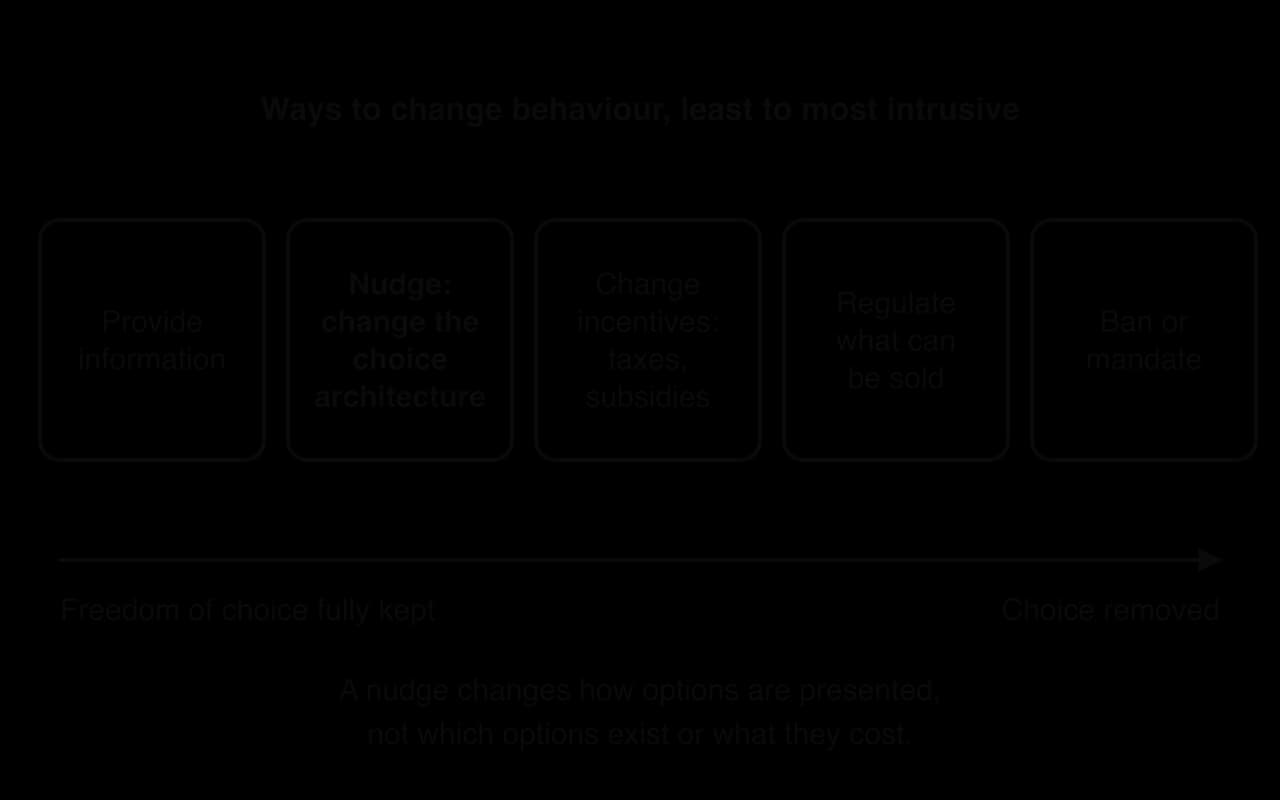
The diagram places nudges among other ways of changing behaviour. Providing information leaves choices entirely to the individual. A nudge goes one step further by changing how the options are presented. Taxes and subsidies change the price of options, regulation limits what can be sold, and bans remove options altogether. The further along the scale, the more powerful the intervention usually is, but also the greater its cost to freedom of choice and, often, to the government.
Firms use the same techniques for their own ends. Subscriptions that renew by default, “only 2 rooms left” messages on booking websites, prices ending in 99 and products placed at eye level are all forms of choice architecture designed to raise sales. When the design works against the consumer’s interest, for example making a subscription easy to start but hard to cancel, it is sometimes called “sludge” or a “dark pattern”.
 YouTube
Evaluating nudges
Arguments for nudges | Arguments against nudges |
|---|---|
Low cost: changing a default or a letter costs little compared with taxes, subsidies or enforcement. | Effects can be small or short-lived; some studies find that nudges change behaviour less than early results suggested. |
Preserve freedom of choice: anyone can opt out, so people with unusual needs are not harmed. | Paternalism: someone has to decide which choice is “better”, and governments may be wrong or have their own interests. |
Work with real behaviour, so they can succeed where information campaigns fail, as automatic enrolment did. | May treat symptoms rather than causes: a nudge to save more does not help people whose income is too low to save. |
Politically easier than taxes or bans, and can be tested quickly with trials. | Can be used manipulatively, by firms as well as governments, and may reduce trust if people feel tricked. |
Can be combined with other policies, such as a tax on a demerit good together with clear labelling. | Not enough on their own for problems with large external costs, such as climate change, where prices or regulation are needed. |
Whether a nudge is the right tool depends on the problem. Nudges work best when people already want to make the “better” choice but fail because of inertia, complexity or present bias, as with pension saving or organ donation. They work less well when the costs fall mainly on others, as with pollution, because steering a person’s choice for their own benefit does not deal with harm to third parties. In those cases, taxes, regulation or tradable permits that change incentives are usually needed, with nudges playing a supporting role.
Business objectives
Supply theory assumes that firms make decisions to earn the greatest possible profit. This assumption explains why firms supply more when prices rise and why they enter profitable industries. Many firms, however, state other aims, and their behaviour does not always fit profit maximisation.
Profit maximisation
Profit is the difference between a firm’s total revenue and its total costs. A firm maximises profit by choosing the level of output at which this difference is as large as possible. Economists show that this happens where the revenue from selling one more unit (marginal revenue) equals the cost of producing it (marginal cost): producing any less gives up profitable units, and producing any more adds units that cost more than they earn.
The assumption is reasonable for several reasons. In competitive markets, firms that do not keep costs down and earn profits may be driven out by rivals. Shareholders, who own the firm, usually want profits paid as dividends or reinvested to raise the value of their shares. Profit is also the reward for risk-taking, and the prospect of profit is what gives the price mechanism its incentive function.
The assumption also has limits. Firms rarely know their marginal revenue and marginal cost precisely, so they cannot calculate the profit-maximising output exactly; they use rules of thumb such as adding a fixed percentage to costs. In large companies, the people who run the firm (managers) are not the people who own it (shareholders), and managers may pursue their own goals, such as a larger firm, higher pay or an easier life. And many firms, from cooperatives to social enterprises, are set up with aims other than profit.
Alternative business objectives
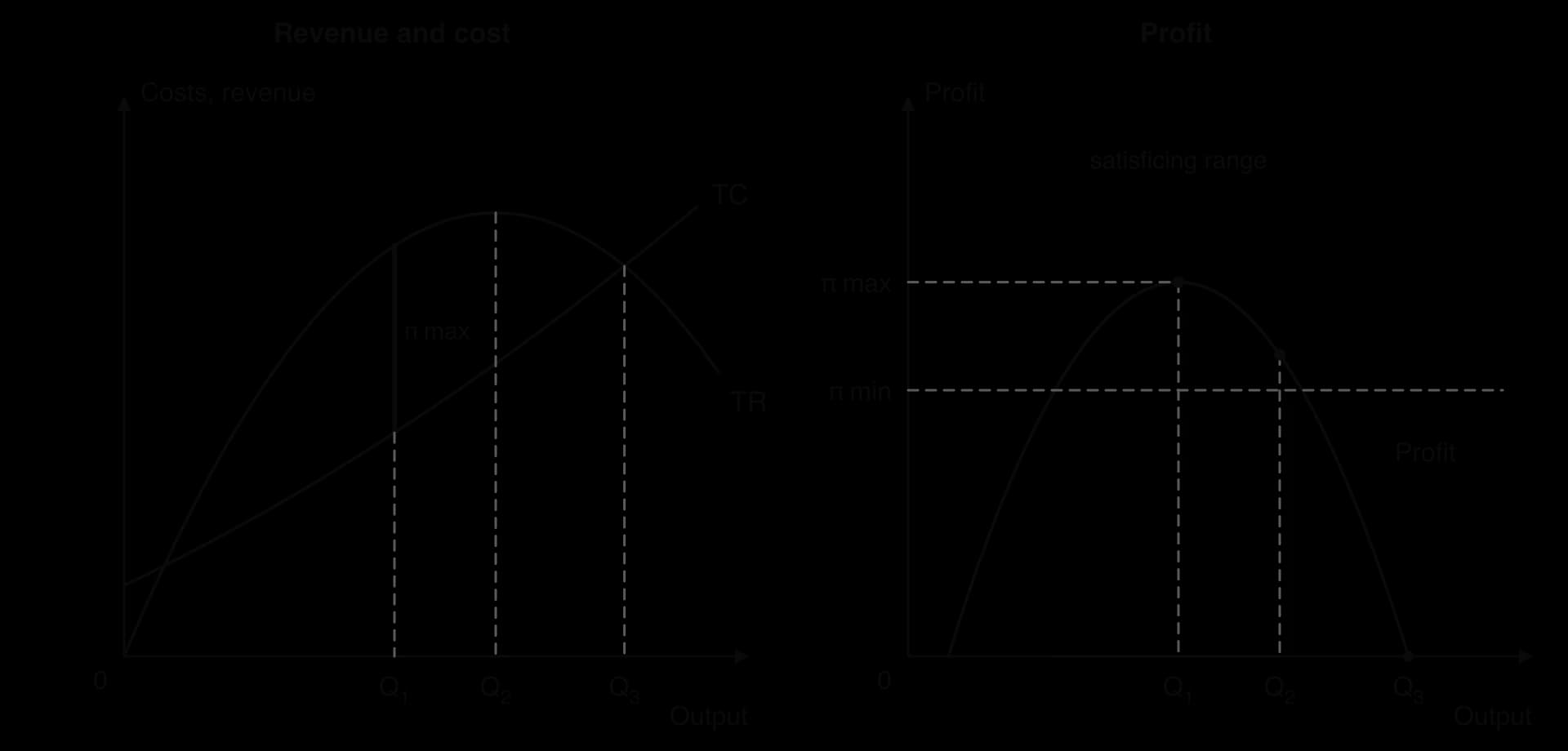
The diagram compares the output a firm chooses under different objectives, using hypothetical revenue and cost curves. A profit-maximising firm produces Q₁, where total revenue (TR) is furthest above total cost (TC).
A firm aiming for the largest possible sales revenue, often as a way of gaining market share, produces more, at Q₂, where TR is at its peak. A firm aiming for growth in size may produce as much as Q₃, the largest output at which revenue still covers costs. A satisficing firm accepts any output in the shaded range, where profit is at least a minimum acceptable level, π min. The revenue, market share and growth objectives all involve producing more, and so charging a lower price, than the profit-maximising firm.
Corporate social responsibility
A firm pursuing CSR accepts higher costs or lower profits to meet ethical goals, or to meet the expectations of customers, workers and investors who care about them. Patagonia, a US outdoor clothing company, has given 1% of its sales to environmental groups since 1985. In September 2022 its founder, Yvon Chouinard, transferred all the company’s voting shares to a trust and all its non-voting shares to a non-profit organisation, with the stated aim that profits not reinvested in the business would be used to fight climate change and protect nature.
CSR can also serve profit. A strong ethical reputation can attract customers willing to pay higher prices, help recruit and keep good workers and reduce the risk of regulation or boycotts. Critics point out that some CSR claims are mainly marketing (“greenwashing”) and that the costs of CSR may be passed on to consumers. Even Patagonia’s ownership change attracted criticism: the structure avoided much of the tax that a sale or inheritance would have triggered, although a gift tax of about $17 million was paid on the voting shares.
Sources: Patagonia, Inc. (2022); Wikipedia, “Patagonia, Inc.” (2026).
Market share
Firms may aim to win market share by charging low prices, spending heavily on advertising or offering products at a loss. A large market share can bring lower costs per unit as output grows, more power over prices and suppliers, and a stronger position against new rivals, which can raise profits in the long run. Amazon, founded in 1994, put market leadership ahead of short-term profit in its early years. In its 1997 letter to shareholders it reported revenue growth of 838%, to $147.8 million, and set out its approach:
We will continue to make investment decisions in light of long-term market leadership considerations rather than short-term profitability considerations or short-term Wall Street reactions.
— Amazon.com, 1997 letter to shareholders
Amazon reported its first quarterly profit only in the last quarter of 2001. Pursuing market share can therefore be consistent with long-run profit maximisation. It becomes a concern for consumers if a firm uses low prices to drive out rivals and then raises prices once it has market power.
Sources: Amazon.com, 1997 letter to shareholders (SEC filing, 2013); Wikipedia, “Amazon (company)” (2026).
Satisficing
The idea comes from Herbert Simon’s work on bounded rationality: with limited information and many people involved in decisions, firms aim for results that are “good enough”. Satisficing is common where managers, not owners, run the firm. Managers may aim to earn enough profit to keep shareholders content, and then use the firm’s resources for other goals, such as a quieter working life, good relations with workers or the prestige of running a large organisation. This gap between the interests of owners and of the managers who act for them is known as the principal–agent problem.
Satisficing can also reflect a firm balancing the interests of many stakeholders: workers who want good pay and job security, customers who want low prices, local communities and the government. Each group has to be kept satisfied, so the firm cannot pursue any single goal, including profit, to the maximum.
Growth
Larger firms can benefit from economies of scale, which lower the cost per unit, and from greater security: large, diversified firms are less likely to fail or be taken over. Managers’ pay and status often rise with the size of the firm, which gives them a personal reason to pursue growth. Growth through takeovers can also bring new technology or access to new markets quickly.
Growth does not always benefit owners. Rapid expansion can raise costs if the firm becomes hard to manage, and many takeovers fail to deliver the gains expected. A firm that grows by buying its competitors may gain market power, which can lead to higher prices for consumers and investigation by competition authorities.
Objective | What the firm aims for | Likely output and price compared with profit maximisation | Who benefits most |
|---|---|---|---|
Profit maximisation | Largest possible TR − TC (MR = MC) | (Benchmark) | Shareholders |
Corporate social responsibility | Ethical and environmental goals as well as profit | Higher costs; price may be higher | Workers, communities, the environment; possibly long-run profit |
Market share | Largest possible share of sales | Higher output, lower price | Consumers in the short run; the firm in the long run |
Satisficing | Satisfactory profit and other goals | Profit below the maximum | Managers and other stakeholders |
Growth | Larger size of the firm | Higher output; may accept lower profit | Managers; possibly shareholders in the long run |
Evaluating the assumption of profit maximisation
The alternative objectives do not mean the profit-maximising model is useless. Most firms must earn enough profit to survive, pay their owners and finance investment, and in competitive markets the pressure to keep costs down is strong. Many alternative objectives, such as gaining market share or building a reputation through CSR, are ways of raising profit over a longer period. Profit maximisation remains a good approximation for small, owner-run firms in competitive markets and a useful benchmark for analysing larger ones.
The model fits less well where competition is weak, ownership is separated from control, or firms are set up with a social purpose. In those cases, predictions based on profit maximisation, for example about how a firm will respond to a tax or a fall in demand, may be wrong. A balanced judgment is that profit is the main long-run objective of most private firms, but the short-run behaviour of many firms reflects a mix of goals and the limits of bounded rationality.
Case study: automatic enrolment in UK workplace pensions
In the decades before 2012, the share of UK employees saving in a workplace pension fell. Many workers, especially young and lower-paid workers in the private sector, did not join their employer’s scheme, even when the employer would add money to it. In the rational model this is hard to explain: joining a pension with an employer contribution is like receiving extra pay. Behavioural economics offers explanations: present bias makes the cost of saving today feel large, bounded rationality makes pensions hard to compare, and inertia means that people who never get round to joining stay out.
The policy
From 2012 UK employers had to enrol eligible workers in a workplace pension automatically, starting with the largest employers and reaching all of them over the following years. The main rules are set out in the table.
Feature | Rule | Behavioural idea it uses |
|---|---|---|
Who is enrolled | Workers aged 22 to State Pension age earning at least £10,000 a year | Default choice: saving happens unless the worker acts |
Opting out | Allowed; contributions refunded if the worker opts out within a month | Freedom of choice kept, so it remains a nudge |
Re-enrolment | Workers who opted out are enrolled again every three years | Inertia works in favour of saving a second time |
Minimum contributions, from April 2019 | 8% of qualifying earnings in total, at least 3% from the employer | A financial incentive, which goes beyond a pure nudge |
The policy combines a nudge with a rule. Saving is the default, and workers keep the freedom to leave: that part is a nudge. But employers must enrol workers and contribute: that part is regulation. The employer contribution also gives workers a financial incentive to stay in.
What happened
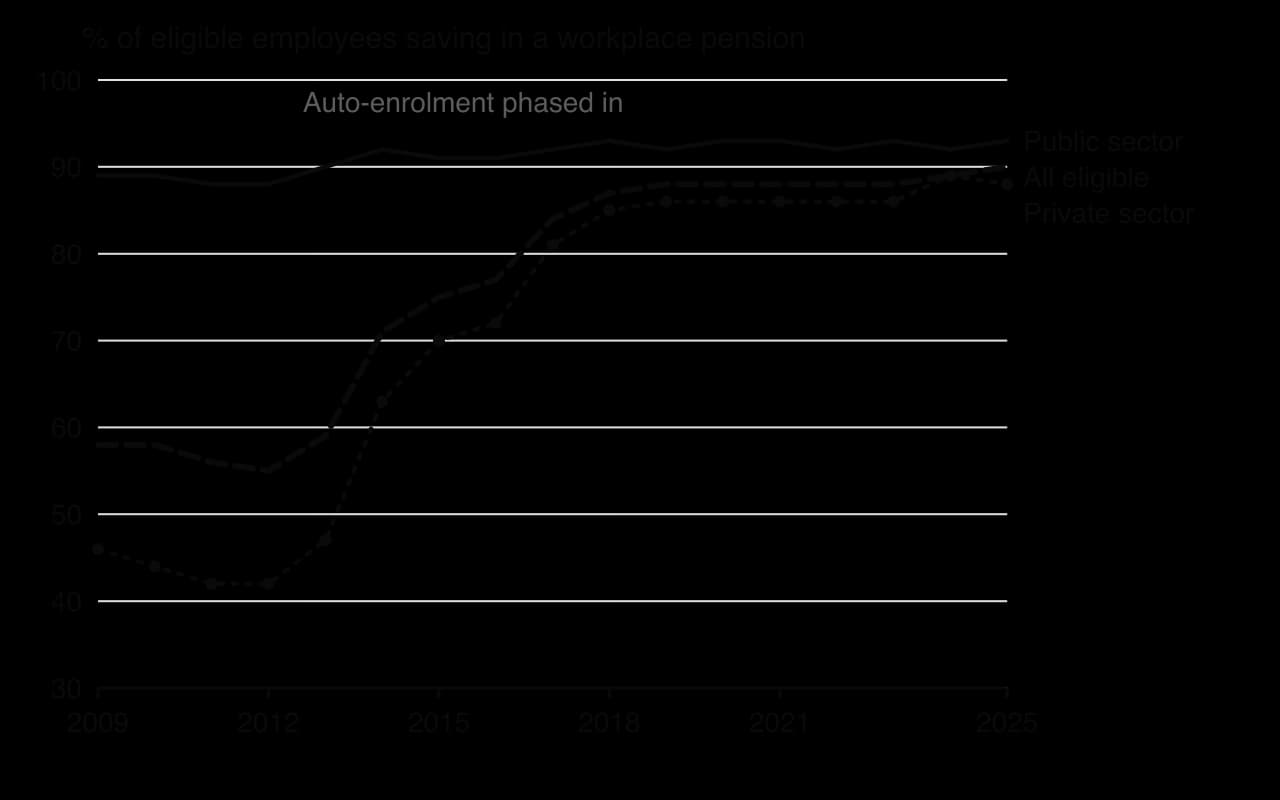
The chart shows the share of eligible employees in Great Britain saving in a workplace pension. In 2012, 55% of eligible employees were saving; by 2025 the figure was 90%, or 22.6 million people. The rise came almost entirely from the private sector, where participation more than doubled from 42% to 88%, while the public sector, where enrolment was already the norm, stayed at about 90%. Participation rose step by step as each size group of employers began enrolling its workers, and it levelled off once the roll-out was complete. Total annual saving by eligible savers reached £166.1 billion in 2025.
What the case shows
The case is strong evidence that defaults change behaviour on a national scale. Nothing about the financial case for saving changed when a worker’s employer reached its enrolment date, yet participation jumped. This is hard to reconcile with a rational, fully informed consumer, who would have joined beforehand if joining was in their interest. It supports the behavioural view that inertia, present bias and the complexity of the decision kept many people out, and that changing the default overcame all three.
Limits of the policy
Automatic enrolment raised the number of savers more than the amount each saves. A total contribution of 8% of qualifying earnings may not be enough for an adequate retirement income, and many workers stay at the minimum rate, which is itself a sign of the power of defaults. Workers earning below £10,000 a year, often part-time, and the self-employed are not covered. In 2025 only around 55% of eligible employees working for private-sector employers with fewer than five staff were saving.
There are signs that the nudge weakens when budgets are tight. The share of newly enrolled workers who actively opted out rose to around 11–12% in the year to early 2026; the Department for Work and Pensions suggested that opt-outs may have been pushed up by periods of higher living costs. A default can overcome inertia, but it cannot make saving affordable for a household that needs every pound for current spending. On balance, automatic enrolment is one of the most successful applications of nudge theory, but its success depended on combining the default with compulsory employer contributions, and it has not solved the problem of how much people save.
Sources: Department for Work and Pensions, Workplace pension participation and savings trends: 2009 to 2025 (July 2026); GOV.UK, Workplace pensions guidance (2026).
Exam practice
This HL-only content appears in HL Paper 1 and in Paper 3, never in Paper 2. Because everything in it is at the evaluation level, questions typically ask candidates to evaluate, discuss or examine: the realism of the rational consumer model, the effectiveness of nudges compared with other policies, or whether firms really aim to maximise profit. Paper 3 part (b) policy recommendations can include a nudge as the recommended policy, or as part of it.
Part (b) questions on this content ask for a balanced judgment, so the plan below gives as much space to the evaluation as to the analysis.
Paper 3-style items (HL):
Define the term default choice. [2]
Explain why a firm aiming to increase its market share may charge a lower price than a profit-maximising firm. [4]
Using the information provided and your knowledge of economics, recommend a policy to increase retirement saving among young workers in Country X. [10]
Show the answers
1. An option that applies automatically unless a person actively chooses another one (1 mark), for example being enrolled in a pension scheme unless the worker opts out (1 mark).
2. A profit-maximising firm produces where MR = MC and charges the price consumers will pay for that output. A firm aiming for market share produces more than this to win sales from rivals, and can sell the extra output only at a lower price. It accepts lower profit now in exchange for a larger share of the market, which may bring lower costs per unit and higher profit later.
3. Recommend one policy, for example automatic enrolment in a workplace pension with an opt-out and a matching employer contribution. Explain the mechanism (default choice overcoming inertia and present bias), use the data given on current saving rates, refer to the UK’s experience as evidence, and weigh the costs to employers, the risk of opt-outs among low-income workers and the alternative of a tax incentive. End with a clear recommendation.
Summary
The rational consumer choice model assumes consumer rationality, utility maximisation and perfect information; it predicts well in many markets and gives a useful benchmark.
Behavioural economics finds systematic biases (rules of thumb, anchoring, framing, availability), so departures from rationality are predictable rather than random.
Bounded rationality, bounded self-control and bounded selfishness limit the rational model, and information is usually imperfect.
Choice architecture (default, restricted and mandated choices) shapes decisions; a nudge changes it to steer choices without banning options or changing prices.
Nudges are cheap and preserve freedom, and work well against inertia and self-control problems, but their effects can be small and they do not deal with external costs.
Firms may aim for profit maximisation (MR = MC) or for CSR, market share, satisficing or growth; many alternative goals serve long-run profit.
UK pension automatic enrolment shows the power of defaults: eligible participation rose from 55% in 2012 to 90% in 2025, though contribution levels remain low.
Self-check
- To do:
I can explain the three assumptions of rational consumer choice and why economists use the model.
- To do:
I can explain rules of thumb, anchoring, framing and availability bias with real examples.
- To do:
I can explain bounded rationality, bounded self-control, bounded selfishness and imperfect information.
- To do:
I can evaluate the rational consumer model using evidence from behavioural economics.
- To do:
I can explain default, restricted and mandated choices, and what makes a policy a nudge.
- To do:
I can evaluate nudges against other policies, using a real example such as automatic pension enrolment.
- To do:
I can explain profit maximisation and the alternative objectives of CSR, market share, satisficing and growth.
- To do:
I can evaluate whether firms really aim to maximise profit.