D4.1 Natural selection questions for IB Biology
48 questions on Natural selection, written by Augment in the style of IB exam papers. Six of them are below in full, to answer on paper.
- IB Biology
- Part of D Continuity and change
- SL and HL
Questions by paper and level
SL and HL questions are for students at either level. HL only questions cover what only HL students study.
| Paper | SL and HL | HL only | All |
|---|---|---|---|
| Paper 1A | 11 | 9 | 20 |
| Paper 1B | 3 | 4 | 7 |
| Paper 2 | 14 | 7 | 21 |
| Every paper | 28 | 20 | 48 |
Counted on
Questions to try
Written by Augment in the style of IB exams, not past papers. Answer them on paper, then check each one against its markscheme with a free account.
Darwin's theory of evolution by natural selection replaced Lamarckism as the accepted explanation of how species change. Why is this described as a paradigm shift?
Researchers investigated how quickly influenza A virus evolves resistance to oseltamivir, an antiviral drug that blocks the viral enzyme neuraminidase. The virus was grown in cultured mammalian cells and transferred to fresh cells every two days (one passage). In three lines, oseltamivir was added and its concentration was doubled at each passage. Three control lines were passaged in the same way without the drug.
After every second passage, the researchers measured the IC50 of virus from each line: the concentration of oseltamivir needed to reduce virus replication by 50 %. The graph shows the mean IC50 (log scale); error bars show ± one standard deviation.
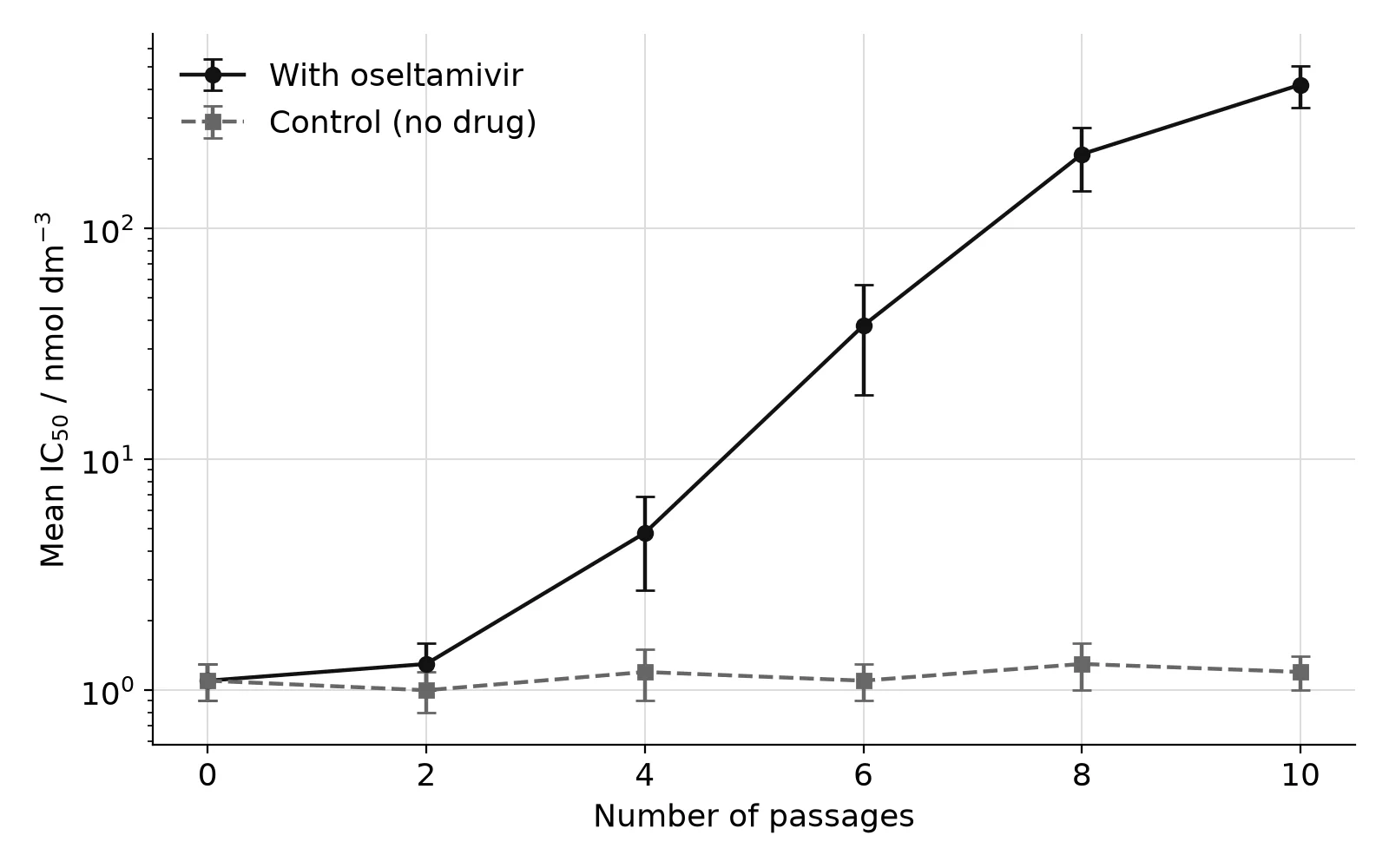
At passage 10, the neuraminidase gene of virus from every drug-treated line had the same single base substitution, which changes one amino acid. This substitution was not found in the control lines.
- (a)
In the drug-treated lines, the mean IC50 was 1.1 nmol dm-3 at passage 0 and 420 nmol dm-3 at passage 10. Calculate how many times greater the mean IC50 was at passage 10 than at passage 0.
1 mark
- (b)
Describe the changes in IC50 of the drug-treated lines over the ten passages.
2 marks
- (c)
State the purpose of the control lines.
1 mark
- (d)
Explain how resistance to oseltamivir evolved in the drug-treated lines.
3 marks
- (e)
Suggest reasons why resistance evolved within only a few passages.
2 marks
- (f)
Suggest one limitation of using these results to predict resistance in people treated with oseltamivir.
1 mark
Organisms are adapted to the ecological niches that they occupy.
- (a)
Explain how natural selection could lead to adaptations in prey species that help them to resist predation.
7 marks
- (b)
Outline the differences between obligate anaerobes, facultative anaerobes and obligate aerobes, with reference to cell respiration.
4 marks
- (c)
Outline photosynthesis as a mode of nutrition, including the groups of organisms that use it.
4 marks
Which statements about the sources of variation in a sexually reproducing population are correct?
I. Mutation is the original source of new alleles.
II. Crossing over and random orientation of bivalents in meiosis produce new combinations of alleles.
III. Fertilization creates new alleles by combining genetic material from two parents.
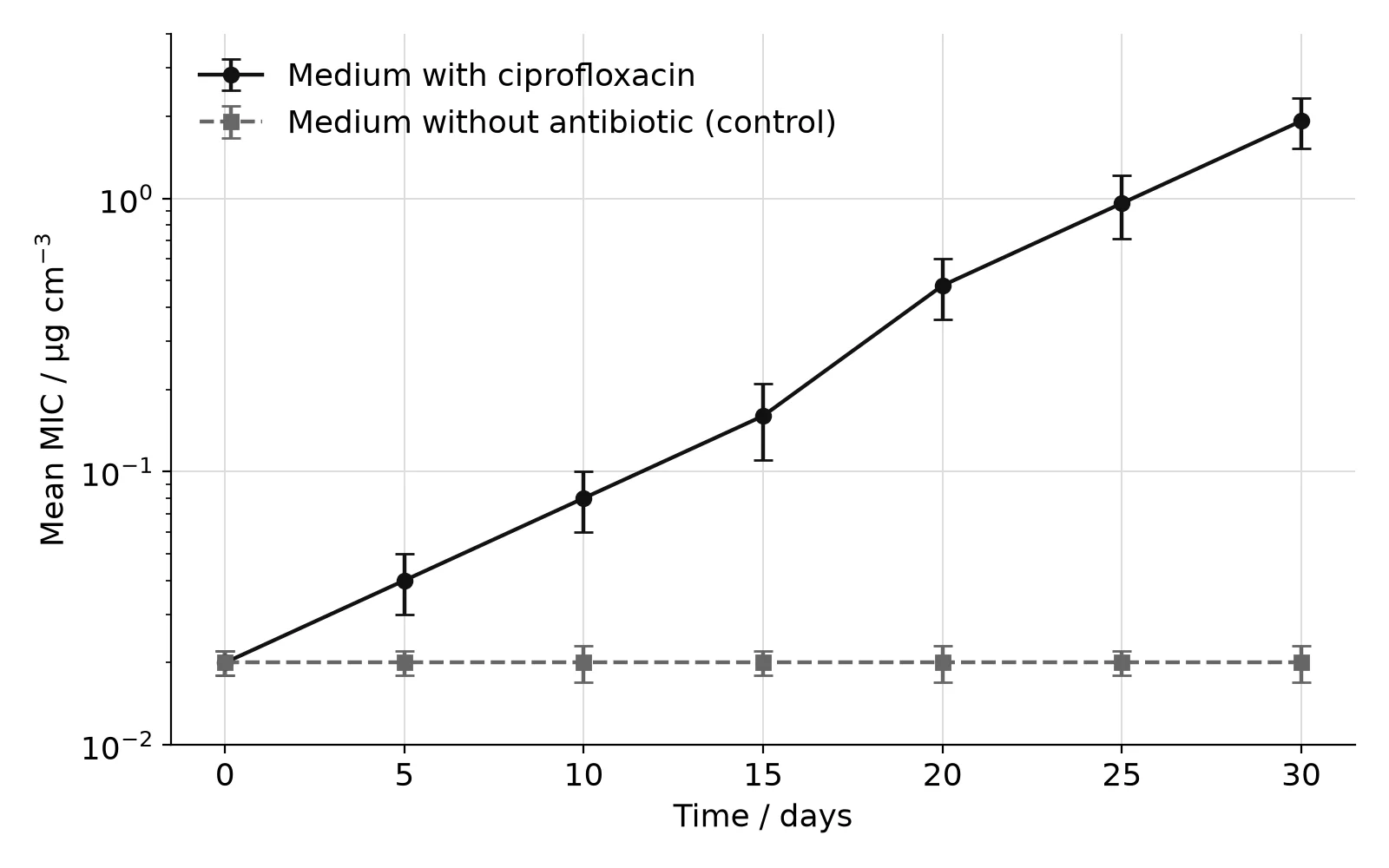
Researchers investigated the evolution of antibiotic resistance in the bacterium Escherichia coli. Four populations were grown in a liquid medium containing a low concentration of the antibiotic ciprofloxacin. Every day, a sample of each population was transferred to fresh medium, and the concentration of ciprofloxacin was doubled whenever the bacteria grew well. Four control populations were transferred in the same way in medium without the antibiotic. Every 5 days the minimum inhibitory concentration (MIC), the lowest concentration of ciprofloxacin that prevents visible growth, was measured for each population. The graph shows the mean MIC; error bars show ±1 standard deviation. Note that the vertical axis uses a logarithmic scale.
- (a)
Calculate how many times greater the mean MIC was on day 30 than on day 0 for the populations grown with ciprofloxacin.
1 mark
- (b)
Outline the purpose of the control populations.
1 mark
- (c)
Explain the change in MIC in the populations grown with ciprofloxacin.
3 marks
- (d)
Suggest why four populations were used for each treatment.
1 mark
- (e)
The populations from day 30 also had a higher MIC for two other antibiotics. Using these results, discuss why antibiotics should be used carefully in medicine.
2 marks
Variation is the raw material on which evolution acts.
- (a)
Describe how meiosis generates genetic variation.
4 marks
- (b)
Outline how the selective breeding of crop plants provides evidence for evolution.
4 marks
- (c)
Explain how natural selection can lead to evolutionary change in a population.
7 marks
Practice all 48 in Augment
Free with an account. Every question has its markscheme, and Augment keeps the ones you got wrong so you can come back to them.
More questions in Continuity and change
- D1.1DNA replication
- D1.2Protein synthesis
- D1.3Mutations and gene editing
- D2.1Cell and nuclear division
- D2.2Gene expressionHL only
- D2.3Water potential
- D3.1Reproduction
- D3.2Inheritance
- D3.3Homeostasis
- D4.1Natural selectionThis page
- D4.2Stability and change
- D4.3Climate change
Check your answers in Augment
A free account opens all 48 questions on Natural selection with their markschemes, and keeps a record of what you have marked.