D1.2 Protein synthesis questions for IB Biology
47 questions on Protein synthesis, written by Augment in the style of IB exam papers. Six of them are below in full, to answer on paper.
- IB Biology
- Part of D Continuity and change
- SL and HL
Questions by paper and level
SL and HL questions are for students at either level. HL only questions cover what only HL students study.
| Paper | SL and HL | HL only | All |
|---|---|---|---|
| Paper 1A | 12 | 9 | 21 |
| Paper 1B | 3 | 2 | 5 |
| Paper 2 | 10 | 11 | 21 |
| Every paper | 25 | 22 | 47 |
Counted on
Questions to try
Written by Augment in the style of IB exams, not past papers. Answer them on paper, then check each one against its markscheme with a free account.
Viruses use the same genetic code as cellular organisms. Why is this not strong evidence that all viruses share a single common ancestor?
Actinomycin D is a drug that binds to DNA and prevents RNA polymerase from moving along it. Cultured mouse (Mus musculus) cells were supplied with radioactive uridine, which cells use to make RNA, and a radioactive form of the amino acid leucine. At time 0, actinomycin D was added to some cultures; other cultures were left untreated. Every hour, the rates of incorporation of the radioactive labels into RNA and into protein were measured in three treated cultures and expressed as a percentage of the rates in untreated cultures.
Time after adding actinomycin D / h | Rate of RNA synthesis / % of untreated | Mean rate of protein synthesis / % of untreated | Standard deviation of protein synthesis / % |
|---|---|---|---|
0 | 100 | 100 | 4 |
1 | 6 | 96 | 5 |
2 | 4 | 85 | 6 |
3 | 4 | 68 | 5 |
4 | 3 | 52 | 6 |
5 | 3 | 40 | 4 |
6 | 3 | 31 | 4 |
- (a)
Identify the control in this investigation.
1 mark
- (b)
Calculate the percentage decrease in the mean rate of protein synthesis between 1 hour and 5 hours.
1 mark
- (c)
Compare and contrast the effects of actinomycin D on the rates of RNA synthesis and protein synthesis.
2 marks
- (d)
Explain why protein synthesis continued for several hours after RNA synthesis had almost stopped.
3 marks
- (e)
Suggest why radioactive uridine rather than radioactive thymidine was used to measure the rate of RNA synthesis.
1 mark
Nucleic acids store genetic information and allow it to be copied and expressed.
- (a)
Draw a labelled diagram of a section of a DNA molecule consisting of two nucleotides on each strand.
4 marks
- (b)
Explain how the base sequence of a gene is used to produce a polypeptide.
7 marks
- (c)
Outline the roles of helicase and DNA polymerase in DNA replication.
4 marks
What is a role of RNA polymerase in transcription?
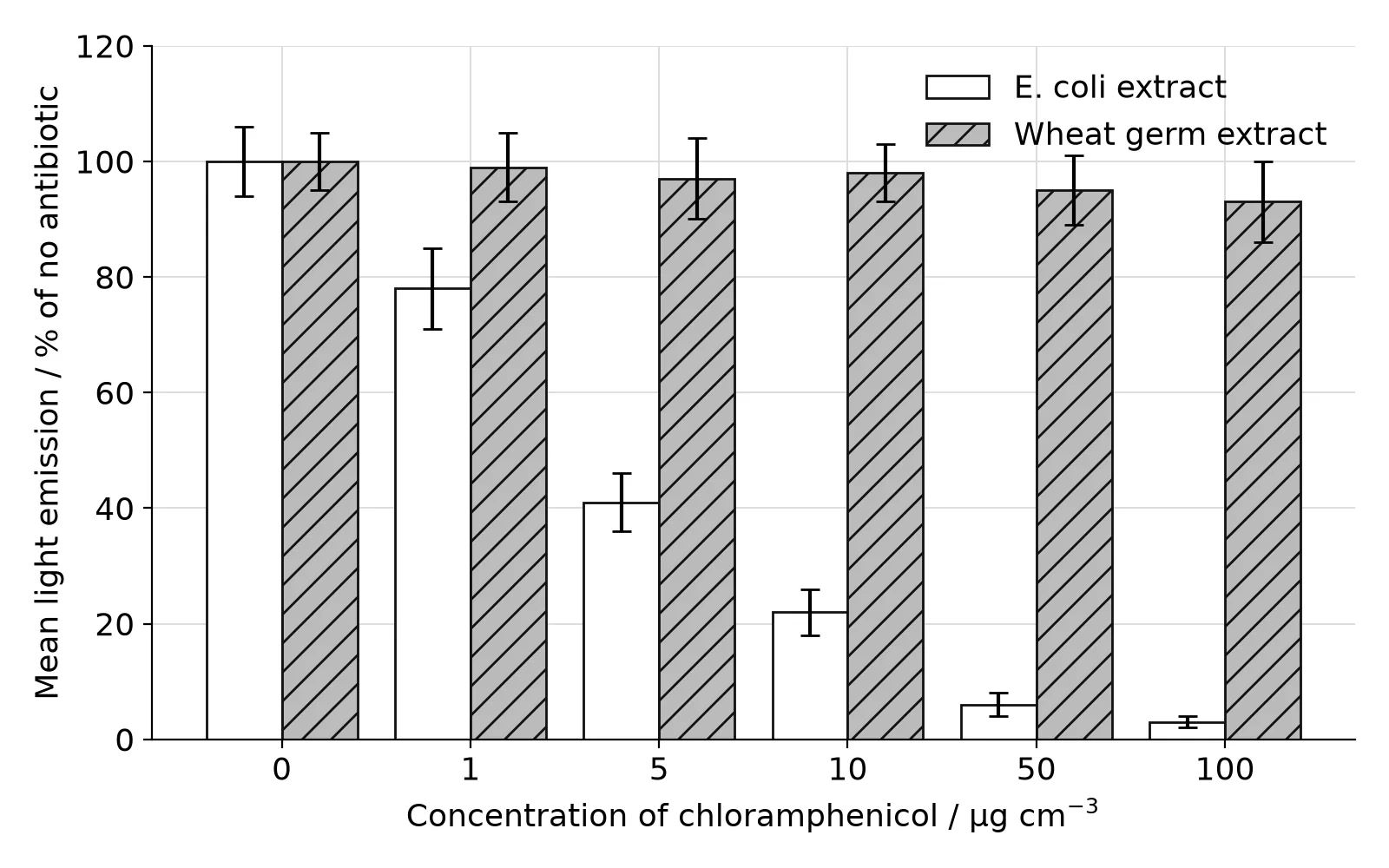
Cell-free extracts containing ribosomes, tRNAs, enzymes and amino acids were prepared from the bacterium Escherichia coli and from wheat (Triticum aestivum) germ. The same mRNA, coding for the firefly enzyme luciferase, was added to each extract together with one of six concentrations of the antibiotic chloramphenicol. After 30 minutes at 30 °C, the substrate of luciferase was added and the light emitted was measured as an indicator of the quantity of luciferase made. Four replicates were set up for each treatment. The graph shows the mean light emission as a percentage of that with no antibiotic; error bars show ± one standard deviation.
- (a)
State the dependent variable in this investigation.
1 mark
- (b)
Suggest why the same mRNA was added to both extracts.
1 mark
- (c)
Describe the effect of chloramphenicol on translation in the two extracts.
2 marks
- (d)
Using the error bars, discuss whether chloramphenicol at 100 μg cm-3 affects translation in the wheat germ extract.
2 marks
- (e)
Chloramphenicol binds to the large subunit of bacterial ribosomes and prevents peptide bonds from forming. Explain why this stops the synthesis of luciferase.
2 marks
- (f)
Suggest why both bacterial and plant ribosomes can produce luciferase from a firefly mRNA.
1 mark
Proteins must be delivered to the correct place inside or outside a cell.
- (a)
Outline how vesicles are formed and used to move materials into and out of cells.
4 marks
- (b)
Describe how insulin and glucagon regulate the concentration of glucose in the blood.
4 marks
- (c)
Explain how a protein hormone such as insulin is synthesized, processed and secreted by a cell.
7 marks
Practice all 47 in Augment
Free with an account. Every question has its markscheme, and Augment keeps the ones you got wrong so you can come back to them.
More questions in Continuity and change
- D1.1DNA replication
- D1.2Protein synthesisThis page
- D1.3Mutations and gene editing
- D2.1Cell and nuclear division
- D2.2Gene expressionHL only
- D2.3Water potential
- D3.1Reproduction
- D3.2Inheritance
- D3.3Homeostasis
- D4.1Natural selection
- D4.2Stability and change
- D4.3Climate change
Check your answers in Augment
A free account opens all 47 questions on Protein synthesis with their markschemes, and keeps a record of what you have marked.