D3.1 Reproduction questions for IB Biology
39 questions on Reproduction, written by Augment in the style of IB exam papers. Six of them are below in full, to answer on paper.
- IB Biology
- Part of D Continuity and change
- SL and HL
Questions by paper and level
SL and HL questions are for students at either level. HL only questions cover what only HL students study.
| Paper | SL and HL | HL only | All |
|---|---|---|---|
| Paper 1A | 12 | 8 | 20 |
| Paper 1B | 3 | 2 | 5 |
| Paper 2 | 7 | 7 | 14 |
| Every paper | 22 | 17 | 39 |
Counted on
Questions to try
Written by Augment in the style of IB exams, not past papers. Answer them on paper, then check each one against its markscheme with a free account.
What is an advantage of asexual reproduction for an organism that is well adapted to a stable environment?
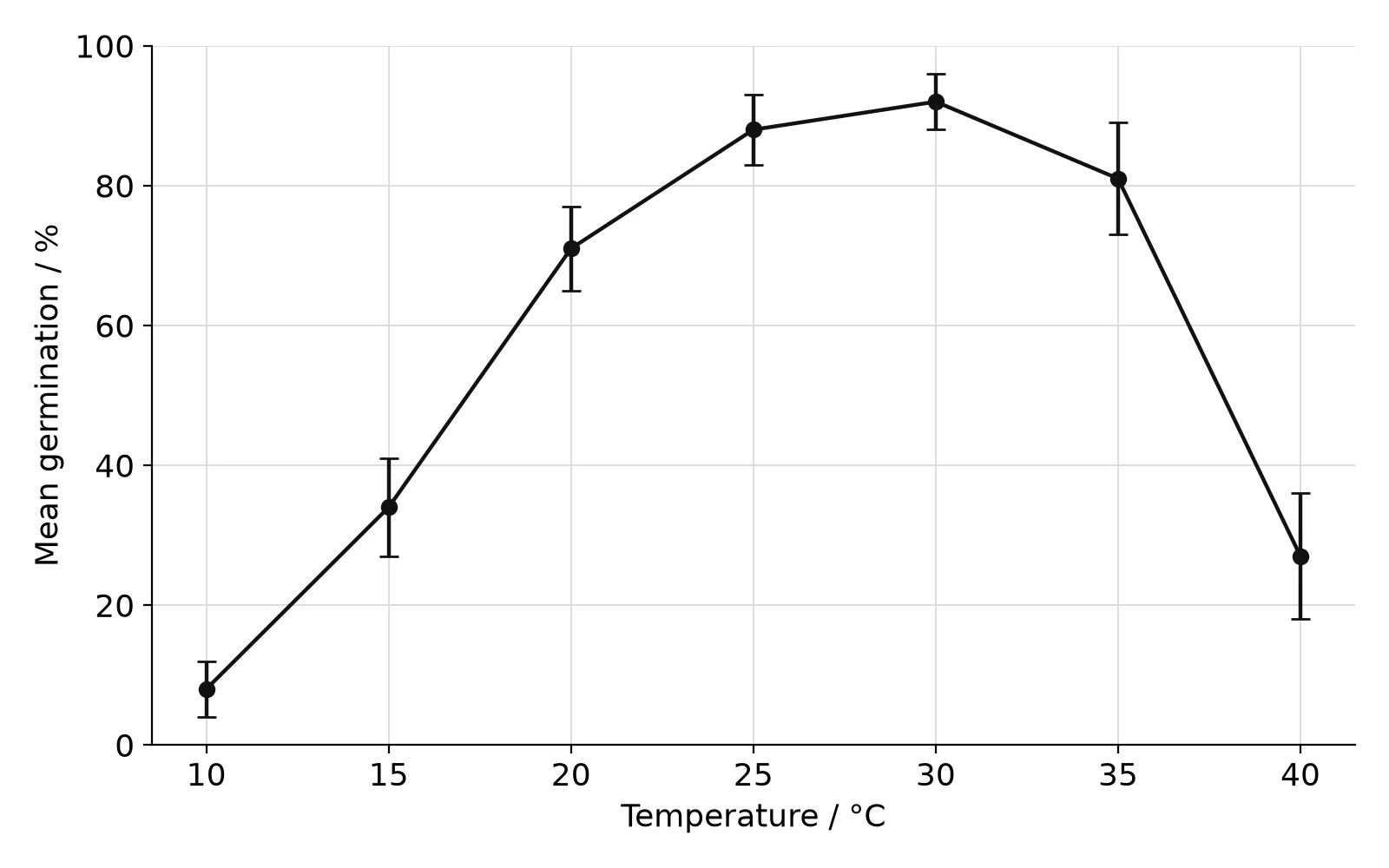
Students investigated the effect of temperature on the germination of mung bean (Vigna radiata) seeds. Seeds were soaked in water for 2 hours, then placed on moist filter paper in Petri dishes, 20 seeds per dish. Five dishes were placed in an incubator at each of seven temperatures. After 4 days, a seed was counted as germinated if its radicle (embryonic root) had emerged. The graph shows the mean percentage germination at each temperature; error bars show ± one standard deviation.
- (a)
State two variables, other than the number of seeds, that should have been kept constant in this investigation.
2 marks
- (b)
Calculate the percentage increase in mean germination between 15 °C and 25 °C.
1 mark
- (c)
A student concluded that 30 °C is the optimum temperature for germination of mung bean seeds. Evaluate this conclusion using the data.
2 marks
- (d)
Suggest why five dishes, each with 20 seeds, were used at each temperature.
1 mark
- (e)
Suggest a reason for the low germination at 40 °C.
1 mark
- (f)
Explain how food reserves in the seed allow the embryo to grow during germination.
3 marks
The concentrations of four hormones were measured in blood samples taken from a woman during one menstrual cycle. Day 1 is the first day of menstruation. The graph shows the concentrations of luteinizing hormone (LH) and follicle-stimulating hormone (FSH).
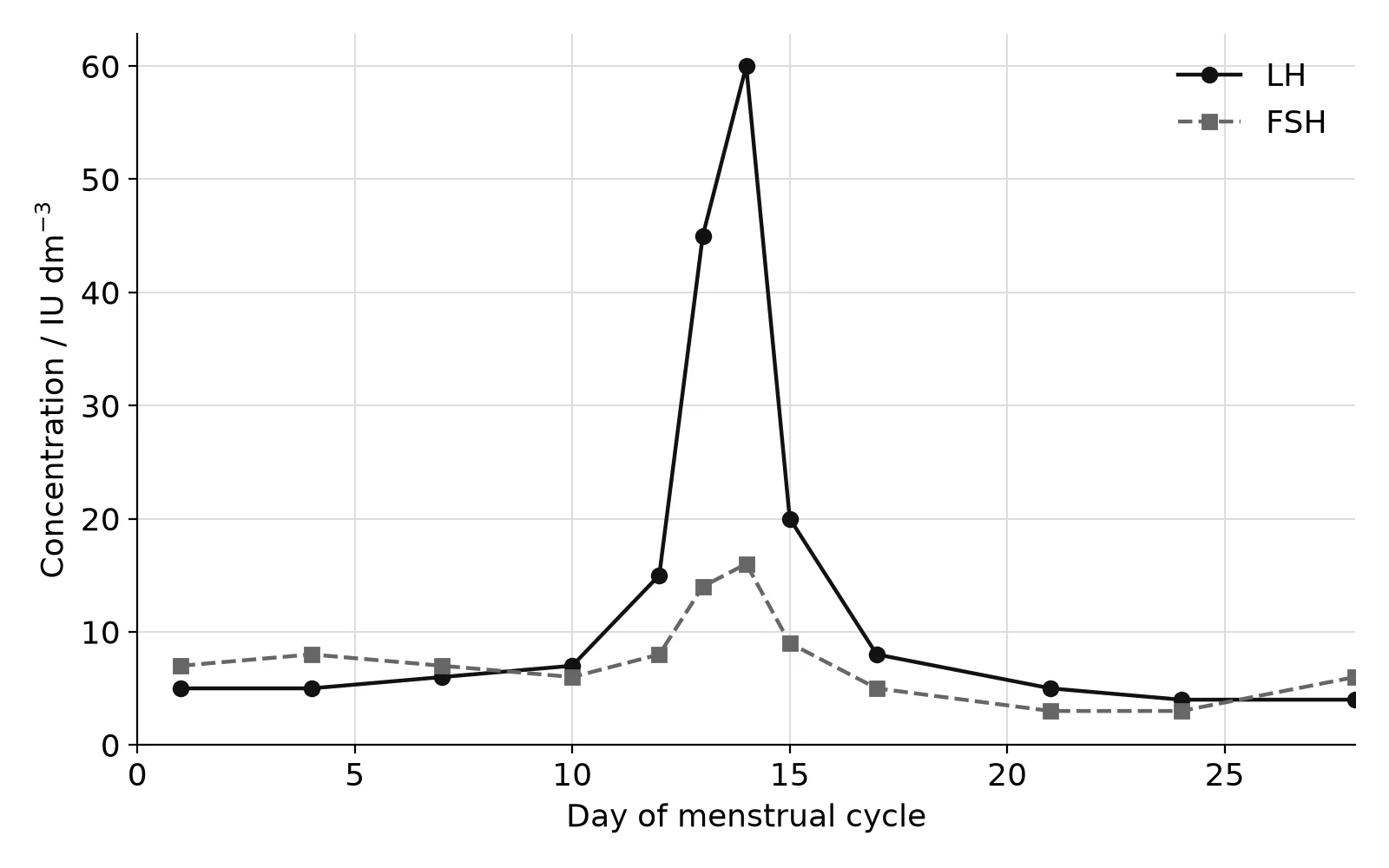
The table shows the concentrations of oestradiol and progesterone on six days of the same cycle.
Day | 2 | 7 | 12 | 14 | 21 | 27 |
|---|---|---|---|---|---|---|
Oestradiol / pg cm-3 | 40 | 70 | 280 | 180 | 160 | 60 |
Progesterone / ng cm-3 | 0.5 | 0.5 | 0.8 | 1.5 | 14.0 | 1.5 |
- (a)
Identify the day on which ovulation most probably occurred.
1 mark
- (b)
Explain the change in oestradiol concentration between day 2 and day 12 and its effect on LH secretion.
2 marks
- (c)
Explain why the progesterone concentration is highest on day 21.
2 marks
- (d)
Outline the roles of progesterone during the second half of the cycle.
2 marks
- (e)
Explain the consequences of the fall in progesterone concentration between day 21 and day 27.
2 marks
Which row describes the roles of meiosis and of fusion of gametes in a sexual life cycle?
Row | Meiosis | Fusion of gametes |
|---|---|---|
A | Halves the chromosome number; breaks up parental combinations of alleles | Restores the diploid number; produces new combinations of alleles |
B | Halves the chromosome number; keeps parental combinations of alleles | Restores the diploid number; produces new combinations of alleles |
C | Keeps the diploid number; breaks up parental combinations of alleles | Halves the chromosome number; produces new combinations of alleles |
D | Halves the chromosome number; breaks up parental combinations of alleles | Restores the diploid number; keeps parental combinations of alleles |
Researchers investigated pollination in a species of flowering plant. On each of 10 plants, three flowers were given each of four treatments, so each treatment was applied to 30 flowers. Flowers in treatments 1–3 were enclosed in fine mesh bags before they opened. Pollen used in treatment 3 came from plants at least 50 m away. After six weeks, the number of flowers that had developed into fruits was counted and the seeds in each fruit were counted.
Treatment | Flowers that set fruit (out of 30) | Mean number of seeds per fruit | Standard deviation |
|---|---|---|---|
1. Bagged, not pollinated | 0 | — | — |
2. Bagged, hand-pollinated with pollen from the same plant | 2 | 3.5 | — |
3. Bagged, hand-pollinated with pollen from a different plant | 23 | 24.1 | 5.2 |
4. Not bagged, natural pollination | 16 | 18.6 | 6.3 |
- (a)
Calculate the percentage of flowers that set fruit in treatment 3.
1 mark
- (b)
Explain the purpose of treatment 1.
2 marks
- (c)
Deduce, with a reason from the data, whether this plant species is self-incompatible.
2 marks
- (d)
Suggest two reasons why fewer flowers set fruit with natural pollination than with hand cross-pollination.
2 marks
- (e)
State one reason why the treatments were applied to flowers on the same 10 plants rather than each treatment to a different set of plants.
1 mark
- (f)
Explain how self-incompatibility benefits a plant species.
2 marks
The human female and male reproductive systems produce gametes and allow fertilization and development of the embryo.
- (a)
Draw a labelled diagram of the female reproductive system, as seen from the front.
4 marks
- (b)
State the function of: (i) the testis; (ii) the epididymis.
2 marks
- (c)
Outline the role of the oviduct in reproduction.
2 marks
Practice all 39 in Augment
Free with an account. Every question has its markscheme, and Augment keeps the ones you got wrong so you can come back to them.
More questions in Continuity and change
- D1.1DNA replication
- D1.2Protein synthesis
- D1.3Mutations and gene editing
- D2.1Cell and nuclear division
- D2.2Gene expressionHL only
- D2.3Water potential
- D3.1ReproductionThis page
- D3.2Inheritance
- D3.3Homeostasis
- D4.1Natural selection
- D4.2Stability and change
- D4.3Climate change
Check your answers in Augment
A free account opens all 39 questions on Reproduction with their markschemes, and keeps a record of what you have marked.