D2.2 Gene expression questions for IB Biology
37 questions on Gene expression, written by Augment in the style of IB exam papers. Six of them are below in full, to answer on paper.
- IB Biology
- Part of D Continuity and change
- HL only
Questions by paper and level
| Paper | Questions |
|---|---|
| Paper 1A | 20 |
| Paper 1B | 5 |
| Paper 2 | 12 |
| Every paper | 37 |
Counted on
Questions to try
Written by Augment in the style of IB exams, not past papers. Answer them on paper, then check each one against its markscheme with a free account.
In human skin cells, a gene codes for tyrosinase, an enzyme needed to make the pigment melanin. The events below occur as this gene affects skin colour.
I. The polypeptide folds to form the enzyme
II. RNA polymerase produces mRNA from the gene
III. The enzyme catalyses a step in the synthesis of melanin
IV. Ribosomes link amino acids in the order set by the codons
What is the correct sequence of these events?
Students investigated the effect of lactose on the production of β-galactosidase, the enzyme that breaks down lactose, in the bacterium Escherichia coli. Six cultures were grown at 37 °C in a medium containing glycerol as the only source of energy. At time 0, lactose was added to three cultures; the other three cultures received an equal volume of water. Samples were removed every 10 minutes and the activity of β-galactosidase was measured.
Time after addition / min | Mean β-galactosidase activity with lactose / arbitrary units | Standard deviation | Mean β-galactosidase activity without lactose / arbitrary units | Standard deviation |
|---|---|---|---|---|
0 | 2 | 0.5 | 2 | 0.4 |
10 | 15 | 2.1 | 2 | 0.6 |
20 | 58 | 5.4 | 3 | 0.5 |
30 | 112 | 8.0 | 2 | 0.7 |
40 | 168 | 9.6 | 3 | 0.6 |
50 | 221 | 12.3 | 2 | 0.5 |
60 | 270 | 14.1 | 3 | 0.8 |
- (a)
State the independent variable in this investigation.
1 mark
- (b)
Outline the purpose of the cultures to which water was added.
1 mark
- (c)
Calculate the mean rate of increase in β-galactosidase activity in the cultures with lactose between 20 minutes and 60 minutes. Show your working.
2 marks
- (d)
Compare the results for the cultures with and without lactose.
2 marks
- (e)
Explain how the presence of lactose leads to the increase in β-galactosidase activity.
3 marks
The response of a cell to a signal depends on the type of receptor that detects it.
- (a)
Compare and contrast transmembrane receptors and intracellular receptors.
7 marks
- (b)
Outline how transcription is regulated by proteins that bind to specific base sequences in DNA.
4 marks
- (c)
Describe the roles of oestradiol and progesterone in the menstrual cycle.
4 marks
What is the role of a transcription factor in a eukaryotic cell?
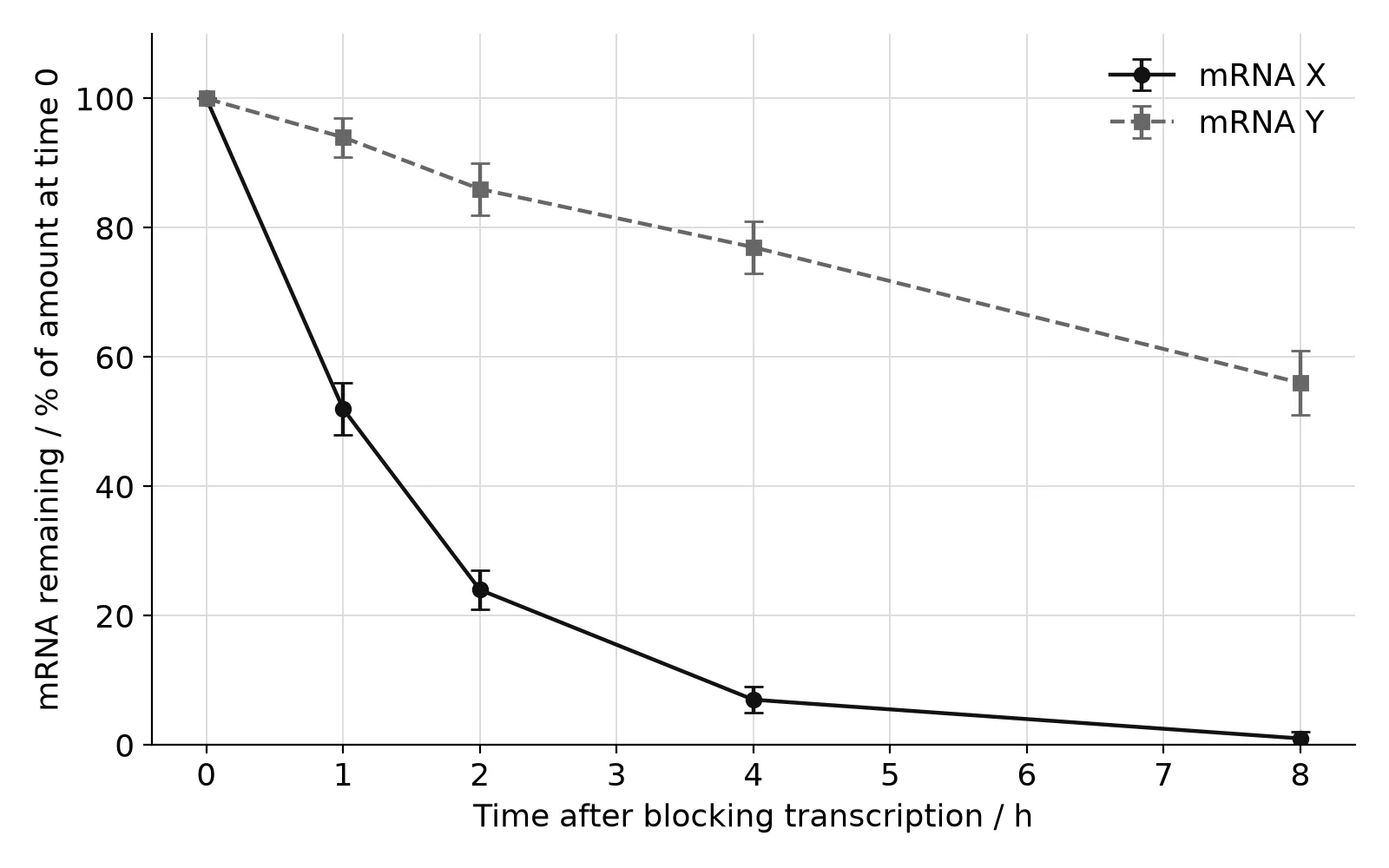
Researchers investigated how long two mRNAs persist in cultured human cells. At time 0, a drug that blocks transcription was added to the cells. At intervals, the amount of each mRNA was measured and expressed as a percentage of the amount at time 0. mRNA X codes for a signalling protein made in response to infection; mRNA Y codes for a structural protein of the cytoskeleton. Each point is the mean of four cultures; error bars show the standard error of the mean.
- (a)
Suggest why transcription was blocked at the start of the investigation.
1 mark
- (b)(i)
Estimate, from the graph, the half-life of mRNA X.
1 mark
- (b)(ii)
Calculate the percentage decrease in mRNA Y over the 8 hours.
1 mark
- (c)
Discuss whether the difference between the two mRNAs at 1 hour is likely to be significant.
2 marks
- (d)
Suggest an advantage to the cell of mRNA X being broken down more rapidly than mRNA Y.
2 marks
- (e)
Explain how the rate of breakdown of an mRNA regulates the expression of its gene.
2 marks
Lactase is an enzyme secreted in the small intestine. It is coded for by a single gene.
- (a)
State the two main stages of gene expression that produce a polypeptide from the information in a gene.
1 mark
- (b)
Outline how expression of the lactase gene affects the phenotype of a person.
3 marks
- (c)
In many adults, the lactase gene has a normal base sequence but is transcribed much less than in childhood. Suggest how transcription of the gene could be reduced.
2 marks
Practice all 37 in Augment
Free with an account. Every question has its markscheme, and Augment keeps the ones you got wrong so you can come back to them.
More questions in Continuity and change
- D1.1DNA replication
- D1.2Protein synthesis
- D1.3Mutations and gene editing
- D2.1Cell and nuclear division
- D2.2Gene expressionThis page
- D2.3Water potential
- D3.1Reproduction
- D3.2Inheritance
- D3.3Homeostasis
- D4.1Natural selection
- D4.2Stability and change
- D4.3Climate change
Check your answers in Augment
A free account opens all 37 questions on Gene expression with their markschemes, and keeps a record of what you have marked.