B4.2 Ecological niches questions for IB Biology
38 questions on Ecological niches, written by Augment in the style of IB exam papers. Six of them are below in full, to answer on paper.
- IB Biology
- Part of B Form and function
- SL and HL
Questions by paper and level
SL and HL questions are for students at either level. HL only questions cover what only HL students study.
| Paper | SL and HL | HL only | All |
|---|---|---|---|
| Paper 1A | 20 | 0 | 20 |
| Paper 1B | 5 | 0 | 5 |
| Paper 2 | 13 | 0 | 13 |
| Every paper | 38 | 0 | 38 |
Counted on
Questions to try
Written by Augment in the style of IB exams, not past papers. Answer them on paper, then check each one against its markscheme with a free account.
What is meant by the ecological niche of a species?
Students investigated the nutrition of the freshwater protist Euglena gracilis. Flasks of a mineral nutrient medium, either with or without sodium acetate (an organic carbon source), were inoculated with 1.0 × 10⁴ cells cm-3. Flasks were kept at 22 °C either in continuous light or in continuous darkness. There were three flasks for each treatment. Cell density was measured after 7 days.
Treatment | Mean cell density after 7 days / × 104 cells cm-3 | Standard deviation / × 104 cells cm-3 |
|---|---|---|
Light, no acetate | 18.4 | 1.6 |
Light, with acetate | 32.6 | 2.4 |
Dark, no acetate | 0.9 | 0.2 |
Dark, with acetate | 14.2 | 1.9 |
- (a)
Identify the two independent variables in this investigation.
2 marks
- (b)
Calculate the percentage increase in mean cell density caused by adding acetate to flasks kept in the light.
1 mark
- (c)
Suggest why the treatment kept in the dark with no acetate was included.
1 mark
- (d)
Using the standard deviations, discuss whether the difference between the treatments "light, no acetate" and "dark, with acetate" is likely to be significant.
2 marks
- (e)
Explain what the results show about the mode of nutrition of Euglena gracilis.
3 marks
Heath bedstraw (Galium saxatile) grows naturally on acid soils, and limestone bedstraw (Galium sylvestre) grows on calcareous (lime-rich) soils. In an experiment, seedlings of each species were grown in pots of acid soil or calcareous soil, either alone or as a mixture of both species. The table shows the mean dry mass of each species after six months.
Soil | G. saxatile alone / g | G. sylvestre alone / g | G. saxatile in mixture / g | G. sylvestre in mixture / g |
|---|---|---|---|---|
Acid | 4.2 | 2.6 | 3.9 | 0.3 |
Calcareous | 2.8 | 4.6 | 0.4 | 4.3 |
- (a)
Outline what is meant by the ecological niche of a species.
2 marks
- (b)
Calculate the percentage decrease in the mean dry mass of G. sylvestre on acid soil when it was grown in a mixture with G. saxatile.
1 mark
- (c)
Using the data, distinguish between the fundamental niche and the realized niche of G. saxatile.
2 marks
- (d)
Explain how these results illustrate the principle of competitive exclusion.
3 marks
Three species of bacteria, X, Y and Z, were each grown in a tube of nutrient broth. Oxygen diffuses into the broth from the surface only, so oxygen concentration is highest at the top and zero near the bottom. After 48 hours the growth was as follows.
X: growth only near the bottom of the tube
Y: growth throughout the tube, densest near the top
Z: growth only near the top of the tube
Which row identifies the three species?
Row | X | Y | Z |
|---|---|---|---|
A | obligate anaerobe | facultative anaerobe | obligate aerobe |
B | obligate aerobe | facultative anaerobe | obligate anaerobe |
C | facultative anaerobe | obligate anaerobe | obligate aerobe |
D | obligate anaerobe | obligate aerobe | facultative anaerobe |
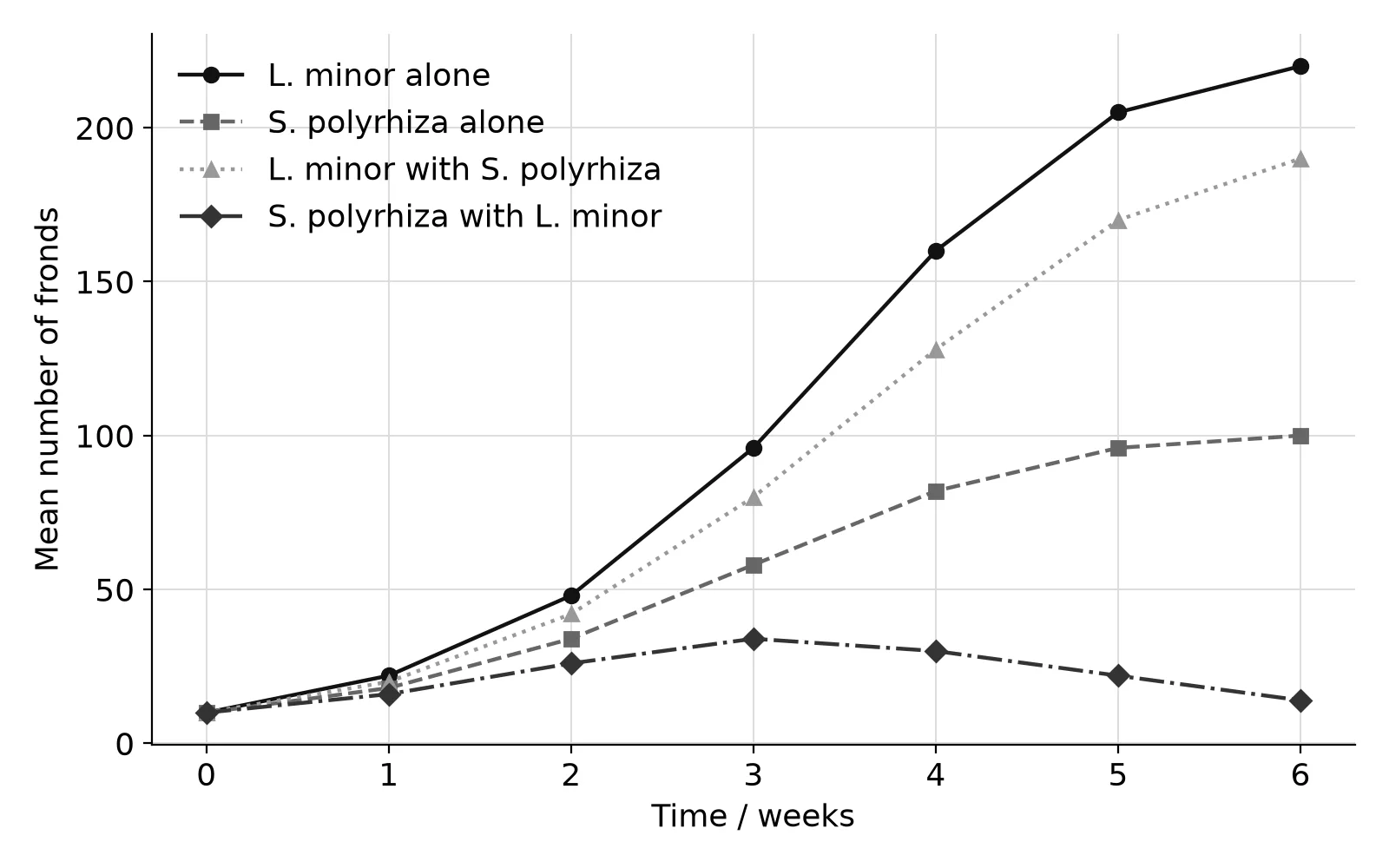
Two species of duckweed, Lemna minor and Spirodela polyrhiza, are small floating plants that reproduce by producing new fronds. Students set up containers of pond water with nutrients, each with 10 fronds of one species alone, or 10 fronds of each species together. The containers were kept in the same greenhouse and the number of fronds of each species was counted every week. The graph shows the mean of five containers for each treatment.
- (a)
State the dependent variable in this investigation.
1 mark
- (b)
Calculate the percentage decrease in the mean number of fronds of S. polyrhiza grown with L. minor between week 3 and week 6.
1 mark
- (c)
Outline two variables, other than those in the stem, that should have been kept the same in all containers.
2 marks
- (d)
Compare and contrast the growth of S. polyrhiza alone and in the presence of L. minor.
2 marks
- (e)
Explain the results with reference to competition and ecological niches.
3 marks
- (f)
Suggest one reason why these results may not show what happens to the two species in a natural pond.
1 mark
The table shows features of the skulls and teeth of three species in the family Hominidae. Values are approximate means estimated from fossils and living populations.
Feature | Homo sapiens | Homo floresiensis | Paranthropus robustus |
|---|---|---|---|
First molar crown area / mm2 | 115 | 105 | 205 |
Body mass / kg | 60 | 30 | 40 |
Canine teeth | small | small | small |
Lower jaw | slender | moderately robust | very robust |
Sagittal crest (bony ridge on top of skull) | absent | absent | present |
- (a)
Calculate the first molar crown area per kg of body mass for Paranthropus robustus.
1 mark
- (b)
Using the data, deduce which species was most adapted to a diet of tough or hard plant material.
3 marks
- (c)
Homo sapiens is omnivorous. Outline how its dentition is suited to an omnivorous diet.
2 marks
- (d)
Explain how scientists can deduce the diet of an extinct hominid from its teeth and skull, and suggest one limitation of this approach.
3 marks
Practice all 38 in Augment
Free with an account. Every question has its markscheme, and Augment keeps the ones you got wrong so you can come back to them.
More questions in Form and function
- B1.1Carbohydrates and lipids
- B1.2Proteins
- B2.1Membranes and membrane transport
- B2.2Organelles and compartmentalisation
- B2.3Cell specialisation
- B3.1Gas exchange
- B3.2Transport
- B3.3Muscle and motilityHL only
- B4.1Adaptation to environment
- B4.2Ecological nichesThis page
Check your answers in Augment
A free account opens all 38 questions on Ecological niches with their markschemes, and keeps a record of what you have marked.