B2.1 Membranes and membrane transport questions for IB Biology
52 questions on Membranes and membrane transport, written by Augment in the style of IB exam papers. Six of them are below in full, to answer on paper.
- IB Biology
- Part of B Form and function
- SL and HL
Questions by paper and level
SL and HL questions are for students at either level. HL only questions cover what only HL students study.
| Paper | SL and HL | HL only | All |
|---|---|---|---|
| Paper 1A | 12 | 9 | 21 |
| Paper 1B | 5 | 2 | 7 |
| Paper 2 | 11 | 13 | 24 |
| Every paper | 28 | 24 | 52 |
Counted on
Questions to try
Written by Augment in the style of IB exams, not past papers. Answer them on paper, then check each one against its markscheme with a free account.
Cultured human cells were treated with a drug that prevents clathrin from binding to membranes. The rate of uptake of three substances was then measured and expressed as a percentage of the rate in untreated cells.
Substance taken up | Uptake rate / % of untreated cells |
|---|---|
Transferrin (an iron-carrying protein) | 9 |
Oxygen | 101 |
Glucose | 97 |
Which conclusion is best supported by these results?
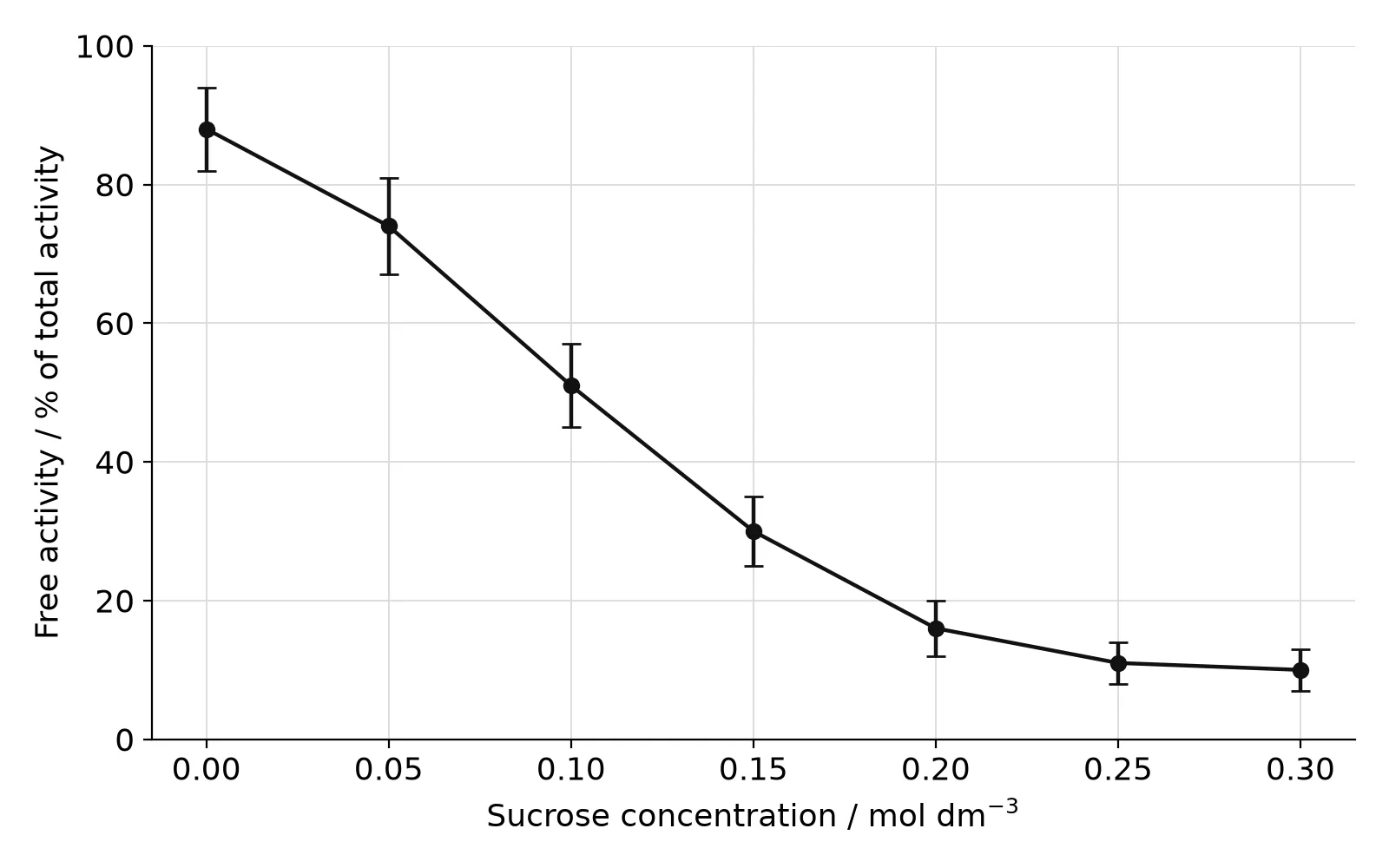
A fraction rich in lysosomes was prepared from liver cells. Equal samples were suspended in sucrose solutions of different concentrations for 15 minutes at 25 °C. The activity of acid phosphatase, a lysosomal enzyme, was then measured by adding its substrate to the medium. The substrate cannot cross the lysosome membrane, so only enzyme that has escaped from lysosomes is active (free activity). Total activity was measured in a separate sample after adding a detergent that dissolves all membranes. Five replicates were done at each concentration.
The graph shows the mean free activity as a percentage of total activity. Error bars show ± one standard deviation.
- (a)
State the independent variable in this investigation.
1 mark
- (b)
Suggest why free activity was expressed as a percentage of total activity.
1 mark
- (c)
Describe the effect of sucrose concentration on free activity.
2 marks
- (d)
Deduce whether there is a significant difference between the free activity at 0.25 mol dm-3 and at 0.30 mol dm-3.
1 mark
- (e)
Explain the high free activity in low sucrose concentrations.
2 marks
- (f)
Using the results, explain the advantage to a living cell of keeping hydrolytic enzymes inside lysosomes.
2 marks
Biological molecules and structures are held together both by covalent bonds and by weaker interactions.
- (a)
Outline how condensation reactions produce polymers, using nucleic acids and one other type of macromolecule as examples.
4 marks
- (b)
Explain how the structure of DNA is related to its functions.
7 marks
- (c)
Outline how hydrophobic and hydrophilic interactions lead to the formation of lipid bilayers in cell membranes.
4 marks
Why do phospholipids form a bilayer when they are mixed with water?
Researchers made artificial membranes consisting only of a phospholipid bilayer, with no proteins. They measured how quickly six substances diffused through the bilayer and expressed the results as permeability coefficients: the higher the coefficient, the faster the substance crosses the bilayer.
Substance | Description | Permeability coefficient / cm s-1 |
|---|---|---|
testosterone | steroid hormone | 4.0 × 10⁻³ |
oestradiol | steroid hormone | 2.0 × 10⁻³ |
glycerol | small polar molecule with three –OH groups | 5.0 × 10⁻⁶ |
urea | small polar molecule | 4.0 × 10⁻⁶ |
glucose | hexose sugar with five –OH groups | 5.0 × 10⁻¹⁰ |
sodium ion (Na+) | positively charged ion | 1.0 × 10⁻¹² |
- (a)
Identify the substance that crosses the bilayer most slowly.
1 mark
- (b)
Calculate how many times greater the permeability coefficient of oestradiol is than that of glucose.
1 mark
- (c)
Suggest why the researchers used membranes that contained no proteins.
1 mark
- (d)
Explain why testosterone and oestradiol have the highest permeability coefficients.
2 marks
- (e)
Explain the low permeability coefficients of glucose and sodium ions.
2 marks
- (f)
Glycerol and glucose are both polar. Suggest why glycerol crosses the bilayer much faster than glucose.
1 mark
Eukaryotic cells are divided into compartments by membranes.
- (a)
Describe the structure of the plasma membrane according to the fluid mosaic model.
4 marks
- (b)
Explain the advantages of compartmentalization in eukaryotic cells.
7 marks
- (c)
Outline how phagocytes help to control infections.
4 marks
Practice all 52 in Augment
Free with an account. Every question has its markscheme, and Augment keeps the ones you got wrong so you can come back to them.
More questions in Form and function
- B1.1Carbohydrates and lipids
- B1.2Proteins
- B2.1Membranes and membrane transportThis page
- B2.2Organelles and compartmentalisation
- B2.3Cell specialisation
- B3.1Gas exchange
- B3.2Transport
- B3.3Muscle and motilityHL only
- B4.1Adaptation to environment
- B4.2Ecological niches
Check your answers in Augment
A free account opens all 52 questions on Membranes and membrane transport with their markschemes, and keeps a record of what you have marked.