B2.2 Organelles and compartmentalisation questions for IB Biology
39 questions on Organelles and compartmentalisation, written by Augment in the style of IB exam papers. Six of them are below in full, to answer on paper.
- IB Biology
- Part of B Form and function
- SL and HL
Questions by paper and level
SL and HL questions are for students at either level. HL only questions cover what only HL students study.
| Paper | SL and HL | HL only | All |
|---|---|---|---|
| Paper 1A | 7 | 13 | 20 |
| Paper 1B | 2 | 3 | 5 |
| Paper 2 | 5 | 9 | 14 |
| Every paper | 14 | 25 | 39 |
Counted on
Questions to try
Written by Augment in the style of IB exams, not past papers. Answer them on paper, then check each one against its markscheme with a free account.
Which structure in a eukaryotic cell is classed as an organelle?
Rat liver tissue was homogenized in an ice-cold, isotonic, buffered solution and the homogenate was separated by differential centrifugation. The homogenate was spun at increasing speeds; after each spin the pellet was collected and the supernatant was spun again. Four marker substances, each found mainly in one part of the cell, were measured in every fraction. The table shows the percentage of the total amount of each marker recovered in each fraction.
Fraction | Centrifugation | DNA / % | Respiratory enzyme found only in mitochondria / % | Enzyme found only in ER membranes / % | Glycolysis enzyme found only in the cytosol / % |
|---|---|---|---|---|---|
Pellet 1 | 700 g, 10 min | 92 | 14 | 9 | 4 |
Pellet 2 | 10 000 g, 20 min | 6 | 78 | 15 | 3 |
Pellet 3 | 100 000 g, 60 min | 2 | 6 | 71 | 4 |
Final supernatant | none | 0 | 2 | 5 | 89 |
- (a)
Identify the fraction that contained most of the mitochondria.
1 mark
- (b)
The total activity of the mitochondrial enzyme in the homogenate was 480 units. Calculate the activity of this enzyme in pellet 1.
1 mark
- (c)
Explain why nuclei were collected in pellet 1 but fragments of endoplasmic reticulum were collected in pellet 3.
2 marks
- (d)
Suggest two reasons why 14 % of the mitochondrial enzyme was found in pellet 1.
2 marks
- (e)
Suggest one way of increasing the purity of the mitochondria in pellet 2.
1 mark
- (f)
Outline how cell fractionation contributed to understanding of the functions of organelles.
2 marks
Gene expression in eukaryotes and prokaryotes differs because of the way their cells are compartmentalized.
- (a)
State where transcription takes place in a eukaryotic cell.
1 mark
- (b)
Distinguish between the locations of transcription and translation in prokaryotic and eukaryotic cells.
2 marks
- (c)
Explain the advantage to eukaryotic cells of separating the nucleus from the cytoplasm.
2 marks
Before cell fractionation, liver tissue is homogenized in an ice-cold, buffered sucrose solution that is isotonic with the cells. Which statements give reasons for these conditions?
I. The low temperature slows the activity of enzymes that would digest the organelles.
II. The isotonic solution prevents organelles from bursting or shrinking by osmosis.
III. The high solute concentration makes the organelles denser so that they sediment at lower speeds.
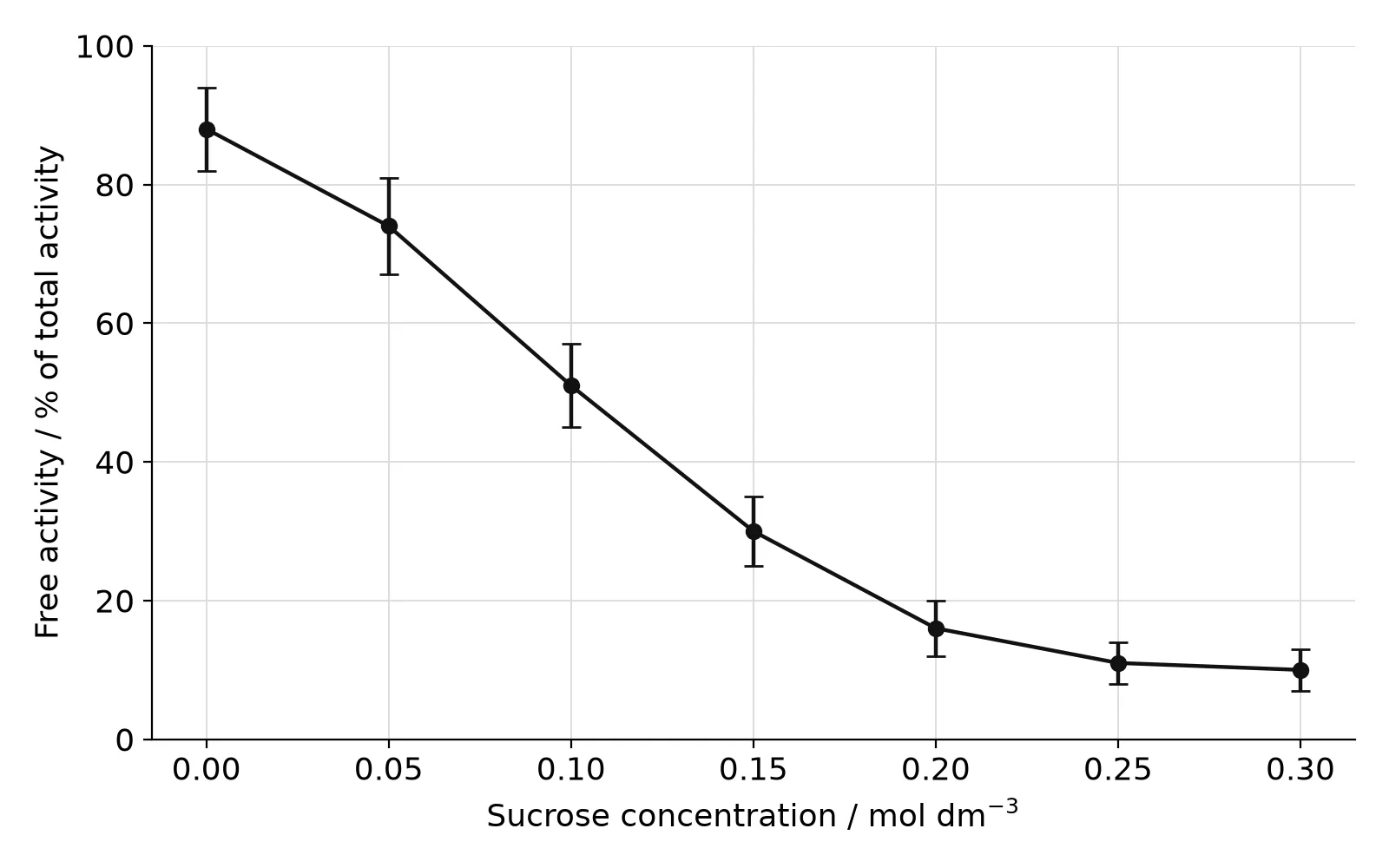
A fraction rich in lysosomes was prepared from liver cells. Equal samples were suspended in sucrose solutions of different concentrations for 15 minutes at 25 °C. The activity of acid phosphatase, a lysosomal enzyme, was then measured by adding its substrate to the medium. The substrate cannot cross the lysosome membrane, so only enzyme that has escaped from lysosomes is active (free activity). Total activity was measured in a separate sample after adding a detergent that dissolves all membranes. Five replicates were done at each concentration.
The graph shows the mean free activity as a percentage of total activity. Error bars show ± one standard deviation.
- (a)
State the independent variable in this investigation.
1 mark
- (b)
Suggest why free activity was expressed as a percentage of total activity.
1 mark
- (c)
Describe the effect of sucrose concentration on free activity.
2 marks
- (d)
Deduce whether there is a significant difference between the free activity at 0.25 mol dm-3 and at 0.30 mol dm-3.
1 mark
- (e)
Explain the high free activity in low sucrose concentrations.
2 marks
- (f)
Using the results, explain the advantage to a living cell of keeping hydrolytic enzymes inside lysosomes.
2 marks
Electron micrographs of three types of mammalian cell were analysed to estimate the percentage of the cell volume occupied by different structures. Pancreatic acinar cells secrete large quantities of digestive enzymes.
Structure | Liver cell (hepatocyte) / % | Pancreatic acinar cell / % | Cardiac muscle cell / % |
|---|---|---|---|
Mitochondria | 22 | 8 | 36 |
Rough endoplasmic reticulum | 9 | 20 | 0.5 |
Golgi apparatus | 1.0 | 2.5 | 0.3 |
Secretory vesicles | 0.5 | 15 | 0 |
Myofibrils | 0 | 0 | 48 |
- (a)
Identify the cell type in which the rough endoplasmic reticulum occupies the largest percentage of the cell volume.
1 mark
- (b)
Calculate how many times greater the percentage volume of mitochondria is in cardiac muscle cells than in pancreatic acinar cells.
1 mark
- (c)
Explain the high percentages of rough endoplasmic reticulum, Golgi apparatus and secretory vesicles in pancreatic acinar cells.
3 marks
- (d)
Suggest reasons for the high percentage of mitochondria in cardiac muscle cells.
2 marks
Practice all 39 in Augment
Free with an account. Every question has its markscheme, and Augment keeps the ones you got wrong so you can come back to them.
More questions in Form and function
- B1.1Carbohydrates and lipids
- B1.2Proteins
- B2.1Membranes and membrane transport
- B2.2Organelles and compartmentalisationThis page
- B2.3Cell specialisation
- B3.1Gas exchange
- B3.2Transport
- B3.3Muscle and motilityHL only
- B4.1Adaptation to environment
- B4.2Ecological niches
Check your answers in Augment
A free account opens all 39 questions on Organelles and compartmentalisation with their markschemes, and keeps a record of what you have marked.