B4.1 Adaptation to environment questions for IB Biology
36 questions on Adaptation to environment, written by Augment in the style of IB exam papers. Six of them are below in full, to answer on paper.
- IB Biology
- Part of B Form and function
- SL and HL
Questions by paper and level
SL and HL questions are for students at either level. HL only questions cover what only HL students study.
| Paper | SL and HL | HL only | All |
|---|---|---|---|
| Paper 1A | 20 | 0 | 20 |
| Paper 1B | 5 | 0 | 5 |
| Paper 2 | 11 | 0 | 11 |
| Every paper | 36 | 0 | 36 |
Counted on
Questions to try
Written by Augment in the style of IB exams, not past papers. Answer them on paper, then check each one against its markscheme with a free account.
Which is a description of the habitat of the Eurasian otter (Lutra lutra)?
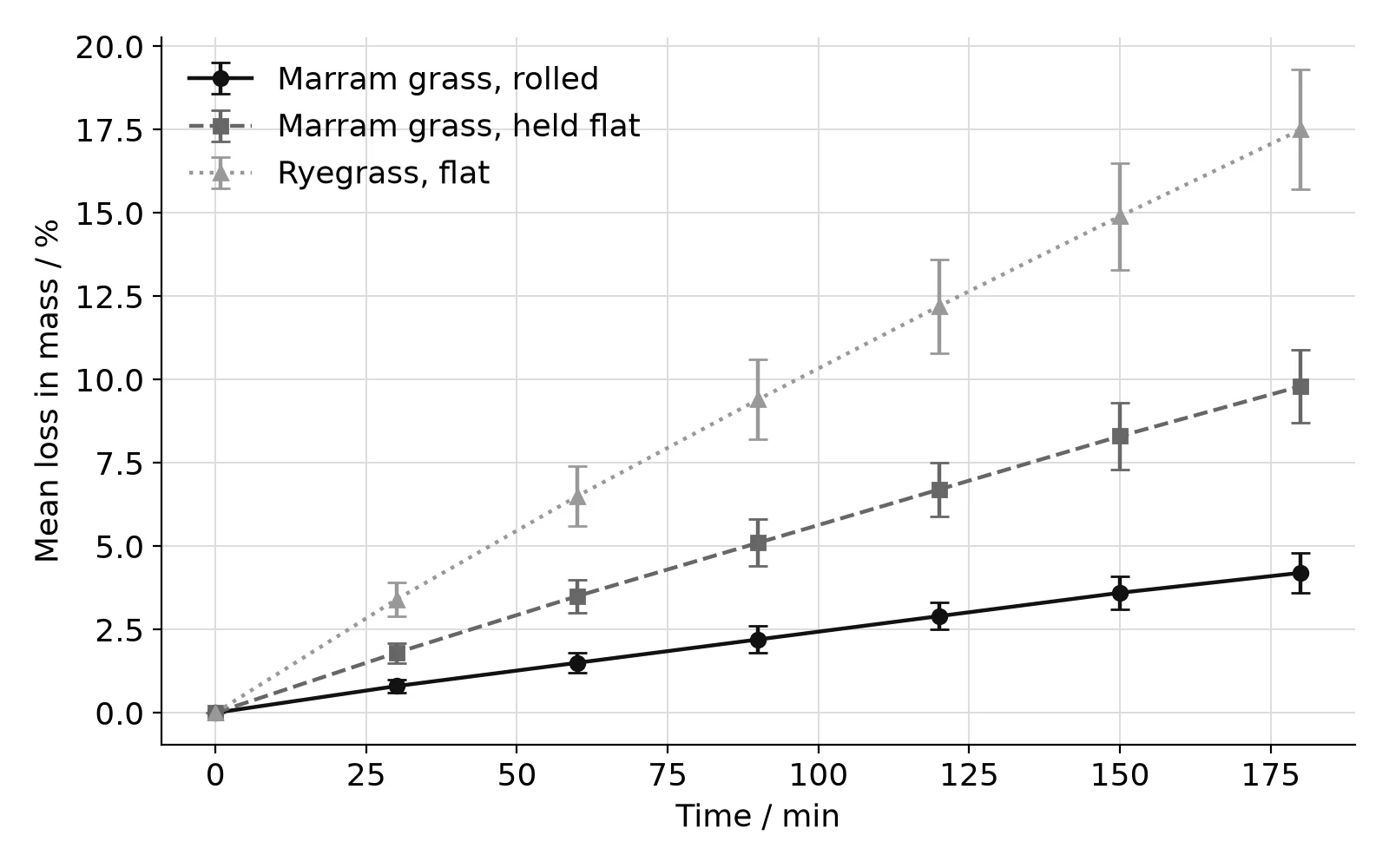
Marram grass (Ammophila arenaria) grows on coastal sand dunes. Its leaves roll up in dry conditions. Students investigated whether leaf rolling reduces water loss. They cut leaves of marram grass and sealed the cut ends with petroleum jelly. Some leaves were left rolled; others were held open and flat with small plastic clips. Leaves of perennial ryegrass (Lolium perenne), a grass of fertile inland soils, were treated in the same way and left flat. Each leaf was weighed, then hung in front of a fan and reweighed every 30 minutes. There were eight leaves in each group.
The graph shows the mean percentage loss in mass. Error bars show ± one standard deviation.
- (a)
State the independent variable in the comparison between the two groups of marram grass leaves.
1 mark
- (b)(i)
Outline the reason for sealing the cut ends of the leaves.
1 mark
- (b)(ii)
Suggest why the results were expressed as percentage loss in mass.
1 mark
- (c)
Calculate the mean rate of mass loss of the marram grass leaves held flat over the 180 minutes, giving the units.
1 mark
- (d)
Discuss whether the data show a significant difference between rolled and flattened marram grass leaves after 180 minutes.
2 marks
- (e)
Suggest a reason for including leaves of ryegrass in the investigation.
1 mark
- (f)
Explain how the structure of a rolled marram grass leaf reduces water loss.
3 marks
The table shows climate data for four locations, P to S, at low altitude.
Location | Mean annual temperature / °C | Annual precipitation / mm |
|---|---|---|
P | 26 | 2800 |
Q | 24 | 150 |
R | 1 | 550 |
S | −12 | 180 |
- (a)
Identify the biome most likely to be found at each location.
2 marks
- (b)
Using the data for P and Q, outline how rainfall determines the type of ecosystem at locations with similar temperatures.
2 marks
- (c)
Suggest two reasons why mean annual temperature and precipitation do not always predict the ecosystem found at a location.
2 marks
- (d)
Explain why trees do not grow at location S.
2 marks
Which adaptation of marram grass (Ammophila arenaria) reduces water loss on sand dunes?
Students used a transect to study the distribution of two plant species from open grassland into a beech woodland, which began at 12 m along the transect. At every 5 m they placed a 0.5 m × 0.5 m quadrat and estimated the percentage cover of Yorkshire fog grass (Holcus lanatus) and wood sorrel (Oxalis acetosella). They measured light intensity at ground level in each quadrat with a light sensor connected to a data logger.
Distance along transect / m | Light intensity / klx | Cover of Holcus lanatus / % | Cover of Oxalis acetosella / % |
|---|---|---|---|
0 | 48.0 | 78 | 0 |
5 | 46.0 | 72 | 0 |
10 | 41.0 | 65 | 2 |
15 | 22.0 | 30 | 8 |
20 | 12.0 | 12 | 22 |
25 | 8.5 | 4 | 35 |
30 | 6.0 | 0 | 41 |
35 | 5.2 | 0 | 38 |
40 | 4.8 | 0 | 44 |
45 | 4.5 | 0 | 40 |
- (a)
Light intensity in the wood changes during the day. Suggest how the students could make their light readings comparable.
1 mark
- (b)
Calculate the percentage decrease in light intensity between 0 m and 45 m.
1 mark
- (c)
Describe the relationship between light intensity and the percentage cover of Oxalis acetosella.
2 marks
- (d)
The students concluded that low light intensity causes the distribution of Oxalis acetosella. Evaluate this conclusion.
3 marks
- (e)
Suggest one improvement to the method.
1 mark
- (f)
Using the concept of a range of tolerance, explain the distribution of Holcus lanatus.
2 marks
Mangrove swamps form along tropical and subtropical coasts.
- (a)
Outline two features of the abiotic environment of a mangrove swamp that make it difficult for trees to grow there.
2 marks
- (b)
Describe the adaptations of a named mangrove tree species to these conditions.
4 marks
- (c)
State one abiotic factor that affects both mangrove trees and marram grass (Ammophila).
1 mark
Practice all 36 in Augment
Free with an account. Every question has its markscheme, and Augment keeps the ones you got wrong so you can come back to them.
More questions in Form and function
- B1.1Carbohydrates and lipids
- B1.2Proteins
- B2.1Membranes and membrane transport
- B2.2Organelles and compartmentalisation
- B2.3Cell specialisation
- B3.1Gas exchange
- B3.2Transport
- B3.3Muscle and motilityHL only
- B4.1Adaptation to environmentThis page
- B4.2Ecological niches
Check your answers in Augment
A free account opens all 36 questions on Adaptation to environment with their markschemes, and keeps a record of what you have marked.