B1.2 Proteins questions for IB Biology
40 questions on Proteins, written by Augment in the style of IB exam papers. Six of them are below in full, to answer on paper.
- IB Biology
- Part of B Form and function
- SL and HL
Questions by paper and level
SL and HL questions are for students at either level. HL only questions cover what only HL students study.
| Paper | SL and HL | HL only | All |
|---|---|---|---|
| Paper 1A | 9 | 11 | 20 |
| Paper 1B | 2 | 3 | 5 |
| Paper 2 | 7 | 8 | 15 |
| Every paper | 18 | 22 | 40 |
Counted on
Questions to try
Written by Augment in the style of IB exams, not past papers. Answer them on paper, then check each one against its markscheme with a free account.
Which groups are bonded to the alpha (central) carbon atom of every amino acid?
Students investigated the effect of temperature on egg albumin, a soluble protein from egg white. Test tubes containing 5 cm3 of a 1 % albumin solution at pH 7 were placed in water baths at seven temperatures for 10 minutes, then cooled to room temperature. Denatured albumin forms insoluble clumps that make the solution cloudy, so the cloudiness of each solution was measured as its absorbance in a colorimeter. There were three tubes at each temperature.
Temperature / °C | Absorbance, tube 1 / AU | Absorbance, tube 2 / AU | Absorbance, tube 3 / AU | Mean absorbance / AU |
|---|---|---|---|---|
30 | 0.02 | 0.03 | 0.02 | 0.02 |
40 | 0.03 | 0.02 | 0.03 | 0.03 |
50 | 0.04 | 0.05 | 0.04 | 0.04 |
60 | 0.21 | 0.26 | 0.24 | 0.24 |
70 | 0.68 | 0.74 | 0.71 | X |
80 | 0.89 | 0.93 | 0.92 | 0.91 |
90 | 0.94 | 0.95 | 0.92 | 0.94 |
- (a)
Identify the dependent variable in this investigation.
1 mark
- (b)
Calculate the value of X.
1 mark
- (c)
Describe the effect of temperature on the absorbance of the albumin solution.
2 marks
- (d)
State one variable, other than those mentioned, that should have been kept constant.
1 mark
- (e)
Explain the change in absorbance between 50 °C and 80 °C.
3 marks
- (f)
Suggest how the method could be improved to find more precisely the temperature at which albumin starts to be denatured.
1 mark
Many biological processes depend on the specific shapes of molecules.
- (a)
Outline how amino acids are linked together to form polypeptides and why an immense variety of polypeptides is possible.
4 marks
- (b)
Explain how the structure of the active site of an enzyme determines its specificity and how denaturation affects this.
7 marks
- (c)
Describe how the rate of an enzyme-catalysed reaction changes as substrate concentration increases.
4 marks
When two amino acids are linked by a condensation reaction, which atoms form the molecule of water that is released?
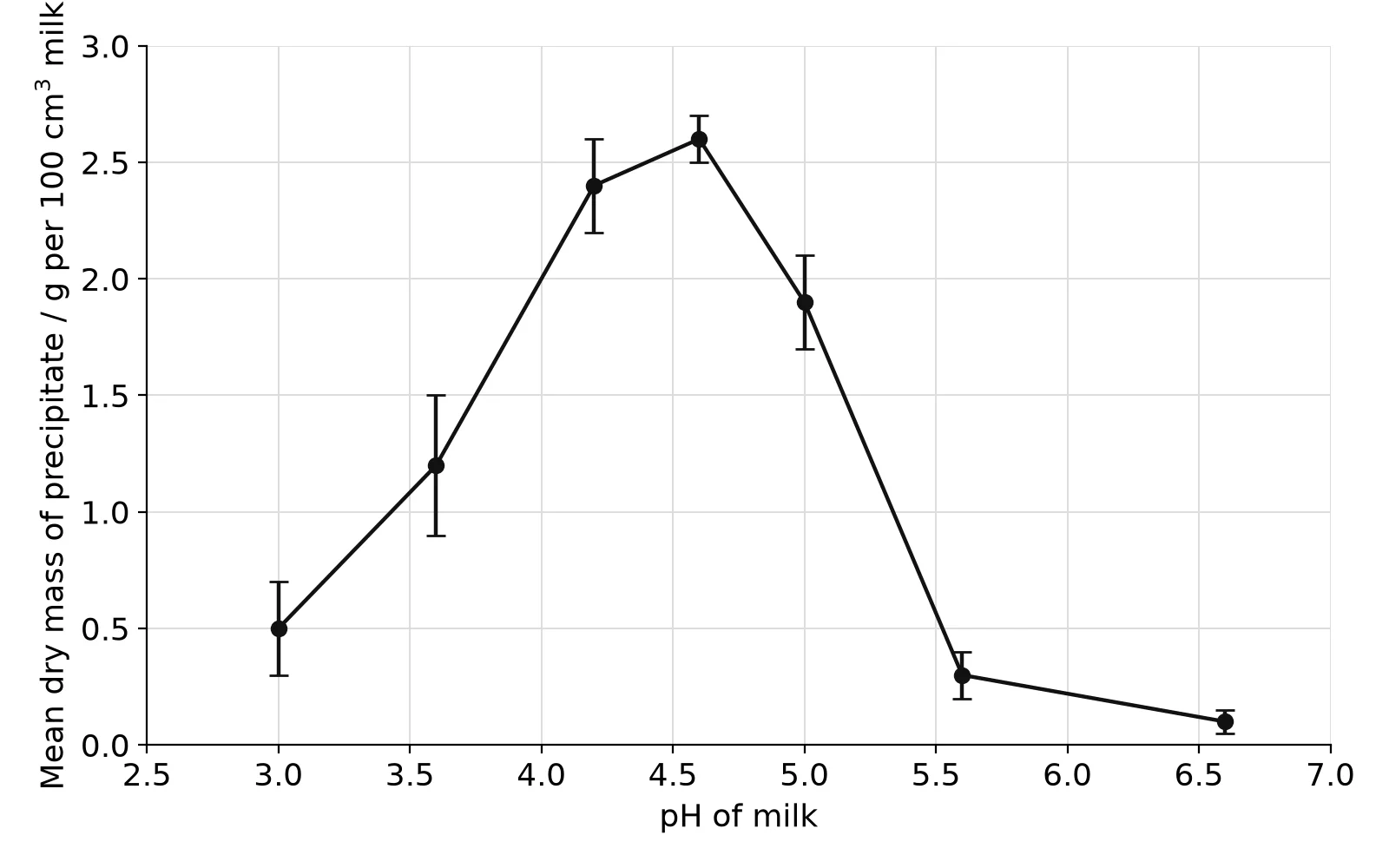
Casein is the main protein in cow's milk. At the normal pH of milk (pH 6.6), casein molecules remain dispersed in the water. Students adjusted 100 cm3 samples of skimmed milk to different pH values by adding hydrochloric acid at 20 °C. After 10 minutes, each sample was centrifuged and the solid precipitate was dried and weighed. Four samples were tested at each pH.
- (a)
State the pH at which the mass of precipitate was greatest.
1 mark
- (b)
Calculate the percentage decrease in mean mass of precipitate between pH 4.6 and pH 3.6.
1 mark
- (c)
Deduce, with a reason, whether the difference in mass of precipitate between pH 4.6 and pH 4.2 is significant.
1 mark
- (d)
At pH 6.6, casein molecules carry a net negative charge. Explain, with reference to the R-groups of amino acids, why casein precipitates when the pH of milk is lowered to about 4.6.
3 marks
- (e)
Suggest a reason for the decrease in mass of precipitate below pH 4.2.
2 marks
- (f)
Identify one variable, other than those mentioned in the method, that should be controlled.
1 mark
Proteins are polymers of amino acids.
- (a)
Draw a labelled diagram to show the generalized structure of an amino acid.
3 marks
- (b)
State the word equation for the formation of a dipeptide.
1 mark
- (c)
Draw the structure of a generalized dipeptide, showing the position of the peptide bond.
2 marks
- (d)
State the type of reaction that breaks peptide bonds during the digestion of proteins.
1 mark
Practice all 40 in Augment
Free with an account. Every question has its markscheme, and Augment keeps the ones you got wrong so you can come back to them.
More questions in Form and function
- B1.1Carbohydrates and lipids
- B1.2ProteinsThis page
- B2.1Membranes and membrane transport
- B2.2Organelles and compartmentalisation
- B2.3Cell specialisation
- B3.1Gas exchange
- B3.2Transport
- B3.3Muscle and motilityHL only
- B4.1Adaptation to environment
- B4.2Ecological niches
Check your answers in Augment
A free account opens all 40 questions on Proteins with their markschemes, and keeps a record of what you have marked.