B1.1 Carbohydrates and lipids questions for IB Biology
43 questions on Carbohydrates and lipids, written by Augment in the style of IB exam papers. Six of them are below in full, to answer on paper.
- IB Biology
- Part of B Form and function
- SL and HL
Questions by paper and level
SL and HL questions are for students at either level. HL only questions cover what only HL students study.
| Paper | SL and HL | HL only | All |
|---|---|---|---|
| Paper 1A | 20 | 0 | 20 |
| Paper 1B | 5 | 0 | 5 |
| Paper 2 | 15 | 3 | 18 |
| Every paper | 40 | 3 | 43 |
Counted on
Questions to try
Written by Augment in the style of IB exams, not past papers. Answer them on paper, then check each one against its markscheme with a free account.
Which property of carbon atoms allows them to form the backbone of a very wide range of compounds?
Students investigated whether amylase can hydrolyse starch and cellulose. Three tubes were set up at 37 °C, each containing 10 cm3 of a 1 % suspension of polysaccharide and 1 cm3 of amylase solution: starch with amylase, starch with amylase that had been boiled for 10 minutes and then cooled, and cellulose with amylase. Every 2 minutes a sample was removed and the concentration of reducing sugar (maltose and glucose) was measured with a colorimeter. Each treatment was repeated three times. The table shows the mean concentrations.
Time / min | Starch + amylase / mg cm-3 | Starch + boiled amylase / mg cm-3 | Cellulose + amylase / mg cm-3 |
|---|---|---|---|
0 | 0.00 | 0.00 | 0.00 |
2 | 0.62 | 0.01 | 0.00 |
4 | 1.15 | 0.00 | 0.01 |
6 | 1.58 | 0.01 | 0.00 |
8 | 1.86 | 0.02 | 0.01 |
10 | 2.01 | 0.01 | 0.00 |
- (a)
State the dependent variable in this investigation.
1 mark
- (b)
Calculate the mean rate of production of reducing sugar from starch by active amylase during the first 4 minutes. Give the units.
1 mark
- (c)
Describe how the concentration of reducing sugar changed over 10 minutes in the tube containing starch and active amylase.
2 marks
- (d)
Outline the purpose of the tube containing boiled amylase.
1 mark
- (e)
Explain why amylase did not produce reducing sugar from cellulose.
3 marks
- (f)
Suggest a reason for the change in rate shown in the starch and active amylase tube.
1 mark
Organisms are adapted to the physical environments in which they live.
- (a)
Compare and contrast water and air as habitats for animals, with reference to the black-throated loon (Gavia arctica) and the ringed seal (Pusa hispida).
7 marks
- (b)
Describe the properties of gas-exchange surfaces.
4 marks
- (c)
Outline how the hydrophobic properties of lipids are used by organisms.
4 marks
Starch grains in the cells of a potato (Solanum tuberosum) tuber have a diameter of about 0.035 mm. What is this diameter in nanometres?
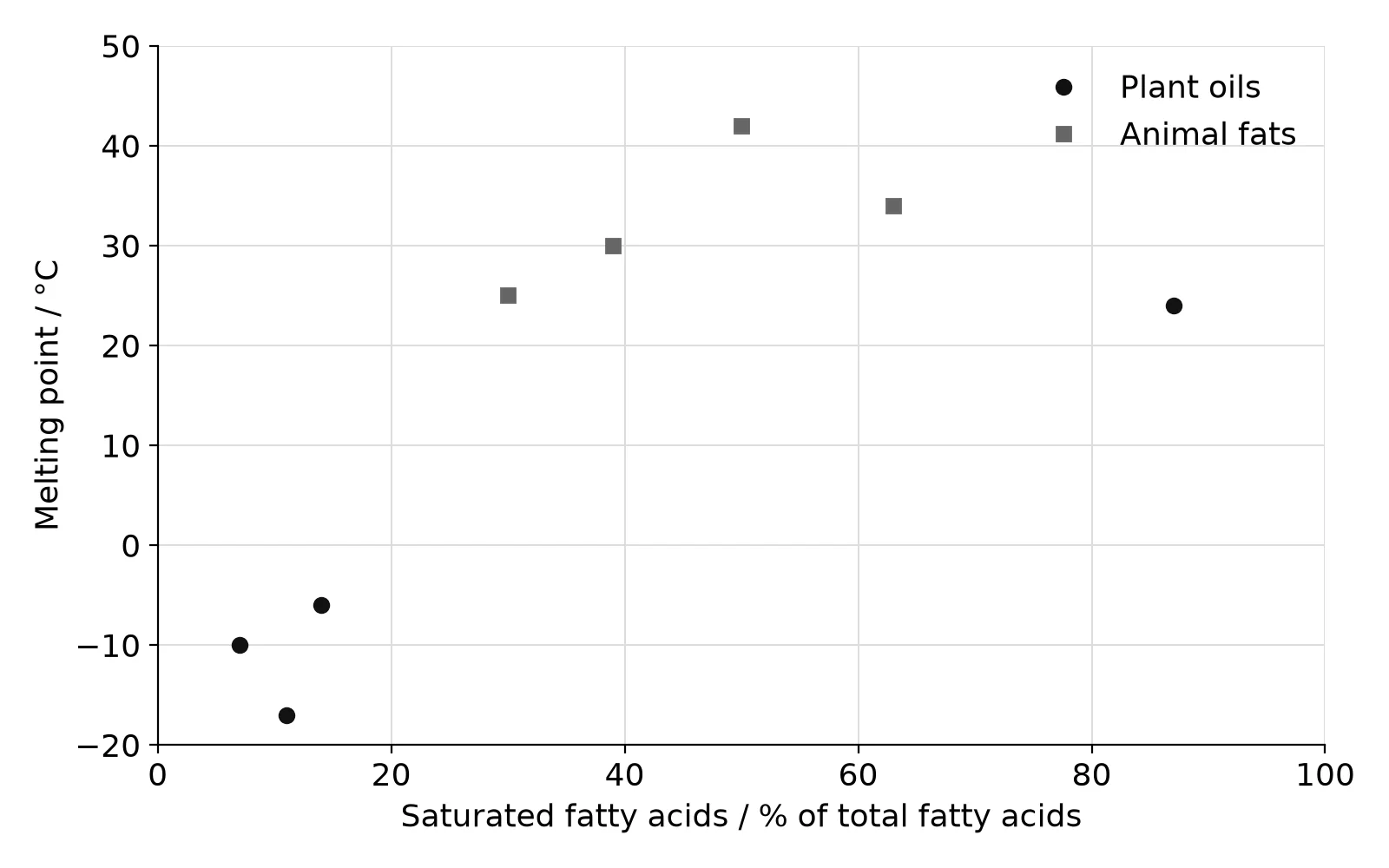
Students measured the melting points of eight fats and oils. A small sample of each was frozen in a thin glass capillary tube, which was then warmed slowly in a water bath; the temperature at which the sample became completely clear was recorded as the melting point. The percentage of saturated fatty acids in each sample was taken from food composition tables. Four samples came from plants (sunflower, rapeseed, olive and coconut oils) and four were fats from endothermic animals (chicken fat, lard, beef fat and butter). Coconut oil, from a tropical plant, contains 87 % saturated fatty acids.
- (a)
State the relationship between the percentage of saturated fatty acids and the melting point for the samples other than coconut oil.
1 mark
- (b)
Suggest a reason why coconut oil does not fit this relationship.
1 mark
- (c)
Explain why fats with a high proportion of saturated fatty acids have higher melting points than oils with a high proportion of unsaturated fatty acids.
3 marks
- (d)
Using the data, outline how the composition of the plant oils and animal fats relates to the organisms they come from.
2 marks
- (e)
Evaluate the conclusion that the percentage of saturated fatty acids is the only factor that determines the melting point of a fat or oil.
2 marks
Water is essential for life as we know it.
- (a)
Outline how Earth is thought to have gained and retained its water.
4 marks
- (b)
Describe the roles of water in condensation and hydrolysis reactions.
4 marks
- (c)
Explain why the search for extraterrestrial life focuses on places where liquid water may exist.
7 marks
Practice all 43 in Augment
Free with an account. Every question has its markscheme, and Augment keeps the ones you got wrong so you can come back to them.
More questions in Form and function
- B1.1Carbohydrates and lipidsThis page
- B1.2Proteins
- B2.1Membranes and membrane transport
- B2.2Organelles and compartmentalisation
- B2.3Cell specialisation
- B3.1Gas exchange
- B3.2Transport
- B3.3Muscle and motilityHL only
- B4.1Adaptation to environment
- B4.2Ecological niches
Check your answers in Augment
A free account opens all 43 questions on Carbohydrates and lipids with their markschemes, and keeps a record of what you have marked.