B2.3 Cell specialisation questions for IB Biology
39 questions on Cell specialisation, written by Augment in the style of IB exam papers. Six of them are below in full, to answer on paper.
- IB Biology
- Part of B Form and function
- SL and HL
Questions by paper and level
SL and HL questions are for students at either level. HL only questions cover what only HL students study.
| Paper | SL and HL | HL only | All |
|---|---|---|---|
| Paper 1A | 13 | 7 | 20 |
| Paper 1B | 3 | 2 | 5 |
| Paper 2 | 6 | 8 | 14 |
| Every paper | 22 | 17 | 39 |
Counted on
Questions to try
Written by Augment in the style of IB exams, not past papers. Answer them on paper, then check each one against its markscheme with a free account.
What is meant by cell differentiation?
Students used cubes of agar jelly as models of cells. The agar contained sodium hydroxide and phenolphthalein indicator, which made it pink. Cubes with sides of 0.5, 1, 2, 3 and 4 cm were cut and placed in hydrochloric acid at 0.1 mol dm-3. As the acid diffused into the agar, it turned colourless. After 10 minutes the cubes were removed and cut open, the pink region in the centre was measured, and the percentage of each cube's volume that had become colourless was calculated. Five cubes of each size were tested.
Length of side / cm | Mean volume that became colourless / % | Standard deviation / % |
|---|---|---|
0.5 | 98.6 | 1.1 |
1 | 77.2 | 3.4 |
2 | 49.5 | 2.9 |
3 | 35.8 | 2.6 |
4 | 27.9 | 2.2 |
- (a)
Identify the independent variable in this investigation.
1 mark
- (b)
Calculate the surface area-to-volume ratio of a cube with sides of 2 cm.
1 mark
- (c)
State two variables that should have been kept constant.
2 marks
- (d)
Describe the relationship between the size of the cubes and the percentage of their volume that became colourless.
2 marks
- (e)
Explain why a greater percentage of the volume of the smaller cubes became colourless.
2 marks
- (f)
Cells are not cubes and are not made of agar. Discuss the use of agar cubes as models of cells.
2 marks
The structure of specialized cells and tissues is closely related to their function.
- (a)
Compare and contrast the structure of xylem vessels and phloem sieve tubes in relation to their functions.
7 marks
- (b)
Describe the adaptations of type I and type II pneumocytes in the alveoli.
4 marks
- (c)
Outline how valves maintain the one-way flow of blood and lymph in mammals.
4 marks
In an early-stage embryo, a signalling molecule is secreted by cells at one end and diffuses through the surrounding tissue. Cells at different distances from the source develop into different cell types. What is the best explanation for this?
Embryonic stem cells were taken from the inner cell mass of mouse (Mus musculus) blastocysts and grown as colonies in culture. Half of the dishes were given a signalling protein called LIF and the other half were not. Every two days, colonies were stained for a protein that is produced only by unspecialized stem cells, and the percentage of colonies that were still unspecialized was recorded. There were six dishes for each treatment.
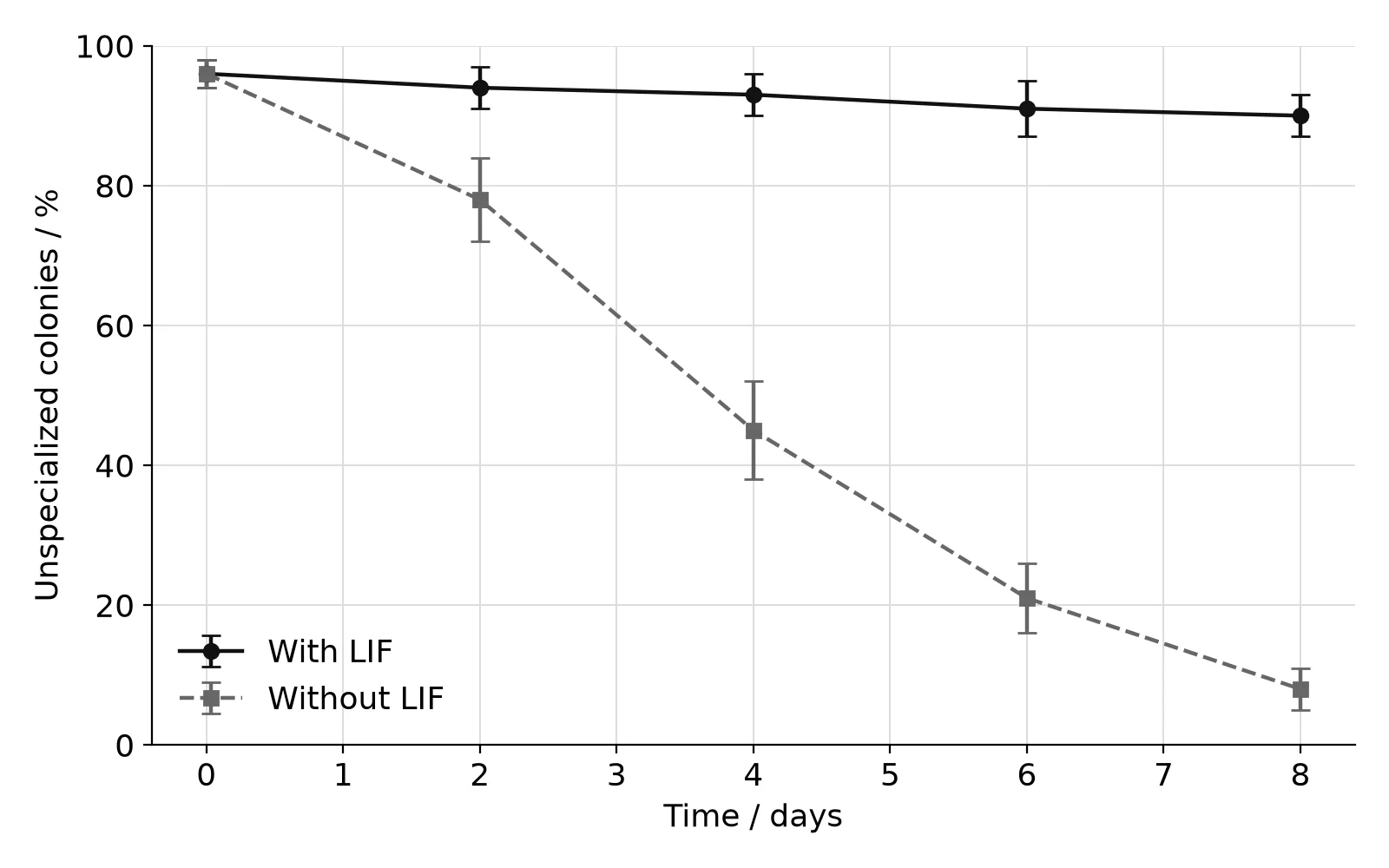
- (a)
State the dependent variable in this investigation.
1 mark
- (b)
Calculate the percentage decrease in unspecialized colonies without LIF between day 0 and day 8.
1 mark
- (c)
Compare the results with and without LIF.
2 marks
- (d)
Discuss whether the difference between the two treatments on day 2 is significant.
2 marks
- (e)
Explain the results using your knowledge of the properties of stem cells.
2 marks
- (f)
Outline how the potency of these embryonic stem cells differs from that of stem cells in adult human bone marrow.
2 marks
Multicellular organisms depend on cooperation between specialized cells.
- (a)
Outline the evolution of multicellularity and its advantages.
4 marks
- (b)
Explain how unspecialized cells develop into specialized cells.
7 marks
- (c)
Describe how phloem sieve tube elements and companion cells are adapted for translocation.
4 marks
Practice all 39 in Augment
Free with an account. Every question has its markscheme, and Augment keeps the ones you got wrong so you can come back to them.
More questions in Form and function
- B1.1Carbohydrates and lipids
- B1.2Proteins
- B2.1Membranes and membrane transport
- B2.2Organelles and compartmentalisation
- B2.3Cell specialisationThis page
- B3.1Gas exchange
- B3.2Transport
- B3.3Muscle and motilityHL only
- B4.1Adaptation to environment
- B4.2Ecological niches
Check your answers in Augment
A free account opens all 39 questions on Cell specialisation with their markschemes, and keeps a record of what you have marked.