B3.3 Muscle and motility questions for IB Biology
36 questions on Muscle and motility, written by Augment in the style of IB exam papers. Six of them are below in full, to answer on paper.
- IB Biology
- Part of B Form and function
- HL only
Questions by paper and level
| Paper | Questions |
|---|---|
| Paper 1A | 20 |
| Paper 1B | 5 |
| Paper 2 | 11 |
| Every paper | 36 |
Counted on
Questions to try
Written by Augment in the style of IB exams, not past papers. Answer them on paper, then check each one against its markscheme with a free account.
Which row describes the changes in the bands of a sarcomere when a skeletal muscle fibre contracts?
Row | A band | I band | H zone |
|---|---|---|---|
A | shorter | shorter | shorter |
B | unchanged | unchanged | shorter |
C | unchanged | shorter | shorter |
D | shorter | unchanged | unchanged |
Students investigated the conditions needed for contraction using glycerinated rabbit skeletal muscle. Glycerination makes the fibre membranes permeable and removes the fibres' own ATP and ions, but leaves the actin and myosin filaments in place. Thin strips of fibres were placed on microscope slides, their length was measured, and a few drops of one of four solutions were added. The length was measured again after 2 minutes. Five strips were tested with each solution.
Solution added | Mean initial length / mm | Mean change in length / % | Standard deviation / % |
|---|---|---|---|
distilled water | 19.6 | −0.4 | 0.6 |
salt solution (K+ and Mg2+ ions) | 20.3 | −0.8 | 0.9 |
ATP solution | 19.9 | −7.6 | 2.1 |
ATP and salt solution | 20.1 | −24.5 | 3.2 |
- (a)
State the dependent variable in this investigation.
1 mark
- (b)
Suggest why the results were expressed as a percentage change in length.
1 mark
- (c)
One strip in the ATP and salt solution measured 18.4 mm before and 14.0 mm after the solution was added. Calculate the percentage change in its length.
1 mark
- (d)
Explain the reason for including strips treated with distilled water.
1 mark
- (e)
Evaluate the hypothesis that ATP is required for muscle contraction, using the data.
3 marks
- (f)
Explain, using the sliding filament model, why the strips shortened in the ATP and salt solution.
3 marks
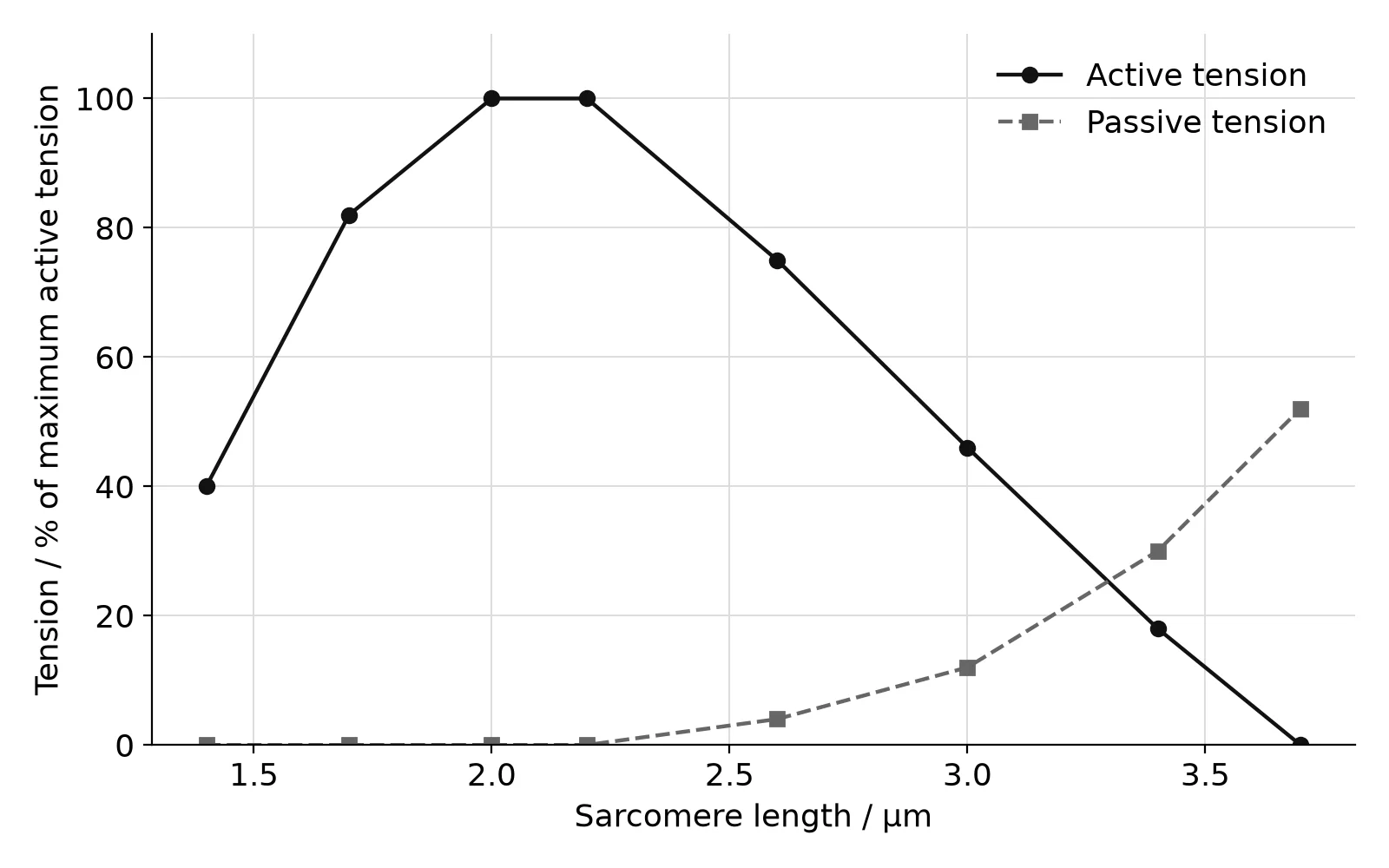
Single skeletal muscle fibres from a frog were held at different sarcomere lengths. At each length the fibre was stimulated and the active tension it produced was measured. The passive tension (the tension in the fibre when it was stretched but not stimulated) was also measured. Both are shown as a percentage of the maximum active tension.
- (a)
State the range of sarcomere lengths at which active tension is greatest.
1 mark
- (b)
Explain why active tension decreases as sarcomere length increases above 2.2 µm.
2 marks
- (c)
Suggest why active tension also falls at sarcomere lengths below 2.0 µm.
2 marks
- (d)
Explain the change in passive tension at sarcomere lengths above 2.2 µm.
2 marks
- (e)
Draw a labelled diagram of a sarcomere in a relaxed muscle fibre.
3 marks
What is the direct effect of a molecule of ATP binding to a myosin head that is attached to actin?
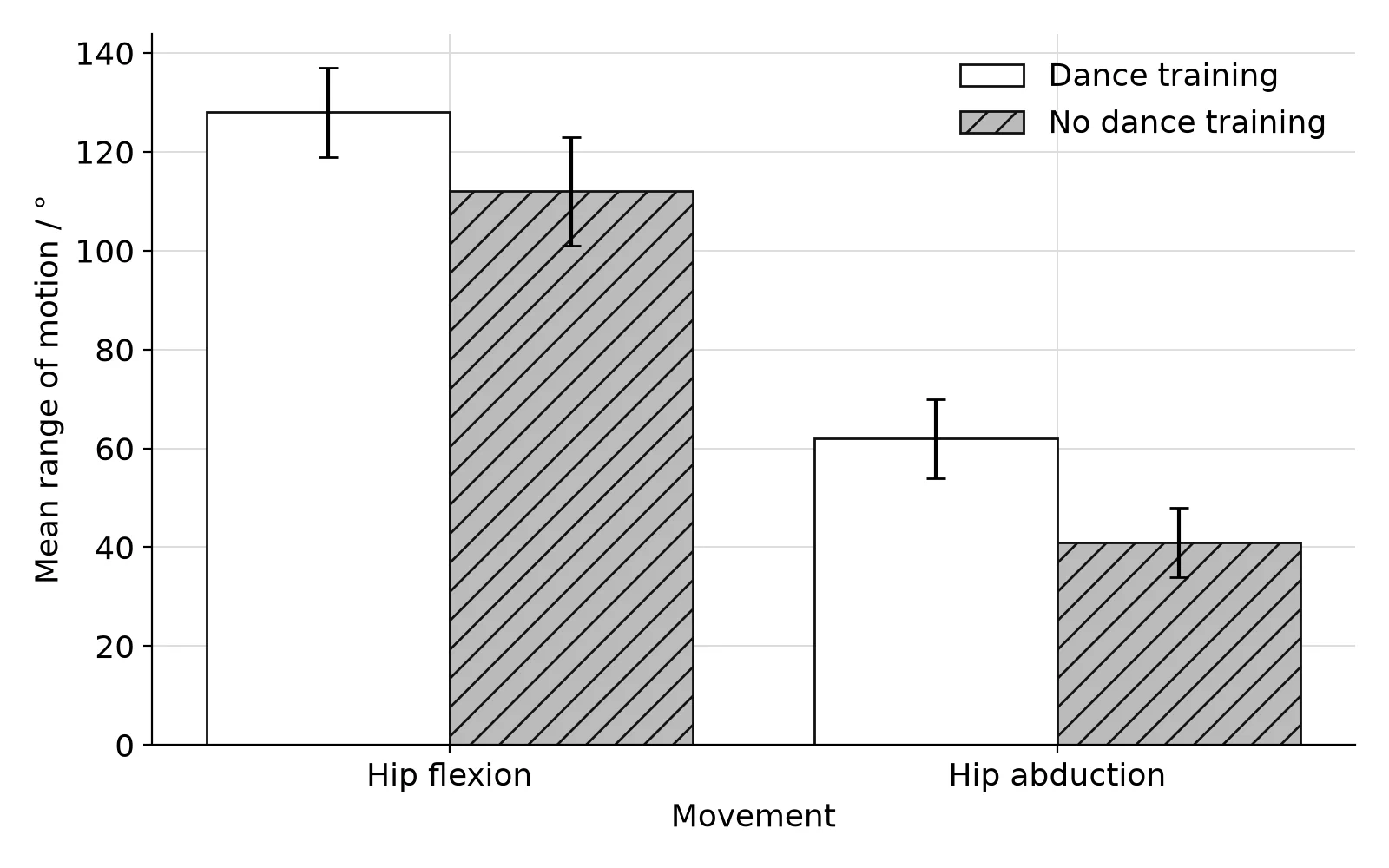
Students investigated whether dance training affects the range of motion of the hip joint. They used a goniometer to measure the maximum active hip flexion (bringing the bent knee up towards the chest while lying on the back) and hip abduction (moving the leg sideways away from the body) in ten students who trained in dance for at least 5 hours a week and ten students who did no dance training. All participants were 16–17 years old. The chart shows the means; error bars show ± 1 standard deviation.
- (a)
Outline how a goniometer could be used to measure hip flexion.
2 marks
- (b)
Calculate the percentage difference in mean hip abduction of the students with dance training compared with the students without.
1 mark
- (c)
Discuss whether the differences between the two groups are significant, using the error bars.
2 marks
- (d)
State one variable, other than age, that should have been controlled.
1 mark
- (e)
Suggest one way of measuring the joint angles more accurately.
1 mark
- (f)
Explain how the structure of the hip joint allows movement in more than one plane.
2 marks
The table shows estimates of the number of motor neurons supplying three human skeletal muscles and the number of muscle fibres in each muscle.
Muscle | Number of motor neurons | Number of muscle fibres | Mean number of fibres per motor unit |
|---|---|---|---|
muscle that moves the eyeball | 2 970 | 27 000 | 9 |
muscle that moves the index finger | 120 | 40 800 | 340 |
calf muscle that raises the heel | 580 | 1 040 000 |
- (a)
Calculate the mean number of fibres per motor unit in the calf muscle.
1 mark
- (b)
State the name of the junction between a motor neuron and a muscle fibre.
1 mark
- (c)
Suggest, using the data, why the muscle that moves the eyeball has small motor units.
2 marks
- (d)
Explain how the force of contraction of the calf muscle can be varied.
2 marks
- (e)
Describe the events at a neuromuscular junction that lead to depolarization of the muscle fibre membrane.
3 marks
Practice all 36 in Augment
Free with an account. Every question has its markscheme, and Augment keeps the ones you got wrong so you can come back to them.
More questions in Form and function
- B1.1Carbohydrates and lipids
- B1.2Proteins
- B2.1Membranes and membrane transport
- B2.2Organelles and compartmentalisation
- B2.3Cell specialisation
- B3.1Gas exchange
- B3.2Transport
- B3.3Muscle and motilityThis page
- B4.1Adaptation to environment
- B4.2Ecological niches
Check your answers in Augment
A free account opens all 36 questions on Muscle and motility with their markschemes, and keeps a record of what you have marked.