A4.2 Conservation of biodiversity questions for IB Biology
37 questions on Conservation of biodiversity, written by Augment in the style of IB exam papers. Six of them are below in full, to answer on paper.
- IB Biology
- Part of A Unity and diversity
- SL and HL
Questions by paper and level
SL and HL questions are for students at either level. HL only questions cover what only HL students study.
| Paper | SL and HL | HL only | All |
|---|---|---|---|
| Paper 1A | 20 | 0 | 20 |
| Paper 1B | 5 | 0 | 5 |
| Paper 2 | 11 | 1 | 12 |
| Every paper | 36 | 1 | 37 |
Counted on
Questions to try
Written by Augment in the style of IB exams, not past papers. Answer them on paper, then check each one against its markscheme with a free account.
Which is an example of genetic diversity?
Students investigated whether urbanization affects plant biodiversity. They chose five areas of unmown grassland, in parks and on road verges, at increasing distances from the centre of a large city. At each site they placed ten 1 m × 1 m quadrats at random and recorded the number of plant species in each quadrat.
Distance from city centre / km | Mean number of plant species per quadrat | Standard deviation |
|---|---|---|
0 | 4.2 | 1.1 |
5 | 6.8 | 1.5 |
10 | 9.1 | 1.8 |
15 | 12.4 | 2.0 |
20 | 13.0 | 2.3 |
- (a)
State the independent variable in this investigation.
1 mark
- (b)
Explain why the quadrats were placed at random.
1 mark
- (c)
Calculate the percentage increase in the mean number of plant species per quadrat between 0 km and 20 km from the city centre.
1 mark
- (d)
Describe the relationship between distance from the city centre and the number of plant species.
2 marks
- (e)
Discuss whether the data show a difference in the number of plant species between the sites at 15 km and 20 km.
2 marks
- (f)
Suggest two reasons why plant species richness is lower close to the city centre.
2 marks
Biodiversity can be considered at several levels.
- (a)
Define biodiversity.
1 mark
- (b)
Distinguish between species diversity and genetic diversity.
2 marks
- (c)
Outline what is meant by ecosystem diversity, using an example.
2 marks
- (d)
Explain why genetic diversity within a species is important for its long-term survival.
3 marks
Which statements about the number of species on Earth are supported by current evidence?
I. Most species alive today have not yet been named and described.
II. Fossil evidence suggests that more species are alive now than at any time in the past.
III. More than half of all the species that have ever existed are alive today.
Bird surveys are often carried out by citizen scientists. In a study of their reliability, twelve 1 km transects were surveyed on the same mornings by a trained ecologist, a novice volunteer (less than one year of experience) and an experienced volunteer (more than five years). They walked each transect separately, at the same pace, one after another, and the order in which they walked was changed each day. Each recorded every bird species seen or heard.
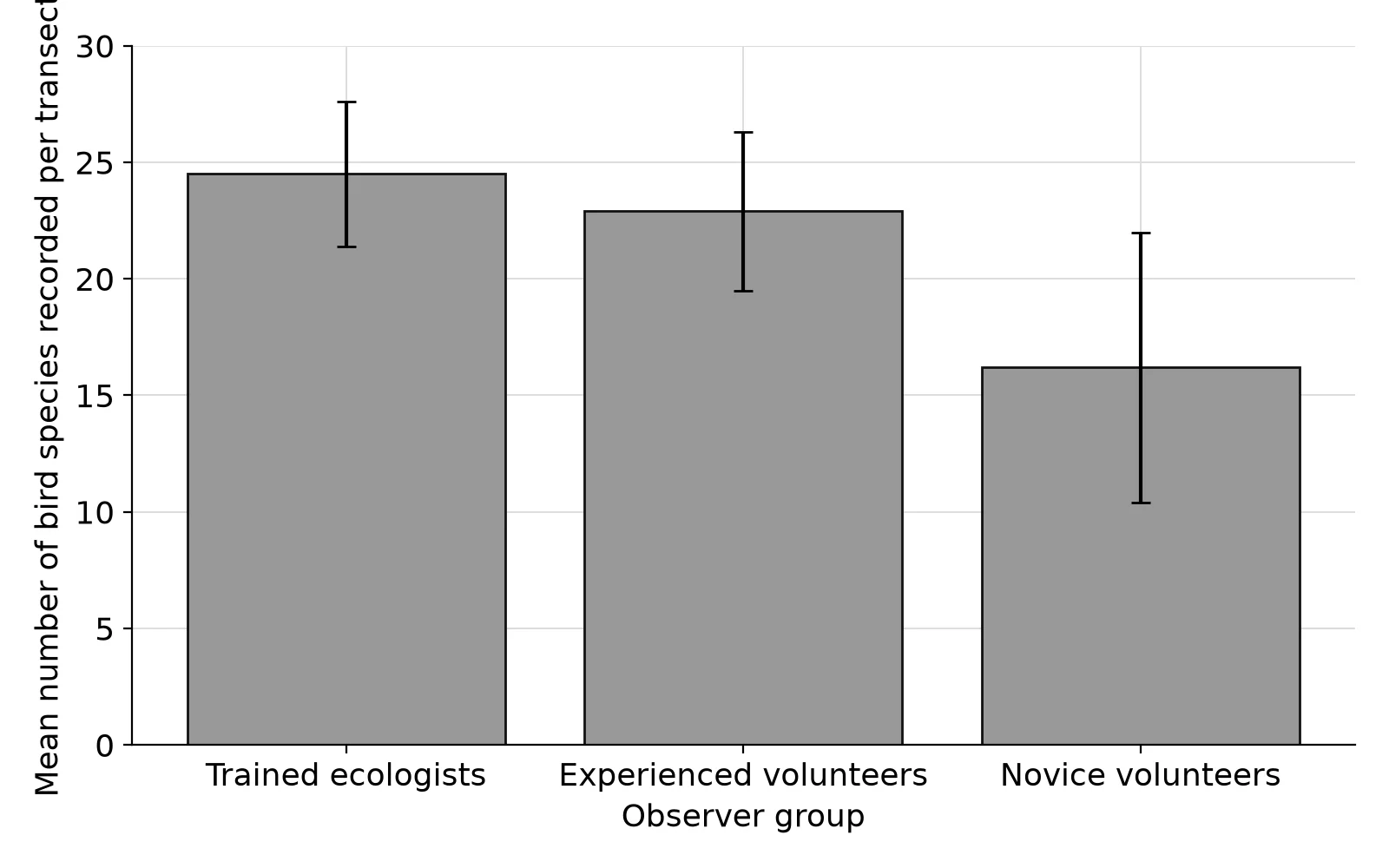
Photographs and sound recordings were used to check identifications. The percentage of records that were misidentifications was 1.2 % for the trained ecologists, 2.6 % for the experienced volunteers and 9.8 % for the novice volunteers.
- (a)
Calculate the mean number of species recorded by novice volunteers as a percentage of the mean recorded by trained ecologists.
1 mark
- (b)
Compare the results of the experienced volunteers with those of the trained ecologists.
2 marks
- (c)
Explain why the order in which the three observers walked each transect was changed each day.
2 marks
- (d)
Using the data, evaluate the use of citizen scientists for monitoring changes in bird biodiversity.
3 marks
- (e)
Suggest one way to improve the reliability of data collected by novice volunteers.
1 mark
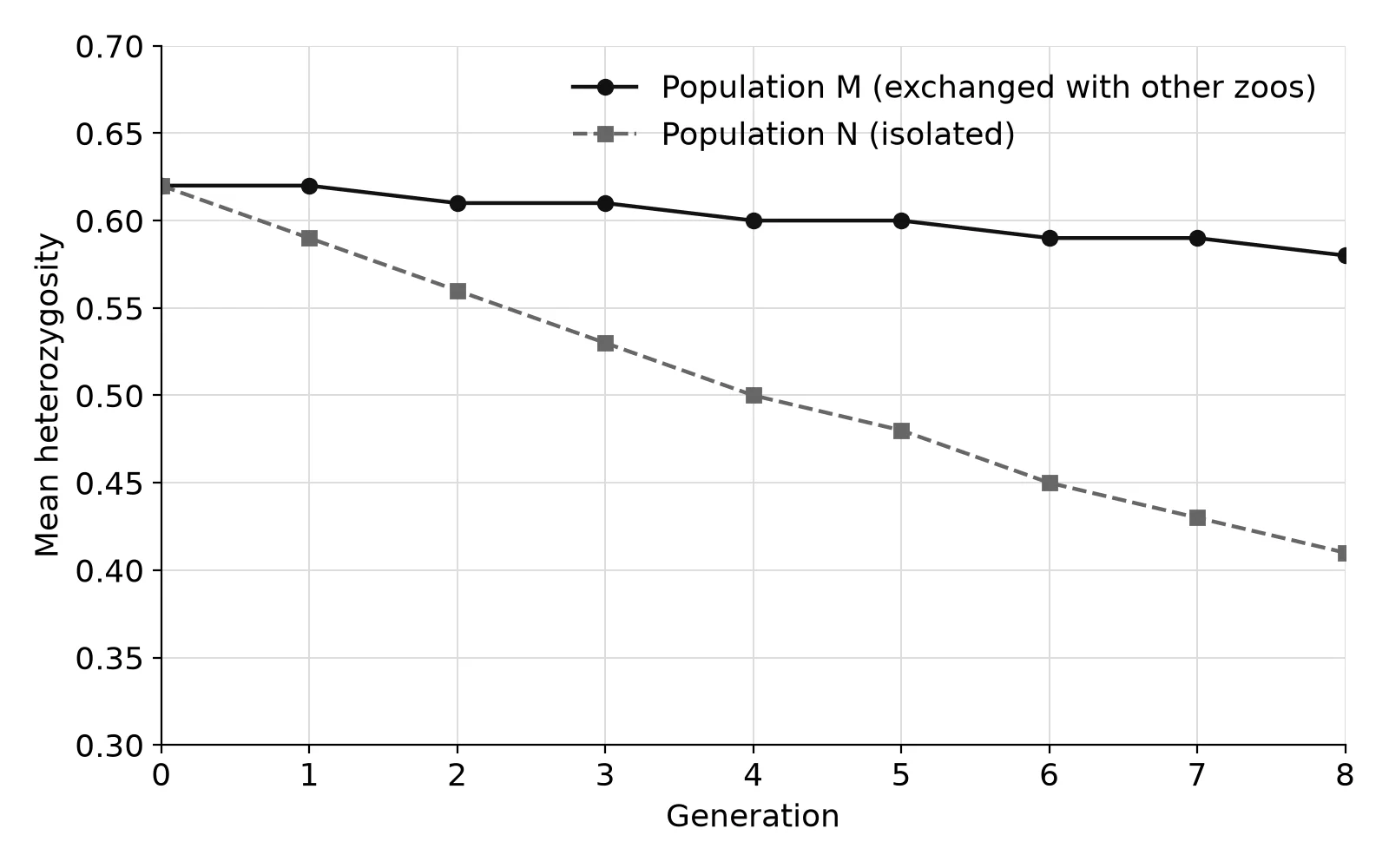
Two captive breeding populations of an endangered antelope were each started from the same number of founders taken from the wild. In population M, animals were exchanged with other zoos every generation, following a breeding plan. Population N was kept isolated. Genetic diversity was measured in each generation as the mean heterozygosity: the proportion of gene loci at which an individual has two different alleles.
- (a)
State the mean heterozygosity of population N in generation 4.
1 mark
- (b)
Calculate the percentage decrease in mean heterozygosity of population N between generation 0 and generation 8.
1 mark
- (c)
Compare and contrast the changes in genetic diversity of the two populations.
2 marks
- (d)
Explain why genetic diversity decreases in a small, isolated captive population.
2 marks
- (e)
Outline two reasons why ex situ conservation alone is not enough to conserve a species such as this antelope.
2 marks
Practice all 37 in Augment
Free with an account. Every question has its markscheme, and Augment keeps the ones you got wrong so you can come back to them.
More questions in Unity and diversity
- A1.1Water
- A1.2Nucleic acids
- A2.1Origins of cellsHL only
- A2.2Cell structure
- A2.3VirusesHL only
- A3.1Diversity of organisms
- A3.2Classification and cladisticsHL only
- A4.1Evolution and speciation
- A4.2Conservation of biodiversityThis page
Check your answers in Augment
A free account opens all 37 questions on Conservation of biodiversity with their markschemes, and keeps a record of what you have marked.