A2.1 Origins of cells questions for IB Biology
38 questions on Origins of cells, written by Augment in the style of IB exam papers. Six of them are below in full, to answer on paper.
- IB Biology
- Part of A Unity and diversity
- HL only
Questions by paper and level
| Paper | Questions |
|---|---|
| Paper 1A | 20 |
| Paper 1B | 5 |
| Paper 2 | 13 |
| Every paper | 38 |
Counted on
Questions to try
Written by Augment in the style of IB exams, not past papers. Answer them on paper, then check each one against its markscheme with a free account.
Why did more ultraviolet (UV) radiation reach the surface of the early Earth than reaches it today?
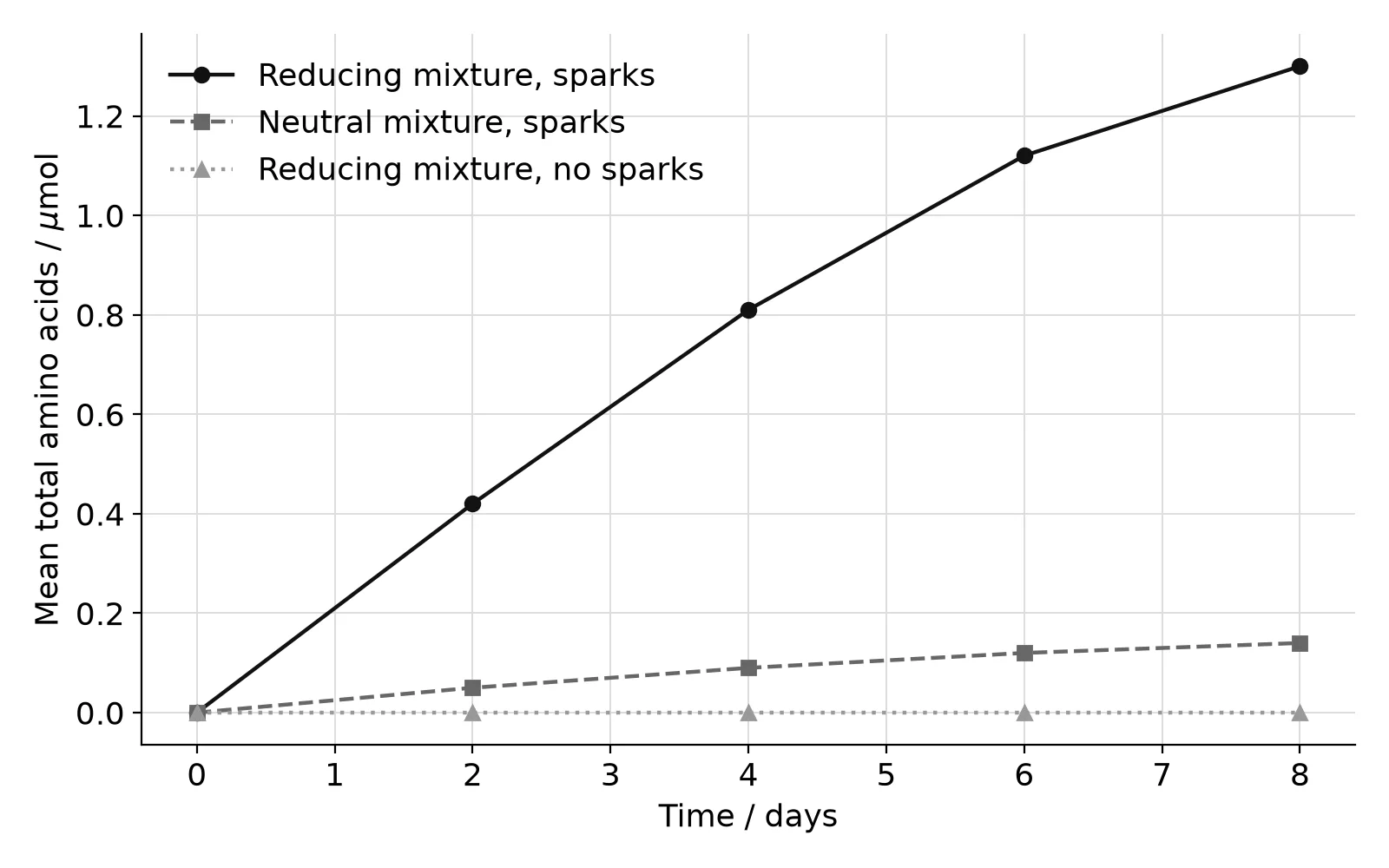
Researchers repeated a version of the Miller–Urey experiment. Sealed glass flasks containing water and a mixture of gases were heated so that water vapour circulated past a pair of electrodes. Two gas mixtures were tested: a reducing mixture (methane, ammonia and hydrogen) and a neutral mixture (carbon dioxide and nitrogen). Sparks were passed between the electrodes continuously, and the total quantity of amino acids in the water was measured every two days. A further flask containing the reducing mixture was set up identically but with no sparks. Each treatment was carried out three times and the means are shown.
- (a)
State the independent variable when the two mixtures with sparks are compared.
1 mark
- (b)
Explain why the flask with no sparks was included.
2 marks
- (c)(i)
Calculate the mean rate of amino acid formation in the reducing mixture with sparks over the 8 days.
1 mark
- (c)(ii)
Calculate how many times more amino acids had formed in the reducing mixture than in the neutral mixture after 8 days.
1 mark
- (d)
Describe the change in the quantity of amino acids in the reducing mixture with sparks over the 8 days.
2 marks
- (e)
The researchers concluded that amino acids would have formed readily on the early Earth. Evaluate this conclusion.
3 marks
Hypotheses about the nature and origin of genetic material have been tested by experiments.
- (a)
Explain how the Hershey–Chase experiment provided evidence that DNA is the genetic material.
7 marks
- (b)
Outline the reasons for thinking that RNA may have been the first genetic material.
4 marks
- (c)
Describe how the Miller–Urey experiment provided evidence for the origin of carbon compounds.
4 marks
Which conditions on the early Earth may have allowed carbon compounds to form spontaneously, by processes that do not occur today?
I. High levels of ultraviolet radiation reaching the surface
II. Absence of free oxygen in the atmosphere
III. Low concentrations of carbon dioxide and methane
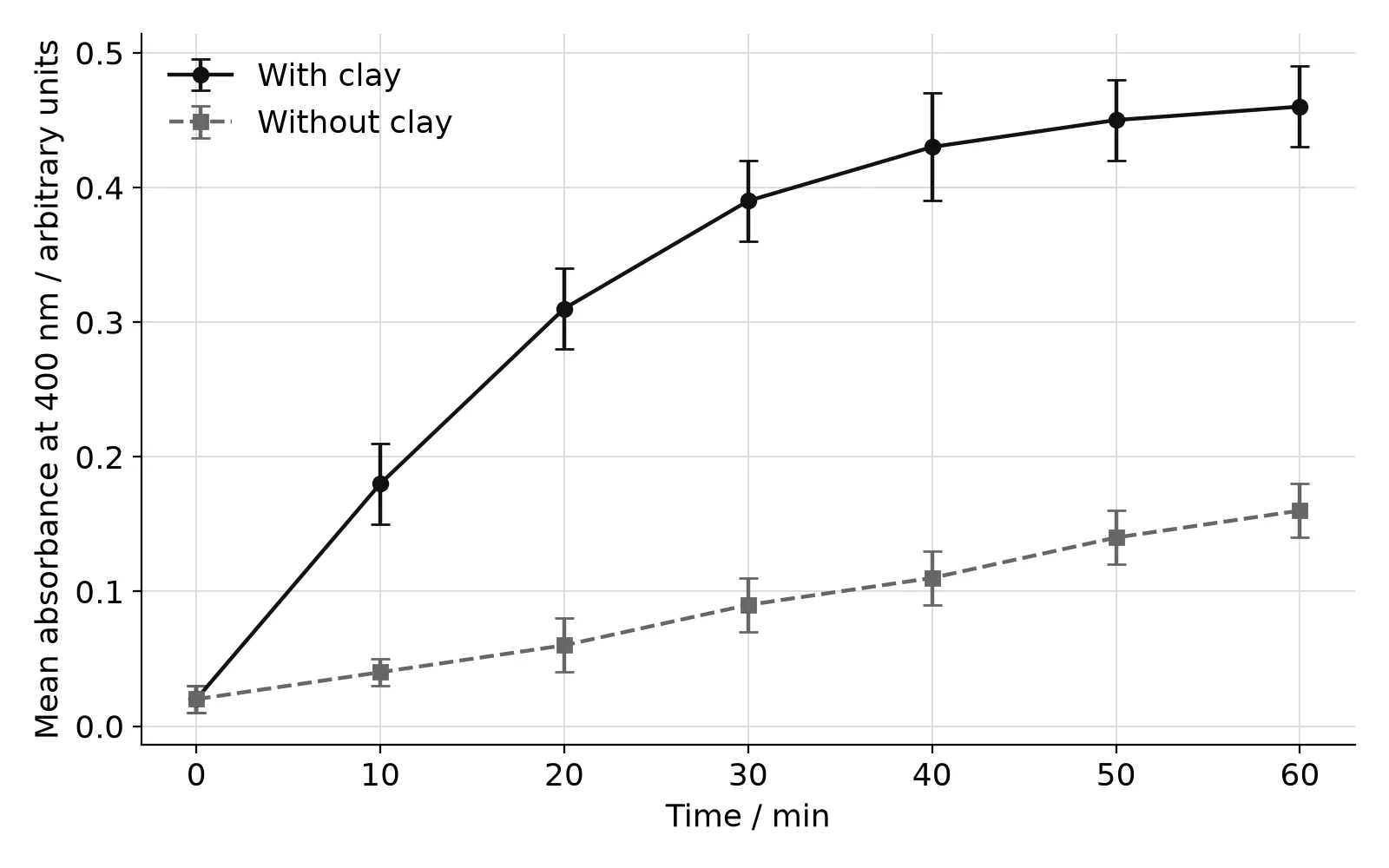
Fatty acids form micelles in alkaline solution but coalesce into vesicles (spherical bilayers) when the pH is lowered. Vesicles scatter light, so the turbidity (absorbance at 400 nm) of the solution increases as they form. Researchers lowered the pH of a decanoic acid solution to pH 7.5 and measured absorbance every 10 minutes, with and without small particles of montmorillonite, a clay mineral that was common on the early Earth. Absorbance readings were corrected using a tube containing the clay suspension without decanoic acid. Five repeats were carried out for each treatment; error bars show ± one standard deviation.
- (a)
State the dependent variable in this investigation.
1 mark
- (b)
Explain why the absorbance readings were corrected using a tube containing clay without decanoic acid.
2 marks
- (c)
Calculate how many times faster the mean rate of increase in absorbance was with clay than without clay during the first 10 minutes.
2 marks
- (d)
Using the error bars, state whether the difference in absorbance between the two treatments at 60 minutes is likely to be significant. Give a reason.
1 mark
- (e)
Suggest why the absorbance with clay levels off after about 40 minutes.
2 marks
- (f)
Suggest how the results of this investigation support hypotheses about the origin of the first cells.
2 marks
Several kinds of evidence are used to estimate when life first appeared on Earth. The table shows estimated ages for some of this evidence.
Evidence | Estimated age / billion years |
|---|---|
Formation of the Earth | 4.54 |
Graphite enriched in carbon-12, trapped inside ancient mineral crystals | 4.1 |
Filaments resembling microfossils in seafloor hydrothermal vent precipitates | at least 3.77 |
Carbon enriched in carbon-12 in ancient sedimentary rocks | 3.7 |
Stromatolites (layered rocks formed by mats of microorganisms) | 3.48 |
Molecular clock estimates of the age of the last universal common ancestor (LUCA) | 3.5 to 4.5 |
- (a)
Calculate the time between the formation of the Earth and the formation of the oldest stromatolites shown.
1 mark
- (b)
Outline how the ratio of carbon isotopes in ancient rocks can provide evidence of life.
2 marks
- (c)
Suggest reasons why the isotope and filament evidence is regarded as less certain than the stromatolite evidence.
2 marks
- (d)
Suggest why molecular clock estimates of the age of LUCA cover such a wide range.
2 marks
Practice all 38 in Augment
Free with an account. Every question has its markscheme, and Augment keeps the ones you got wrong so you can come back to them.
More questions in Unity and diversity
- A1.1Water
- A1.2Nucleic acids
- A2.1Origins of cellsThis page
- A2.2Cell structure
- A2.3Viruses
- A3.1Diversity of organisms
- A3.2Classification and cladistics
- A4.1Evolution and speciation
- A4.2Conservation of biodiversity
Check your answers in Augment
A free account opens all 38 questions on Origins of cells with their markschemes, and keeps a record of what you have marked.