A1.2 Nucleic acids questions for IB Biology
42 questions on Nucleic acids, written by Augment in the style of IB exam papers. Six of them are below in full, to answer on paper.
- IB Biology
- Part of A Unity and diversity
- SL and HL
Questions by paper and level
SL and HL questions are for students at either level. HL only questions cover what only HL students study.
| Paper | SL and HL | HL only | All |
|---|---|---|---|
| Paper 1A | 12 | 9 | 21 |
| Paper 1B | 3 | 2 | 5 |
| Paper 2 | 12 | 4 | 16 |
| Every paper | 27 | 15 | 42 |
Counted on
Questions to try
Written by Augment in the style of IB exams, not past papers. Answer them on paper, then check each one against its markscheme with a free account.
Which components are found in every nucleotide of DNA?
Students compared the yield of DNA extracted from three fruits: strawberry (Fragaria × ananassa), kiwifruit (Actinidia deliciosa) and banana (Musa acuminata). For each extraction, 10 g of fruit was mashed in a solution of detergent and salt, the mixture was filtered and ice-cold ethanol was layered on top of the filtrate. The white precipitate that formed at the boundary was wound onto a glass rod and its wet mass was measured. Five extractions were carried out for each fruit.
Fruit | Trial 1 / mg | Trial 2 / mg | Trial 3 / mg | Trial 4 / mg | Trial 5 / mg | Mean / mg | Standard deviation / mg |
|---|---|---|---|---|---|---|---|
Strawberry | 182 | 167 | 195 | 174 | 188 | X | 11.1 |
Kiwifruit | 102 | 81 | 110 | 85 | 104 | 96.4 | 12.7 |
Banana | 70 | 105 | 92 | 74 | 99 | 88.0 | 15.4 |
- (a)
State the dependent variable in this investigation.
1 mark
- (b)
Calculate the mean wet mass of precipitate, X, for strawberry.
1 mark
- (c)
Using the data, discuss whether there is a significant difference between the yields from kiwifruit and banana.
2 marks
- (d)
Suggest one reason why the mass of precipitate may not be an accurate measure of the mass of DNA extracted.
1 mark
- (e)
Suggest one modification to the method that would allow a fairer comparison of DNA yield between the fruits.
1 mark
- (f)
The DNA formed long strands that could be wound onto the rod without breaking into small pieces. Outline how the structure of DNA explains this.
2 marks
Hydrogen bonds are individually weak, but together they have major effects in living organisms.
- (a)
Describe how hydrogen bonds form between water molecules.
4 marks
- (b)
Outline the role of hydrogen bonds in the structure of DNA.
4 marks
- (c)
Explain how the properties of water allow it to be transported to the top of tall trees.
7 marks
A purified nucleic acid sample contains adenine, cytosine, guanine and uracil but no thymine. What could the sample be?
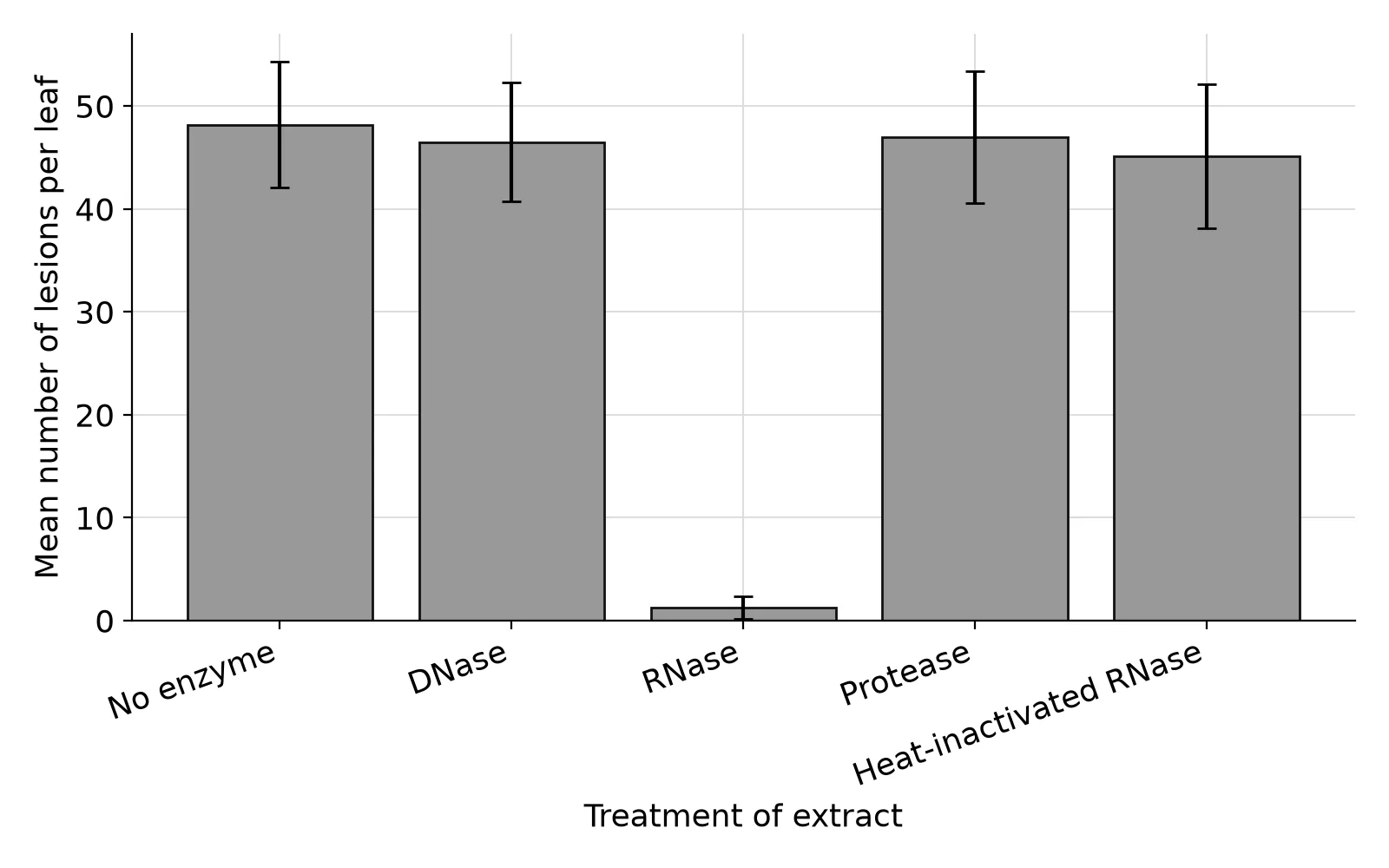
Researchers extracted nucleic acid from purified tobacco mosaic virus (TMV), a virus that infects tobacco plants (Nicotiana tabacum). Samples of the extract were incubated for 30 minutes at 37 °C with one of four treatments, or with no enzyme. Each sample was then rubbed onto ten leaves of separate young tobacco plants. After five days the number of dead spots (lesions) per leaf, each caused by a successful infection, was counted.
- (a)
State the dependent variable in this investigation.
1 mark
- (b)
Calculate the percentage decrease in the mean number of lesions per leaf caused by treatment with RNase, compared with no enzyme.
1 mark
- (c)
Explain the purpose of including a sample treated with heat-inactivated RNase.
2 marks
- (d)
Deduce, with a reason, the type of genetic material of TMV.
2 marks
- (e)
Suggest why treatment with protease had no significant effect on the number of lesions.
1 mark
- (f)
TMV has its own genetic material but is not considered to be a living organism. State one reason for this.
1 mark
RNA is a polymer made of nucleotide monomers.
- (a)
Draw a labelled diagram of a single RNA nucleotide, using a circle, a pentagon and a rectangle to represent its components.
2 marks
- (b)
State the type of reaction that links RNA nucleotides together.
1 mark
- (c)
Draw a diagram of a section of an RNA molecule containing three nucleotides.
3 marks
Practice all 42 in Augment
Free with an account. Every question has its markscheme, and Augment keeps the ones you got wrong so you can come back to them.
More questions in Unity and diversity
- A1.1Water
- A1.2Nucleic acidsThis page
- A2.1Origins of cellsHL only
- A2.2Cell structure
- A2.3VirusesHL only
- A3.1Diversity of organisms
- A3.2Classification and cladisticsHL only
- A4.1Evolution and speciation
- A4.2Conservation of biodiversity
Check your answers in Augment
A free account opens all 42 questions on Nucleic acids with their markschemes, and keeps a record of what you have marked.