A3.1 Diversity of organisms questions for IB Biology
40 questions on Diversity of organisms, written by Augment in the style of IB exam papers. Six of them are below in full, to answer on paper.
- IB Biology
- Part of A Unity and diversity
- SL and HL
Questions by paper and level
SL and HL questions are for students at either level. HL only questions cover what only HL students study.
| Paper | SL and HL | HL only | All |
|---|---|---|---|
| Paper 1A | 15 | 5 | 20 |
| Paper 1B | 3 | 2 | 5 |
| Paper 2 | 10 | 5 | 15 |
| Every paper | 28 | 12 | 40 |
Counted on
Questions to try
Written by Augment in the style of IB exams, not past papers. Answer them on paper, then check each one against its markscheme with a free account.
Which is the correct way to write the binomial name of the grey wolf in a printed text?
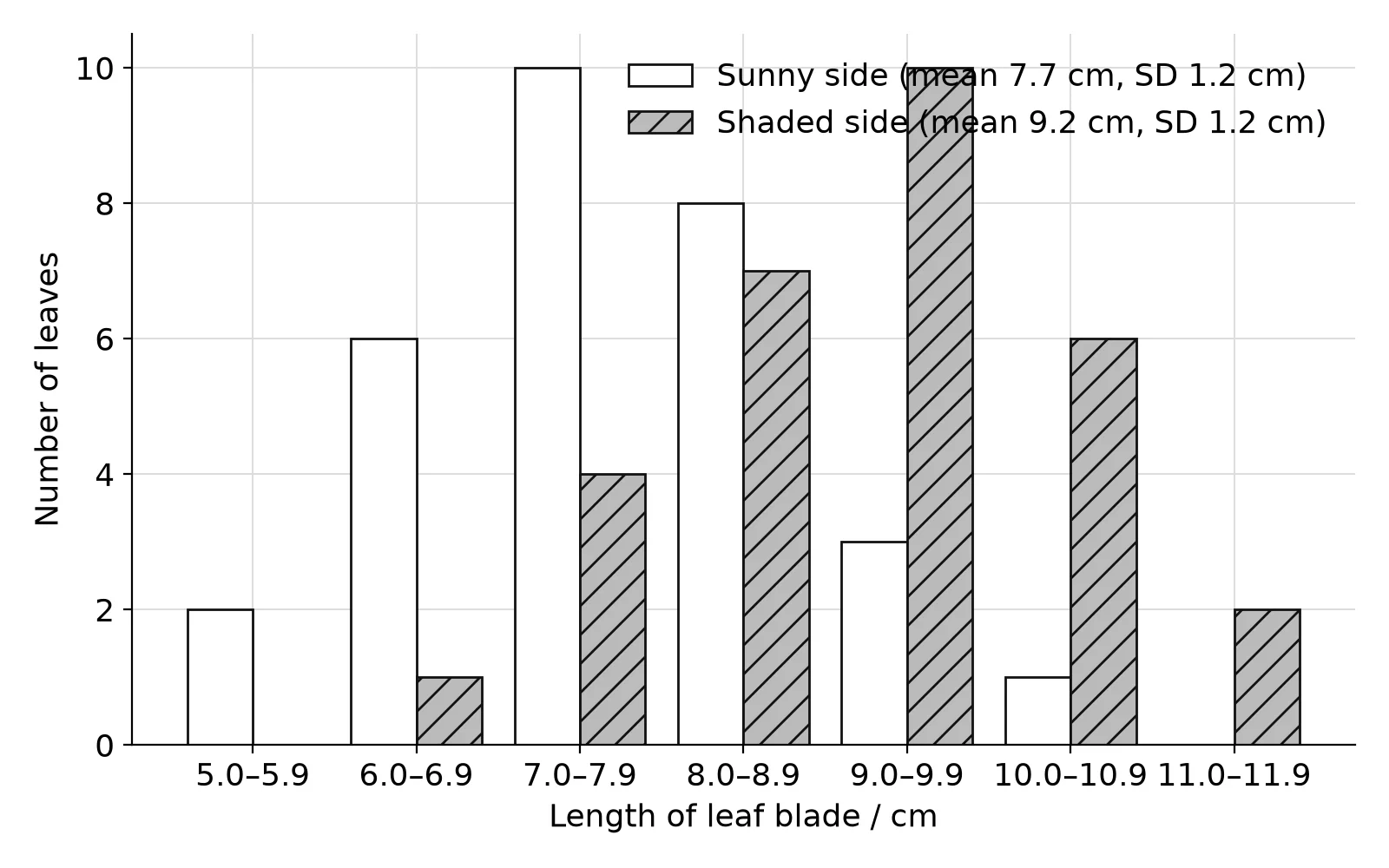
Students investigated variation in the leaves of a single European beech tree (Fagus sylvatica). They collected 30 leaves at random from the outer branches on the sunny south side of the tree and 30 from the shaded north side, all at a height of 1.5–2.0 m. The length of each leaf blade was measured to the nearest 0.1 cm.
- (a)
Identify the most common length class for leaves from the shaded side of the tree.
1 mark
- (b)
Calculate the percentage by which the mean length of shaded leaves is greater than the mean length of sunny leaves.
1 mark
- (c)
Describe the variation in leaf length shown by the data.
2 marks
- (d)
All of the leaves came from one tree and so share the same genome. Explain what the results suggest about the causes of variation in leaf length.
2 marks
- (e)
Suggest two improvements that would allow the students to draw a more reliable conclusion about the effect of light on leaf length in beech.
2 marks
Living organisms can be grouped into species.
- (a)
Outline the biological species concept and the difficulties in applying it.
4 marks
- (b)
Describe the evidence for evolution from base sequences in DNA and amino acid sequences in proteins.
4 marks
- (c)
Explain the roles of reproductive isolation and differential selection in the formation of new species.
7 marks
According to the biological species concept, a species is a group of organisms that
Students used an online genome database to compare genome sizes in different taxonomic groups. For each group they chose ten species with a complete genome sequence and recorded the genome size and the number of protein-coding genes.
Group | Smallest genome / Mbp | Largest genome / Mbp | Mean genome size / Mbp | Mean number of protein-coding genes |
|---|---|---|---|---|
Bacteria | 1.3 | 9.1 | 4.2 | 3 900 |
Fungi | 12 | 110 | 38 | 9 800 |
Insects | 120 | 6 500 | 1 100 | 15 000 |
Birds | 1 000 | 1 400 | 1 200 | 17 000 |
Mammals | 2 400 | 3 500 | 2 900 | 21 000 |
Amphibians | 1 500 | 32 000 | 10 500 | 22 000 |
Flowering plants | 135 | 17 000 | 3 900 | 31 000 |
Mbp = million base pairs
- (a)
Calculate how many times larger the mean genome of amphibians is than the mean genome of mammals.
1 mark
- (b)
Identify the group with the greatest range of genome sizes.
1 mark
- (c)
Evaluate the claim that genome size increases with the complexity of an organism.
3 marks
- (d)
Suggest reasons for genome size varying much more between groups than the number of protein-coding genes.
2 marks
- (e)
Suggest one limitation of using these database values to draw conclusions about each whole group.
1 mark
Speciation and changes to chromosomes have shaped the diversity of life.
- (a)
Outline the evidence that human chromosome 2 was formed by the fusion of two chromosomes in a primate ancestor.
4 marks
- (b)
Describe adaptive radiation as a source of biodiversity.
4 marks
- (c)
Compare and contrast allopatric and sympatric speciation.
7 marks
Practice all 40 in Augment
Free with an account. Every question has its markscheme, and Augment keeps the ones you got wrong so you can come back to them.
More questions in Unity and diversity
- A1.1Water
- A1.2Nucleic acids
- A2.1Origins of cellsHL only
- A2.2Cell structure
- A2.3VirusesHL only
- A3.1Diversity of organismsThis page
- A3.2Classification and cladisticsHL only
- A4.1Evolution and speciation
- A4.2Conservation of biodiversity
Check your answers in Augment
A free account opens all 40 questions on Diversity of organisms with their markschemes, and keeps a record of what you have marked.