A3.2 Classification and cladistics questions for IB Biology
36 questions on Classification and cladistics, written by Augment in the style of IB exam papers. Six of them are below in full, to answer on paper.
- IB Biology
- Part of A Unity and diversity
- HL only
Questions by paper and level
| Paper | Questions |
|---|---|
| Paper 1A | 20 |
| Paper 1B | 5 |
| Paper 2 | 11 |
| Every paper | 36 |
Counted on
Questions to try
Written by Augment in the style of IB exams, not past papers. Answer them on paper, then check each one against its markscheme with a free account.
What is the main reason why biologists need to classify organisms?
Students examined preserved specimens of five species of ground beetle, P to T, and one species from a different, distantly related family of beetles, which was used as an outgroup. They scored five morphological characters as 0 (the state found in the outgroup) or 1 (a different state). The table shows their results.
Character | Outgroup | P | Q | R | S | T |
|---|---|---|---|---|---|---|
1. ridged wing cases | 0 | 1 | 1 | 1 | 1 | 1 |
2. toothed mandibles | 0 | 0 | 1 | 1 | 1 | 1 |
3. hairs on hind legs | 0 | 0 | 0 | 1 | 1 | 1 |
4. metallic body colour | 0 | 0 | 0 | 0 | 1 | 1 |
5. reduced eyes | 0 | 1 | 0 | 0 | 0 | 0 |
- (a)
State the reason for including an outgroup in the analysis.
1 mark
- (b)
Identify the character that is shared only by the clade containing R, S and T.
1 mark
- (c)
Draw a cladogram for the five species and the outgroup, based on these data.
3 marks
- (d)
State why character 5 gives no information about the relationships between the five species.
1 mark
- (e)
A study of base sequences of several genes placed Q and S in a clade that excluded R. Suggest two reasons why the morphological data and the sequence data give different cladograms.
2 marks
- (f)
Suggest one way the students could increase confidence in their cladogram.
1 mark
Biologists have described about two million species, and many more remain undescribed.
- (a)
State the taxon in the traditional hierarchy that lies between order and genus.
1 mark
- (b)
Outline two reasons why biologists need to classify organisms.
2 marks
- (c)
Explain one difficulty of classifying organisms into the traditional hierarchy of taxa.
2 marks
- (d)
Outline why the change to classifying organisms into unranked clades is described as a paradigm shift.
2 marks
Which sequence shows the taxa of the traditional hierarchy from the most inclusive to the least inclusive?
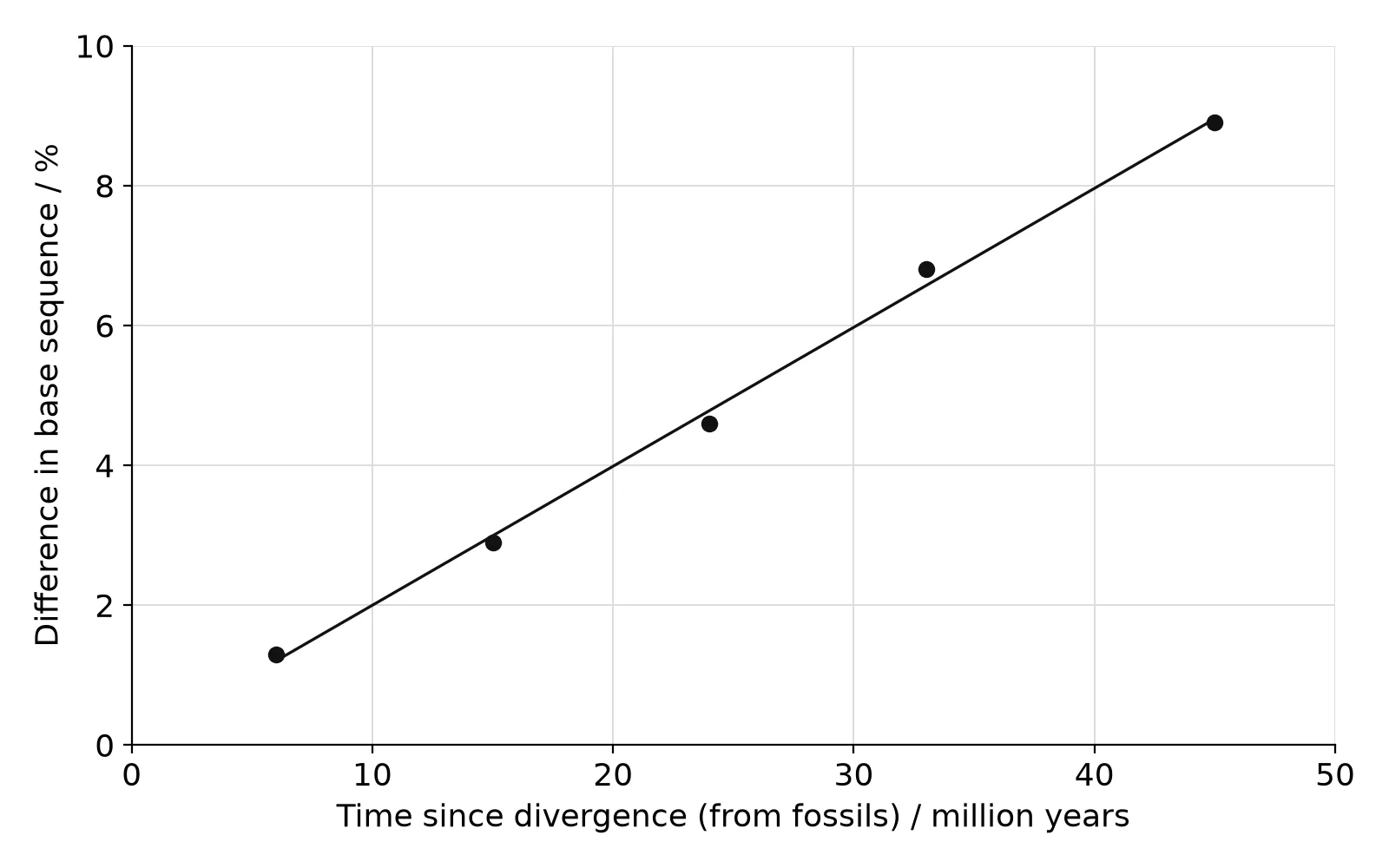
Researchers sequenced the same nuclear gene in five pairs of mammal species. For each pair, the time since the two species diverged had been estimated from the fossil record. The graph shows the percentage of bases that differed between the two species in each pair, with a line of best fit.
- (a)
Describe the relationship between time since divergence and difference in base sequence.
1 mark
- (b)
Calculate the rate at which differences accumulated in this gene, giving the units.
2 marks
- (c)
Two other mammal species have no useful fossil record. They differ by 3.8 % in this gene. Estimate the time since they diverged.
1 mark
- (d)
Explain why the estimate in (c) is only approximate.
3 marks
- (e)
Suggest one improvement to the method that would make the estimate more reliable.
1 mark
Cladistics groups organisms into clades.
- (a)
Define the term clade.
1 mark
- (b)
State the type of evidence that gives the most objective basis for identifying clades.
1 mark
- (c)
Outline two advantages of a classification that corresponds to evolutionary relationships.
2 marks
- (d)
Distinguish between a node and a terminal branch on a cladogram.
2 marks
- (e)
State what the root of a cladogram represents.
1 mark
Practice all 36 in Augment
Free with an account. Every question has its markscheme, and Augment keeps the ones you got wrong so you can come back to them.
More questions in Unity and diversity
- A1.1Water
- A1.2Nucleic acids
- A2.1Origins of cells
- A2.2Cell structure
- A2.3Viruses
- A3.1Diversity of organisms
- A3.2Classification and cladisticsThis page
- A4.1Evolution and speciation
- A4.2Conservation of biodiversity
Check your answers in Augment
A free account opens all 36 questions on Classification and cladistics with their markschemes, and keeps a record of what you have marked.