A1.1 Water questions for IB Biology
39 questions on Water, written by Augment in the style of IB exam papers. Six of them are below in full, to answer on paper.
- IB Biology
- Part of A Unity and diversity
- SL and HL
Questions by paper and level
SL and HL questions are for students at either level. HL only questions cover what only HL students study.
| Paper | SL and HL | HL only | All |
|---|---|---|---|
| Paper 1A | 15 | 5 | 20 |
| Paper 1B | 4 | 1 | 5 |
| Paper 2 | 11 | 3 | 14 |
| Every paper | 30 | 9 | 39 |
Counted on
Questions to try
Written by Augment in the style of IB exams, not past papers. Answer them on paper, then check each one against its markscheme with a free account.
Why is water described as the medium for life?
Students investigated capillary rise of water in soil. Glass tubes 50 cm long with an internal diameter of 2 cm were packed with dry, sieved sand of one of five particle sizes. The lower end of each tube was placed in 1 cm of water and the height of the wetting front (the top of the wet sand) was measured after 24 hours. Five tubes were set up for each particle size.
Mean particle diameter / mm | Mean height of wetting front after 24 h / cm | Standard deviation / cm |
|---|---|---|
2.0 | 4.1 | 0.6 |
1.0 | 8.3 | 0.9 |
0.5 | 15.6 | 1.4 |
0.25 | 29.8 | 2.7 |
0.125 | 46.2 | 4.1 |
- (a)
Identify the independent variable in this investigation.
1 mark
- (b)
State two variables that should have been kept constant.
2 marks
- (c)
Calculate the percentage increase in mean height of the wetting front when the mean particle diameter decreased from 0.5 mm to 0.25 mm.
1 mark
- (d)
Describe the relationship between particle diameter and the height of the wetting front.
2 marks
- (e)
Explain the results in terms of the properties of water.
3 marks
- (f)
Suggest one limitation of using sieved sand in tubes as a model of capillary rise in natural soil.
1 mark
The black-throated loon (Gavia arctica) flies between lakes and dives under water to catch fish. The ringed seal (Pusa hispida) swims in Arctic seawater and rests on the ice in air. The table compares some physical properties of air and water at 20 °C.
Property | Air | Water |
|---|---|---|
Density / kg m-3 | 1.2 | 998 |
Viscosity / mPa s | 0.018 | 1.00 |
Thermal conductivity / W m-1 K-1 | 0.025 | 0.60 |
Specific heat capacity / J g-1 K-1 | 1.0 | 4.2 |
- (a)
Calculate how many times greater the thermal conductivity of water is than that of air.
1 mark
- (b)
Using the data, outline why a streamlined body shape is more important for a loon swimming under water than for a loon flying.
2 marks
- (c)
Explain how the difference in density between air and water affects the loon when it dives and when it flies.
2 marks
- (d)
Using the data, explain why a ringed seal loses heat faster when swimming than when resting on the ice in air at the same temperature.
2 marks
What makes a water molecule polar?
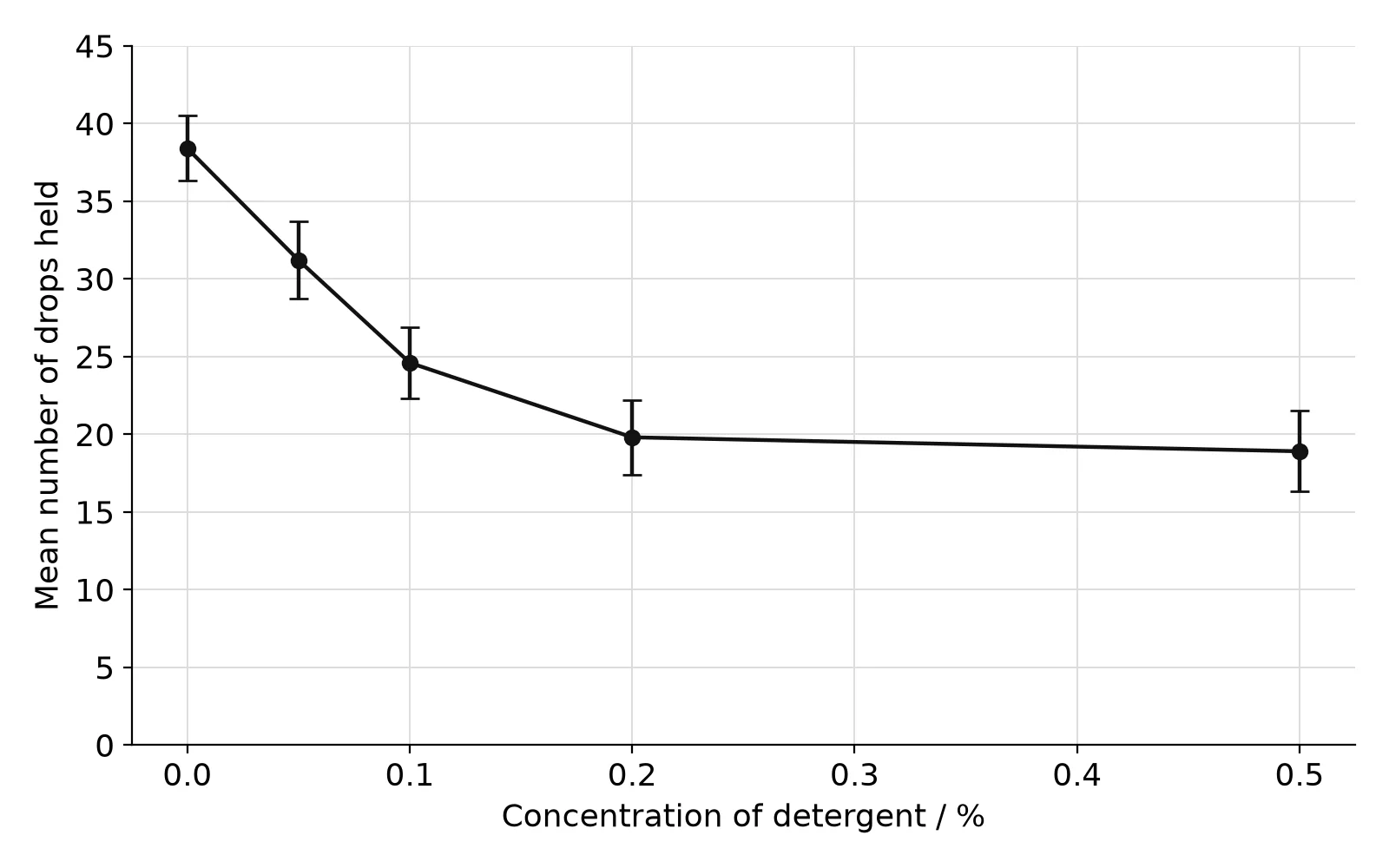
Students investigated the effect of detergent on the surface tension of water. A clean coin was placed flat on a bench and drops of a detergent solution were added one at a time from the same plastic dropper until the liquid overflowed the edge of the coin. The number of drops held was recorded. This was repeated ten times for each of five concentrations of detergent. The graph shows the mean number of drops held; error bars show ±1 standard deviation.
- (a)
State the dependent variable.
1 mark
- (b)
Suggest why the same dropper was used for every trial.
1 mark
- (c)
Calculate the percentage decrease in the mean number of drops held between 0 % and 0.20 % detergent.
1 mark
- (d)
Evaluate the claim that 0.50 % detergent reduces surface tension more than 0.20 % detergent.
2 marks
- (e)
Explain why pure water can form a dome above the rim of the coin.
2 marks
- (f)
Pond skaters (Gerris lacustris) live on the surface of ponds. Suggest the consequences for pond skaters of detergent entering a pond.
2 marks
Water molecules are polar and form hydrogen bonds with each other.
- (a)
Draw a labelled diagram showing three water molecules and the hydrogen bonds between them.
3 marks
- (b)
State the type of bond between the oxygen atom and a hydrogen atom within a water molecule.
1 mark
- (c)
Explain why a water molecule is polar.
2 marks
- (d)
Outline why water is described as the medium for life.
2 marks
Practice all 39 in Augment
Free with an account. Every question has its markscheme, and Augment keeps the ones you got wrong so you can come back to them.
More questions in Unity and diversity
- A1.1WaterThis page
- A1.2Nucleic acids
- A2.1Origins of cellsHL only
- A2.2Cell structure
- A2.3VirusesHL only
- A3.1Diversity of organisms
- A3.2Classification and cladisticsHL only
- A4.1Evolution and speciation
- A4.2Conservation of biodiversity
Check your answers in Augment
A free account opens all 39 questions on Water with their markschemes, and keeps a record of what you have marked.