Describe variation, define species using morphological and biological concepts, name organisms binomially, read karyograms, compare genomes and their sizes, and (HL) use dichotomous keys and eDNA.
Each is in the Biology glossary, with every other term in the subject.
One of the different forms of a gene, differing from other forms of the same gene by small differences in base sequence.
Any chromosome that is not a sex chromosome; humans have 22 pairs of autosomes.
The international system of naming each species with two words: the genus name followed by the specific name, for example Homo sapiens.
The definition of a species as a group of organisms that can interbreed and produce fertile offspring, and that are reproductively isolated from other such groups.
The region of a chromosome where the two sister chromatids are held together and where spindle microtubules attach during cell division.
Variation in which a trait can take any value within a range, with many intermediates, such as human height; usually controlled by many genes and affected by the environment.
An identification tool made of a series of steps, each offering a choice between two contrasting descriptions of an observable feature, leading to the name of an organism.
Variation in which individuals fall into a small number of distinct categories with no intermediates, such as the four ABO blood groups; also called discontinuous variation.
Life on Earth is extremely diverse: about two million species have been named, and every individual of every species differs from all others. Biologists describe this diversity by grouping organisms into species, naming them, and comparing their chromosomes and genomes.
The species is the unit used to count, name and protect living things, yet defining it precisely is difficult. Chromosome counts and genome sequences now give evidence that can test where the boundaries between species lie.
40 exam-style questions on this subtopic, written in the style of the IB papers. The first has its markscheme open. Counted on
Living organisms can be grouped into species.
Outline the biological species concept and the difficulties in applying it.
4 marks
a. a species is a group of organisms that can interbreed;
b. and produce fertile offspring;
c. cannot be applied to organisms that reproduce asexually / bacteria;
d. cannot be tested for fossils / extinct organisms;
e. some different species can interbreed and produce fertile hybrids;
f. populations that are geographically separated cannot be tested for interbreeding;
g. during speciation, populations diverge gradually, so the point at which they become separate species is arbitrary;
[4 max]
Describe the evidence for evolution from base sequences in DNA and amino acid sequences in proteins.
4 marks
a. all organisms use DNA / the same genetic code, suggesting a common origin;
b. many proteins / genes are found in very different organisms (e.g. cytochrome c);
c. sequences can be compared between species;
d. closely related species have more similar sequences / fewer differences;
e. differences accumulate by mutation after species diverge;
f. the number of differences is roughly proportional to the time since divergence / molecular clock;
The official deck for this part of the syllabus.
What is variation?
Why is variation described as a defining feature of life?
With a free account, Augment remembers where you stopped and what you have practiced.
The identification of species using the base sequence of a short, standardised region of DNA, such as part of the COI gene in animals, compared with a reference database.
DNA that has been shed by organisms into their surroundings, such as water, soil or air, and can be collected and analysed to identify the species present; abbreviated eDNA.
The whole of the genetic information of an organism, consisting of the entire base sequence of its DNA (or RNA in some viruses).
A group of closely related species that share many features and a recent common ancestor; the first part of a binomial name.
A pair of chromosomes, one from each parent, with the same length, centromere position and sequence of genes, though not necessarily the same alleles.
The transfer of genetic material between organisms other than from parent to offspring, for example between different bacterial species by conjugation, transformation or transduction.
The offspring of a cross between two different species (or two genetically different varieties); hybrids between species are often sterile.
An image of the chromosomes of a cell, arranged in homologous pairs in order of decreasing length, used to show the karyotype.
The number and type of chromosomes present in the nucleus of a cell of an organism.
The definition of a species as a group of organisms that share the same set of observable structural features (morphology).
Medical care in which the prevention, diagnosis or treatment of disease is tailored to an individual, using information such as their genome sequence.
A chromosome that determines the sex of an organism; in humans the X and Y chromosomes, with females XX and males XY.
A position in the genome where the base differs between individuals of the same species, for example C in some individuals and T in others; abbreviated SNP.
A group of organisms with shared traits that can interbreed to produce fertile offspring; the basic unit of classification.
A region of repeated short DNA sequences at each end of a eukaryotic chromosome that protects the chromosome from damage and from shortening during replication.
The presence of three copies of a particular chromosome in a cell instead of the normal two, for example trisomy 21, which causes Down syndrome.
Differences in the traits of individual organisms, both between members of the same species and between different species.
The process of determining the complete base sequence of all the DNA in the genome of an organism.
No two living organisms are exactly the same. Two oak trees in the same wood differ in height, leaf shape and the number of acorns they produce, and two people differ in height, blood group, fingerprints and thousands of other traits. These differences between individuals are called variation. Variation is found in every group of organisms, from bacteria to whales, so it is one of the defining features of life.
Even identical twins are not identical in every trait. They develop from one fertilised egg, so they inherit the same genes, but they differ in fingerprints, in small details of the face and in many features shaped by their environment, such as body mass and the antibodies they carry. New mutations that arise after the egg divides, and differences in which genes are switched on, add further small differences. Variation therefore has two sources: differences in genes and differences in the environment, and most traits are affected by both.
Variation exists at two scales. Variation within a species is the difference between individuals of the same species, such as the range of coat colours in domestic cats. Variation between species is the larger set of differences that separates one species from another, such as the differences between a cat and a dog. The patterns of variation between species are complex: some species differ in only a few features, while others differ in almost everything. These patterns are the basis on which biologists name and classify organisms.
Traits vary in two different ways. Some traits fall into a few separate categories with nothing in between, while others can take any value within a range.
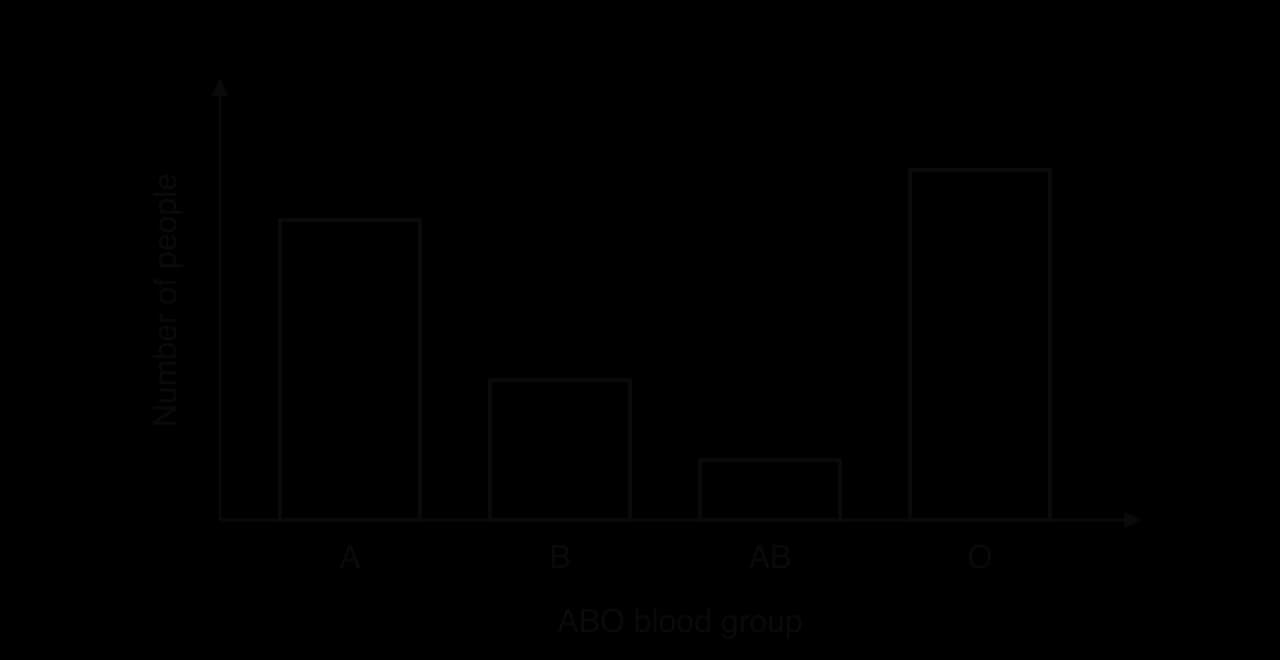
Human ABO blood group is an example of discrete variation. Every person has blood group A, B, AB or O, and there are no intermediate groups. Discrete traits are usually controlled by one gene, or a few genes, with little effect of the environment. The bar chart of ABO blood groups shows that data for a discrete trait are plotted as separate bars with gaps between them, because the categories do not run into each other.
Height in humans is an example of continuous variation. Heights can take any value between the shortest and the tallest person, and a large sample shows a smooth bell-shaped (normal) distribution: most people are close to the mean, and fewer are very short or very tall. Continuous traits are usually polygenic, which means they are influenced by many genes, each with a small effect, and they are also strongly affected by the environment. Height depends on diet and health in childhood as well as on genes.
Feature | Discrete variation | Continuous variation |
|---|---|---|
Values | A few distinct categories | Any value within a range |
Intermediates | None | Many |
Genes involved | Usually one or a few | Usually many (polygenic) |
Effect of environment | Small | Often large |
How data are shown | Bar chart with gaps between bars | Histogram or smooth curve, often a normal distribution |
Human examples | ABO blood group, ability to roll the tongue | Height, body mass, skin colour |
Biologists group organisms that share many traits into units called species. The species is the basic unit of classification: every organism belongs to one species, and each species has its own scientific name.
The first systematic way of recognising species was to compare the form of organisms: their shape, size, colour and structure. This is the morphological species concept. The Swedish naturalist Carl Linnaeus (1707–1778) used it to describe and name thousands of plants and animals. Linnaeus examined specimens and grouped together all those that shared the same set of visible features. Organisms that consistently differed in those features were placed in different species.
The morphological concept is still used every day. Museum collections, field guides and identification keys all rely on visible features, and it is the only concept that can be applied to fossils, whose behaviour and genes cannot be studied. Its weaknesses include the following.
Variation within a species. Males and females of one species may look very different. The male mallard duck (Anas platyrhynchos) has a green head and a grey body, while the female is mottled brown, yet they are the same species.
Similar-looking species. Two species may look almost identical. The chiffchaff (Phylloscopus collybita) and the willow warbler (Phylloscopus trochilus) are small green-brown birds that are very hard to tell apart by appearance, but they have different songs and do not interbreed.
Changes during life. A caterpillar and the butterfly it becomes look nothing alike, and a tadpole looks nothing like a frog.
Arbitrary decisions. Deciding how different two forms must be to count as separate species depends on the judgement of the biologist.
Linnaeus introduced a simple two-part naming system that is still used for every species. In binomial nomenclature, each species is given a name of two words, written in Latin form. The first word is the genus, a group of closely related species. The second word, the specific name, identifies the species within that genus. Together they form a unique name for the species.
The lion is Panthera leo, and the tiger, a closely related species in the same genus, is Panthera tigris. The shared genus name shows that the two are closely related, while the specific names (leo and tigris) separate them. The diagram of the name Panthera leo shows the conventions for writing a binomial name.

The rules for writing a binomial name are strict:
The genus name comes first and begins with a capital letter.
The specific name comes second and is written entirely in lower case, even when it comes from the name of a person or place (Rhinoderma darwinii, Darwin's frog).
The whole name is printed in italics. When written by hand, each word is underlined separately instead.
After the full name has been used once, the genus may be shortened to its first letter: Escherichia coli becomes E. coli.
Common names cause confusion because they differ between languages and regions. In Britain a "buzzard" is a hawk, Buteo buteo, whereas in North America the same word is used for vultures such as the turkey vulture, Cathartes aura. A binomial name refers to one species only, in every country and language. A scientist in Japan and a scientist in Brazil can be sure they are discussing the same organism.
This depends on international cooperation. Biologists have agreed sets of rules, called codes of nomenclature, for naming animals, for naming plants, algae and fungi, and for naming prokaryotes. The codes set out which name is valid when two scientists have named the same species independently (usually the older name) and ensure that no two species in the same code share a name. For animals, the starting date for valid names is the tenth edition of Linnaeus's Systema Naturae, published in 1758. Names change only when new evidence shows that a species belongs in a different genus, and the change is then adopted by biologists everywhere.
 YouTube
In the twentieth century biologists, led by Ernst Mayr, proposed a definition based on reproduction instead of appearance. The biological species concept defines a species as a group of populations whose members can interbreed and produce fertile offspring, and which are reproductively isolated from other such groups. Members of one species share a common pool of genes, because genes can pass between them through sexual reproduction. Genes cannot pass to other species, so each species evolves separately.
The offspring must be fertile for the parents to count as one species. Individuals of two different species sometimes mate and produce offspring, called hybrids, but the hybrids are usually infertile or less fit. The horse and the donkey can produce a mule, but mules are almost always sterile, so horses and donkeys remain separate species. The barriers that prevent interbreeding are forms of reproductive isolation, studied further in A4.1 Evolution and speciation.
The biological species concept explains why the chiffchaff and willow warbler are two species despite looking almost the same: they have different songs, females respond only to the song of their own species, and the two do not interbreed. It also explains why a male and a female mallard are one species despite looking different.
Like every definition in biology, the biological species concept is a model, and it does not fit every case:
Organisms that reproduce asexually. Bacteria, many fungi, and plants such as dandelions produce offspring without mating, so the question "can they interbreed?" has no meaning for them.
Fossils and extinct organisms. Their ability to interbreed cannot be tested, so fossil species can only be defined by morphology.
Populations that never meet. Two populations on different continents or islands may never have the chance to interbreed, even though they could if they met, and testing this in practice is usually impossible.
Fertile hybrids. Some species that are clearly distinct produce fertile hybrids where their ranges meet. Many species of oak (Quercus) hybridise freely, yet they remain recognisably different.
Gradual divergence. During speciation, populations that are separating may still interbreed occasionally, so there is no clear point at which they become two species.
Because no single definition works for every organism, biologists use several species concepts, including morphological, biological and phylogenetic (based on DNA and evolutionary history) concepts. Each is useful in different situations. Definitions of a species are therefore models that are tested and revised as new evidence becomes available, which is a feature of how science works.
African elephants show why choosing a species concept matters in practice. For most of the twentieth century they were treated as one species, Loxodonta africana, with two forms: a larger savanna elephant of the open grasslands of eastern and southern Africa, and a smaller forest elephant of the rainforests of central and western Africa.
The two forms differ clearly in morphology. Forest elephants are smaller, with rounder ears and straighter, thinner tusks that point downwards, an advantage when moving through dense vegetation. Savanna elephants are larger, with very large ears and tusks that curve outwards. They also live in different habitats and eat different foods: forest elephants eat large amounts of fruit and disperse the seeds of many rainforest trees. Where their ranges meet, hybrids do occur, but they are rare.
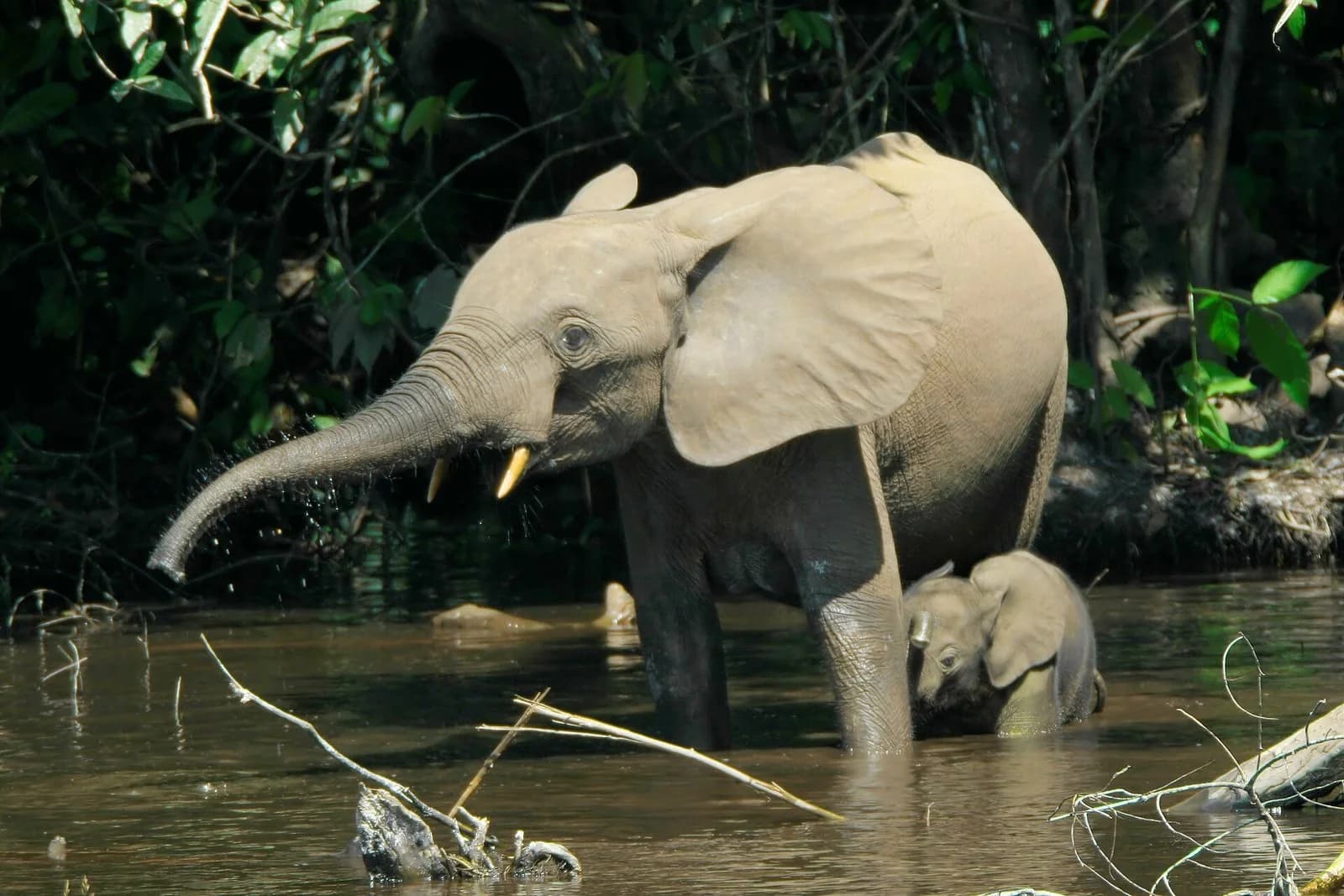
Analysis of the DNA of forest and savanna elephants found that the two lineages separated about 2–7 million years ago and that very little gene flow has occurred between them since. The genetic difference between them is comparable to the difference between the Asian elephant and the extinct woolly mammoth, which are placed in different genera. Under the biological species concept, two groups that have exchanged almost no genes for millions of years are reproductively isolated, so they are two species: the savanna elephant, Loxodonta africana, and the forest elephant, Loxodonta cyclotis.
The decision has direct consequences for conservation. The International Union for Conservation of Nature (IUCN) assesses how threatened each species is, and on 25 March 2021 it assessed the two African elephants separately for the first time.
Feature | Savanna elephant | Forest elephant |
|---|---|---|
Binomial name | Loxodonta africana | Loxodonta cyclotis |
Habitat | Grasslands and open woodland, eastern and southern Africa | Rainforests of central and western Africa |
Ears and tusks | Very large ears; tusks curve outwards | Rounder ears; straighter, thinner tusks pointing downwards |
IUCN Red List status (2021) | Endangered | Critically Endangered |
Population decline | At least 60% over 50 years | More than 86% over 31 years |
Sources: Rohland et al., PLoS Biology 8: e1000564, 2010; IUCN Red List press release, 25 March 2021.
Treated as one species, African elephants appeared less threatened as a whole, because large savanna populations in a few countries hid the steep decline of forest elephants, caused mainly by poaching for ivory and loss of habitat. Recognised as a separate species, the forest elephant is now listed as Critically Endangered, the highest category of threat before extinction in the wild, which directs conservation effort and funding towards it. Where the line between species is drawn is a scientific judgement based on evidence, and it has practical consequences for the protection of biodiversity.
A population is a group of organisms of the same species living in the same area at the same time. New species arise by speciation, the splitting of one species into two or more. Speciation usually begins when populations of one species stop interbreeding, for example because they become separated by a mountain range or a river. Each population then evolves separately, by mutation, natural selection and chance, and the two gradually become more and more different.
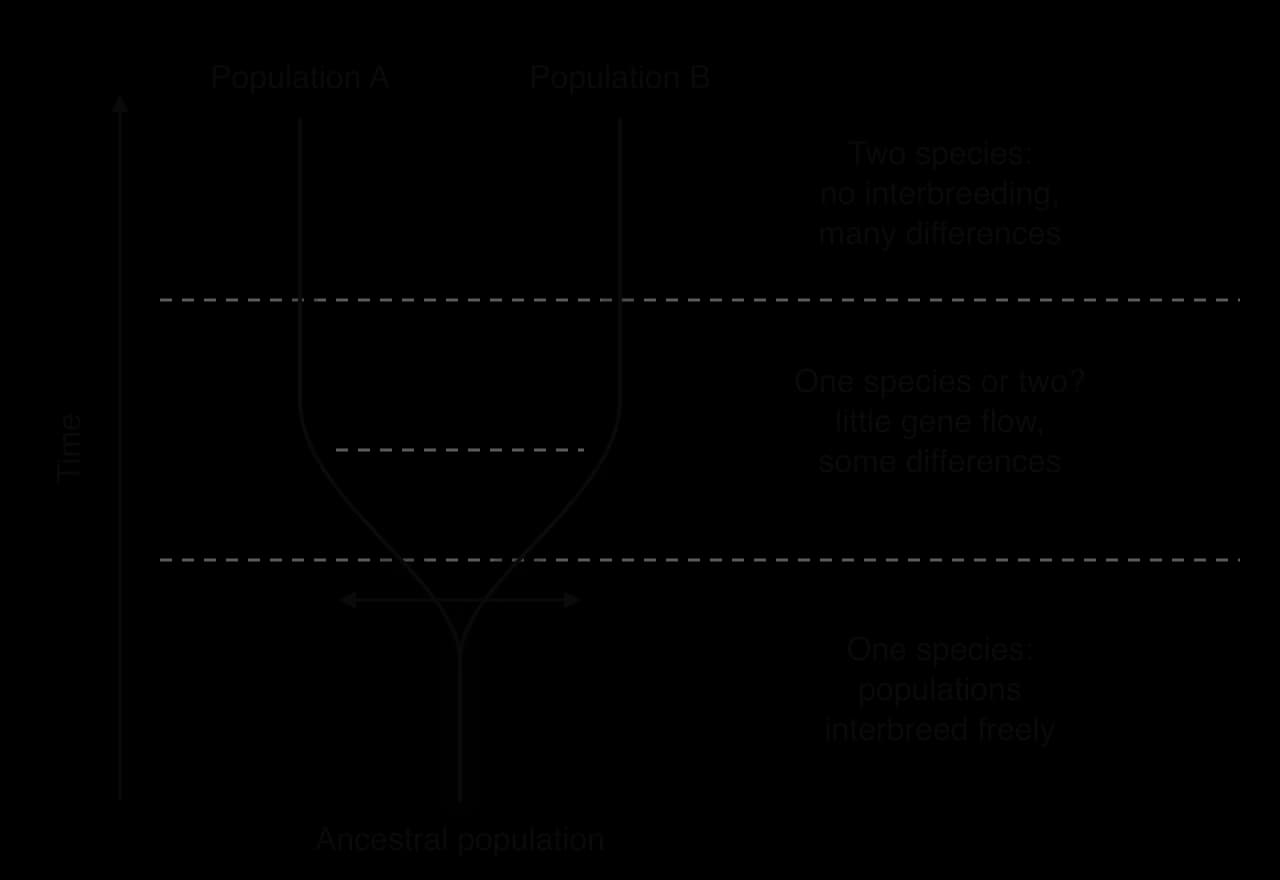
At the start, the separated populations are clearly one species: if they met, they would interbreed freely. Much later, they may have become so different that they could not interbreed even if they met, and they are clearly two species. Between these stages there is a long period in which the populations differ in some features and interbreed only partly or rarely. The diagram of diverging populations shows this middle stage as a zone of uncertainty.
Because divergence is gradual, there is no single moment at which one species becomes two, and deciding whether two diverging populations are separate species can be an arbitrary decision. The carrion crow (Corvus corone), which is all black, and the hooded crow (Corvus cornix), which is grey and black, show the problem. They meet in a narrow zone across Europe where they interbreed and produce fertile hybrids, yet outside that zone each form keeps its own appearance and tends to choose mates of its own type. For many years they were treated as one species; most authorities now treat them as two. The African elephants had diverged for much longer, so the evidence for two species was stronger.
In eukaryotes, the DNA of the nucleus is divided between several linear chromosomes. The number of chromosomes is a characteristic feature of each species: every normal body cell of a human has 46 chromosomes, every body cell of a chimpanzee has 48, and every body cell of a garden pea has 14. Chromosome number varies widely between species, as the table of plant and animal species shows.
Species | Type of organism | Diploid number (2n) |
|---|---|---|
Arabidopsis thaliana (thale cress) | Plant | 10 |
Pisum sativum (garden pea) | Plant | 14 |
Zea mays (maize) | Plant | 20 |
Oryza sativa (rice) | Plant | 24 |
Triticum aestivum (bread wheat) | Plant | 42 |
Drosophila melanogaster (fruit fly) | Animal | 8 |
Felis catus (domestic cat) | Animal | 38 |
Homo sapiens (human) | Animal | 46 |
Pan troglodytes (chimpanzee) | Animal | 48 |
Canis familiaris (dog) | Animal | 78 |
Most plants and animals are diploid: their body cells contain two sets of chromosomes, one set inherited from each parent. The diploid number is written 2n, and the number in one set, found in the gametes, is written n. Because the chromosomes come in pairs, diploid numbers are normally even. Humans have 2n = 46 and n = 23.
Chromosome number is not linked to the size or complexity of an organism. Dogs have 78 chromosomes and humans 46, and the extremes are found in unexpected places. Males of the Australian bulldog ant Myrmecia pilosula have only one chromosome in each cell, while the fern Ophioglossum reticulatum has more than 1,200. What matters for a species is that all its members share the same number, so that their chromosomes can pair correctly when gametes are made.
Humans have one pair of chromosomes fewer than chimpanzees, gorillas and orangutans, which all have 48. Chimpanzees are the closest living relatives of humans, and the two species share a common ancestor that lived roughly 6–7 million years ago. Since great apes have 48 chromosomes, the common ancestor almost certainly had 48 too, and the human lineage must have lost a pair. The leading explanation is that two ancestral chromosomes joined end to end to form human chromosome 2, so that humans have one large chromosome where chimpanzees have two smaller ones. Karyograms and DNA sequences provide the evidence used to test this fusion hypothesis.
The karyotype of an organism is the number and type of chromosomes in its cells. It is studied by making a karyogram, an image of the chromosomes of one cell arranged in pairs.
Chromosomes are only visible as separate structures when they are fully condensed, during mitosis. To make a karyogram, cells such as white blood cells are grown in culture and stimulated to divide. A chemical such as colchicine is added to stop division at metaphase, when the chromosomes are most condensed. The cells are then burst on a microscope slide so that the chromosomes spread out, stained, and photographed through a microscope. Finally, the images of the chromosomes are arranged in pairs, today usually by computer software.
Chromosomes are arranged in a karyogram using three features:
Length. Pairs are numbered from the longest (chromosome 1) to the shortest. Chromosomes 21 and 22 are exceptions in humans: chromosome 21 is slightly shorter than 22, but the numbering was fixed before this was known.
Position of the centromere. The centromere is the narrow region that joins the two chromatids of a condensed chromosome. Its position divides each chromosome into a short arm (p) and a long arm (q). Some chromosomes have the centromere near the middle; others, such as chromosomes 13, 14 and 15, have it very near one end.
Banding pattern. Stains such as Giemsa produce a pattern of light and dark bands that is the same in every copy of a given chromosome, so it identifies each chromosome precisely.
The two chromosomes in each pair are homologous chromosomes: one comes from the mother and one from the father, and they have the same length, centromere position and banding pattern, and carry the same genes in the same order. They may carry different versions of those genes.
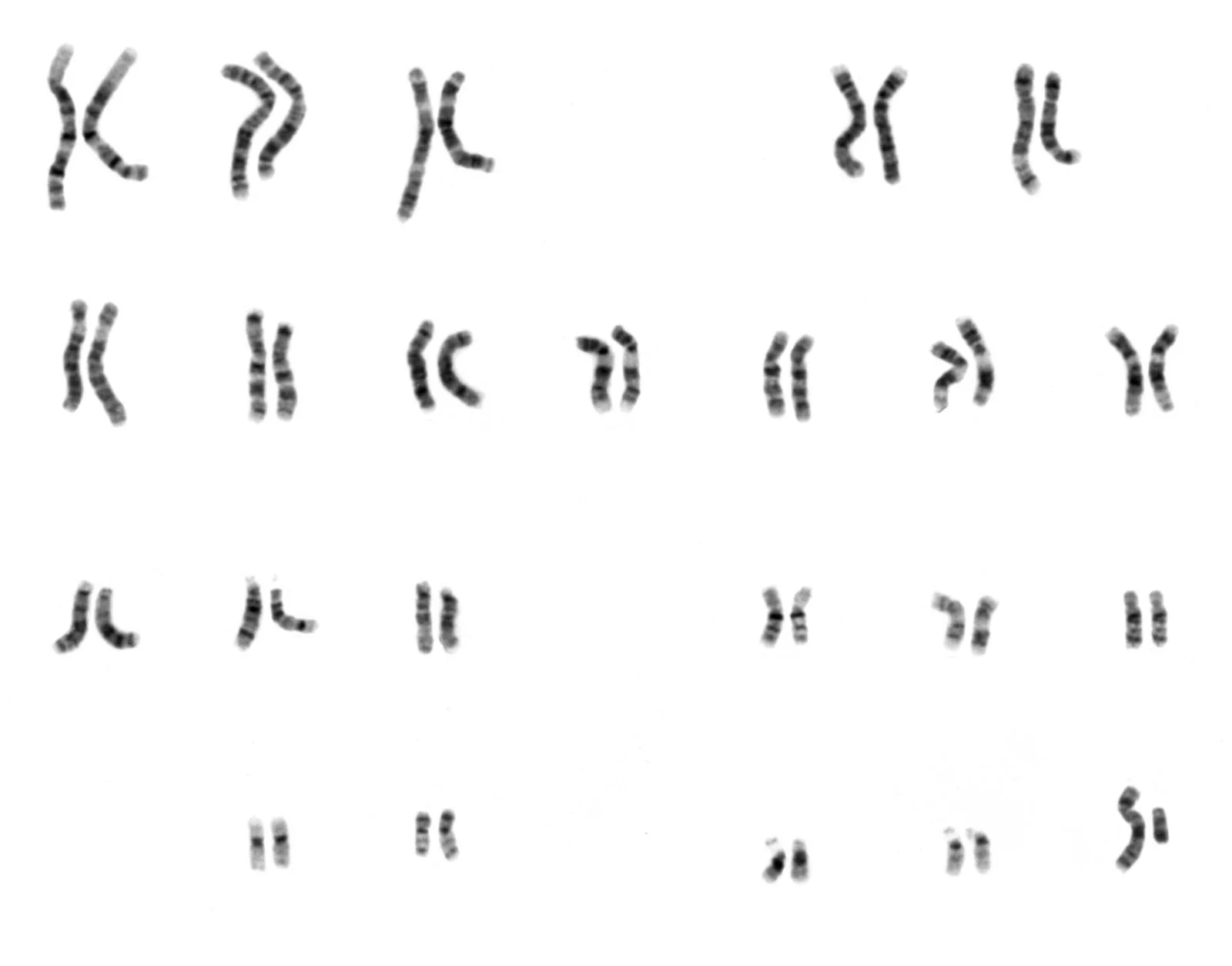
The human karyogram shows 23 pairs of chromosomes. Pairs 1 to 22 are autosomes, which are the same in males and females. The 23rd pair are the sex chromosomes, which determine sex. Females have two X chromosomes (XX), and males have one X and one much smaller Y chromosome (XY). The Y chromosome carries the SRY gene, which causes an embryo to develop as a male. The sex of a person can therefore be deduced from a karyogram by looking at the last pair: two X chromosomes indicate a female, and an X with a Y indicates a male.
A karyogram can also show differences in chromosome number. If a pair of chromosomes fails to separate during meiosis, an event called non-disjunction, a gamete may receive an extra copy of one chromosome. A zygote formed from it has three copies of that chromosome instead of two, a condition called trisomy. The best-known example is Down syndrome, caused by trisomy 21. A person with Down syndrome usually has 47 chromosomes instead of 46. The schematic karyogram used in the worked example shows this.
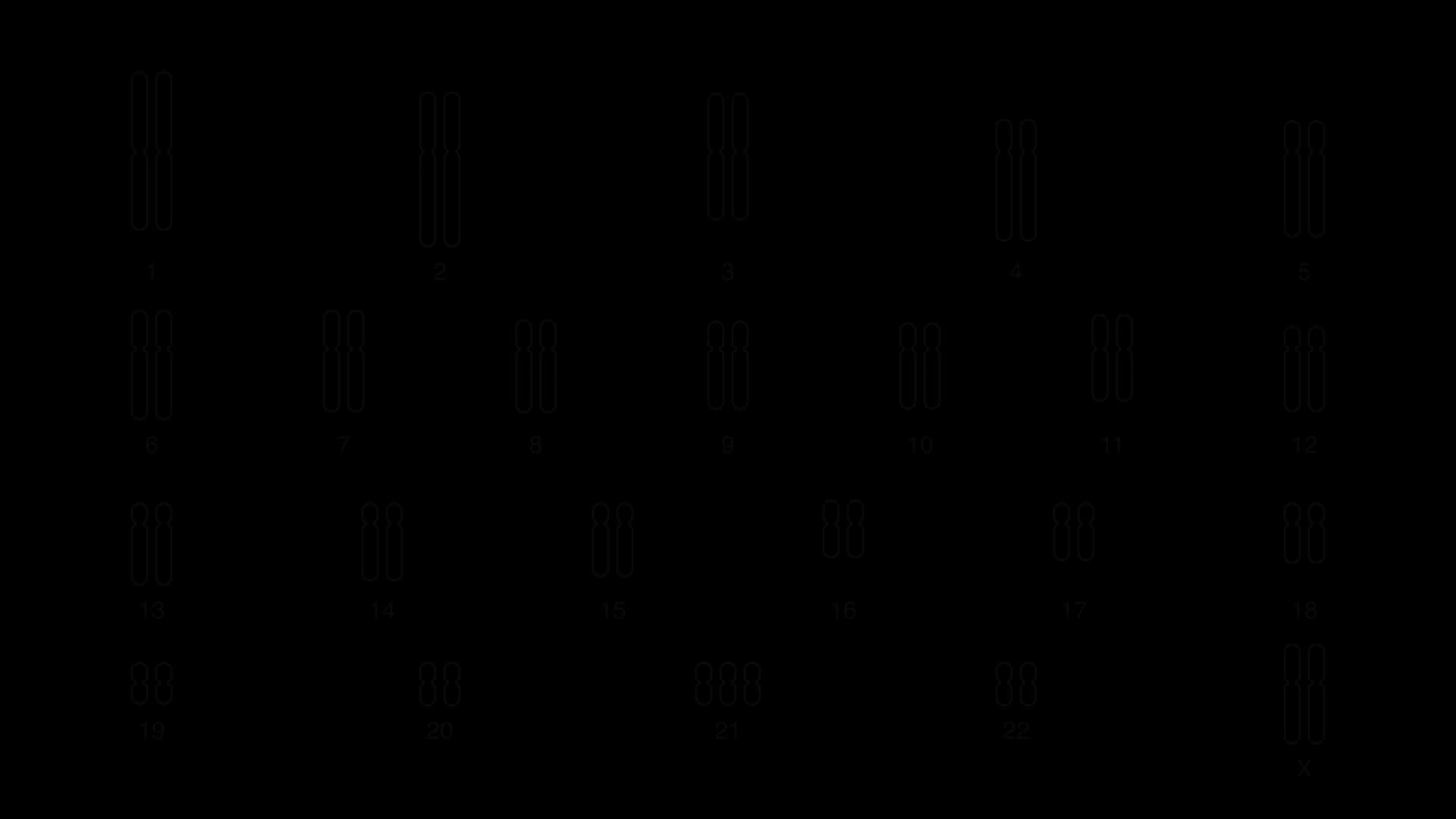
Karyograms are used in medicine to check for chromosome abnormalities before birth, using fetal cells, and in biology to compare species. An animated summary shows how chromosomes are prepared, paired and counted.
 YouTube
Humans have 46 chromosomes and the other great apes have 48. The leading hypothesis is that two ancestral chromosomes, which are still separate in chimpanzees (now called 2A and 2B, formerly numbered 12 and 13), fused end to end in an ancestor of humans after the human and chimpanzee lineages split, forming the single large human chromosome 2. A good hypothesis makes predictions that can be tested, and could be shown to be wrong if the predictions fail, and the fusion hypothesis makes several such predictions.
Each chromosome ends in a telomere, a region of short DNA sequence (TTAGGG in vertebrates) repeated thousands of times, which protects the ends of the chromosome. Each chromosome also has one centromere. If two chromosomes had fused end to end, the fused chromosome should show both of these features in places where they are not normally found.
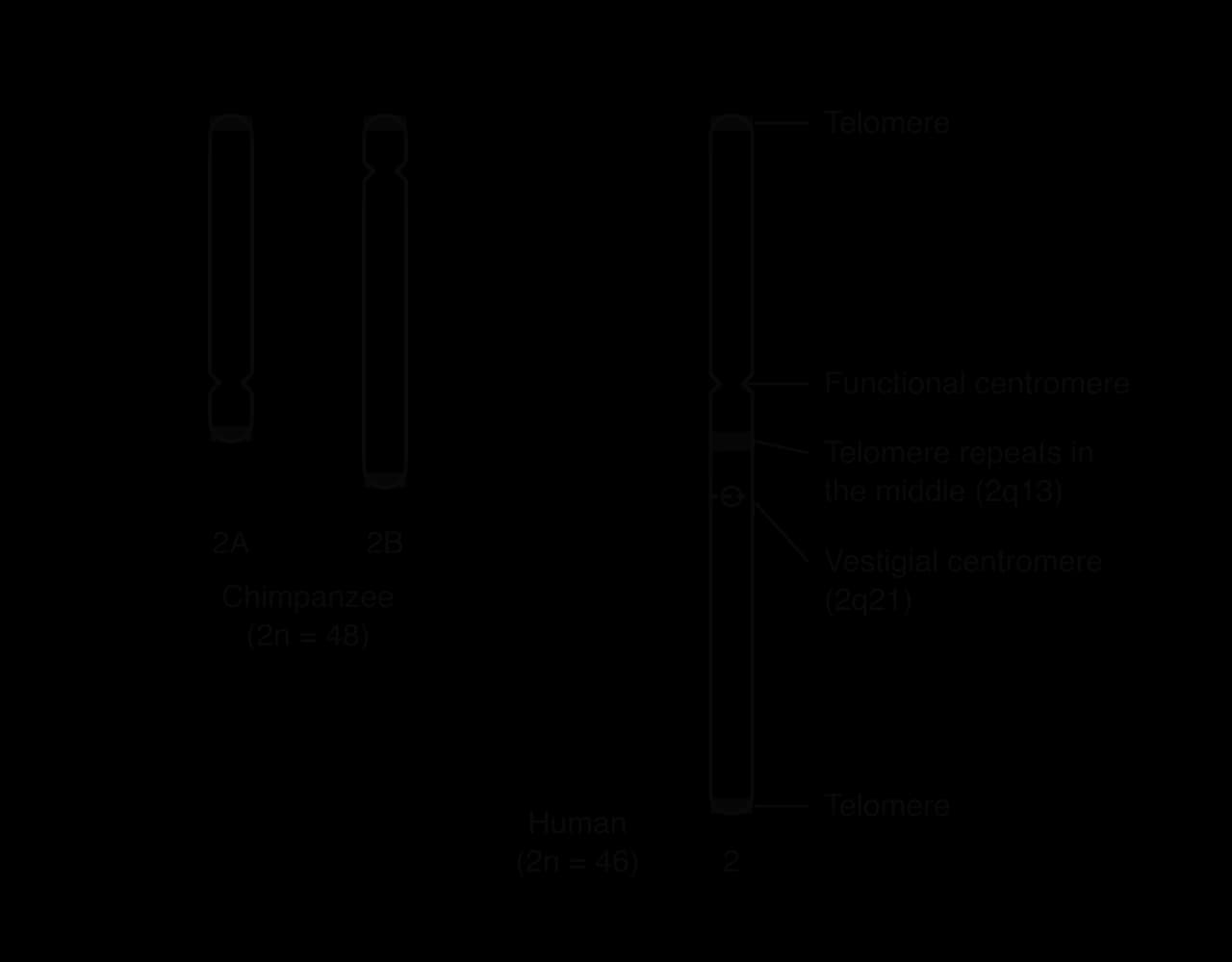
Each prediction has been tested against the human and chimpanzee chromosomes:
Banding patterns. The banding pattern of human chromosome 2 matches the banding of chimpanzee chromosomes 2A and 2B placed end to end, with the genes in the same order.
Telomere sequences in the middle. At band 2q13, near the middle of human chromosome 2, there is a stretch of telomere repeats arranged head to head, with one set running in each direction. This is exactly the arrangement expected if the ends of two chromosomes had joined.
A vestigial second centromere. At band 2q21 there are DNA sequences typical of a centromere that no longer functions. Its position matches the centromere of chimpanzee chromosome 2B.
Size. Human chromosome 2 is about as long as chimpanzee chromosomes 2A and 2B together.
The evidence strongly supports the hypothesis. It does not prove it, because a hypothesis in science can be supported but never proved with certainty. A strength of the test is that each prediction could have failed: if no telomere sequences had been found in the middle of chromosome 2, the hypothesis would have been falsified. A limitation is that the fusion happened in the past and cannot be observed directly, so the conclusion rests on comparing living species. The fused chromosome is also evidence that humans and chimpanzees share a common ancestor, an example of continuity and change in evolution.
The genome of an organism is all of its genetic information: the whole base sequence of its DNA, including all its genes and all the DNA between them. In eukaryotes the genome includes the DNA of the chromosomes in the nucleus and the small amount of DNA in mitochondria and, in plants, chloroplasts.
Members of one species share almost all of their genome. Every human has the same set of about 20,000 protein-coding genes, arranged in the same order on the same 23 pairs of chromosomes. When the genomes of two unrelated people are compared base by base, they are about 99.9% identical. This shared genome is the unity of the species: it is what makes every member of the species able to develop and function in the same way, and able to interbreed.
The remaining 0.1% is the diversity. A gene can exist in different versions, called alleles, which differ from each other in their base sequence. Most of the differences are single-base changes at particular positions in the genome, called single-nucleotide polymorphisms (SNPs, pronounced "snips"). At a SNP position, some members of the population have one base (for example C) and others have another (for example T).
Although 0.1% sounds small, the human genome has about 3.1 billion base pairs, so two people differ at several million positions. A typical human genome differs from the reference genome at about 4–5 million sites, and the 1000 Genomes Project, which sequenced 2,504 people from 26 populations, catalogued about 88 million variant positions in total. SNPs are used to trace ancestry and family relationships and to find alleles that affect the risk of diseases.
Unity (shared within the species) | Diversity (differs within the species) | |
|---|---|---|
Genes | The same genes in the same order | Different alleles of many genes |
Chromosomes | The same number and structure | Rare changes such as trisomy |
Base sequence | About 99.9% identical in humans | Millions of SNPs and other variants |
Consequence | Members can interbreed and develop alike | Variation on which natural selection can act |
This pattern of unity with diversity is the genetic basis of one of the central themes of biology. The shared genome holds a species together, while the variation within it is the raw material for natural selection and for the gradual changes that can lead to new species.
Genomes differ much more between species than within a species. They differ in two ways:
Base sequence. The more distantly related two species are, the more their base sequences differ. Humans and chimpanzees differ at about 1.2% of the bases in sequences that can be aligned, which is about twelve times the difference between two humans. Humans and mice differ far more. Comparing base sequences is therefore a powerful way to measure how closely species are related.
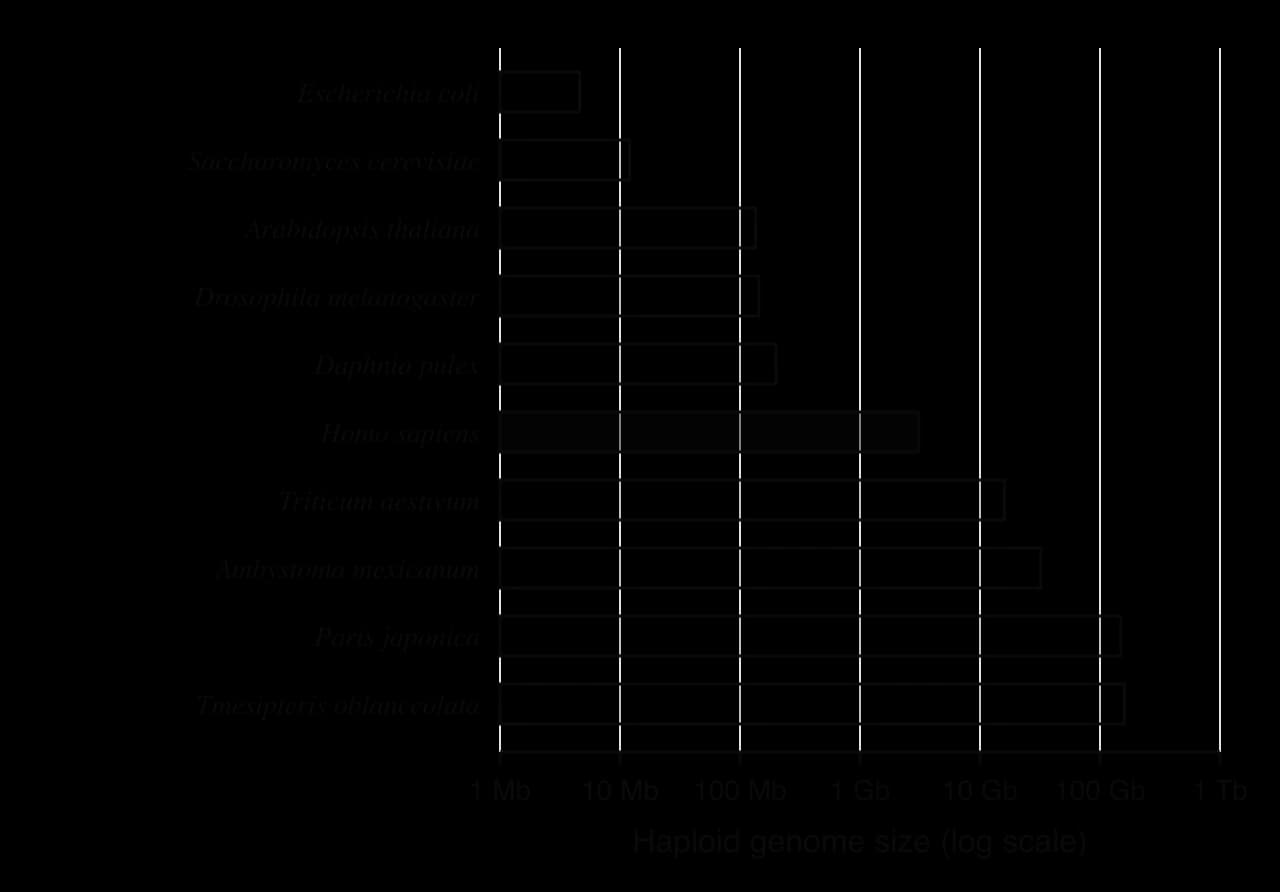
Size. Eukaryote genomes range from a few million base pairs in some fungi to more than 100 billion in some plants. Genome size is measured in base pairs (bp): 1 Mb is a million base pairs and 1 Gb is a billion base pairs.
Genome size depends only partly on the number of genes. Only about 1.5% of the human genome consists of base sequences that code for proteins. Much of the rest is non-coding DNA: sequences that regulate genes, sequences transcribed into RNA that is not translated, and a large amount of repeated sequences, many of them copies of transposable elements that have multiplied over evolutionary time. Species with very large genomes usually have more of this repeated DNA, not more genes. Some plants also have large genomes because they carry several complete sets of chromosomes.
Genome sizes for thousands of species are freely available in online databases such as the NCBI Genome database, the Animal Genome Size Database and the Plant DNA C-values Database. To compare genome sizes between taxonomic groups:
Search the database for each species or group, for example a bacterium, a fungus, an insect, a mammal and a flowering plant.
Record the genome size for each, making sure the values use the same unit (Mb or Gb) and the same measure (the haploid genome, one set of chromosomes).
Plot the values on a bar chart. Because the values span several orders of magnitude, use a logarithmic scale.
Compare the values with the complexity of each organism (for example, the number of cell types) and look for a pattern.
The bar chart of genome sizes plotted from such databases shows the result. Bacteria have the smallest genomes and humans sit in the middle of the range. The largest genomes belong to a flowering plant and a fern, not to animals, and the axolotl, a salamander, has a genome about ten times larger than that of humans.
Whole genome sequencing is the determination of the complete base sequence of the DNA of an organism. The first human genome was sequenced by the Human Genome Project, an international collaboration that ran from 1990 to 2003 and cost about US$2.7 billion. Since then, new technologies that sequence millions of DNA fragments at the same time have made sequencing enormously faster and cheaper. A human genome can now be sequenced in a day or two, for a few hundred US dollars.
Milestone | Date | Detail |
|---|---|---|
Human Genome Project | 1990–2003 | First human genome; about US$2.7 billion in total |
Estimated cost per human genome | 2001 | About US$95 million |
1000 Genomes Project | 2015 | 2,504 people from 26 populations; about 88 million variants |
Estimated cost per human genome | 2022 | About US$500 |
UK Biobank | 2023 | Whole genomes of about 500,000 volunteers released to researchers |
Sources: National Human Genome Research Institute, DNA Sequencing Costs Data, 2023; 1000 Genomes Project Consortium, Nature, 2015; UK Biobank, 2023.
This fall in cost, by a factor of more than 100,000 in about twenty years, is a clear example of technology driving scientific progress. Questions that once required a whole international project can now be answered by a single laboratory.
Current uses of whole genome sequencing include:
Research into evolutionary relationships. Comparing whole genomes shows how closely species are related, for example confirming chimpanzees and bonobos as the closest living relatives of humans, and the genetic separation of the two African elephants.
Diagnosing genetic diseases. Sequencing the genome of a child with an undiagnosed rare disease can identify the mutation responsible.
Tracking pathogens. Sequencing the genomes of bacteria and viruses from patients shows how an infection spread and how the pathogen is evolving, as in the worldwide tracking of SARS-CoV-2 variants.
Studying biodiversity and conservation. Genome sequences show how much genetic diversity remains in small populations of endangered species.
A major potential future use is personalised medicine: choosing the treatment and the dose of a drug according to the genome of each patient. Some alleles affect how quickly a person breaks down certain drugs, so the same dose can be too weak for one person and dangerous for another. In cancer, sequencing the genome of the tumour cells shows which mutations are driving the cancer and which targeted drugs are likely to work.
Whole genome sequencing also raises ethical questions:
Privacy. A genome sequence identifies a person and gives information about their relatives, who have not given consent.
Discrimination. Insurers or employers could use genetic information to treat people unfairly, which is why many countries have passed laws restricting this.
Unwanted knowledge. Sequencing may show a high risk of a disease that cannot be prevented or treated, which a person might prefer not to know.
Consent and ownership. It must be clear who owns the data, who may use it, and what the person has agreed to.
The biological species concept defines a species by the ability of its members to interbreed. Organisms that reproduce only by asexual reproduction never interbreed, so the concept cannot be applied to them. Each individual passes its genes only to its own offspring, and every line of descent is reproductively isolated from every other.
The common dandelion (Taraxacum officinale) is an example. Most dandelions in northern Europe are triploid, with three sets of chromosomes, and cannot complete normal meiosis. They produce seeds by apomixis: an egg cell develops into an embryo without being fertilised, so each seed is a genetic clone of its parent. The flowers still look as though they are pollinated, but pollen plays no part. Each clonal line differs slightly from the others in its leaves and flowers, and botanists have described hundreds of these lines as separate "microspecies". Whether they count as species, and how many there are, is a matter of judgement, because the interbreeding test cannot be used.
Other asexual organisms raise the same problem. Bdelloid rotifers, tiny freshwater animals, have no males at all and have reproduced asexually for millions of years, yet they have diversified into hundreds of recognisable forms. For such organisms, biologists define species by morphology or by DNA sequence similarity instead.
Bacteria reproduce asexually by binary fission, so the biological species concept does not apply to them either. A second difficulty comes from the way bacteria gain genes. Genes are normally passed from a parent cell to its offspring, which is vertical gene transfer. Bacteria can also take up genes from other bacterial cells, including cells of distantly related species, by a process called horizontal gene transfer.
Horizontal gene transfer happens in three main ways, shown in the diagram of the three mechanisms:
Conjugation. A copy of a plasmid is passed from one bacterium to another through a thin tube called a pilus.
Transformation. A bacterium takes up fragments of free DNA released into its surroundings when other cells die and burst.
Transduction. A bacteriophage accidentally packages a piece of bacterial DNA into its capsid in one host and injects it into the next bacterium it infects.
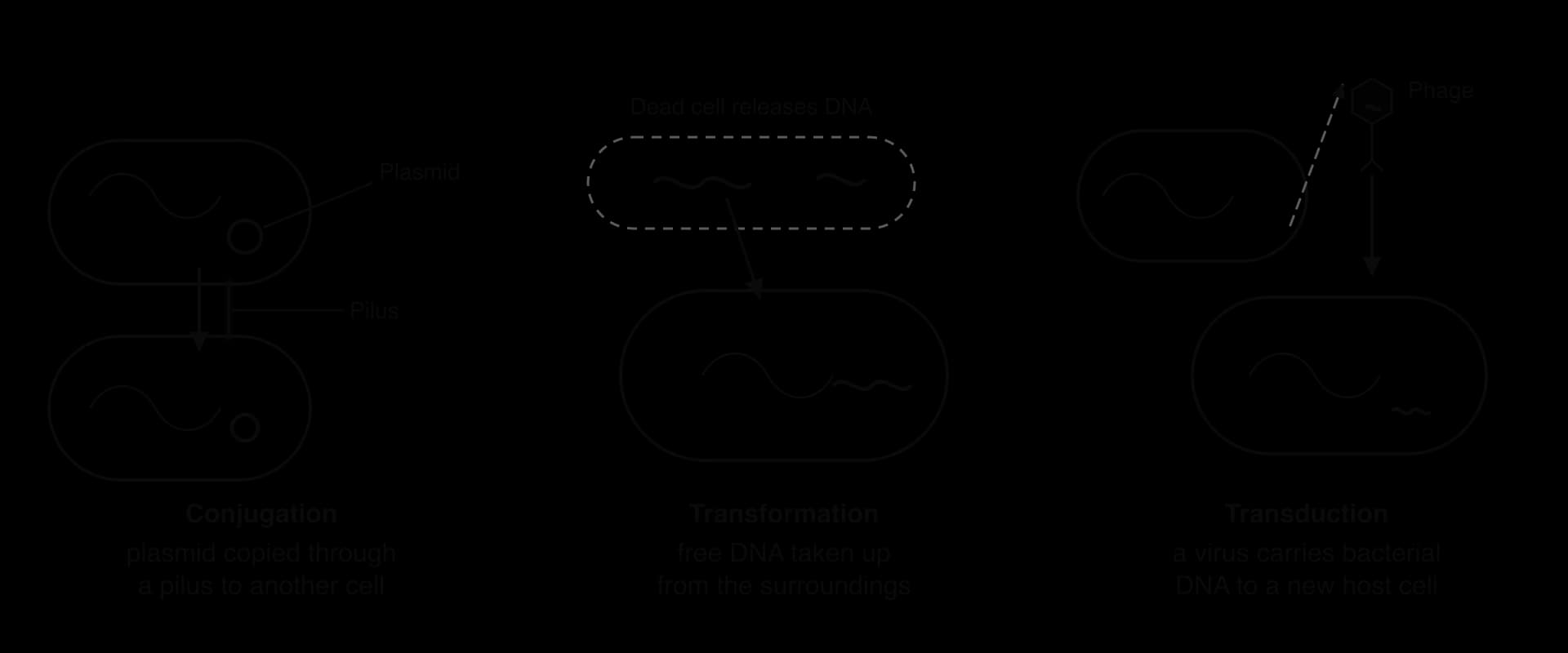
Horizontal gene transfer means that a bacterial genome is a mixture of genes inherited from its ancestors and genes acquired from other species. Genes for antibiotic resistance often spread this way. The gene mcr-1, which gives resistance to colistin, an antibiotic of last resort, was first reported in 2015 in Escherichia coli from pigs and patients in China; because it is carried on a plasmid, it has since been found in several species of bacteria in many countries. If genes move freely between "species", the boundaries between bacterial species are blurred. In practice, microbiologists define bacterial species by the similarity of their DNA base sequences, using a threshold such as about 95% identity across the genome. The threshold is a convention agreed by microbiologists, and some strains fall close to it.
All normal members of a species have the same chromosome number, because chromosome number is inherited and must stay constant for sexual reproduction to work. During meiosis, each chromosome must pair with its homologue before the pairs separate into the gametes. This pairing is only possible when the chromosomes from the two parents match in number and in their sequences of genes.
When two species with different chromosome numbers interbreed, the hybrid inherits one set of chromosomes from each parent. These sets differ in number and structure, so many chromosomes cannot find a partner to pair with in meiosis. The gametes formed receive incomplete or unbalanced sets of chromosomes and are not viable. The result is hybrid sterility, one of the ways in which species stay reproductively isolated.
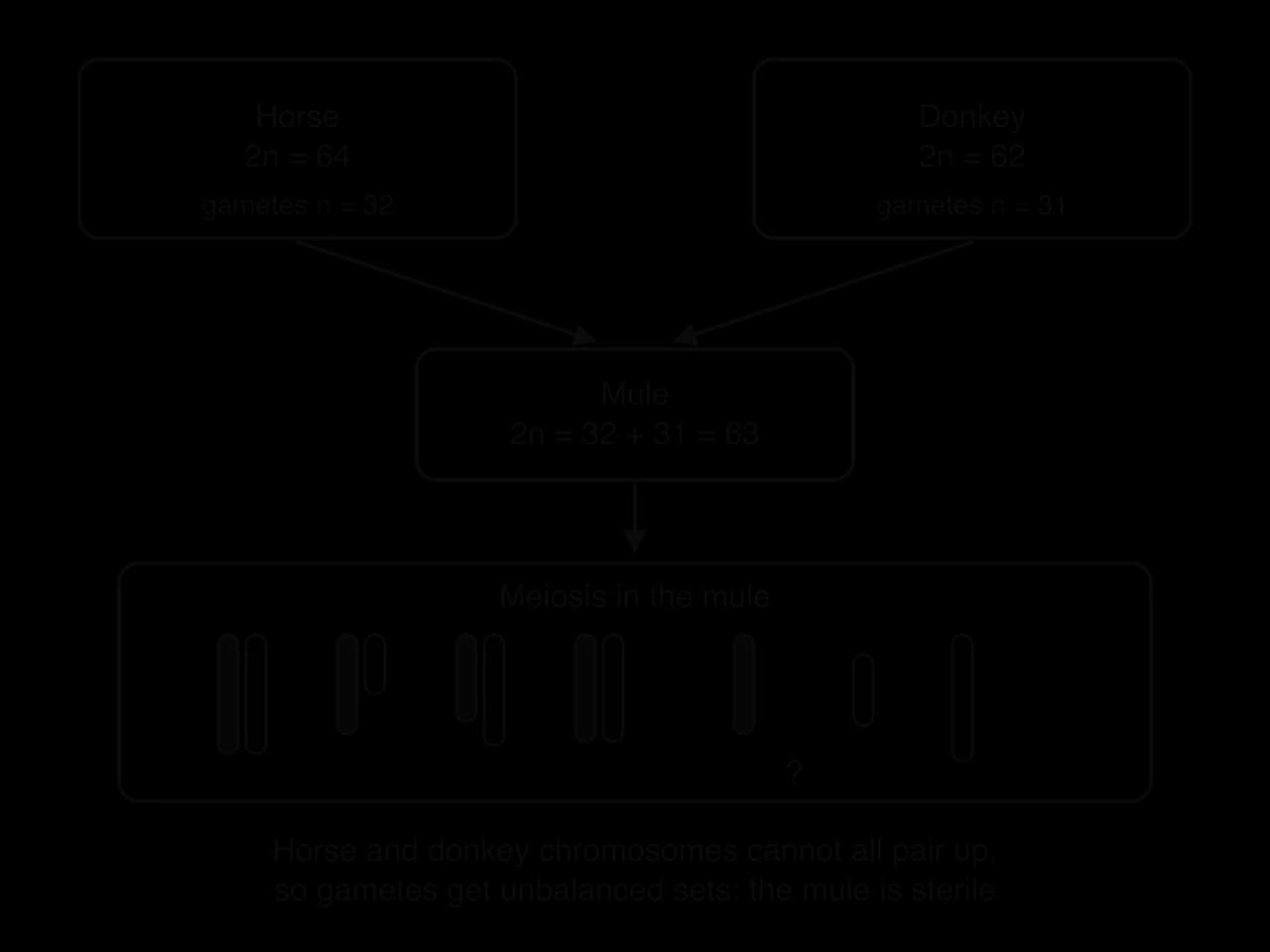
The mule is the classic example. A horse (Equus caballus, 2n = 64) produces gametes with 32 chromosomes, and a donkey (Equus asinus, 2n = 62) produces gametes with 31. A mule, from a female horse and a male donkey, therefore has 32 + 31 = 63 chromosomes. Mules are healthy and strong, because their body cells divide by mitosis, which does not need homologues to pair. They are almost always sterile, though, because the horse and donkey chromosomes differ in number and in the arrangement of their genes and cannot pair correctly in meiosis.
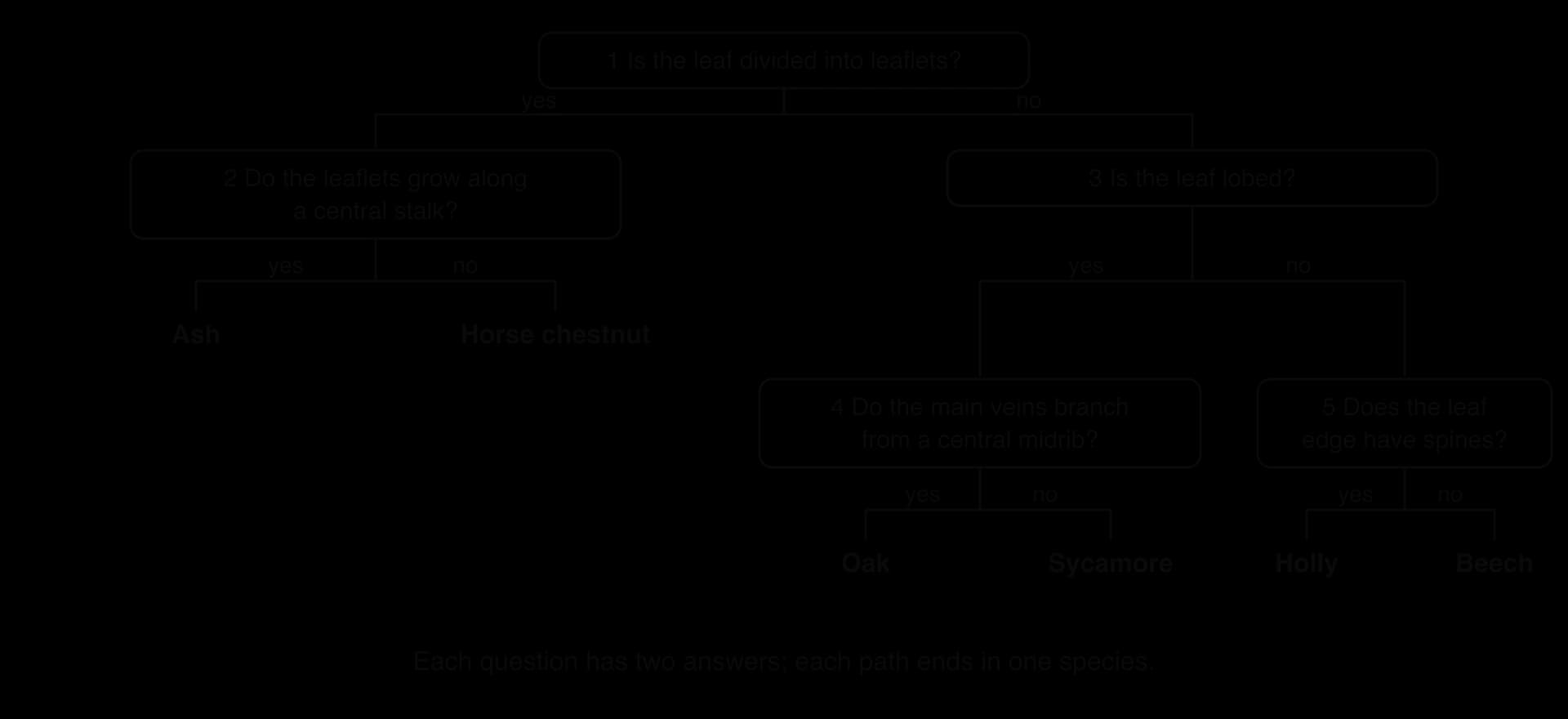
A dichotomous key is a tool for identifying organisms. It is a series of numbered steps, each with two alternative descriptions of a feature. The user chooses the description that fits the organism, which leads either to the name of the organism or to another step. "Dichotomous" means dividing into two.
The key to six common European trees shows how it works. A leaf is identified by answering one question at each step until a name is reached. The same key can be written as a table of numbered couplets, which is the usual printed form:
Step | Description | Go to |
|---|---|---|
1a | Leaf divided into separate leaflets (compound) | 2 |
1b | Leaf a single blade (simple) | 3 |
2a | Leaflets arranged in pairs along a central stalk | Ash (Fraxinus excelsior) |
2b | Leaflets spreading from one point, like fingers | Horse chestnut (Aesculus hippocastanum) |
3a | Leaf deeply lobed | 4 |
3b | Leaf not lobed | 5 |
4a | Main veins branch from a central midrib (lobes rounded) | Oak (Quercus robur) |
4b | Five main veins spread from the leaf base (lobes pointed) | Sycamore (Acer pseudoplatanus) |
5a | Leaf edge with sharp spines; thick and glossy | Holly (Ilex aquifolium) |
5b | Leaf edge wavy, without spines | Beech (Fagus sylvatica) |
A good key follows several rules:
Each step has exactly two choices, and they are opposite descriptions of the same feature ("leaf lobed" / "leaf not lobed").
Features are observable and unambiguous: counts, shapes and present/absent features, not relative terms such as "large" or "dark".
Features do not change with season, age or sex. Flower colour is useless in winter, and antlers are only present in male deer.
Every route ends in one organism, and a key for n organisms has n − 1 steps.
Designing a key for local species follows a clear method. First, collect or photograph specimens of the organisms to be identified, and list their observable features. Next, find a feature that divides the group into two, then divide each subgroup again, until every organism is separated. Finally, test the key on specimens that were not used to build it, or ask another person to use it, and improve any step that causes confusion.
All organisms shed DNA into their surroundings in skin cells, mucus, faeces, urine, hair, pollen and gametes. This environmental DNA (eDNA) persists for days to weeks in water and longer in cold sediment or soil. Sampling it allows biologists to find out which species live in a habitat without seeing, trapping or disturbing them.
Species are identified from eDNA using DNA barcoding. A barcode is a short, standard region of the genome that is present in all members of a large group, varies little within a species but differs between species, and is flanked by sequences similar enough in all species for one pair of primers to copy it. In animals the usual barcode is a section of about 650 base pairs of the mitochondrial gene COI (cytochrome c oxidase subunit I). In plants, sections of the chloroplast genes rbcL and matK are used.
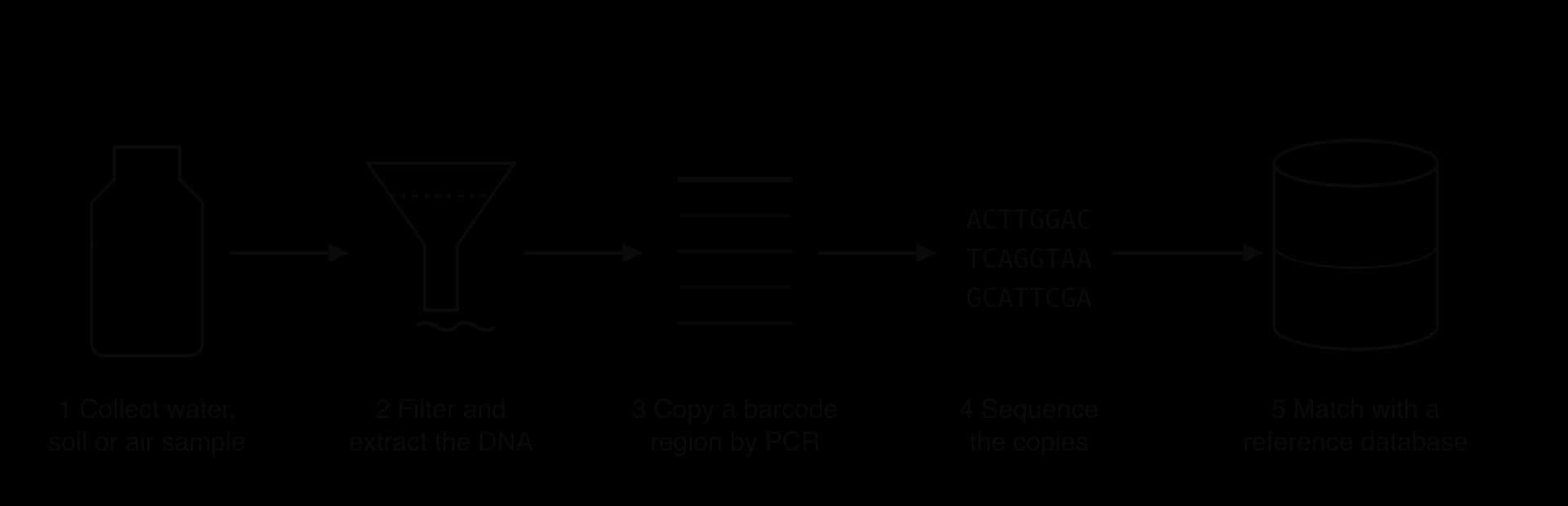
An eDNA survey has five stages:
A sample of water, soil or air is collected, taking care not to contaminate it with DNA from other sources.
The sample is filtered to collect cells and DNA, and the DNA is extracted.
The barcode region is copied millions of times by the polymerase chain reaction (PCR), using primers that bind to the conserved sequences either side of it.
The copies are sequenced. Modern methods sequence all the copies in a mixed sample at once, so many species are detected together; this is called metabarcoding.
Each sequence is compared with a reference database of barcodes from identified specimens, which gives a list of the species present.
eDNA is used to monitor biodiversity, to detect rare or endangered species, to give early warning of invasive species and to study diets from the DNA in faeces. In the United Kingdom, the great crested newt (Triturus cristatus) is protected by law, and since 2014 eDNA testing of pond water has been accepted for official surveys of whether newts are present, replacing nights of searching ponds with torches and traps. In 2018 an eDNA survey of Loch Ness in Scotland found DNA from about 3,000 species in water samples; it found no reptile DNA, but large amounts of eel DNA.
The method has limitations. eDNA shows that DNA of a species is present in the sample, and the species may no longer be alive at that spot, because DNA can be carried by currents or in the faeces of a predator, and it can persist after an organism has died or moved on. The amount of DNA gives only a rough idea of abundance, and nothing about age or sex. Species missing from the reference database cannot be identified, and contamination can give false positives.
Diversity of organisms is assessed in Paper 1A through questions on binomial names, species concepts and chromosome numbers; in Paper 1B and Paper 2 Section A through data on karyograms, genome sizes or eDNA surveys; and in Paper 2 Section B through extended responses on species concepts, the evidence for the chromosome 2 fusion or the uses and ethics of genome sequencing. Common command terms are state, outline, deduce, distinguish, evaluate and discuss.
Precise vocabulary earns marks throughout: "homologous chromosomes", "fertile offspring", "reproductively isolated", "non-coding DNA" and "barcode region" are each worth more than a vague description.
Both activities connect the species concept to classification, in which species are grouped into genera, families and higher taxa.
I can distinguish between continuous and discrete variation, with examples.
I can write binomial names correctly and explain why international agreement on names matters.
I can outline the morphological and biological species concepts and give the limitations of each.
I can explain why it is difficult to decide whether diverging populations are separate species, using the African elephants as an example.
I can compare chromosome numbers of species and explain why diploid numbers are usually even.
I can deduce sex and identify trisomy from a karyogram, and distinguish a karyotype from a karyogram.
I can evaluate the evidence that human chromosome 2 formed by the fusion of two chromosomes.
I can explain the unity and diversity of genomes within a species, including SNPs, and compare genome sizes between species using a database.
I can outline current and future uses of whole genome sequencing and discuss the ethical issues.
I can explain why the biological species concept cannot be applied to asexual species and to bacteria. (HL)
I can explain why a mule is sterile in terms of chromosome pairing in meiosis. (HL)
I can design and use a dichotomous key, and outline how eDNA barcoding identifies species. (HL)
[4 max]
Explain the roles of reproductive isolation and differential selection in the formation of new species.
7 marks
a. speciation is the splitting of one species into two (or more);
b. a population becomes divided / some individuals become isolated;
c. geographic isolation by a barrier such as a river / mountain / sea;
d. reproductive isolation means no interbreeding / no gene flow between the populations;
e. (so) allele frequencies in the populations can change independently;
f. environments of the populations differ, so they experience different selection pressures;
g. differential selection favours different traits / alleles in each population;
h. (so) the populations diverge / become increasingly different;
i. eventually they can no longer interbreed / produce fertile offspring even if they meet again;
j. example: bonobos and chimpanzees separated by the Congo River;
k. different selection on each side, e.g. less competition for food south of the river favoured less aggressive behaviour in bonobos;
[7 max]
One additional mark is available for the construction of the answer.
Speciation and changes to chromosomes have shaped the diversity of life.
Outline the evidence that human chromosome 2 was formed by the fusion of two chromosomes in a primate ancestor.
4 marks
Describe adaptive radiation as a source of biodiversity.
4 marks
Compare and contrast allopatric and sympatric speciation.
7 marks
Which is the correct way to write the binomial name of the grey wolf in a printed text?