6.8 Encyclopaedia entry
What encyclopedia entries are for and how they work: headword and definition, headed sections, hedges, neutral point of view and its limits, cross-references and sources, wikis, and the change from print to screen.
- IB English A: Language and Literature
- Part of 6 Non-literary text types
- SL and HL
Notes on 6.8 Encyclopaedia entry
An encyclopedia entry summarizes what is known about one subject for a general reader who comes looking for it. Readers rarely read an encyclopedia from start to finish: they arrive at one entry from an index, a link or a search, want a name, a date or a quick account, and leave. Entries are written by editors and experts for printed reference works, by volunteers for online wikis, and by museums, councils and trusts for collections of their own. Each speaks in no one’s voice and gives the impression of simply recording facts. That impression is the type’s main achievement and the main thing to analyze, since every entry is still the result of decisions about what to say, in what order and in whose words.
The Gully Record is the online encyclopedia of the Sluicehead Heritage Trust, which looks after the ruins of a nineteenth-century gold-mining settlement in Central Otago, New Zealand. It holds about three hundred entries on the gully’s places, people, machines and words. Its entry on the Chinese Camp, the settlement where Chinese miners lived at Sluicehead, is a subject on which the trust’s readers include descendants of the people described.
A summary for a reader who is looking
An entry is consulted rather than read, and its opening is built for that situation. The name of the subject stands alone in bold at the top: “Chinese Camp” (paragraph 1). This is the headword, the word under which the entry is filed and found. Someone who searched for the camp sees at once that the search has succeeded, and someone who followed a link from another entry sees what this one is about.
The next sentence defines the subject in one move:
The Chinese Camp is the site of a settlement of Chinese gold miners on the terrace beyond the tailings at the lower end of Sluicehead gully, occupied from about 1868 until 1897.
The Gully Record, “Chinese Camp”, paragraph 2
The sentence follows the oldest pattern of definition. It names the class the subject belongs to (“the site of a settlement”), then the details that set it apart from every other member of that class: who lived there, where it lies and when it was occupied. The verb is the plain is, the grammar of fact. Everything after this sentence expands one part of it, so anyone who stops here already has a correct, if small, account of the subject.
The “At a glance” line (paragraph 3) serves someone in an even greater hurry. It sets out five facts as labels and values: location, dates of occupation, population, what survives and related entries. Online encyclopedias usually print such facts in a box at the side of the entry, often called an infobox. Its form presents the facts as settled and comparable, since every entry on a settlement can carry the same labels. The figure “about 160 (1875)” gives a number, its date and a measure of its precision in four words.
Headed sections for selective reading
Below the opening, the entry divides into sections with plain headings: “History”, “Gaps in the record”, “The site today” and “Sources”. These headings are labels, not claims, so the whole shape of the entry is visible at once and each part can be found directly. A visitor planning a walk can skip to “The site today”; a descendant tracing a family can go to “Sources”. History comes first and in chronological order, from the first arrivals in 1866 to Wong Sai Fook’s departure in 1897. The present comes after it, so the ruins are seen as the end of a story already told.
The order of sections is already a choice. Many heritage entries begin with the site as it is today and add the history after it, which puts the visitor first. The Gully Record puts the people first. By the time the entry reports that the huts were “stabilised and partly rebuilt in 2009” (paragraph 11), it has already said who built them and why the camp emptied.
The voice of authority
No one says “I” in the entry, and no one signs it. The trust that wrote it appears only in the third person, as one actor among others. The huts were rebuilt “by the trust, working with the families of descendants” (paragraph 11), and the archaeological survey is listed under the trust’s name in the sources (paragraph 13). This impersonal voice is the main convention of the type. It presents the entry as the record of what is known, not as one writer’s view, and it asks the reader to trust an institution rather than a person.
The voice is formal but plain. Its long sentences, joined by semicolons, carry two or three facts each, and its verbs are verbs of record: began, opened, bought, fell, left. Figures and dates appear wherever they are available: “in 1866”, “by 1875 about 160 people”, “1871–1879”. The numbers invite trust because they are exact, and the prose because it never raises its voice. The page on perspective reads the same signals of objectivity in an older entry, the 1911 Encyclopædia Britannica on the umbrella, and argues that they do not remove the position of the people who wrote it.
Hedges as a measure of evidence
The most telling words in the entry are the ones that limit its claims:
The camp is thought to have taken shape by 1868, when Wong Sai Fook opened a store on the terrace;
Whether its residents chose the site or were pressed to it by their European neighbours is not known;
the letters he is known to have written for other miners have not been found.The Gully Record, “Chinese Camp”, paragraphs 5, 6 and 9
Each of these phrases is a form of hedging, and each is exact about a different degree of knowledge. Is thought to marks an inference: the store gives a date, and the camp is assumed to have formed around it. Is not known marks a question the evidence cannot answer. Have not been found is more precise still, because it says the letters existed and could still be found. In an encyclopedia, hedges show that the entry has weighed its sources, and they measure how much weight each claim can bear.
Hedging also shows where an entry is confident. The claims about water are stated flatly: “Records show that the camp’s claims bought water from the Kerr Water Race at the same rates as other claims” (paragraph 6). Records show names the kind of evidence and then lets the fact stand. Set beside the hedged claims, it marks this point as settled, unlike the reason the camp stood apart.
Neutrality and its limits
Most modern reference works aim at a neutral point of view: the ideal of presenting every significant view on a subject fairly and in proportion, without the writer taking a side. Wikipedia makes the ideal a written rule. Its policy opens by stating that “All encyclopedic content on Wikipedia must be written from a neutral point of view”. It then explains the ideal as “representing fairly, proportionately, and, as far as possible, without editorial bias” the significant published views on a subject. Two of its short instructions set out the balance a neutral writer has to keep: “Avoid stating opinions as facts” and “Avoid stating facts as opinions.”
The Gully Record follows the same ideal where its subject is disputed. On why the camp stood apart, it gives both explanations, notes that “both explanations appear in later accounts” and adds that “no document of the period settles the question” (paragraph 6). It does not choose. The phrase “pressed to it by their European neighbours” is still on the page, though. A neutral entry that reports a possibility of exclusion puts that possibility into the reader’s mind, and the trust has chosen to include it.
Neutral words, chosen
Neutrality governs the wording of an entry, not what it selects. The entry’s sentence on the poll tax is built so that no one acts:
Fewer new miners came after a poll tax on Chinese arrivals was introduced in 1881 (see Poll tax);
The Gully Record, “Chinese Camp”, paragraph 7
The tax “was introduced”, in the passive voice, with no government named. The sentence is accurate and calm, and it points to a separate entry for the full story. It also makes a law passed by a parliament read like a change in the weather. Readers who follow the cross-reference will learn who taxed whom and why; readers who stay on this entry learn only that miners stopped coming. The choice suits a short entry about a place, and it shows how an impersonal voice can soften an act of exclusion without saying anything untrue.
The section headed “Gaps in the record” goes further than most entries in making its own limits visible. It states that “Almost everything known about the camp was written by people who did not live in it” (paragraph 9). The point concerns sources, not opinion: the newspaper, the court and the archaeologists all looked at the camp from outside. Even the name of the subject is an outsider’s. The trust keeps “Chinese Camp” “because it is the name under which the records can be searched” (paragraph 9), a practical reason given openly, which admits that the headword itself is not neutral.
Reference works that show their makers
Older reference works often show their makers more plainly. Samuel Johnson’s Dictionary of the English Language (1755) defined oats, in a famous entry, as a grain “generally given to horses” in England but which “in Scotland supports the people”. The definition is usually read as a joke at the expense of the Scots, delivered in the form of a fact, and it has often been cited as a sign of Johnson’s prejudice. The form of a definition, it turns out, does not make its content neutral. A modern entry would not make such a joke, but it still decides which facts define its subject, and those decisions belong to a time and a place as surely as Johnson’s did.
Try it
The entry lists the objects found in the 2007 excavation: “rice bowls, ginger jars, a set of brass scales, coins and gaming pieces” (paragraph 11). What does this list suggest about the camp, and what might a different selection of objects have suggested?
The list mixes daily life (bowls, jars), trade (scales, coins) and leisure (gaming pieces), so it presents the camp as a working community with a store at its center, which matches the entry’s attention to Wong Sai Fook. A list that led with objects associated in older accounts with vice or strangeness would have presented the residents as curiosities. The entry’s list is no less a selection; it selects for ordinary life, which suits a trust that worked with descendants’ families.
Cross-references and sources
An entry is one part of a larger work, and it points to the other parts. The Gully Record names four related entries in its summary line and links three of them again in the text, set in bold: “Wong Sai Fook” (paragraph 5), “Kerr Water Race” (paragraph 6) and “(see Poll tax)” (paragraph 7). Each of these pointers is a cross-reference. Cross-references let a short entry stay short, because the storekeeper’s life and the history of the tax are told elsewhere. They also make an argument about what belongs together. Linking the camp to the water race places the Chinese miners inside the economy of the gully, as customers buying water on equal terms, not as a separate story.
The sources section closes the entry with the evidence for everything above it:
Wong Sai Fook, account book, 1871–1879 (Sluicehead Heritage Trust collection). ‘Sluicehead Courier’, 1868–1897. Records of the warden’s court, Sluicehead, 1866–1899. Sluicehead Heritage Trust, ‘Archaeological survey of the Chinese Camp’, 2007.
The Gully Record, “Chinese Camp”, paragraph 13
A list of sources does two things at once. It makes each claim checkable, which is the basis of a reference work’s authority. It also records where knowledge about the subject comes from. Read beside the section on gaps, this list makes the point visible: one document from inside the camp, three from outside it. The last line of the entry adds a date and a reason, “Last revised 4 February 2025, after comments from descendants’ families” (paragraph 14). A printed encyclopedia was fixed until its next edition; an online entry can be corrected, and this one says who asked for the change.
The diagram sets out the parts of the entry as they would appear on a screen, with what each part does for the entry’s authority. Read from top to bottom, the parts move from what the entry claims to how it supports the claim. The headword and definition assert, and the sections explain. The cross-references, sources and revision line point to evidence outside the entry.


The entry read closely
Read with these conventions in mind, the key lines of the entry show how its authority is built and where its choices lie.
Chinese Campnote 1
The Chinese Camp is the site of a settlement of Chinese gold minersnote 2 on the terrace beyond the tailings at the lower end of Sluicehead gully, occupied from about 1868 until 1897.
Population: about 160 (1875)note 3
The camp is thought to have taken shape by 1868note 4, when Wong Sai Fook opened a store on the terrace;
Whether its residents chose the site or were pressed to it by their European neighbours is not known; both explanations appear in later accountsnote 5
Fewer new miners came after a poll tax on Chinese arrivals was introduced in 1881note 6 (see Poll taxnote 7);
Almost everything known about the camp was written by people who did not live in itnote 8
the trust keeps it because it is the name under which the records can be searchednote 9.
Headword. The subject filed under the name outsiders gave it, a choice the entry later explains.
Defining sentence. Class (“the site of a settlement”) then difference (who, where, when), in the plain grammar of fact.
A number with its limits. “About” and a year in brackets tell the reader how exact the figure is and when it applied.
Hedge of inference. The date of the camp is reasoned from the store, and the verb says so.
Neutrality on a dispute. Two explanations reported, neither chosen; the entry describes the state of the evidence.
Agentless passive. The tax arrives with no one passing it, which keeps the sentence calm and leaves the government out.
Cross-reference. The full story of exclusion is moved to another entry, so this one stays about the place.
The entry on its own sources. A rare admission that the record is an outsider’s view.
A practical reason given openly. The headword is kept for searching, not defended as neutral.
The notes show a pattern that runs through the type. The conventions that make an entry look neutral (the defining sentence, the passive, the cross-reference) are also the places where its choices are made. This entry is unusual in making some of those choices visible, and that openness is itself a way of earning trust from readers who know the history.
Wikis and the hidden texts of an entry
Wikipedia, founded in 2001, is the best-known wiki, and it has changed what an encyclopedia entry is. A printed entry was written by an editor or a named expert and fixed in print; a wiki entry has many unnamed writers and is never finished. Anyone can edit its pages, and two texts that most visitors never open stand behind every one of them. The page history lists every change, who made it and when. The talk page, a discussion attached to the entry, records the arguments about what the entry should say.
Those hidden texts show neutrality being negotiated in public. One of the best-documented disputes on English Wikipedia was about spelling, not politics: whether the article on the fermented milk product should be titled “Yogurt” or “Yoghurt”. Editors argued it on the talk page through eight formal requests to move the page, the first in 2005, until the last, in December 2011, moved it to “Yogurt”. The quarrel looks trivial, but it was about whose English the encyclopedia speaks, American or British, and its talk page shows a neutral title being reached by repeated argument.
The Gully Record is not a wiki, since only the trust edits it, but its last line is a small trace of the same process:
Last revised 4 February 2025, after comments from descendants’ families.
The Gully Record, “Chinese Camp”, paragraph 14
Somewhere behind the entry are the comments of descendants’ families and the trust’s response to them. The date and the reason announce that the present wording replaced an earlier one, which invites the question of what changed.
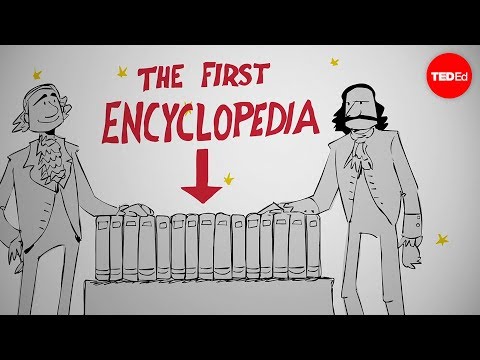 YouTube
The video tells the story of the Encyclopédie, edited by Denis Diderot and Jean le Rond d’Alembert in Paris from 1751, which treated the crafts of workers as knowledge worth recording beside philosophy and theology. Its organization was itself an argument. Arranging all knowledge alphabetically and by reason, and linking entries by cross-references, it placed religion among other subjects rather than above them, which is one reason the French authorities tried to suppress it.
From printed volumes to the screen
For two centuries the encyclopedia was a set of heavy volumes in alphabetical order, bought by libraries and by families who could afford them, and revised in new editions every decade or two. Its entries were written or commissioned by editors, and the longest were essays by experts. The eleventh edition of the Encyclopædia Britannica, published in 1911, is a famous example of the printed type. Its short entry on the umbrella, which the page on perspective reads for the position of its writers, also shows how differently a printed entry handled evidence. It has no headings and no list of sources; its evidence sits inside its sentences, and it reasons in plain view:
Although it was the practice to keep an umbrella in the coffee-houses early in the 18th century, its use cannot have been very familiar, for in 1752 Colonel Wolfe, writing from Paris, mentions the carrying of them there as a defence against both rain and sun, and wonders that they are not introduced into England.
“Umbrella”, The Encyclopædia Britannica, 11th edition (1911), paragraph 5
The sentence is an argument. A fact (umbrellas kept in coffee-houses) is set against a later letter, and the entry draws its own conclusion with “cannot have been very familiar”. The Gully Record would put the same kind of reasoning into a hedge (“is thought to”) and the letter into a sources section. The 1911 entry also quotes two lines of verse by the poet Michael Drayton as evidence that the word was in use in the seventeenth century (lines 3–4), treating a poem as a historical record. A modern entry would cite a dictionary of the language instead. Both entries are impersonal, but the printed one sounds like a learned writer reasoning, and the online one like an institution reporting.
What the screen changed
Online encyclopedias changed the type in four ways. Entries are found by search rather than by alphabet, so the first sentence must work alone, and search engines often display it beside their results. Entries link to each other directly, so cross-references became the main way of moving through knowledge. Entries can be revised at any time, so they carry dates, histories and talk pages instead of edition numbers. And entries can be written by anyone, so authority moved from the name of the expert to the rules of the process: neutrality, sources that can be checked, and open discussion.
Some differences remain across places and readers. The same subject has different entries in different languages of Wikipedia, written by different communities of editors with different sources, and comparing them is a quick way to see that neutral entries still stand somewhere. Encyclopedias for children explain more and hedge less. Specialist and local encyclopedias such as The Gully Record write for readers who already care about the subject, and some of them, like this one, answer to the families of the people they describe.
Writing about an encyclopedia entry
A paragraph about an entry starts from its claim to neutrality and then shows the choices inside it: what the entry defines first, how it handles uncertainty, and what it leaves to other entries. The paragraph that follows, as a strong student might write it, is about the entry on the Chinese Camp.
The trust’s entry earns its readers’ trust by showing exactly how much it knows.note 1 Claims it can document are stated flatly (“Records show that the camp’s claims bought water … at the same rates as other claims”), while the reason the camp stood apart is left open, since “no document of the period settles the question”.note 2 Its impersonal voice is less complete on exclusion: the poll tax “was introduced in 1881”, in an agentless passive, and its story is moved to another entry.note 3 The entry therefore presents the camp as a working community first and a site of exclusion second, an order that suits a trust writing for descendants as well as visitors.note 4
Claim about purpose and authority. The topic sentence states what the entry does and how, not what it is about.
Hedging analyzed as calibration. Two quotations show the difference between a fact stated and a question left open.
Neutrality tested. A grammatical choice is named and its effect on the account of exclusion explained.
Selection and audience. The last sentence judges the order of emphasis and links it to the entry’s readers.
The same habit of tying a convention to its effect separates a weak and a strong sentence about the entry’s opening.
Weak: The entry starts with a definition so that the reader knows what it is about.note 1
Strong: By defining the camp as “the site of a settlement of Chinese gold miners”, the opening sentence names its residents by their work, so the entry’s first claim about them is that they came to mine.note 2
A convention named, not read. Every entry opens with a definition; the sentence says nothing about this one.
Quotation, choice, effect. The sentence quotes the definition, notices what it chooses to name, and says what that choice establishes.
The strong sentence treats the definition as a choice among possible definitions. The same move works on headings, figures and cross-references: each could have been otherwise, and the version on the page has an effect.
Applying it in Paper 1
An encyclopedia entry in Paper 1 gives a student a text that seems to have nothing to analyze: no argument, no persuasion and no voice. A guiding question on an entry is likely to direct attention to how the text establishes authority or presents its subject as neutral or objective. It may instead ask how the entry represents a person, a group or an event. A model sentence of analysis follows. By reporting both explanations for the camp’s isolation and noting that “no document of the period settles the question”, the entry presents itself as neutral while still placing the possibility of exclusion before its readers.
The commonest way to lose marks is to accept the entry’s neutrality and simply summarize its information. Another is to swing to the opposite claim and call the entry biased without evidence. A strong response shows how the conventions build authority, then shows a choice inside them: a definition, a hedge, an order of sections, a passive verb or a source.
Its conventions in brief
A headword that names and files the subject.
A defining first sentence: the class, then what sets the subject apart.
A summary box of facts set out as labels and values.
Headed sections, often history first, for selective reading.
An impersonal, formal voice with exact dates and figures.
Hedges that measure how certain each claim is.
Cross-references that link the entry to related entries.
Sources and, online, a revision date or history.
The encyclopedia entry leads to the textbook, which uses the same voice of authority to teach rather than to inform. It also leads to the report, which presents findings in the same impersonal register to readers who must act on them.
Self-check
- To do:
I can explain what an encyclopedia entry is for and how it differs from a dictionary entry.
- To do:
I can analyze a headword, a defining sentence, a summary box and headed sections.
- To do:
I can explain how hedges, figures and an impersonal voice build an entry’s authority.
- To do:
I can explain neutral point of view and show a choice inside an entry that presents itself as neutral.
- To do:
I can describe how wikis are written and what page histories and talk pages show.
- To do:
I can compare a printed entry of 1911 with an online entry and explain what changed.
- To do:
I can write a paragraph that links an entry’s conventions to its authority and its readers.
Key terms
Each is also in the Non-literary text types glossary for IB English A Lang & Lit, beside the other terms of its topic.
- Cross-reference
A pointer from one entry or section of a text to another that treats a related subject, such as a “see” note or a link. Cross-references join separate entries into a network of knowledge and suggest which subjects belong together.
- Encyclopedia entry
A text in a reference work that summarizes what is known about one subject for a general reader, opening with a defining sentence and usually divided into headed sections with sources. Its voice is impersonal, so its choices of what to include and in what order are easy to overlook.
- Headword
The word or name at the head of an entry in a dictionary or encyclopedia, under which the entry is filed and found. Choosing a headword decides what a subject is called and where a reader will look for it.
- Neutral point of view
The ideal, set out as a written policy by many reference works, of presenting every significant published view on a subject fairly and in proportion, without the writer taking a side. It governs the wording of an entry but cannot remove the choices of what to include and how much space each view gets.
- Wiki
A website whose pages its readers can edit, with every change recorded in a public history and disputes argued on attached discussion pages. A wiki entry is a text that is never finished and has many unnamed writers.
Practice questions on 6.8 Encyclopaedia entry
Augment’s own questions, written in the style of IB exam papers. Here is how a few of them start.
Practice all 3 questions on 6.8 Encyclopaedia entry
Free with an account. Write your answer, open the markscheme beside it and mark yourself. Augment keeps the ones you got wrong for another go.
More in 6 Non-literary text types
The whole topic is on its own page.
- 6.1Advertisement
- 6.2Appeal
- 6.3Blog
- 6.4Brochure or leaflet
- 6.5Cartoon
- 6.6Diagram
- 6.7Electronic text
- 6.8Encyclopaedia entryThis page
- 6.9Film and television
- 6.10Guide book
- 6.11Infographic
- 6.12Interview
- 6.13Music video
- 6.14Photograph
- 6.15Radio broadcast
- 6.16Report
- 6.17Screenplay for TV or film
- 6.18Set of instructions
- 6.19Textbook
- 6.20Work of art
- 6.21Autobiography or biography
- 6.22Diary entry
- 6.23Essay
- 6.24Letter
- 6.25Magazine article
- 6.26Manifesto
- 6.27Memoir
- 6.28Opinion column
- 6.29Parody
- 6.30Pastiche
- 6.31Speech
- 6.32Travelogue
Carry on with 6.8 Encyclopaedia entry in Augment
With a free account, Augment remembers where you stopped in the notes and which questions you have marked.