6.26 Manifesto
What a manifesto is for and how it works: the collective we, numbered declarations, absolutes and anaphora, the manifesto as a performative act, its opponents, the avant-garde manifesto, and how the type varies and has changed.
- IB English A: Language and Literature
- Part of 6 Non-literary text types
- SL and HL
Notes on 6.26 Manifesto
A manifesto is a public declaration in which a group states what it believes, what it opposes and what it means to do. Its writers speak as we, and its readers are invited either to join that we or to recognize themselves among its opponents. The Tank Keepers’ Trust, a residents’ charity formed in 2016 to restore Sengazhuneer Eri, a rain-fed lake in south Chennai, adopted this ten-point manifesto in 2017. Its secretary reads it aloud at the trust’s annual meeting every year.
A group declaring itself
Manifestos are written at moments when a group needs to exist in public. A political movement announces its program, a party publishes its promises before an election, a new school of artists announces that the old art is dead. In each case the text does two things at once. It tells outsiders who the group is, and it tells the members what they have agreed to be.
The Sengazhuneer Promise is written mainly for the second audience. Its readers are the trust’s own members, and it assumes they know the lake and its words. Two Tamil terms stand without explanation:
We will open the inlet channel and keep it open, season after season, with our own hands and our own money, as the villages of this land once kept their tanks by kudimaramathu.
The Sengazhuneer Promise, paragraph 3
Kudimaramathu names the old custom by which villagers maintained their water tanks together, and eri (paragraphs 1 and 8) is the local word for a rain-fed lake. The trust’s appeals gloss such words for donors; the Promise does not, because everyone who says it already belongs. Leaving the words unexplained draws a line around the we. It also places a modern residents’ trust inside an older tradition, as if the members were reviving a village practice in the middle of a city suburb.
The signature makes the collective voice formal. The text ends “— The members of the Tank Keepers’ Trust” (paragraph 11), with no individual name. A manifesto may be drafted by one person, but it is owned by the group that adopts it. With no author named, the commitments read as a body’s, and no single writer can be asked to explain or withdraw them.
Ten sentences that begin with We
Every point of the Promise opens with the same words, “We will” or “We will not”. The repeated opening is anaphora, and in a manifesto it does more than create rhythm. Each repetition renews the subject, so that the group is named ten times and the reader hears the commitment grow heavier with each point. Read aloud, as the Promise is each year, the opening words become a refrain the members can almost say with the speaker.
The diagram sorts the ten points by their opening. Seven say what the members will do; three say what they will not do. The negative points are where the manifesto names what it stands against, and the positive ones describe the life the members choose instead.


The numbers matter as much as the repetition. Numbered points make each commitment separate and quotable, so a member can ask at the next meeting whether point 7 has been kept. They also give the text the look of a constitution or a set of rules, which suits a body that publishes its accounts and expects to be checked. Continuous prose can only persuade a reader, while numbered points can also be checked against what the group later does.
Absolute words
Manifestos rarely hedge. The Promise speaks of “every house in Sengazhuneer Nagar” (paragraph 1), “every rupee we are given and every rupee we spend” (paragraph 7), and of not allowing “one more lorry of debris, one more pipe of sewage or one more wall” (paragraph 4). Words such as every, all, never and one more leave no room for exceptions, and they are typical of the type. A group declaring itself cannot sound unsure, because uncertainty would invite its members to keep only some of the promises.
The modal verb will carries the same force. In other texts will can predict (“it will rain”); here it commits. The modality of the whole text is therefore the modality of a vow. The Promise makes no claim about what will happen to the lake, only about what its members will do, and that restraint is part of what makes it believable.
Saying it makes it so
Most sentences describe the world. Some change it by being said. When a judge says “I sentence you”, or two people say “I do” at a wedding, the words are not a report of an action that happens elsewhere; they are the action. The philosopher J. L. Austin called such sentences performative utterances in lectures published as How to Do Things with Words (1962). The promise is one of his standard examples, since saying “I promise” is how a promise is made.
The Promise is a performative text from its title onward. When the members adopted it in 2017, they did not describe a commitment that already existed; the adoption created it. Its last point builds the performance into the future:
We will work until the red water lily that gave the lake its name grows on it again, and every year we will read these words aloud beside the water and ask whether we have kept them.
The Sengazhuneer Promise, paragraph 10
The annual reading turns a document into a ritual. Each time the words are spoken “beside the water”, the members who hear them renew the vow, and new members join it simply by being present. The second half of the sentence also builds in a test. A manifesto that must be read aloud with the question “whether we have kept them” cannot drift quietly away from its own words. The point is the Promise’s only call to action, and it is addressed entirely to the group itself.
Political declarations have long worked in the same way. The Declaration of Sentiments, adopted at a convention for women’s rights at Seneca Falls, New York, in July 1848, opens by explaining that a people who change their position owe the world an account:
a decent respect to the opinions of mankind requires that they should declare the causes that impel them to such a course.
Declaration of Sentiments, Seneca Falls, 1848, paragraph 1
The words are borrowed almost exactly from the opening of the Declaration of Independence of 1776, and the borrowing is itself an argument, since it claims for women the right to declare that the founders had claimed for the colonies. The document then performs the act it describes. It declares, lists grievances and ends in resolutions, and about a hundred of those present signed it. Signing is the performative act a manifesto asks of its readers: a name added to the text makes the reader one of the we.
Defined by its opponents
A group declares itself against something. Most manifestos name an opponent early, and many draw their energy from it. The Manifesto of the Communist Party was written by Karl Marx and Friedrich Engels in German in 1848, and Samuel Moore’s English translation appeared in 1888. Its preamble begins with its enemies before it says a word about its own program. It is printed here as an example of the type, not as an argument this book makes:
The opening sentence is a metaphor of fear: Communism is a “specter” (paragraph 1), a ghost that people in power see everywhere. The next clause lists those people as a comic alliance of opposites, “Pope and Czar, Metternich and Guizot, French radicals and German police spies”. The list makes the opponents look both mighty and ridiculous. The questions of paragraph 2 then turn the enemies’ name-calling into evidence: if every party calls its rivals Communist, the word must already name a force.
Only after the opponents comes the declaration. The two numbered points (paragraphs 4 and 5) give the manifesto’s reason to exist, and the second ends by naming the type:
meet this nursery tale of the Specter of Communism with a Manifesto of the party itself.
Manifesto of the Communist Party, paragraph 5
The enemies have told a frightening story, a “nursery tale”, and the manifesto is the group’s own story told in public. That is a definition of the type in a phrase. The preamble also claims a wide we: it was “sketched” by “Communists of various nationalities” and will be published in six languages (paragraph 6). A manifesto of 1848 that names its own translations is announcing that its audience is the world.
The Sengazhuneer Promise names opponents too, but it chooses them carefully. Its “We will not” points (paragraphs 4, 5 and 9) oppose the dumping of debris and sewage, building on the lake bed, and silence about “on whose permission it came” (paragraph 4). Then paragraph 5 refuses an enemy the members might easily have chosen:
We will not blame the families who live where the water used to be; we will ask them to keep the lake with us, and we will keep it for them.
The Sengazhuneer Promise, paragraph 5
Many of the trust’s own members live in flats built on the old lake bed, so a manifesto that blamed residents would divide the group it is trying to make. The sentence turns potential opponents into future members, and the semicolon marks the turn from refusal to invitation. The ninth point goes further and names the group’s own weakness as an opponent: the members promise not to let “one dry summer” or “one wet monsoon” (paragraph 9) change their minds. A manifesto that lists its own moods among its enemies is unusually self-aware.
The avant-garde manifesto
In the early twentieth century the manifesto became the favorite form of artists who wanted to break with the past. Groups announced new movements in painting, poetry, music and architecture with declarations that were often louder than the works that followed. An artistic movement that claims to be ahead of its time and against the established art of its day is called the avant-garde, a French military term for the troops that march in front of an army.
The founding manifesto of Futurism, written by the Italian poet Filippo Tommaso Marinetti, was published in French on the front page of the Paris newspaper Le Figaro on 20 February 1909 and then reprinted as a leaflet. The photograph shows a copy of that leaflet: a large title, Manifeste du Futurisme, the line “Publié par le « Figaro » le 20 Février 1909”, dense columns of text, and Marinetti’s signature at the end as director of the poetry magazine Poesia.

Marinetti’s text begins not with a declaration but with a story. A group of friends who have stayed up all night drive out at dawn in fast cars, and the narrator swerves to avoid two cyclists and overturns into a muddy factory ditch. He climbs out exhilarated, and only then, their faces still covered in factory mud, do the friends dictate their program to the living men of the earth. The eleven numbered points that follow are mostly in the first person plural, and four of them begin “We want” (Noi vogliamo). The fourth, in the Italian version, reads:
Noi affermiamo che la magnificenza del mondo si è arricchita di una bellezza nuova: la bellezza della velocità.
Fondazione e Manifesto del futurismo (1909), point 4, opening sentence
In English: “We declare that the splendor of the world has been enriched by a new beauty: the beauty of speed.” The point goes on to declare that a roaring racing car is more beautiful than the Victory of Samothrace, the ancient Greek statue in the Louvre. The tenth promises to destroy museums, libraries and academies of every kind.
Provocation as method
The Futurist manifesto shows the avant-garde convention of provocation at its most extreme. It sets a car against a masterpiece because the comparison is meant to offend the people who love the statue. Its ninth point glorifies war and declares contempt for women, and its tenth attacks feminism along with museums. Those points are not side issues. Marinetti later became a supporter of Mussolini’s Fascist movement, and readers now read the 1909 text knowing where its love of speed, violence and the crowd led. The manifesto shows how a type built on absolute claims and named enemies can serve any cause, including one its first readers could not foresee.
Try it
Several of the Futurist manifesto’s points begin “We want”; every one of the Promise’s begins “We will” or “We will not”. What does each opening suggest about the group speaking and its relationship with the future?
“We want” states a desire. It suits a group that defines itself by appetite and attack, demanding a new world from outside the existing one. “We will” states a commitment the speakers can keep themselves. It suits a group that has accepted responsibility for something it already shares, the lake, and expects to be held to its word. The first opening looks outward to provoke; the second looks inward to bind.
A manifesto as literature
Most manifestos are non-literary texts: their purpose is practical, to found a group, win an election or start a campaign. A manifesto can count as literary when its purpose is aesthetic as well as practical and its language asks to be read for its own design. Marinetti’s manifesto is a strong case. It was written by a poet who directed a poetry magazine, Poesia, and who signed it in that role. Its opening story of the night, the cars and the ditch is a piece of prose fiction in its own right. Manifestos by poets and painters are often studied alongside their works for the same reason. The Sengazhuneer Promise, by contrast, is designed to be kept, not admired, and its craft serves that purpose.
The distinction matters for the individual oral, which pairs one literary work with one non-literary body of work. A set of political or organizational manifestos is a natural non-literary body of work. An artist’s manifestos collected with the poems they introduce may be treated as part of a literary work instead. Teachers decide how such texts are classified for their course, and a student using one should be ready to explain in the oral why it belongs on its side of the line.
Across media and across time
The word manifesto comes from Italian through Latin, from the idea of making something manifest, or plainly visible. Early manifestos were declarations by rulers and states explaining their actions, and the modern sense of a group announcing itself grew in the age of revolutions and pamphlets. The type has kept its core conventions while its occasions have multiplied.
Political parties publish election manifestos, the programs they promise to carry out if they win. In the United Kingdom and India, among many other countries, these are long documents divided by policy area, launched with speeches and examined line by line by journalists. They keep the collective voice and the numbered or headed commitments, but they trade the manifesto’s fire for detail and costing, because their readers will later hold the winners to them.
Companies and professions write manifestos too. In 2001 a group of seventeen software developers published the Manifesto for Agile Software Development, which sets out its values as four balanced pairs:
Individuals and interactions over processes and tools
Working software over comprehensive documentation
Customer collaboration over contract negotiation
Responding to change over following a planManifesto for Agile Software Development, 2001
Each line names what the group prefers and what it ranks lower, so the opponent is built into every sentence through the word over. The text then adds a concession that a revolutionary manifesto would never make: “while there is value in the items on the right, we value the items on the left more.” The professional manifesto keeps the type’s first person plural and its declared values, but it trades absolutes for priorities, because its readers are colleagues who must keep working with the people it disagrees with.
Online, a manifesto can gather signatures as it spreads. A web page holds the text, a counter shows how many have signed, and each new name performs the act that the Seneca Falls signers performed with a pen in 1848. Corporate “values” pages borrow the type’s voice without its risk: they speak as we and list commitments, but no member reads them aloud and asks whether they have been kept. Comparing such a page with the Promise is a quick way to see what makes a manifesto more than a list of good intentions.
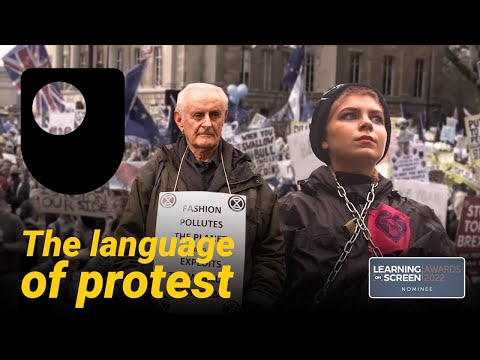 YouTube
The video sets manifestos beside other forms of protest language, which share their collective voice, their brevity and their opponents. A manifesto is the most organized of these forms, since it asks a group to agree on the words before it says them in public.
Writing about a manifesto
A paragraph about a manifesto begins with the group and its situation, then shows how the text’s form makes or binds that group. The paragraph that follows, as a strong student might write it, is about the opening words of the Promise.
The Sengazhuneer Promise turns a residents’ trust into a community by making every sentence a vow spoken by the same voice.note 1 All ten points begin “We will” or “We will not”, so the group names itself ten times, and the modal will commits the speakers rather than predicting the lake’s future.note 2 The text’s one refusal of an enemy, “We will not blame the families who live where the water used to be” (paragraph 5), shows why that voice matters: many members live on the old lake bed, and a manifesto that blamed them would split the we it exists to create.note 3 Because the last point requires the words to be read aloud each year “beside the water”, the manifesto works less as an argument to outsiders than as a ritual that renews the group.note 4
Group and function. The claim says what the text does to its community, not only what it says.
Form as evidence. Anaphora and modality are named only as part of the argument, with their effect.
Context used precisely. One fact about the members explains one choice in the text.
Judgment about type. The paragraph ends by placing the text within the type: ritual more than argument.
A weaker paragraph would list the features without connecting them to the group. The pair that follows is about the same point.
Weak: The manifesto uses anaphora with “We will” to show that the group is united and determined.note 1
Strong: By opening every point with “We will”, the Promise makes its members repeat their own commitment ten times, so that a meeting which hears it read aloud is renewing a vow rather than listening to a statement.note 2
Feature and adjective. “United and determined” could describe any text with a we; the sentence does not say what this repetition does in this situation.
Situation and effect. The rewrite links the repetition to the way the text is used, read aloud each year, and states the effect precisely.
A manifesto’s absolutes belong to its rhetoric, and an analysis gains precision by saying what each absolute does for the group that speaks it.
Applying it in Paper 1
A manifesto in Paper 1 offers a text whose purpose is on its surface and whose form is unusually visible: numbered points, a repeated opening, a named group. A guiding question on one is likely to direct attention to how the text builds a collective identity, how it positions its readers as members or opponents, or how its structure and repetition give it force. A model sentence of analysis follows. Because the Promise names practices rather than people in its “We will not” points, it can oppose the lake’s destruction without making enemies of the neighbors it needs to recruit.
The commonest way to lose marks is to describe the manifesto’s beliefs instead of analyzing how it presents them, so that the essay becomes a summary of a program. Another is to miss the question of who is included in the we and who is left outside it. A response that identifies the group, its audience and its opponents, then shows how two or three formal choices serve them, usually goes furthest.
Its conventions in brief
A title that names the group, the cause or the act of declaring.
A collective first person plural that defines who belongs.
Numbered or separated declarations that can be quoted and checked.
Absolute claims and a modality of commitment (will, must, never).
Repetition, often anaphora, that gives the text the rhythm of a vow.
Opponents named, mocked or deliberately refused.
A call to action, to the group or to readers, often to sign or join.
A performative force: adopting, signing or reading the text aloud is the act it describes.
The manifesto leads to the speech, since many manifestos are read aloud and many speeches declare a movement’s aims, and to the global issue of politics, power and justice. The appeal from the same Chennai trust shows the other side of the group’s writing, where it turns outward and asks for help.
Self-check
- To do:
I can explain what a manifesto is for and how a group’s need to declare itself shapes its conventions.
- To do:
I can analyze the collective voice, numbered declarations, absolute claims and anaphora of a manifesto.
- To do:
I can explain what a performative utterance is and how adopting, signing or reading a manifesto performs it.
- To do:
I can show how a manifesto defines itself against opponents, and how it chooses them.
- To do:
I can compare a local manifesto with a political, an avant-garde and a professional one.
- To do:
I can say what would make a manifesto literary and why the distinction matters for the oral.
- To do:
I can write a paragraph that links a manifesto’s form to the group it creates.
Key terms
Each is also in the Non-literary text types glossary for IB English A Lang & Lit, beside the other terms of its topic.
- Avant-garde
Artists, writers or movements that present themselves as ahead of their time and in revolt against the established art and values of their day. Avant-garde groups often announced themselves in manifestos.
- Manifesto
A public declaration in which a group states what it believes, what it opposes and what it intends to do, usually in a collective first person plural and in separate, numbered points. It is meant both to bind its members and to announce the group to everyone else.
- Performative utterance
A statement that performs the action it names in the act of being said or signed, rather than describing something that happens elsewhere. Promises, vows, declarations and verdicts are performative utterances.
Practice questions on 6.26 Manifesto
Augment’s own questions, written in the style of IB exam papers. Here is how a few of them start.
Practice all 4 questions on 6.26 Manifesto
Free with an account. Write your answer, open the markscheme beside it and mark yourself. Augment keeps the ones you got wrong for another go.
More in 6 Non-literary text types
The whole topic is on its own page.
- 6.1Advertisement
- 6.2Appeal
- 6.3Blog
- 6.4Brochure or leaflet
- 6.5Cartoon
- 6.6Diagram
- 6.7Electronic text
- 6.8Encyclopaedia entry
- 6.9Film and television
- 6.10Guide book
- 6.11Infographic
- 6.12Interview
- 6.13Music video
- 6.14Photograph
- 6.15Radio broadcast
- 6.16Report
- 6.17Screenplay for TV or film
- 6.18Set of instructions
- 6.19Textbook
- 6.20Work of art
- 6.21Autobiography or biography
- 6.22Diary entry
- 6.23Essay
- 6.24Letter
- 6.25Magazine article
- 6.26ManifestoThis page
- 6.27Memoir
- 6.28Opinion column
- 6.29Parody
- 6.30Pastiche
- 6.31Speech
- 6.32Travelogue
Carry on with 6.26 Manifesto in Augment
With a free account, Augment remembers where you stopped in the notes and which questions you have marked.