4.6 Transformation
How texts show change in characters, speakers, readers and texts themselves, from a clerk’s first week at a Dundee mill to a tuner’s daughter, Kafka’s insect and a campaign that set out to change a phrase.
- IB English A: Language and Literature
- Part of 4 Central concepts
- SL and HL
Notes on 4.6 Transformation
Transformation asks what changes in a text, or because of it, and what makes the change happen. The change may be in a character who learns something, in a speaker who inherits something, in a reader who comes to see differently, or in a text that is carried into a new form or a new time. Reading for transformation means finding the before, the after and the cause, each in the words of the text. The opening of “The Ledger”, from a novel about a jute mill in Dundee, Scotland, follows one week in the working life of a sixteen-year-old clerk in January 1958, told by the woman she became.
A week that changes a clerk
Isobel arrives at the weighing house sure of one thing about herself. In paragraph 6 she says so plainly: “I believed that a good hand and a right figure were the same thing.” The verb believed is in the past, and the past tense carries the change. The woman telling the story no longer believes it, and the paragraph shows why. Mr Gourlay finds a bale “two pounds heavy”, rules a line through her figure and writes the right one “in his own small hand”. A belief she has held since she was nine ends in one ruled line on a Friday afternoon.
The extract never says that Isobel changed. It shows the change through what she keeps. Paragraph 7 is two sentences long: “That is the only figure on those first pages that is not mine. I have the ledger still.” A girl who was proud of her handwriting has kept, for the rest of her life, the page on which someone else corrected it. This kind of change, in a person, a speaker, a reader or a text, traced from a before to an after through its cause, is transformation.
The cause matters as much as the change. A reading that says only “Isobel matures” describes a result. A reading that points to the ruled line, and to the silence around it (“He said nothing”), explains how the result comes about. In “The Ledger” the cause is small, exact and outside Isobel, while the effect is large and inside her. That imbalance is typical of the novel’s quiet style, in which the important events are often the smallest ones.
Change that happens slowly
Some changes in the extract have no single cause at all. In paragraph 4 Isobel describes copying the shippers’ marks from the bales of jute. Then she adds: “It did not occur to me for years that somebody a long way off had pressed and stencilled every one of those bales.” The phrase “for years” marks a transformation with no turning point. The girl saw marks on hessian; the woman sees the workers in Calcutta who made them, paid “less than the four pounds ten I took home on a Friday”. The change is in what she is able to notice, and the extract measures it only by its result.
Work itself changes her even faster. By March, only weeks into the job, she finds the receipt for her fountain pen. She turns its price into labor at once: “I worked it out, as by then I worked everything out: nearly four hours at her loom” (paragraph 1). The clause “as by then I worked everything out” shows a habit learned at the scale and carried home. The weighing house has begun to shape how she thinks about her own family. A reader for transformation notices these small markers of time, such as by then, for years and since, because they show where a person has moved.
What changes, and what causes it
Three different things change in the extract, and each changes in a different way. The diagram sets them out. Isobel changes from within, through understanding. Her father changes from outside, through events she records but does not explain: his initials appear in the ledger “until the autumn, and then they are not” (paragraph 5). The ledger changes in meaning without a single mark on it being altered, since a mill’s record of jute has become a record of a family.


The third row matters most for the idea of transformation as a way of reading. A text can change its meaning while its words stay fixed, because the people who read it change. The ledger was “new that January, as I was” (paragraph 4), and both have aged together. The same is true of every text a student reads from another time, from a pamphlet of 1852 to a poster of the 1930s: the page is the same, and its readers are not.
Characters who change and characters who stay
Change in a narrative is easiest to see against something that does not change. In “The Ledger” that fixed point is Mr Gourlay. He “did not shake hands” on the first morning (paragraph 3), and at the end of the week, having corrected Isobel’s figure, he “went back to his stool” (paragraph 6). Nothing in the extract suggests that the week has altered him, and his rule, “Never from the side”, is the same on Friday as on Monday. Isobel is measured against him. Because he stays exactly where he was, her movement shows.
A character who changes in an important way, in understanding, values or situation, is a dynamic character. One who stays essentially the same is a static character. The terms describe a character’s role in a story’s design, not the quality of the writing, as the father in paragraph 5 shows. Gourlay is drawn with great care and a few exact gestures, and his stillness is what the extract needs from him. The father is harder to place than Gourlay. He changes in situation, since his initials stop “until the autumn”, but the extract never shows whether he changes in himself.
Tracing a character arc
The path of a character’s change, from the first state through each cause to the last, is a character arc. In a novel an arc can run over hundreds of pages. A short story can compress one into an evening. Anton Chekhov’s “The Student” (1894), in Constance Garnett’s English translation of 1918, opens on a young man walking home in a sudden cold, hungry and certain that “the lapse of a thousand years would make life no better”. His despair is complete, and the weather seems to confirm it.
The arc turns in the widows’ gardens, where “A camp fire was burning brightly” (paragraph 3). The student tells two women, a mother and her daughter, the story of the apostle Peter’s denial of Christ on the night before the Crucifixion, and the older woman begins to weep. Walking on, he feels that the past is joined to the present by an unbroken chain of events, and his despair gives way to joy. The cause of his change is a story and a listener’s response to it. Chekhov leaves one question open: whether this is a lasting change in the student or the bright mood of a young man on a spring night. A reader who traces the arc has to decide how much weight the ending can carry, and say why.
Novels built on growing up
Some novels are built entirely on the change of one young person. A bildungsroman, from the German for “novel of formation”, follows its protagonist from childhood or youth toward adulthood, through schooling, work, loss and the search for a place in society. The model is often traced to Goethe’s Wilhelm Meister’s Apprenticeship (1795–96), and Charles Dickens’s Great Expectations (1861) is a familiar English example. The form’s structure is its subject: the chapters are the stages of a self being made. Tsitsi Dangarembga’s Nervous Conditions (1988), set in colonial Rhodesia (now Zimbabwe) in the 1960s, opens on one sentence:
I was not sorry when my brother died.
Tsitsi Dangarembga, Nervous Conditions (1988), the opening sentence
The narrator, Tambu, is looking back on her younger self. Her brother’s death opens the way to the mission school, and to the education that had been meant for him. Her transformation begins with a loss she refuses to mourn, so the novel asks from its first line what her growth has cost and who paid for it. The sentence also shows the double time of a novel of formation: “was not sorry” is the girl’s feeling, and the decision to admit it first is the grown woman’s.
“The Ledger” could be the opening of a novel of formation too. It has a sixteen-year-old’s first job, a teacher, a single correction, and a narrator who has “tried since” to live by what she learned (paragraph 3). An extract alone cannot prove what the whole novel becomes, and a reading should say so. What it can show is the pattern the form depends on: a young person entering a world of adult rules, and an older voice measuring the distance traveled.
What one generation passes to the next
Inheritance is a particular shape of transformation: something passes from one generation to the next, and changes as it passes. “Temperament”, the poem of a piano tuner’s daughter in Winnipeg, Canada, written in the 1980s and remembering the years around 1960, ends with what the father left behind:
It’s in my hallway now. His tuning hammer
lies in the drawer of the hall table, in its cloth.
I have his ear, my mother says. Some nights
I strike the A and listen to it waver,
someone breathing behind a door,
and I leave it.“Temperament”, lines 26–31
The objects arrive whole. The family piano stands in the speaker’s hallway, and the hammer lies “in its cloth” (line 27), wrapped as if for burial or for a journey. What has changed is their use. The father’s work, in the first stanza, was “putting them back” (line 4): restoring every piano in the city to pitch. The daughter strikes the out-of-tune A and does the opposite: “I leave it” (line 31). The tool is kept and the trade is not, so the inheritance is real but transformed.
The father’s lesson changes too. In the car he said that every fifth is tuned “a hair narrow” so that music can go into any key, and that if “one key” is tuned “pure”, the rest cannot be played (lines 15–17). The child of eleven heard a fact about pianos. The adult speaker seems to have taken it as a way of living with imperfection, since she lets the A “waver” rather than correct it. The words she inherited are unchanged; their meaning has grown with the listener.
Line 28 names the one gift that is not an object: “I have his ear, my mother says.” The claim is reported, not confirmed. The speaker neither agrees nor disagrees, and her mother may be seeing a likeness the daughter cannot feel. Inheritance in this poem is something others notice in the speaker as much as something she owns. That uncertainty is part of how the poem shows a self being changed by a parent who is no longer there.
Continuity announced in public
A non-literary text can handle inheritance in a far more open way, because it has a practical reason to explain itself. The blog post of a family oyster-omelette stall in Penang, Malaysia, announces that the grandmother has retired and the stall is reopening. It sorts the change into two lists. Paragraph 8 begins “Here is what stays the same” and names the batter, the chilli sauce and “the colour of the umbrella”. Paragraph 9 begins “Here is what changes”, and lists a new cook, fewer nights, QR payment and a higher price.
The poem leaves its inheritance unresolved, while the post resolves it for its customers in two headed lists. Its purpose requires this: regulars need to know that what they value will survive the change of hands, and that what has changed has a reason. The post treats transformation as something to manage and announce, with continuity placed first. “Temperament” treats it as something to live inside without a verdict.
Try it
Line 25 of “Temperament” says the mother sang over the family piano “in Ukrainian, as if it were in tune”. What does this line suggest about how a culture is carried from one place and generation to the next?
The family has brought the language of its Sunday songs from Ukraine to a kitchen in Winnipeg, and the mother keeps singing in it although the piano beneath her voice is out of tune. The phrase “as if it were in tune” describes the piano. It also describes a way of carrying a culture forward, by holding on to the song when the instrument, the place and the circumstances no longer match it. The daughter inherits the out-of-tune piano and, unlike her mother, does not sing over it, so the line also marks a change between the generations.
When the change is literal
In most texts transformation is gradual and inward. Franz Kafka’s novella The Metamorphosis, published in German in 1915, starts where other stories end. Its first sentence, in the German of the early printings, completes the transformation before the story has begun:
Als Gregor Samsa eines Morgens aus unruhigen Träumen erwachte, fand er sich in seinem Bett zu einem ungeheueren Ungeziefer verwandelt.
Franz Kafka, Die Verwandlung (Leipzig: Kurt Wolff, 1915; text of the 1917 printing), the first sentence
In a literal English version: when Gregor Samsa woke one morning from uneasy dreams, he found himself in his bed transformed into a monstrous Ungeziefer. The German word means vermin, a general word for pests rather than the name of any one creature, and English translators have chosen “insect”, “vermin”, “bug” and “beetle” for it. The verb verwandelt, transformed, is the last word of the sentence, so the change arrives as a completed fact. It is never explained. What the novella follows instead is everything that changes around Gregor, a traveling salesman who supports his family.
Gregor’s first worries are those of an employee: he has overslept and will miss his train, and the Ungeziefer lies in bed planning how to explain himself to his firm. His body has changed beyond recognition, but his habits of mind barely change at all. The family, by contrast, is transformed. Gregor had supported his parents and his sister with his wages, and once he cannot work, they find jobs of their own. His sister Grete, who cares for him at first, comes to insist that the creature must go. After his death the family takes a tram into the country, and the parents notice that their daughter has grown into a young woman.
The literal transformation of one person makes the slower transformations of the others visible. The insect is a single impossible fact, and it shows how much the family’s life depended on one man’s labor. Gregor is, in body, the most changed character in the book and, in mind, one of the least. Grete is the dynamic character, and the ending belongs to her. A reading for transformation in Kafka asks which change the story is about: the one in the first sentence, or the ones it sets off. The TED-Ed lesson on the word “Kafkaesque” shows how this mix of the impossible and the bureaucratic became a name for a whole way of seeing the world.
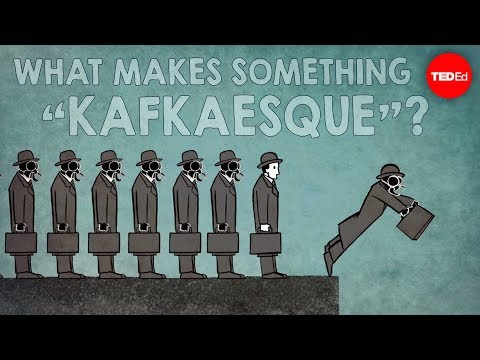 YouTube
The insect that should not be drawn
A text can itself be transformed, when it is carried into a new language, a new medium or a new time. Translation and adaptation each have their own place in the study of how texts move; transformation asks what such a change keeps and what it must decide. Kafka saw the problem before his book was printed. In October 1915, on hearing that the artist Ottomar Starke would design the cover, he wrote to his publisher asking that the insect itself not be drawn. The first edition’s cover shows no insect.
Every adaptation of The Metamorphosis has to make the choice Kafka refused to make. A film must show something on the screen, and a picture of a beetle closes what the prose leaves open. Some stage versions have answered by showing no insect at all: in Steven Berkoff’s production of 1969 the actor playing Gregor creates the creature with his own body. The adaptation is a reading of the original. It is also a new text, which can be analyzed for what its own form makes possible.
Two famous readers of the novella took opposite positions on the Ungeziefer. Vladimir Nabokov, lecturing on the novella at Cornell in the 1950s, treated the insect as a literal fact of the fiction, worked out which kind of beetle it must be, and drew it. Kafka’s own letter takes the opposite position: the creature should stay unseen. Nabokov’s approach rewards attention to the text’s concrete details, but it narrows the transformation to one thing. Kafka’s refusal explains why the story has been read as an image of illness, of disability, of the dehumanizing effect of work and of a family’s shame. A reading that keeps the insect undrawn is closer to the text’s own design.
Texts that set out to change their readers
“The Student” shows a story changing its listener: the old woman weeps at a story told by a fire, and her tears change the teller. Whether real texts change real readers is harder to show, because the change happens outside the page. Some texts, though, show their own change of mind in front of their audience. The morning call-in on a Nairobi community radio station, in which listeners argue about a new bus-only lane on a city road, opens and closes with its host’s question:
So my question today is this: is the red lane a gift to the people who ride the mathree, or a punishment for everybody else?
So, gift or punishment? From this morning, I would say it depends on where you are standing. And some of us are standing at a roundabout with no footpath.Sema Mtaa call-in, turns 3 and 59 (mathree: Sheng for matatu, a minibus taxi)
The host, Njeri, begins with a choice between two answers. Five callers, among them a vegetable seller, a motorcycle-taxi rider and a student who walks, refuse to fit it. By turn 59 the question itself has changed. Njeri repeats it (“So, gift or punishment?”) only to replace it with a claim about position, and she ends on the last caller’s image of the roundabout with no footpath. The framing of the debate is transformed in the course of one program, and the transcript keeps both versions, so a listener can see the change and what caused it.
A campaign to change a phrase
Advertising often promises to transform its audience, and sometimes says so openly. In June 2014 the sanitary products brand Always released a film online, directed by Lauren Greenfield, under the hashtag #LikeAGirl. Teenagers, adults and a young boy are asked to run, fight or throw “like a girl”, and most act out weak, flailing movements. Girls of about ten are asked the same questions and run and punch with full force. A 60-second version was shown during the Super Bowl in February 2015.
The film builds the transformation it wants into its own structure. The older participants have learned the insult, and the youngest have not yet learned it. Set side by side, the two groups suggest that girls are taught, somewhere around adolescence, to think less of their own strength. The film then asks viewers to reverse that change, and to make “like a girl” mean something strong. Its purpose is the transformation of a meaning, and it shows the before and the after on screen. Whether viewers changed is a separate question. The brand’s own surveys reported a large shift in how people felt about the phrase, which is a claim made by an advertiser about its own advertisement.
The scholars Robert Goldman, Deborah Heath and Sharon Smith gave a name to this kind of text in 1991: commodity feminism, in which advertising takes up feminist ideas and turns them into signs that sell products. On that view the film’s message of strength is attached to a brand, and the transformation it offers is partly a transformation of how viewers feel about a company. The strongest reply comes from the film’s reception: it was shared widely, won industry prizes and an Emmy for outstanding commercial in 2015, and gave the phrase a second meaning in public use. Both positions can be argued from the evidence. For a reader of the text, the safer ground is what the film invites and how it builds that invitation, since that can be shown in the text itself.
Transformation across the areas of exploration
One sentence of “The Ledger” changes how everything before it is read:
His initials are on most pages of that ledger until the autumn, and then they are not.
“The Ledger”, paragraph 5
Seen through readers, writers and texts, transformation is part of reading itself. A reader who returns to the father’s greeting after this sentence reads the polite “Morning, Mr Gourlay” differently. The words stay; the reader has changed. Texts often build this second reading into their design, and the narrator who says “I know now” is inviting it.
Through time and space, transformation is what happens to a text as its contexts change. The Metamorphosis was a strange story about a salesman in 1915; a century later its author’s name is an adjective for any maze of rules. A text from another time reaches a reader already changed by everything that has happened since, as “The Ledger” reaches its readers through the narrator’s decades. Reading such a text includes noticing which meanings are new.
Through intertextuality, transformation is how one text becomes another: a translation, an adaptation, a parody, a new version of an old story. It also describes what comparison does to the texts compared. Read beside “Temperament”, Isobel’s father becomes one of two parents whose work the child records but cannot share. Read beside “The Ledger”, the tuner’s untouched home piano becomes one more record of a working life that the next generation keeps.
Transformation with the other concepts
Transformation pairs most often with identity, since a self that changes is a self being remade, as Tambu’s is in Nervous Conditions. It pairs with creativity when a writer transforms existing material into a new text, as every adaptation of Kafka does. It pairs with perspective when the change is in how something is seen: Isobel’s “I know now that it was manners” (paragraph 5) is a transformation of perspective inside one sentence. A strong essay often names the change and then asks which of these it is: a change in who someone is, in what is made, or in how the world is seen.
Writing about transformation
A paragraph about transformation names what changes, shows the before and the after in the text’s words, and identifies the cause. It then says what the change means for the text as a whole. The paragraph that follows reads “The Ledger” through transformation, as a student might in an essay on a novel studied in class.
In the opening of The Weighing House, Isobel’s first week at the scale changes her understanding of what it means to be right.note 1 She arrives believing that “a good hand and a right figure were the same thing”, and the past tense of believed already marks the belief as one the narrator has left behind.note 2 The cause is a single silent correction: Mr Gourlay finds a bale entered “two pounds heavy”, rules a line through it and initials the right figure, without a word.note 3 The change is never stated, only shown in what Isobel keeps, since the ledger with “the only figure on those first pages that is not mine” is still in her possession decades later.note 4 The novel presents growing up as the discovery that care and accuracy are different things, and it lets an object, not a confession, carry the lesson.note 5
What changes. The topic sentence names the change precisely: an understanding, not a mood.
The before, in the text’s words. The quotation and the comment on its tense show the earlier state and the distance from it.
The cause. The paragraph identifies the event that moves Isobel, with its exact details.
The after, and how it is shown. The kept ledger is the evidence that the change lasted.
What it means. The last sentence links the change to the novel’s idea of growing up and to its method.
The paragraph moves through before, cause and after, and its last sentence states what the change means instead of repeating the evidence. The pair that follows shows a weaker response to “Temperament” and a rewrite of the same point.
Weak: In “Temperament” the speaker changes a lot from the beginning to the end of the poem.note 1 At first she is a child who helps her father, and at the end she is an adult with his piano, which shows the theme of change.note 2
Strong: “Temperament” presents inheritance as a transformation of use rather than of objects.note 3 The daughter keeps the father’s tuning hammer “in its cloth” and his piano in her hallway, but where his work was “putting them back”, her last act is to strike the A and “leave it”.note 4
Change asserted. “Changes a lot” gives no before, no after and no cause.
Summary, then a label. Child and adult are stages of the story, and “the theme of change” could be said of any poem that covers time.
A precise claim. The sentence names what kind of transformation the poem shows and what stays fixed.
Before and after in the words. Two quotations are set against each other, so the reversal is visible in the language.
Applying it in Paper 2 and the individual oral
Paper 2 questions often ask how works present change in a character, a family or a society, or how an ending alters what came before. Transformation gives such a comparison a clear axis: what changes in each work, what causes it, and how each work makes the change visible. A comparison of Nervous Conditions and The Metamorphosis might open: “Both works follow a family reorganized around one member’s change. Dangarembga traces a transformation that the narrator chooses and pays for through schooling, while Kafka imposes one in a single sentence and follows its effects on everyone else.”
The commonest way to lose marks is to narrate the change in each work in turn, which turns a comparison into two plot summaries. The stronger move compares the methods: a retrospective narrator’s first sentence set against a novella’s first sentence, each placing the change where the work needs it.
In the individual oral, transformation can link a literary work and a body of non-literary texts through a global issue. A student might pair Nervous Conditions with the films of the #LikeAGirl campaign, under the issue of how girls come to see their own abilities through what others expect of them. In the literary extract, a passage in which Tambu grows maize to pay her own school fees could show a transformation she claims for herself. In the non-literary extract, the film shows a meaning that has been learned and asks for it to be unlearned. Both halves then answer the same question about who causes the change and how each text makes it visible.
Transformation leads to the question of who has the power to describe a person or a place, since every change in a text is told by someone. That question belongs to representation, and the memoir, with its double time of the self then and the self now, takes the narrator’s own transformation further.
Self-check
- To do:
I can explain transformation as change in a character, a speaker, a reader or a text, with its before, its after and its cause.
- To do:
I can distinguish a dynamic character from a static one, and a static character from a flat one.
- To do:
I can trace a character arc, from Isobel’s week at the scale to Chekhov’s student, through causes and evidence.
- To do:
I can explain how a bildungsroman is built on its protagonist’s change.
- To do:
I can show how inheritance transforms what passes between generations in a poem, and how a blog post announces continuity and change.
- To do:
I can discuss what an adaptation must decide, and why a claim that a text transforms its readers needs evidence outside the text.
- To do:
I can use transformation as the axis of a comparison of two works or of an individual oral, comparing methods as well as changes.
- To do:
I can write a paragraph that names a change, shows its before and after in the text, and explains its cause and meaning.
Key terms
Each is also in the Central concepts glossary for IB English A Lang & Lit, beside the other terms of its topic.
- Bildungsroman
A bildungsroman is a novel that follows the growth of a young protagonist from childhood or youth toward adulthood, through education, work, loss and the discovery of a place in society. Its structure is built on the protagonist's transformation.
- Character arc
A character arc is the course of change a character goes through across a narrative, from what they believe or are at the start to what they believe or are at the end. It is traced through the events and choices that cause each step.
- Dynamic character
A dynamic character is one who changes in an important way during a narrative, in understanding, values or situation. The change is usually caused by the events the narrative presents.
- Static character
A static character is one who stays essentially the same from the beginning of a narrative to its end. A static character may still be complex, and often serves as the fixed point against which other characters' change is measured.
- Transformation
Transformation is change in a character, a speaker, a reader or a text, together with what causes it. As a way of reading, it asks what is different at the end of a text, or after it, and which choices make the change visible.
Practice questions on 4.6 Transformation
Augment’s own questions, written in the style of IB exam papers. Here is how a few of them start.

Practice all 22 questions on 4.6 Transformation
Free with an account. Write your answer, open the markscheme beside it and mark yourself. Augment keeps the ones you got wrong for another go.
More in 4 Central concepts
The whole topic is on its own page.
- 4.1Identity
- 4.2Culture
- 4.3Creativity
- 4.4Communication
- 4.5Perspective
- 4.6TransformationThis page
- 4.7Representation
Carry on with 4.6 Transformation in Augment
With a free account, Augment remembers where you stopped in the notes and which questions you have marked.