1 Number and algebra
An overview of number and algebra: how standard form, accuracy, sequences, finance, logarithms and equations fit together, and how HL extends them to complex numbers, matrices and eigenvectors.
- IB Mathematics: Applications and Interpretation
- SL and HL
15 subtopics in Number and algebra
Each one has its own page once something is published for it.
- 1.1Scientific notation40 questions · notes
- 1.2Arithmetic sequences and series36 questions · notes
- 1.3Geometric sequences and series70 questions · notes
- 1.4Financial applications of geometric sequences45 questions · notes
- 1.5Exponents and introduction to logarithms29 questions · notes
- 1.6Approximation and error82 questions · notes
- 1.7Amortisation and annuities30 questions · notes
- 1.8Equations and systems using technology76 questions · notes
- 1.9Laws of logarithmsHL only49 questions · notes
- 1.10Rational exponentsHL only22 questions · notes
- 1.11Infinite geometric seriesHL only25 questions · notes
- 1.12Complex numbersHL only40 questions · notes
- 1.13Polar and Euler formHL only34 questions · notes
- 1.14MatricesHL only47 questions · notes
- 1.15Eigenvalues and eigenvectorsHL only56 questions · notes
An overview of 1 Number and algebra
Introduction
Number and algebra is the toolkit the rest of the course is written in. It covers how quantities are written and rounded, how they grow by steady additions or by steady percentages, how logarithms undo exponents, and how equations and systems of equations are set up and solved with technology. Almost every later model, from a loan repayment to a population forecast, rests on one of these ideas.
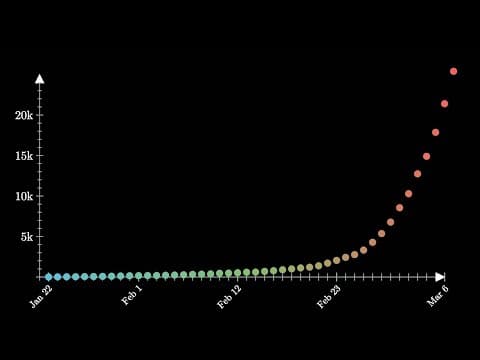
The applied side is strong from the start. Very large and very small measurements are compared in standard form, every rounded answer carries an error that can be measured, and the same geometric sequence that describes the heights of a bouncing ball also describes savings, debt and depreciation. At HL the topic adds three new kinds of object, complex numbers, matrices and eigenvectors, that let one calculation handle rotations, alternating currents and systems that change in steps.
 YouTube
How the subtopics fit together
The subtopics form four strands. The map of the topic shows each strand as a row, with the SL subtopics shaded and the HL-only subtopics dashed; an arrow means the first subtopic is used in the second.
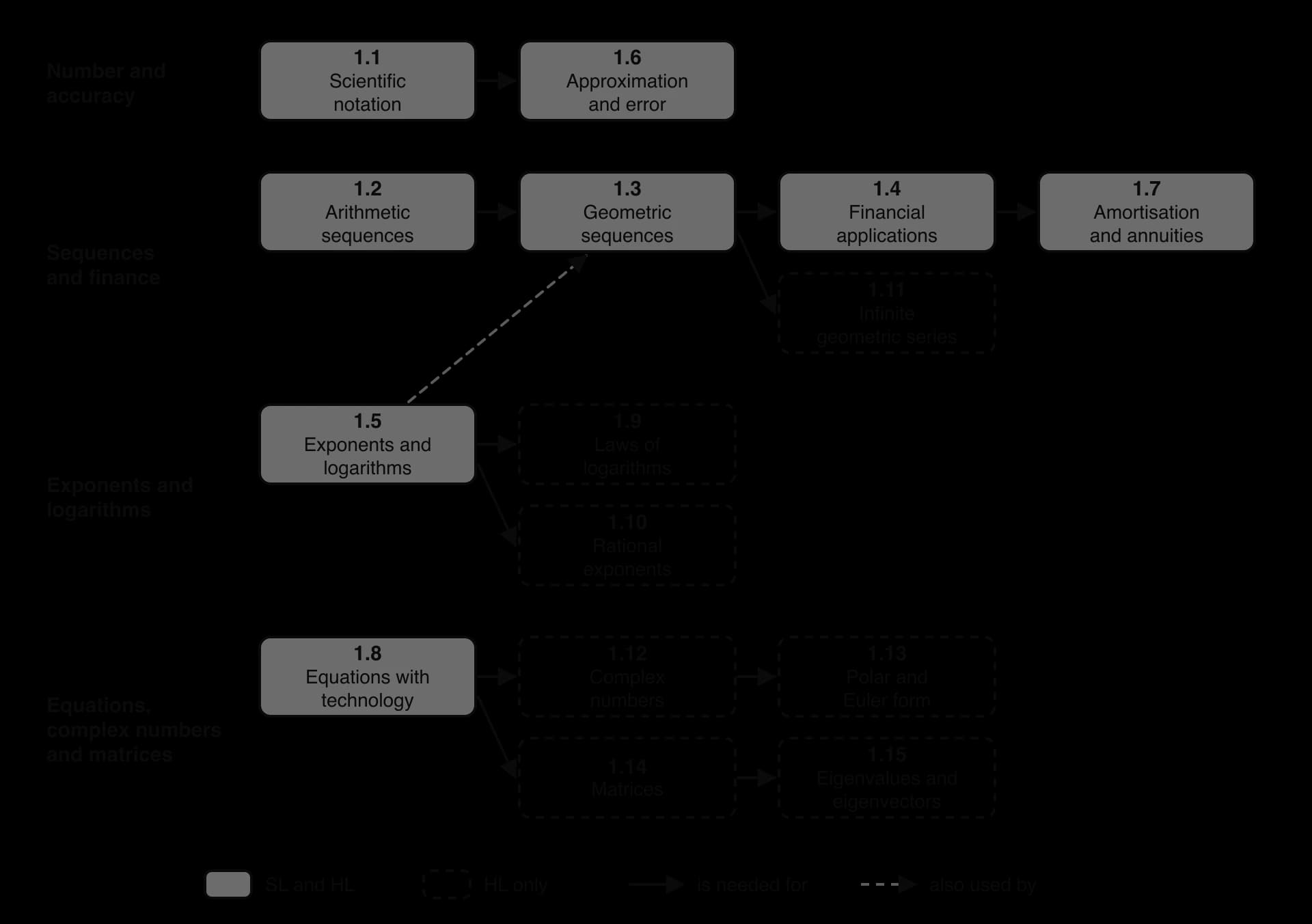
The sequences and finance strand is the backbone of SL. An arithmetic sequence adds the same amount each step; a geometric sequence multiplies by the same amount, which is exactly what compound interest and depreciation do. Loans and annuities then add a regular payment to that growth, and the GDC's TVM solver handles all of it. The exponents and logarithms strand feeds into this chain, because finding when an investment reaches a target means solving an equation with the unknown in the exponent.
The equations strand starts with solving systems and polynomial equations on the GDC. At HL the same systems are rewritten as a single matrix equation, and quadratics with no real roots lead to complex numbers. The number and accuracy strand runs underneath everything, because every answer in the course is rounded and its bounds and percentage error say how far it can be trusted.
The subtopics
Subtopic | Level | What it covers |
|---|---|---|
1.1 Scientific notation | SL | The number sets; writing and calculating with numbers in standard form, with units; orders of magnitude |
1.2 Arithmetic sequences and series | SL | The nth term and the sum of n terms, sigma notation, simple interest and data that grows by a roughly constant amount |
1.3 Geometric sequences and series | SL | The common ratio, the nth term and finite sums; growth and decay factors, half-life and doubling time |
1.4 Financial applications of geometric sequences | SL | Compound interest compounded yearly, half-yearly, quarterly or monthly, the TVM solver, depreciation, inflation and real value, exchange rates |
1.5 Exponents and introduction to logarithms | SL | The laws of integer exponents; logarithms in base 10 and base e, evaluated with technology, and the pH, decibel and Richter scales |
1.6 Approximation and error | SL | Rounding, upper and lower bounds, percentage error and estimation as a check |
1.7 Amortisation and annuities | SL | Loans repaid by regular payments, outstanding balances, total interest, and savings and income annuities, all with the TVM solver |
1.8 Equations and systems using technology | SL | Forming and solving systems of up to three linear equations and polynomial equations of any degree with the GDC, including finding a model's parameters from points |
1.9 Laws of logarithms | HL | The product, quotient and power laws; solving exponential and logarithmic equations and rearranging logarithmic models |
1.10 Rational exponents | HL | Fractional and negative fractional exponents as roots, surds, rationalising denominators and the form |
1.11 Infinite geometric series | HL | When a geometric series converges, the sum to infinity, and repeated bounces, spending and fractals |
1.12 Complex numbers | HL | Cartesian form, arithmetic with complex numbers, the Argand diagram, modulus and argument, and complex roots of quadratics |
1.13 Polar and Euler form | HL | Polar and exponential forms, products and powers as rotations and stretches, and adding sinusoids of the same frequency in AC circuits |
1.14 Matrices | HL | Matrix arithmetic, determinants and inverses, solving , and encoding and decoding messages |
1.15 Eigenvalues and eigenvectors | HL | The characteristic polynomial, eigenvectors, diagonalisation and for long-term behaviour |
Links to other topics
Geometric sequences are the step-by-step version of the exponential models in subtopic 2.5, Modelling with functions, and logarithms return in subtopic 2.10 to straighten curved data on log scales. The GDC methods of subtopic 1.8 find the parameters of the quadratic and cubic models of subtopic 2.5 from points on their graphs, and percentage error measures how good the trapezoidal rule's estimate of an area is in subtopic 5.8.
The HL objects travel furthest. Matrices describe transformations of the plane in subtopic 3.9 and networks in subtopic 3.15; eigenvectors give the long-term state of a Markov chain in subtopic 4.19 and the behaviour of coupled differential equations in subtopic 5.17. Complex numbers add and subtract in the same way as the two-dimensional vectors of subtopic 3.10, which is why both are drawn as arrows.
From the formula booklet
The entries of the mathematics: applications and interpretation formula booklet that 1 uses. Each opens in the explained booklet.
- Solutions of a quadratic equationHL onlyPrior learning › HL only › Solutions of a quadratic equation
- The th term of an arithmetic sequenceTopic 1: Number and algebra › SL and HL › SL 1.2 The th term of an arithmetic sequence
- Sum of an arithmetic sequence from the first term and common differenceTopic 1: Number and algebra › SL and HL › SL 1.2 The sum of terms of an arithmetic sequence
- Sum of an arithmetic sequence from the first and last termsTopic 1: Number and algebra › SL and HL › SL 1.2 The sum of terms of an arithmetic sequence
- The th term of a geometric sequenceTopic 1: Number and algebra › SL and HL › SL 1.3 The th term of a geometric sequence
- The sum of terms of a finite geometric sequenceTopic 1: Number and algebra › SL and HL › SL 1.3 The sum of terms of a finite geometric sequence
- Compound interestTopic 1: Number and algebra › SL and HL › SL 1.4 Compound interest
- Exponents and logarithmsTopic 1: Number and algebra › SL and HL › SL 1.5 Exponents and logarithms
- Percentage errorTopic 1: Number and algebra › SL and HL › SL 1.6 Percentage error
- Logarithm of a productHL onlyTopic 1: Number and algebra › HL only › AHL 1.9 Laws of logarithms
And 9 more in the formula booklet.
Carry on with 1 in Augment
With a free account, Augment remembers where you stopped and what you have practiced.