1.2 Arithmetic sequences and series · IB Maths AI | Augment Education
1.2 Arithmetic sequences and series
Find any term and the sum of the first n terms of an arithmetic sequence, use sigma notation, apply simple interest, and model real data that grows by an approximately constant amount.
IB Mathematics: Applications and Interpretation
Part of 1 Number and algebra
SL and HL
Key terms introduced here
Each is in the Maths AI glossary, with every other term in the subject.
Identify a sequence as arithmetic and write down its first term and common difference, including from a table or list produced by technology.
Calculate any term of an arithmetic sequence with un=u1+(n−1)d
Questions on 1.2
36 exam-style questions on this subtopic, written in the style of the IB papers. The first has its markscheme open. Counted on
Question 1 · AI-000297 marks
The Teatro Alameda in Seville has 30 rows of seats. There are 22 seats in the first row, and each row after the first has 3 more seats than the row in front of it.
(a)
Find the number of seats in the 30th row.
[2]2 marks
Markscheme (a)
u30=22+(30−1)×3
From the formula booklet
The entries of the mathematics: applications and interpretation formula booklet that 1.2 uses. Each opens in the explained booklet.
Interest calculated only on the original principal, so that the same amount is added in every period; on a principal C at r% a year, the total interest over n years is I=100Crn.
One of the numbers in a sequence, written un where the whole number n is its position in the sequence.
, and
find
the position of a term or the number of terms.
Find the first term and common difference of an arithmetic sequence from two of its terms.
Calculate the sum of the first n terms of an arithmetic sequence with either form of the Sn formula, and findn when the sum is given, using technology where appropriate.
Use sigma notation to write and evaluate sums of arithmetic sequences, by hand and with a GDC.
Calculate simple interest and the value of an investment or debt that grows by simple interest.
Solve problems in context with arithmetic sequences and series, giving answers that make sense in the context (whole numbers rounded in the right direction, consistent units).
Estimate a common difference for real data that is not perfectly arithmetic, predict from the model and comment on its reliability.
Introduction
Many quantities change by the same amount at every step: seats added to each row of a theatre, centimetres added to each rung of a ladder, money added to a savings jar every week, interest added each year on a simple-interest loan. Lists of numbers built this way are arithmetic sequences, and adding up their terms gives an arithmetic series. Two short formulas give any term and any sum directly, so a question such as "how many seats are in row 40?" or "how much is saved in a year?" needs one substitution instead of a long list.
Real data is rarely perfectly arithmetic. The world's population grew by between 65 million and 78 million a year from 2020 to 2025, close to but not exactly a constant amount. Approximating the common difference turns such data into a simple model that can be used for prediction, and judging how far such a model can be trusted matters as much as the formulas.
YouTube
Khan Academy, “Introduction to arithmetic sequences”: watch how a constant difference between terms leads to a formula for any term.
Sequences and their terms
A list of numbers written in a definite order, such as the heights of the rungs on a ladder or the amount in a savings account at the end of each month, is called a sequence. The order matters: the list 3, 7, 11 is a different sequence from 11, 7, 3, even though it contains the same numbers.
Each number in the list is a term, labelled by its position. The first term is written u1, the second u2, and the term in position n is un. The small number n is the term's position (its index), not its value: in the sequence 5, 8, 11, 14, … the position n=3 holds the value u3=11.
A sequence can stop or go on forever. The number of seats in each row of a particular theatre stops at the last row, while the list of positive even numbers 2, 4, 6, 8, … has no last term. The three dots "…" at the end of a list show that the sequence continues in the same way.
The distinction matters for sums. A finite sequence always has a total, whereas the terms of an infinite sequence can only be added up to some chosen point.
The general term
Listing terms one by one is slow when a far-off term is needed. A general term is a formula that produces un directly from the position n. Substituting n=1,2,3,… gives the terms in order, and substituting any other whole number gives that term at once.
The general term un=4n+1, for example, gives u1=5, u2=9, u3=13 and u50=201. The positions are always the positive integers 1,2,3,…, so n is never a fraction or a negative number, and a value such as "u2.5" has no meaning.
The gaps between the terms of this sequence (6, 10, …) grow, so it is not arithmetic. In an arithmetic sequence the gap stays the same.
Arithmetic sequences
In the sequence 7, 11, 15, 19, 23, … each term is 4 more than the one before. A sequence that grows or shrinks by the same fixed amount at every step is arithmetic, and that fixed amount is its common difference.
The common difference is found by subtracting any term from the term that follows it. The order of the subtraction matters: later term minus earlier term.
d=un+1−un
A positive d gives an increasing sequence and a negative d a decreasing one. When d=0 every term is equal, which is a constant sequence. The common difference need not be a whole number: 2.5, 3.1, 3.7, 4.3, … has d=0.6.
Sequence
Differences
Arithmetic?
d
7, 11, 15, 19, …
4, 4, 4
yes
4
12, 9.5, 7, 4.5, …
−2.5, −2.5, −2.5
yes
−2.5
3, 6, 12, 24, …
3, 6, 12
no (each term is doubled)
–
1, 4, 9, 16, …
3, 5, 7
no (the differences grow)
–
2.5, 3.1, 3.7, 4.3, …
0.6, 0.6, 0.6
yes
0.6
Showing that a sequence is arithmetic
Checking the first few differences suggests that a sequence is arithmetic but does not prove it, because a pattern that holds for three terms might break later. When the general term is known, a proof works with a general n: subtract un from un+1 and show that the result does not depend on n.
For un=5n+2:
un+1−un=(5(n+1)+2)−(5n+2)=5n+7−5n−2=5
The difference is 5 for every value of n, so the sequence is arithmetic with d=5. Repeating the same step for un=2n2−1 gives un+1−un=4n+2, which changes with n, so that sequence is not arithmetic.
The formula for the nth term
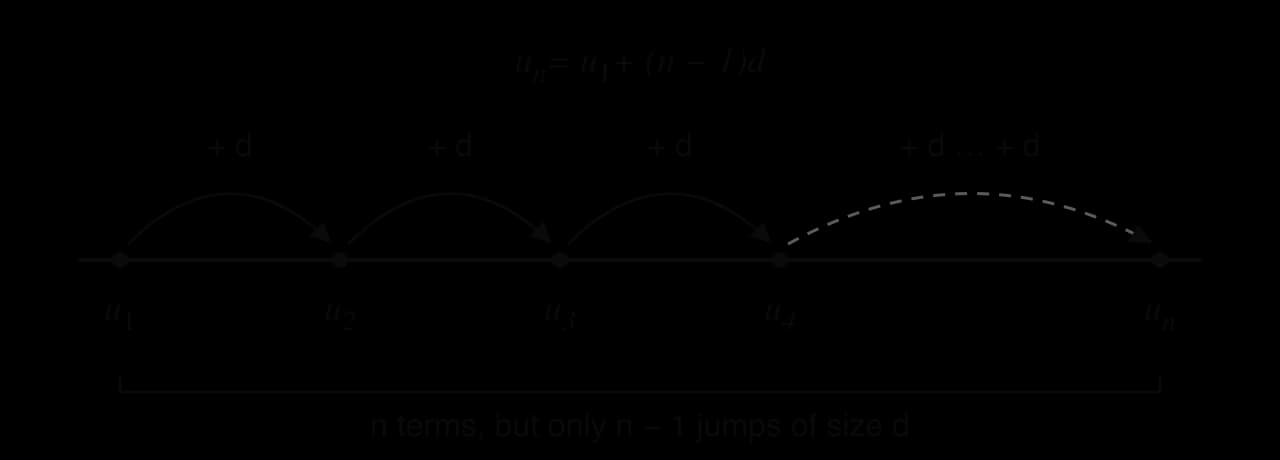
To reach the 5th term of 7, 11, 15, … from the first, the common difference is added four times: u5=7+4×4=23. In general, moving from u1 to un takes n−1 steps, one fewer than the position number, because the first term is already in place before any step is taken. The number line of terms shows n terms joined by only n−1 jumps of size d.
To get from the first term to the nth term, d is added n − 1 times, not n times: the first term needs no jump.
Adding d a total of n−1 times to u1 gives the formula for the general term of any arithmetic sequence.
un=u1+(n−1)d
Expanding the formula shows a second, useful form. For 7, 11, 15, … the general term is un=7+(n−1)×4=4n+3. Every arithmetic sequence has a general term of the form un=dn+c: the coefficient of n is the common difference, and the constant is c=u1−d, the value that a "zeroth" term would have. Spotting this form identifies an arithmetic sequence at once: un=120−8n is arithmetic with d=−8 and u1=112.
Graphs of arithmetic sequences
Plotting each term un against its position n shows the structure of an arithmetic sequence. Because each step to the right adds the same amount d, the points lie on a straight line with gradient d. The points are separate, not joined, because only whole-number positions exist.
line through the terms: y = 4x + 3
The terms of 7, 11, 15, … are separate points that lie on a line of gradient 4, the common difference; only whole-number positions are terms.
The line through the points is y=4x+3, which is the general term un=4n+3 written as a function. Arithmetic sequences are therefore the whole-number version of linear functions, and the same idea of a constant rate of change reappears in linear models in subtopic 2.5 (linear model).
Finding a term's position and counting terms
The nth-term formula can be used backwards: given a value, set un equal to it and solve for n. A whole-number answer gives the position of that term. A non-integer answer shows that the value is not a term.
The same idea counts the terms of a finite arithmetic sequence. The sequence 14, 21, 28, …, 350 has its last term at position n where 14+7(n−1)=350, so n−1=48 and n=49. The general rule is
number of terms=dlast−first+1
The "+ 1" is there for the same reason as the n−1 in the formula: 48 gaps separate 49 terms, in the same way that 4 fence panels need 5 posts.
Rounding n in context
When the answer for n is not a whole number, the context decides whether to round up or down, and the usual rules for rounding to the nearest integer do not apply. Two situations recur.
"What is the greatest number…" (rungs that fit on a ladder, complete rows that can be built, chairs in a stack under a doorway): the quantity must stay within a limit, so n is rounded down. Rounding up would break the limit.
"When does it first exceed…" (the first week a distance is longer than a marathon, the first year a value passes a target): the quantity must pass a limit, so n is rounded up. Rounding down gives a term that has not yet passed it.
Checking the two whole numbers either side of the decimal answer confirms the direction, as with the first negative term of 250, 243, 236, …
Finding u₁ and d from two terms
Often only two terms are known, such as the 4th and the 11th. Each one gives an equation in the two unknowns u1 and d, so the result is a system of linear equations in two unknowns.
There is also a quick route by hand. Between the 4th and 11th terms there are 11−4=7 steps of size d, so the difference between the two terms divided by 7 gives d directly. Once d is known, u1 follows by stepping back from either term.
The GDC's simultaneous equation solver, and how to enter a system into it, is taught in subtopic 1.8, Equations and systems using technology. Writing the two equations on the page matters in either method, because they show the method that the solver carries out.
Three consecutive terms
If a, b and c are consecutive terms of an arithmetic sequence, then b−a=c−b, which rearranges to
b=2a+c
The middle term is the mean of its two neighbours. This gives a quick way to fill a gap (the term between 18 and 31 is 24.5) and an equation when the terms contain an unknown.
Generating sequences with technology
A GDC, a spreadsheet or graphing software lists the terms of a sequence quickly, which is useful for checking an answer or for finding the first term that passes a value.
GDC table. Enter the general term as a function, for example Y1=82+(X−1)×4.5, and view the table with a start of 1 and a step of 1. Each row is a position and its term. Many GDCs also have a sequence or recursion mode (on a TI-84 Plus CE, MODE → SEQ; on a Casio fx-CG50, MENU → Recursion) in which u(n) is entered directly.
Spreadsheet. Put the first term in cell A1 and the formula =A1+4.5 in cell A2, then fill down. Each cell adds the common difference to the cell above, which is the definition of an arithmetic sequence written as a rule.
List command. On a TI-84 Plus CE, seq(82+(X−1)*4.5, X, 1, 30) (from 2ndSTAT → OPS) produces the first 30 terms as a list.
Arithmetic series
Adding the terms of a sequence gives a series. The total number of seats in a theatre is the sum of the numbers of seats in its rows, and the total saved over a year is the sum of the weekly deposits.
Everyday English often uses the two words for the same thing, but in mathematics they differ. A sequence is a list of separate numbers, and a series is the result of adding them.
Most questions add up a fixed number of terms from the start of the sequence. The total of the first n terms is written Sn: S1=u1, S2=u1+u2, S3=u1+u2+u3, and so on.
Deriving the sum formula by pairing
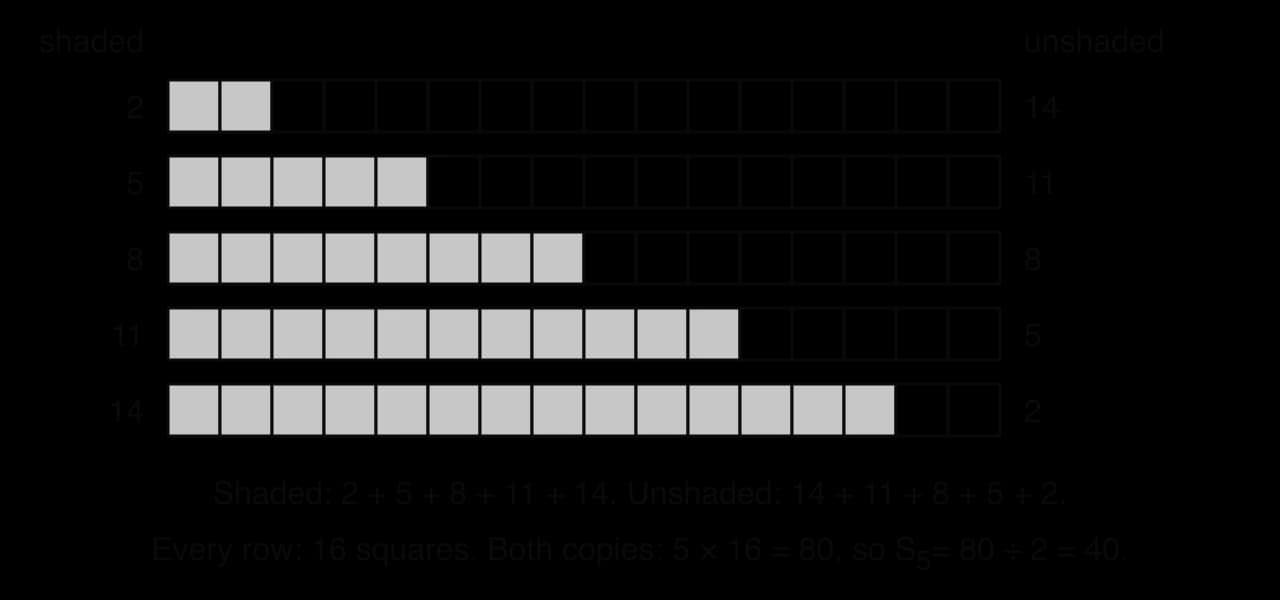
A well-known method adds the series twice, once forwards and once backwards. For 2+5+8+11+14, the first term plus the last is 16, the second plus the second-last is also 16, and so is every other pair: moving inwards, one term rises by d while its partner falls by d. The staircase of squares shows this for five terms: the shaded rows hold 2, 5, 8, 11 and 14 squares, the reversed copy fills the rest, and every row ends up 16 squares long.
Two copies of the series, one reversed, fit together into a rectangle: 5 rows of 16, so one copy is half of 80.
The same argument works for any arithmetic series. Writing Sn forwards and backwards and adding the two lines column by column gives n columns, each equal to u1+un:
Dividing by 2 gives the first form of the formula. In words, the sum is the number of terms multiplied by the mean of the first and last terms.
Sn=2n(u1+un)
Replacing un by u1+(n−1)d gives the second form, which needs only the first term and the common difference:
Sn=2n(u1+u1+(n−1)d)=2n(2u1+(n−1)d)
The pairing idea is old and appears in many cultures. A popular story, of uncertain reliability, tells of the young Carl Friedrich Gauss adding 1 to 100 by forming 50 pairs that each make 101, for a total of 5,050. Rules for summing arithmetic series were known long before, to Archimedes in Greece, to Zhang Qiujian in China, and to Aryabhata in India, whose Aryabhatiya (about 499 CE) treats arithmetic progressions.
YouTube
Eddie Woo, “Sum of an Arithmetic Progression (1 of 5: Visual derivation of formula)”: watch two copies of a staircase of blocks fit together into a rectangle, the picture behind both sum formulas.
Finding n when the sum is known
When the total is given and the number of terms is unknown, substituting into the sum formula gives an equation in n that contains n2, a quadratic equation. With a GDC there are three good ways to solve it:
Equation solver or polynomial solver. Rearrange to the form an2+bn+c=0 (or enter Sn − total =0) and solve. Keep the positive solution that makes sense.
Graphs. Graph y=Sx and the horizontal line y=total and find their point of intersection.
Table. Tabulate Sx and find the two consecutive values either side of the total.
Each of these finds the roots of the equation. A quadratic usually has two, and the context rules out any that are negative or impossible, as the tin display shows. When the total is "at most" or "at least" a value, the decimal answer is rounded down or up with the same reasoning as for terms.
Recovering terms from a sum formula
When a formula for Sn is given, the terms can be found from it. The sum of the first n terms is the sum of the first n−1 terms plus the nth term, so
un=Sn−Sn−1(n≥2),u1=S1
A sum formula of the form Sn=an2+bn always belongs to an arithmetic sequence, with d=2a. Expanding 2n(2u1+(n−1)d) shows why: it equals 2dn2+(u1−2d)n.
Sigma notation
Writing out a long series term by term is slow, and "…" can hide where the sum starts and stops. Sigma notation packs a whole series into one expression with the capital Greek letter sigma, Σ, the Greek S, for "sum".
k=1∑20(3k+4)=7+10+13+⋯+64
The expression is read as "the sum of 3k+4 for k from 1 to 20". The letter k is the index: it takes each whole-number value from the number below the sigma to the number above it, and each value of k gives one term.
Mathematical notation uses letters from several alphabets. The Greek capital Σ for sums sits beside the Latin letters of algebra, Greek π and μ, and the Hebrew ℵ used for sizes of infinite sets in higher mathematics.
Reading the limits
The numbers below and above the sigma fix the first and last values of the index. They need not start at 1, and the number of terms is
number of terms=top−bottom+1
So ∑k=520 has 20−5+1=16 terms, not 15 and not 20. The letter used for the index does not change the value: ∑k=110k and ∑r=110r are both 55.
Sigma notation
First term
Last term
Number of terms
∑k=120(3k+4)
7
64
20
∑k=520(100−3k)
85
40
16
∑n=09(2n+1)
1
19
10
∑r=1127
7
7
12
The last row is a sum of 12 sevens, so it equals 7×12=84. A constant inside the sigma is added once for every value of the index.
Evaluating sums of arithmetic sequences
When the expression inside the sigma is of the form ak+b, consecutive terms differ by a, so the sum is an arithmetic series. Writing down the first term, last term and number of terms turns it into a partial sum that the formula can evaluate.
Writing a series in sigma notation
To write a series in sigma notation, find its general term, then find the values of the index for the first and last terms. For 4+9+14+⋯+99, the common difference is 5, so uk=4+5(k−1)=5k−1. The last term 99 needs 5k−1=99, so k=20:
4+9+14+⋯+99=k=1∑20(5k−1)=220(4+99)=1030
The same series can be written with other limits, for example ∑k=019(5k+4). Both are correct as long as they produce exactly the same terms.
Sigma notation on the GDC
GDCs evaluate a sigma sum directly. Two methods are common:
Summation template. On a TI-84 Plus CE, MATH → summation Σ( gives a template: enter the expression, the index, and the lower and upper limits. On a Casio fx-CG50, in the Run-Matrix app, OPTN → CALC → Σ( takes the expression, the variable, the start and the end.
sum of a list. On a TI-84 Plus CE, sum(seq(100−3X, X, 5, 20)) builds the 16 terms as a list and adds them; sum( is under 2ndSTAT → MATH and seq( under 2ndSTAT → OPS.
Applications of arithmetic sequences and series
Arithmetic sequences model any situation in which a quantity changes by a constant amount per step: rows of seats, stacked objects, training plans, regular savings with no interest, and the total owed on a loan charged simple interest. In each case the work starts by deciding what n counts (rows, weeks, years), what u1 and d are, and whether the question asks for a term or a sum.
Simple interest
Money lent or borrowed earns or costs interest, a charge for the use of the money over time. The amount first invested or borrowed is the principal.
With simple interest, the interest each year is a fixed percentage of the original principal only. Interest already earned does not itself earn interest, so the same amount is added every year.
If the principal is C and the interest rate is r% per year, each year's interest is 100Cr. Over n years the total interest is n times this:
I=100Crn
The value of an investment (or the amount owed on a debt) after n years is the principal plus the interest, C+100Crn. Year by year these values increase by the same amount 100Cr, so they form an arithmetic sequence with common difference equal to one year's interest.
A real quoted rate shows the size of the numbers. In September 2026, UK banks quoted an average interest rate of 11.52% a year on a £5,000 personal loan. Charged as simple interest, this would cost £576 every year (1005000×11.52=576), so the amount owed after 1, 2, 3, … years would be £5,576, £6,152, £6,728, …, an arithmetic sequence with d=576. Real personal loans are repaid in monthly instalments and the interest is charged on the falling balance, which is the amortization of subtopic 1.7, so this simple-interest version is an illustration of the arithmetic pattern rather than how such a loan works.
Source: Bank of England, quoted household interest rate, £5,000 personal loan (series IUMBX67), September 2026.
The way the index is set up needs care in finance questions. In Vn=2400+84n, the position n=0 is the start, before any interest, and Vn is the value after n years. Writing the same values as u1=2484 (after one year) and d=84 is equally correct, but then un is the value after n years and u1 is not the principal. Stating clearly what n counts avoids an answer that is one year out.
Contexts with patterns, rows and plans
Diagrams of tiles, matchsticks or panes are a common way to present an arithmetic sequence: the first few terms are counted from the pictures, and the formulas take over from there. Seating plans, stacked objects and training plans work the same way. A training plan has one extra feature: the target is often given in a different unit, such as a marathon's fixed distance of 42.195 km.
Both the question and the answer of a contextual problem should be read in the context. In the training plan, week 58 is more than a year away, and a runner cannot keep adding 600 m every week indefinitely. The arithmetic model describes the plan as written, and a coach would expect to adjust it once the runs become very long.
Comparing two arithmetic plans
When two quantities each grow by a constant amount, the one with the larger common difference eventually overtakes the other, however far behind it starts. Comparing two arithmetic sequences leads to a linear inequality in n. Comparing their sums leads to an inequality that, after cancelling the common factor 2n, is also linear.
The contrast between parts (b) and (c) matters in context. Offer A's yearly salary is higher from year 7, but the earlier shortfall takes another five years to recover, so a person who expects to stay fewer than 12 years earns more in total with offer B.
When real data is not perfectly arithmetic
Real quantities seldom change by exactly the same amount every year, but many change by roughly the same amount. An arithmetic model replaces the varying differences with a single estimated common difference. This simplification is a mathematical model. It gives reasonable predictions a short way beyond the data, but its accuracy over a long range is doubtful.
Estimating the common difference
The differences between consecutive values give the year-to-year changes. Their mean is the natural estimate of d, and it has a convenient shortcut: when the differences are added, all the middle values cancel, leaving last minus first.
n−1(u2−u1)+(u3−u2)+⋯+(un−un−1)=n−1un−u1
The mean difference is therefore the total change divided by the number of steps, which is one fewer than the number of values. The model built from it, un=u1+(n−1)d, matches the first and last data values exactly.
The world's population from 2020 to 2025 is a good example.
Year
2020
2021
2022
2023
2024
2025
Population (billions)
7.854
7.920
7.989
8.063
8.141
8.215
Change from previous year (millions)
–
+65.7
+69.0
+74.4
+78.0
+74.5
Source: World Bank, World Development Indicators (SP.POP.TOTL), 2026. Populations rounded to the nearest million.
The differences range from 65.7 million to 78.0 million: not constant, but not far apart. The mean difference is
d≈58215424893−7853863139=72312351≈72.3 million a year
Taking 2020 as n=1, the model is Pn=7.854+0.0723(n−1) billion. The plotted data points lie close to the model's line, with the middle years slightly below it because the yearly increases were smaller at the start of the period than at the end.
Pₙ = 7.854 + 0.0723(n − 1)
World population 2020–2025 with an arithmetic model of about 72.3 million people a year; the model's 2030 value is an extrapolation. Source: World Bank, 2026.
The model predicts the 2030 population as the 11th term:
P11=7.854+10×0.0723≈8.58 billion
This prediction lies outside the years of the data, an extrapolation, so it is less reliable than an estimate for a year inside the range. It assumes that the yearly increase stays near 72 million, which is reasonable for a few years but ignores changes in birth and death rates that make the yearly increase drift over decades.
Case study: Carbon dioxide at Mauna Loa
The Mauna Loa Observatory in Hawaii has measured the concentration of carbon dioxide (CO₂) in the air since 1958, in parts per million (ppm). The annual mean rose from 401.01 ppm in 2015 to 427.35 ppm in 2025, and the yearly increases over that decade varied between 1.96 ppm and 3.53 ppm.
Year
2016
2017
2018
2019
2020
2021
2022
2023
2024
2025
Increase on previous year (ppm)
3.40
2.35
1.96
2.93
2.56
2.20
2.12
2.55
3.53
2.74
Source: NOAA Global Monitoring Laboratory, Mauna Loa CO₂ annual mean data, 2026.
The ten differences average
d≈10427.35−401.01=2.634 ppm a year
With 2015 as n=1, the arithmetic model is Cn=401.01+2.634(n−1). It predicts 440.52 ppm for 2030 (n=16), about 441 ppm. Over the decade the model is a fair summary: although single years differ from 2.634 by up to 0.9 ppm, these variations partly cancel, so the model's values stay within about 1 ppm of the measurements.
A longer view shows where the arithmetic model fails. The mean yearly increase has itself grown decade by decade.
d = 0.864 (1959–69)
d = 2.634 (2015–25)
Mean yearly rise in CO₂ at Mauna Loa over successive periods, plotted at the middle of each ten-year period (the last two periods overlap), with the common differences of the 1959–69 and 2015–25 models; d has roughly tripled, so no single d fits the whole record. Source: NOAA GML, 2026.
The rise from 1959 to 1960 was only 0.93 ppm. An arithmetic model fitted to 1959–1969, with d≈0.864, would have predicted about 373 ppm for 2025, 54 ppm below the measured 427.35 ppm. Each decade's increase is larger than the last because emissions have grown, so the data is better described by a curve than by a straight line. An arithmetic model is useful here only for short-range prediction, and its common difference must be re-estimated from recent data.
Regression fits a line to all the data points instead of only the first and last, and it also allows a straight-line model to be compared with a curved one; regression lines are taught in subtopic 4.4 (regression line of y on x).
Exam focus
Arithmetic sequences and series are examined very often, usually as a Paper 1 question of 4–7 marks in two or three parts, or as the opening parts of a longer Paper 2 question that later compares the arithmetic model with a geometric sequence (two salaries, two savings plans, two businesses whose profits grow differently). The command terms are write down (d or u1 read straight from given terms, usually 1 mark with no working needed), find and calculate (a substitution into a formula, with working), show that (usually an expression for Sn), hence (use the result just shown), determine and justify or comment (on a model's reliability or a comparison).
The markschemes follow a regular pattern. An (M1) is given for substituting into the un or Sn formula, an (A1) for a correct substitution and an A1 for the answer; a correct answer from a GDC earns the implied marks, but an incorrect one with no working earns nothing. Contexts that count objects (rungs, rows, weeks, levels) need a whole-number answer rounded in the correct direction, and a decimal such as n=29.7 left unrounded loses the final mark.
The most common lost marks are counting errors: u1+nd instead of u1+(n−1)d, the wrong number of terms in a sigma sum, and giving a single year's value when the total over several years is asked for. Examiners' reports also mention answers given as negative numbers when the context needs a positive amount, such as "−1.5 cups of food per day" for a bag that empties by 1.5 cups a day.
When the equation to solve is quadratic, as in part (d), write the equation or inequality first and then name the GDC method ("solve on GDC", or a sketch with the intersection marked). A labelled sketch of the curve and the horizontal line, with the point of intersection marked, earns the method mark even without algebra.
Practice questions
For the arithmetic sequence 31, 26.5, 22, …, write downu1 and d, and findu15. [3]
Find the number of terms in the sequence 9, 15, 21, …, 357. [2]
The 6th term of an arithmetic sequence is 41 and the 15th term is 113. Find the first term and the common difference, and hence find S30. [5]
Calculatek=1∑30(4k−7) and r=10∑40(2r+1)
A principal of $6,000 is invested at 2.8% simple interest a year. (a) Calculate the value of the investment after 5 years. (b) Find the number of complete years after which the value first reaches $8,000. [5]
A pattern of hexagons is made from matchsticks. Pattern 1 uses 6 matchsticks, pattern 2 uses 11 and pattern 3 uses 16, and the pattern continues in the same way. (a) Find the number of matchsticks in pattern 40. (b) Find the total number of matchsticks needed to make patterns 1 to 40. (c) Find the largest pattern that can be made with 500 matchsticks. [7]
The sum of the first n terms of a sequence is Sn=4n2−n. (a) Write downu1
A café's sales of a new drink in its first five weeks are 380, 402, 431, 447 and 478 cups. (a) Estimate the weekly common difference. (b) Predict the sales in week 8. (c) Comment on the reliability of your prediction. [5]
Offer A pays $38,000 in year 1, rising by $2,000 a year; offer B pays $42,200 in year 1, rising by $1,300 a year. Find the number of years after which the total earned under offer A first exceeds that under offer B. Justify your answer. [5]
Answers
u1=31, d=−4.5; u15=31+14×(−4.5)=−32.
d=6: 6357−9+1=59 terms.
u1+5d=41 and u1+14d=113
First sum: terms −3 to 113, 30 terms: 230(−3+113)=1650. Second sum: terms 21 to 81, 40−10+1=31
(a) I=1006000×2.8×5=840, value $6,840. (b) 6000+168n≥8000
A sequence is an ordered list of terms u1,u2,u3,…; a series is the sum of its terms, and Sn is the sum of the first n terms.
An arithmetic sequence adds the same common difference d=un+1−un at each step; to prove a sequence is arithmetic, show that un+1−un
The nth term is un=u1+(n−1)d, because n
The sum of the first n terms is Sn=2n(u1+un)=2n(2u1+(n−1)d)
Two terms give two linear equations in u1 and d; a given sum gives a quadratic in n, solved with the GDC, keeping only solutions that fit the context.
In context, "greatest number" answers are rounded down and "first time it exceeds" answers are rounded up; check the whole numbers either side.
∑k=abuk has b−a+1
Simple interest I=100Crn (not in the booklet) adds the same amount each year, so values form an arithmetic sequence.
For real data that is approximately arithmetic, estimate d as n−1un−u1
Self-check
To do:
I can tell a sequence from a series, and a finite sequence from an infinite one.
To do:
I can use a general term to find any term and decide whether a value is a term.
To do:
I can write down u1 and d from a list, a table or a pattern diagram.
To do:
I can show that a sequence is arithmetic using un+1−un for a general n.
To do:
I can explain why the nth-term formula contains n−1 and not n.
To do:
I can find the position of a term and count the terms of a finite arithmetic sequence.
To do:
I can find u1 and d from two terms, by hand and with the GDC's equation solver.
To do:
I can derive the sum formula by pairing first and last terms.
To do:
I can choose the better form of the Sn formula and use it.
To do:
I can find n from a given sum with the GDC and reject solutions that do not fit the context.
To do:
I can decide whether to round n up or down from the wording of a question.
To do:
I can read, write and evaluate a sum in sigma notation, counting the terms as top − bottom + 1.
To do:
I can calculate simple interest with I=100Crn and find a rate or a time from it.
To do:
I can estimate a common difference from real data, make a prediction and comment on its reliability.
To do:
I can write down the equations, entries and checks that show my GDC working.
(M1)
=109 (seats) A1
[2 marks]
(b)
Find the total number of seats in the theatre.
[2]2 marks
Markscheme (b)
S30=230(22+109)ORS30=230(2×22+29×3)(M1)
=1965 (seats) A1
Note: Follow through from their answer to part (a).
[2 marks]
(c)
The theatre is to be extended by adding further rows at the back, continuing the same pattern, so that the theatre has at least 2500 seats.
Find the least number of rows that must be added.
[3]3 marks
Markscheme (c)
2n(2×22+(n−1)×3)≥2500 (or =2500) (M1)
n=34.559…(A1)
OR
listing S34=2431 and S35=2555(M1)(A1)
THEN
35 rows are needed, so 35−30=5 rows must be added A1
Note: Award the final mark only for the number of rows added (5), not 35.
[3 marks]
Question 2 · AI-000306 marks
Kofi deposits 4500 Ghanaian cedi (GHS) in a savings account that pays simple interest at a rate of 3.8% per year. No further deposits or withdrawals are made.
The value of the account at the end of each year forms an arithmetic sequence.
(a)
Write down the common difference of this sequence.
[1]1 mark
(b)
Find the value of the account at the end of the 12th year.
[2]2 marks
(c)
Find the number of complete years until the value of the account first exceeds 7000 GHS.
(c) Set the general term equal to 161 and solve for n:
2n2−1n2n=161=81=9(positions are positive, so n=−9 is rejected)
Because n=9 is a positive whole number, 161 is a term: it is u9. If the solution had been a decimal such as n=8.7, the value would not be a term of the sequence.
. The first negative term is
u37=−2
.
cm does not.
in the simultaneous equation solver (as
x+4y=3.4
,
x+11y=5.5
) to get
x=2.2
,
y=0.3
. Write down both equations before the answers, then state which unknown is which.
, about 552 cups. (c) Not very reliable: the differences vary (16 to 31), there are only five weeks of data, and week 8 is an extrapolation; sales of a new drink may level off as novelty fades.
; cancelling the positive factor
2n
gives
700(n−1)>8400
,
n>13
. After 13 years both totals are $650,000, so A first exceeds B after 14 years (A $714,000, B $709,100).
is constant for a general
n
.
terms are joined by
n−1
steps; plotted against
n
, the terms lie on a straight line of gradient
d
.
, found by pairing first and last terms; also
un=Sn−Sn−1
.
terms; evaluate it with the sum formula or the GDC's summation command.
, the mean of the differences; predictions far outside the data are unreliable, especially when
 YouTube
 YouTube