1.5 Exponents and introduction to logarithms
Simplify with the laws of exponents, including zero and negative exponents, switch between exponential and logarithmic form, and evaluate logarithms in base 10 and base e with technology, as on the pH, decibel and Richter scales.
- IB Mathematics: Applications and Interpretation
- Part of 1 Number and algebra
- SL and HL
Key terms introduced here
Each is in the Maths AI glossary, with every other term in the subject.
- Base
The number that is multiplied by itself in a power, written in ; in a logarithm , the base is the number that is raised to a power.
- Common logarithm
The logarithm with base 10, written or simply ; it is the power to which 10 must be raised to give .
- Decibel
The unit of a logarithmic scale of the ratio of two powers or intensities; a sound of intensity has level decibels, where W/m² is the reference intensity, about the threshold of human hearing.
- Euler's number
The irrational constant , the value that approaches as becomes very large; it is the base of the natural logarithm.
- Exponent
The number written as a raised superscript on a base, which, when it is a positive integer , counts how many copies of the base are multiplied together: with factors.
- Exponential equation
An equation in which the unknown appears in an exponent.
- Laws of exponents
The rules for calculating with powers: , , , and , together with and for .
- Logarithm
For a base , , and a positive number , the logarithm is the exponent to which must be raised to give ; so means exactly the same as .
- Logarithmic scale
A scale on which equal distances represent multiplication by the same factor, so that a value is placed according to its logarithm (usually its common logarithm) rather than its size.
- Natural logarithm
The logarithm with base e, written , so that is the power to which e must be raised to give .
- Negative exponent
An exponent less than zero, defined by for , so that a negative power is the reciprocal of the corresponding positive power.
- pH
A logarithmic measure of the acidity of a solution, given by , where is the hydrogen-ion concentration in moles per litre.
- Reciprocal
The reciprocal of a non-zero number is , the number that gives 1 when multiplied by .
- Richter scale
A logarithmic scale of earthquake magnitude, , where is the maximum amplitude recorded by a seismograph and is a fixed reference amplitude, so that each increase of 1 in magnitude is a tenfold increase in measured amplitude.
- Zero exponent
The rule that any non-zero number raised to the power 0 equals 1, so for .
Notes on 1.5 Exponents and introduction to logarithms
Learning objectives
Use the laws of exponents with integer exponents to simplify numerical and algebraic expressions.
Evaluate expressions with a zero exponent or a negative exponent, and write reciprocals as negative powers.
Solve simple exponential equations by writing both sides as powers of the same base.
State the meaning of a logarithm and convert between the forms and .
Explain why the argument of a logarithm must be positive.
Evaluate common logarithms (base 10) and natural logarithms (base e) using technology.
Solve equations of the form using technology, writing down the equation that was solved.
Calculate and interpret values on logarithmic scales such as pH, decibels and the Richter scale.
Introduction
Repeated multiplication appears wherever a quantity grows or shrinks by the same factor again and again: money earning compound interest, a population growing by a fixed percentage, a radioactive sample losing half its atoms in each half-life. Exponents are the short way of writing repeated multiplication, and the laws of exponents are the rules for calculating with them. Logarithms work in reverse: from the result of a repeated multiplication, a logarithm gives the exponent, the number of times the base was used. This makes an unknown exponent something that can be calculated.
Logarithms also make very wide ranges of values manageable. The hydrogen-ion concentration of liquids, the intensity of sounds and the amplitude of earthquake waves each vary by factors of millions or more, so scientists report them on logarithmic scales (pH, decibels and the Richter scale) where each step of 1 stands for multiplication by 10.
Exponents
Repeated multiplication
The product is written and read "3 to the power 4". The 3 is the number being multiplied, and the small raised 4 counts how many times it appears in the product. The value is .
The raised number has several names: "exponent", "power" and "index" (plural "indices") all mean the same thing, and all three are in common use.
For a positive integer exponent the definition is a counting statement, and every law of exponents follows from counting factors. The definition makes no sense for an exponent of 0 or (a product cannot have zero or minus three factors), so those exponents are given meanings later, chosen so that the same rules keep working.
Brackets and negative bases
An exponent applies only to the symbol or bracket written directly before it. This matters most with negative numbers and with coefficients in algebra.
Expression | Meaning | Value |
|---|---|---|
depends on | ||
A negative base raised to an even power gives a positive result, and raised to an odd power gives a negative result, because the minus signs cancel in pairs. In the power is worked out first and the minus sign afterwards, following the usual order of operations. A GDC follows the same rule, so typing -3^2 returns ; to square the brackets must be typed.
The laws of exponents
Multiplying powers with the same base
Multiplying by means writing three factors of 2 followed by four more.
There are factors in total. The same counting works for any base and any positive integer exponents, which gives the first law: to multiply powers of the same base, add the exponents.
Dividing powers with the same base
Dividing by cancels two of the six factors of 5 in the numerator against the two in the denominator, leaving four.
The number of factors left is , so to divide powers of the same base, subtract the exponents: for . The base must not be 0, because division by zero is undefined.
A power of a power and a power of a product
Raising to the power 2 multiplies two copies of , which is . In general factors of , repeated times, gives factors.
A power of a product spreads over every factor in the product: , because multiplication can be done in any order. The same is true for a quotient. These rules are collected in one place because they are always used together.
Law | In words | Example |
|---|---|---|
same base, multiply: add the exponents | ||
same base, divide: subtract the exponents | ||
power of a power: multiply the exponents | ||
power of a product: raise every factor | ||
power of a quotient: raise top and bottom |
The first three laws only apply when the bases are the same. The product cannot be written as one power, and has to be evaluated as . Powers with different bases can sometimes be rewritten with a common base first: , so .
 YouTube
The zero exponent
The quotient law gives a value for an exponent of 0. Dividing any non-zero power by itself gives 1, and subtracting the exponents gives an exponent of 0.
The only way for both statements to be true is . The pattern in a table of powers of 2 leads to the same value: each step down the table halves the result, and halving gives 1.
Power | ||||||||
|---|---|---|---|---|---|---|---|---|
Value | 16 | 8 | 4 | 2 | 1 |
The quotient argument cannot give a value for , because it would need division by 0, so is left undefined.
Negative exponents
Continuing the table past halves the value at each step, which gives , and . The quotient law gives the same result: , while cancelling factors gives . A negative exponent therefore means "one divided by the positive power".
With this word, a negative exponent has a short description: is the reciprocal of .
The second form follows from the first: . To raise a fraction to a negative power, turn the fraction upside down and use the positive power, so . A negative exponent never makes a number negative: is the small positive number .
Negative exponents are already familiar from standard form in subtopic 1.1, Scientific notation: means . Each step down in the power of 10 divides by 10.
Using the laws with algebra
The laws work for letters in the same way as for numbers. With several letters and coefficients, deal with the numbers first, then each letter in turn, using one law at a time. Writing a power of a product as a product of powers before simplifying keeps the steps clear.
Writing expressions such as in the form prepares them for differentiation and integration in topic 5, where every term has to be written as a multiple of a power of .
Substituting small numbers, as in that check, is a quick way to catch a sign slip with negative exponents, a frequent error in this kind of simplification.
Exponential equations
Equations with the unknown in the exponent
An equation such as asks for an exponent rather than a base. The unknown sits in the exponent, so the methods for linear or quadratic equations do not apply directly.
When both sides can be written as powers of the same base, the exponents must be equal. This works because, for a positive base other than 1, different exponents always give different values: the powers of 2 are 1, 2, 4, 8, 16, 32, …, and only one exponent gives 32. So gives .
This matching method works only when the numbers happen to be powers of a common base. Most equations from real situations are not like that. A sum of money invested at 5% compound interest a year doubles when , and 2 is not a whole-number power of 1.05: and , so the answer lies between 14 and 15. Finding it exactly needs either technology or a new kind of number, the logarithm.
Solving exponential equations with the GDC
The GDC solves in two standard ways. The menu names for two common models are given as examples; other models have equivalent tools.
Graph and intersect. Enter the left side as one function and the right side as another ( and ), choose a window that shows the crossing, and use the intersection tool (TI-84 Plus CE:
2ndTRACE→intersect; Casio fx-CG50:SHIFTF5(G-SOLVE) →INTSECT). The -coordinate of the point of intersection is the solution.Equation solver. Enter (or ) in the numerical solver (TI-84 Plus CE:
MATH→Numeric Solver; Casio fx-CG50:MENU→Equation→SOLVER) with a sensible starting value, and solve for .
The graph of rises steadily, so it crosses the line exactly once, at .
- y = 1.05ˣ
- y = 2
The solution of is the doubling time for 5% growth, about 14.2 years, a quantity met in subtopic 1.3, Geometric sequences and series, and used with compound interest in subtopic 1.4.
In the final step of that example the GDC returns 8.91, while the question asks for a whole number of years. Rounding to the nearest integer would give the wrong answer for a value such as 8.3, because the population would still pass 25,000 only during the ninth year. Whether to round up or down depends on what the question asks.
Logarithms
The definition
The number of times a base must be multiplied to give a result is called a logarithm. Since , the logarithm of 1000 in base 10 is 3; since , the logarithm of 32 in base 2 is 5. The logarithm is the exponent, written as the answer rather than as a raised number.
The two forms are two ways of writing one fact, an example of equivalence. The exponential form is the natural way to calculate from ; the logarithmic form is the natural way to calculate from . A useful way to read aloud is "the power of that gives ".
Exponential form | Logarithmic form | In words |
|---|---|---|
10 to the power 4 gives 10,000 | ||
10 to the power −2 gives 0.01 | ||
10 to the power 0 gives 1 | ||
2 to the power 6 gives 64 | ||
e to the power 1.5 gives 4.48… |
Why the base and the argument have conditions
The base is restricted for practical reasons. A base of 1 is useless, because every power of 1 equals 1, so would ask for a power of 1 that equals 5, and there is none. A negative base gives powers that jump between positive and negative values and are undefined for many exponents, so negative bases are excluded too.
The number whose logarithm is taken must be positive. For a positive base, every power is positive, whatever the value of : , and are all greater than zero, and very negative exponents only bring the value closer to zero without reaching it. There is therefore no exponent that turns 10 into 0 or into , and and do not exist. A GDC shows an error (or a non-real result) for them.
Logarithms and exponentials undo each other
Because a logarithm finds an exponent, taking the base- logarithm of simply returns , and raising to the power returns . For base 10:
The functions and are inverse functions: each one reverses the other, in the same way that squaring and taking the positive square root reverse each other for positive numbers. The graph of is the reflection of the graph of in the line .
- y = 10ˣ
- y = log₁₀ x
- y = x
The reflection explains three features of the logarithm graph. It passes through because . It exists only for , because only produces positive values. It rises without limit but very slowly: reaches 1 at , 2 at and only 6 at . That slow growth is what makes logarithms useful for describing quantities that range over many orders of magnitude.
Common logarithms
Base 10
Logarithms in base 10 fit the decimal number system, because the logarithm of a power of 10 is just the exponent. Printed tables of base-10 logarithms were the standard aid to calculation for more than three centuries, and they are the logarithms used by the pH, decibel and Richter scales.
When no base is written, means , which is also what the GDC's LOG key calculates.
Estimating a common logarithm
For numbers that are not exact powers of 10, the common logarithm lies between two integers. Since , lies between and . The GDC gives . The integer part, 2, comes from the order of magnitude of 500, and the decimal part comes from the 5.
This links logarithms to standard form. A number written as with has a common logarithm between and , because . For example, has between 6 and 7 (the GDC gives 6.857), and has between and (the GDC gives ). The integer below the logarithm is the order of magnitude of the number.
Euler's number and the natural logarithm
The number e
One number other than 10 is used as a base so often that it has its own letter. It appears when interest is added more and more frequently. An investment of 1 at an annual rate of 100%, compounded times a year, grows in one year to . Compounding more often gives more, but the extra gained shrinks each time.
Compounding | ||
|---|---|---|
yearly | 1 | 2 |
half-yearly | 2 | 2.25 |
quarterly | 4 | 2.441… |
monthly | 12 | 2.613… |
daily | 365 | 2.714… |
hourly | 8760 | 2.718 127… |
a million times | 1,000,000 | 2.718 280… |
The values settle towards 2.718 281 828…, a number that cannot be written as a fraction or as a terminating or repeating decimal. It is called e. Interest added at every instant in this way is continuous compounding, met in subtopic 1.4.
Beyond interest rates, e is the base for which growth is simplest to describe with calculus, so it appears in models of population growth, radioactive decay, cooling and the spread of disease. Models of the form are met in subtopic 2.5 and, at HL, in subtopic 2.9.
The natural logarithm
A logarithm with base e is called a natural logarithm. It has its own notation and its own key.
Natural logarithms behave in exactly the same way as common logarithms; only the base differs. Since e is smaller than 10, it takes a larger power of e than of 10 to reach a given number, so is larger than for : while .
Evaluating logarithms with technology
The LOG and LN keys
Logarithms of most numbers cannot be found by hand, so they are evaluated with the GDC. Every GDC has a LOG key for base 10 and an LN key for base e, with and as their second functions, because each pair are inverses. Most models open a bracket after the function name, and the whole argument must go inside it before the bracket is closed.
: type
log(3.5×10^4)orlog(3.5E4)and close the bracket: 4.544.: type
ln(8/3): 0.981. Without the bracket around , some models calculate instead.: type the minus sign first, then
log(2.4E-9): 8.620.
Logarithms in other bases
The definition holds for any base , , although base 10 and base e are the ones in everyday use. Many GDCs have a logarithm template or a logBASE function that accepts any base directly, which gives , the doubling time found earlier. On a calculator without one, gives the same value as (or ); the reason for this comes from the laws of logarithms (HL subtopic 1.9). Solving by a graph or the solver avoids the issue altogether.
Solving with a logarithm
The definition turns any equation into a calculation: . For base 10 and base e the GDC evaluates this directly, so gives , and gives . For other bases, a graph, the solver or a log template is used, and the equation solved is written down.
The coefficient in front of the power must be removed before the definition is used. In (b), writing or are both wrong, because is not a power of e until the 4 is divided out.
 YouTube
Logarithmic scales
Why logarithmic scales are used
Some quantities vary over such a wide range that an ordinary number line cannot show them usefully. On a linear scale from 0 to 1,000,000, the values 1, 10, 100 and 1000 are squeezed into the first tiny fraction of the line. On a logarithmic scale, each step of the same length multiplies the value by the same factor, usually 10, so 1, 10, 100, 1000, … are equally spaced.
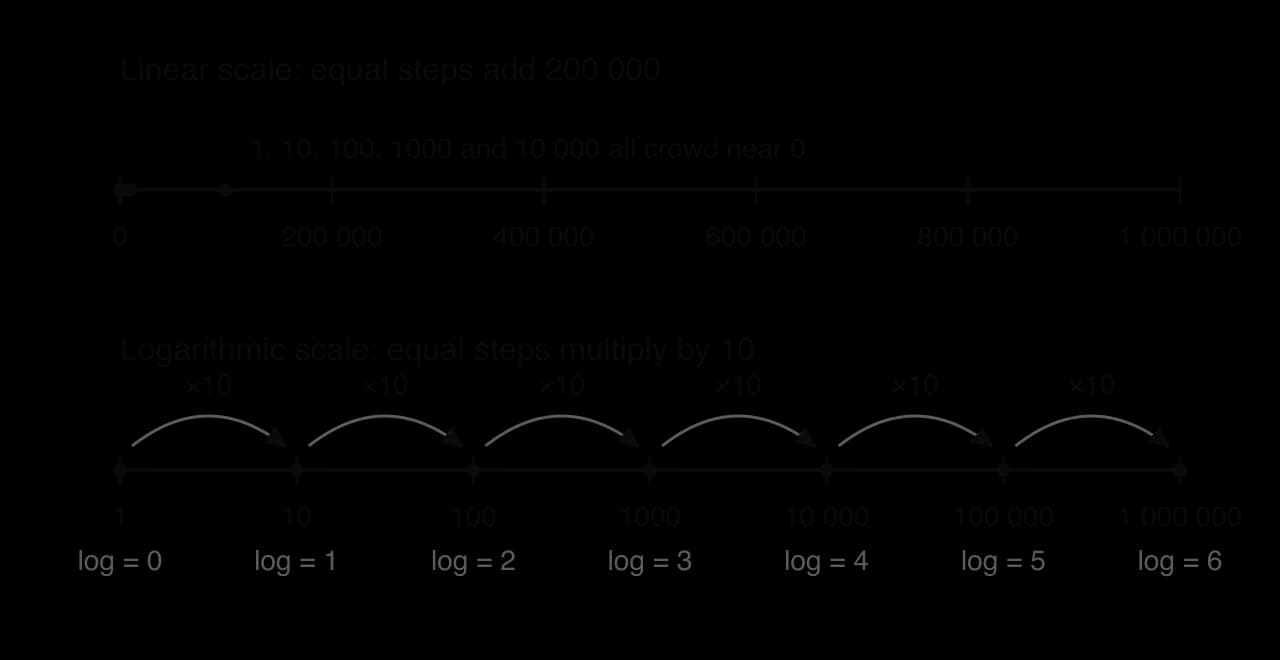
The comparison of the two scales shows that the position on a logarithmic scale is the logarithm of the value: 1000 sits at position 3 because . Equal distances therefore stand for equal ratios rather than equal differences.
Logarithmic scales are a choice of representation. They let quantities from the very small to the very large be compared on one scale, and they roughly match the way human hearing and sight respond to ratios of intensity rather than differences. Their cost is that a small-looking change in the scale value can be a large change in the quantity, which makes reports of pH, sound level and earthquakes easy to misread.
The pH scale
Chemists measure the acidity of a solution by the concentration of hydrogen ions in it, written and measured in moles per litre (mol/L). Concentrations in everyday liquids range from about 1 mol/L in strong acids to about mol/L in strong alkalis, a factor of 100 trillion. The pH scale replaces these concentrations by small numbers.
The minus sign makes the pH positive, because the concentrations are less than 1 and so have negative logarithms. It also reverses the direction of the scale: a higher concentration of hydrogen ions (a more acidic solution) gives a lower pH. The second form comes straight from the definition of a logarithm and is used to find a concentration from a pH.
A coffee with hydrogen-ion concentration mol/L has pH . A liquid with ten times that concentration, mol/L, has pH . Ten times the concentration lowers the pH by exactly 1, and evaluating other pairs gives the same difference every time; the reason is a law of logarithms (HL subtopic 1.9).
Case study: ocean acidification
The surface of the ocean absorbs part of the carbon dioxide released by burning fossil fuels. Dissolved carbon dioxide forms carbonic acid, which raises the hydrogen-ion concentration of seawater and lowers its pH. Seawater is slightly alkaline, with a pH a little above 8, and since the Industrial Revolution the global average pH of the surface ocean has fallen by about 0.11.
A fall of 0.11 sounds negligible, but pH is a logarithmic scale, so the change has to be translated back into concentrations. Taking a starting pH of 8.20 for illustration, the pH after the fall is 8.09.
Surface ocean | pH | (mol/L) |
|---|---|---|
before (illustrative value) | 8.20 | |
after a fall of 0.11 | 8.09 |
Source: change of 0.11 in global average surface pH since the Industrial Revolution, NOAA Pacific Marine Environmental Laboratory, "A primer on pH", accessed 2026. The starting value 8.20 is illustrative.
The ratio of the concentrations is , so the hydrogen-ion concentration has risen by about 28.8%. Repeating the calculation from a different starting pH, such as 7.71 falling to 7.60, gives the same ratio 1.288, because the ratio depends only on the size of the fall: it equals . NOAA rounds this to "approximately a 30% increase in acidity".
The case shows why reports on logarithmic scales need care. A fall of 0.11 pH units is an increase of almost 30% in hydrogen-ion concentration; a fall of a full unit would be a tenfold increase. The model also has limits. pH varies from place to place and from season to season by more than 0.11, so a single global average hides local conditions, and the definition with concentration is itself an approximation that chemists refine for seawater.
The Richter scale
Earthquakes release energy across an enormous range, and the seismograph traces they produce vary in amplitude (the size of the largest swing) by many factors of 10. In 1935 Charles Richter, working with Beno Gutenberg, defined a magnitude scale for earthquakes in southern California based on the logarithm of this amplitude.
Rewriting the definition in exponential form gives the amplitude from the magnitude: , so . Two earthquakes of magnitudes and therefore have amplitudes in the ratio , by the quotient law of exponents. A difference of 2 in magnitude means 100 times the amplitude; a difference of 3 means 1000 times.
Seismologists now use the moment magnitude scale for large earthquakes, because Richter's original scale saturates: above about magnitude 7 its values stop rising in step with the size of the earthquake, but the values are close for moderate earthquakes and news reports often still say "Richter scale". The energy released also grows much faster than the amplitude, a relationship studied with the laws of logarithms in HL subtopic 1.9.
The decibel scale
Sound intensity , the power carried by a sound wave through each square metre, ranges from about W/m² for the faintest sound a typical person can hear to more than 1 W/m² for sounds that cause pain. The sound intensity level compresses this range of a trillion or more into numbers from about 0 to about 120.
The factor 10 in front of the logarithm is there because the original unit, the bel, was felt to be too large; a decibel is one tenth of a bel. Since increases by 1 for each factor of 10, multiplying the intensity by 10 adds dB, and multiplying by 100 adds 20 dB.
Exam focus
Exponents and logarithms are examined mainly on Paper 1 in short questions of 2–6 marks, and appear as single parts of longer Paper 2 questions on financial mathematics or exponential models. Three question shapes recur.
Simplifying with the laws of exponents, usually 2–3 marks with simplify, write or express ("express in the form "). Every step should be shown, one law at a time.
Evaluating a logarithmic formula in context: pH, sound level, earthquake magnitude, or a formula defined in the question. Calculate earns (M1) for the correct substitution, written with the whole argument inside the logarithm, and A1 for the answer to 3 significant figures.
Rearranging to the exponential form or solving : "find the concentration", "find the time when …". Markschemes award a method mark for an exponential equation with the correct base (), or for the equation entered in the GDC.
Justify and determine whether questions ask for a conclusion supported by calculation. Comparing two inputs (two concentrations) does not answer a question about the outputs (two pH values); the outputs must be calculated or a reason given that links one to the other.
Part (d) is answered by evaluating both levels and subtracting. HL students prove that doubling any intensity adds dB with a law of logarithms (subtopic 1.9).
When an answer comes from a power of 10, give it as a decimal or in standard form unless an exact form is requested. Leaving when the question asks for a value can lose the final mark; markschemes give the decimal, 0.0316.
Practice questions
Simplify , giving your answer as a power of 6. [2]
Write in the form . [2]
Simplify , giving your answer without negative exponents. [3]
Solve . [3]
(a) Write in exponential form. [1] (b) Find the exact value of if , and give its value to 3 significant figures. [2]
Use technology to evaluate and , correct to 3 significant figures. [2]
A car worth $28,000 loses 15% of its value each year, so its value after years is . Find the number of complete years after which the car is first worth less than $10,000. [3]
Rainwater in a city has pH 4.6, and rainwater in a mountain village has pH 5.6. Use . (a) Find the hydrogen-ion concentration of the city's rainwater. [2] (b) Find how many times greater the city's concentration is than the village's. [2]
Earthquake A has magnitude 7.3 on the Richter scale. Earthquake B produces seismograph waves with one-fiftieth of the amplitude of A's. Find the magnitude of B. [3]
A sound has level 72 dB, where . (a) Find its intensity . [2] (b) A second sound is 1000 times as intense. Write down its level. [1]
Answers
.
, that is .
; dividing by gives .
, so and . (Check: .)
(a) . (b) .
; .
Solve with the GDC (graph intersection or solver): . The value is after 6 years and after 7 years, so 7 complete years.
(a) mol/L . (b) Village: ; ratio times.
The amplitude ratio is , so and .
(a) , so W/m² . (b) A factor of adds 30 dB: 102 dB.
Summary
means factors of the base ; an exponent applies only to the symbol or bracket directly before it, so , while in only is raised to the power 4.
Laws of exponents (same base): , , ; also .
and for ; a negative exponent gives a reciprocal, never a negative number.
An exponential equation can be solved by matching bases when both sides are powers of one number; otherwise use logarithms or the GDC (graph intersection or solver), writing down the equation solved.
with , , : a logarithm is an exponent, and the logarithm of zero or a negative number does not exist.
means ; , where is Euler's number. Each is the inverse of or .
Logarithms are evaluated with the
LOGandLNkeys, with the whole argument in brackets; estimate first from the power of 10.On a logarithmic scale each step of 1 stands for a factor of 10: pH , Richter , decibels (10 dB per factor of 10).
Self-check
- To do:
I can identify the base and the exponent in a power and use brackets correctly with negative numbers and coefficients.
- To do:
I can justify each law of exponents by counting factors.
- To do:
I can simplify numerical and algebraic expressions using the laws of exponents one step at a time.
- To do:
I can explain why and evaluate negative powers, including powers of fractions.
- To do:
I can write expressions such as in the form .
- To do:
I can solve exponential equations by writing both sides with the same base.
- To do:
I can solve with the GDC by graph intersection or the solver, and write down what I did.
- To do:
I can convert between and in both directions.
- To do:
I can explain why the logarithm of zero or a negative number is undefined.
- To do:
I can evaluate and with the GDC and check the answer with an estimate.
- To do:
I can explain where the number e comes from and what means.
- To do:
I can calculate a pH, a Richter magnitude or a decibel level from a formula, and rearrange to find the underlying quantity.
- To do:
I can compare two values on a logarithmic scale by converting the difference back into a factor.
- To do:
I can give an answer that comes from a power of 10 as a decimal and round a time in context in the right direction.
Questions on 1.5
29 exam-style questions on this subtopic, written in the style of the IB papers. The first has its markscheme open. Counted on
Question 1 · AI-0021015 marks
Chloé makes a cup of coffee in a room where the temperature is a constant 21 °C. She measures the temperature of the coffee, °C, minutes after it is made. She models the temperature by
where and are positive constants.
When the coffee is made, its temperature is 88 °C. After 5 minutes its temperature is 66 °C.
- (a)
Find the value of .
2 marks
Markscheme (a)
(M1)
A1
[2 marks]
- (b)
Show that , correct to three significant figures.
3 marks
Markscheme (b)
M1
OR A1
A1
AG
Note: The unrounded value must be seen for the final A1.
[3 marks]
- (c)
Find the temperature of the coffee 12 minutes after it is made.
2 marks
Markscheme (c)
(M1)
(°C) A1
Note: Accept from using .
[2 marks]
- (d)
Chloé likes to drink her coffee when its temperature is between 50 °C and 60 °C. Find the length of time for which the coffee is in this temperature range.
4 marks
Markscheme (d)
OR OR sketch with both horizontal lines and intersections marked (M1)
A1
A1
(minutes) A1
[4 marks]
- (e)
Explain why, according to the model, the coffee never cools to 21 °C.
2 marks
Markscheme (e)
for all R1
so (the graph approaches the asymptote but never reaches it) R1
[2 marks]
- (f)
Chloé makes a second cup of coffee at the same initial temperature, but puts it outside where the temperature is 8 °C. Assuming the value of is unchanged, write down the new model for the temperature of this cup of coffee.
2 marks
Markscheme (f)
A1A1
Note: Award one mark for as the constant and one mark for .
[2 marks]
Question 2 · AI-003666 marks
A conservation team introduces trout into a lake. The number of trout in the lake, , years after they are introduced is modelled by
where and are positive constants.
Two years after the trout are introduced there are 1450 trout in the lake. Five years after they are introduced there are 2300 trout.
- (a)
Find the value of and the value of .
3 marks
- (b)
Hence write down the annual percentage increase in the number of trout.
1 mark
- (c)
Find the number of years after the trout are introduced until the model predicts there will be 5000 trout in the lake.
2 marks
Answer it, then compare with the markscheme.Check this one with a free account
Question 3 · AI-004027 marks
In this question, give exact answers.
- (a)
Simplify , giving your answer in the form , where .
3 marks
- (b)
Write in the form , where .
1 mark
- (c)
Solve .
1 mark
- (d)
Solve .
2 marks
Answer it, then compare with the markscheme.Check this one with a free account
From the formula booklet
The entries of the mathematics: applications and interpretation formula booklet that 1.5 uses. Each opens in the explained booklet.
Carry on with 1.5 in Augment
With a free account, Augment remembers where you stopped and what you have practiced.