1.10 Rational exponents · IB Maths AI | Augment Education
1.10 Rational exponents
Interpret fractional and negative fractional exponents as roots and reciprocals, simplify numerical and algebraic expressions with rational exponents and surds, rationalise denominators, and rewrite expressions in the form px^q.
IB Mathematics: Applications and Interpretation
Part of 1 Number and algebra
HL only
Key terms introduced here
Each is in the Maths AI glossary, with every other term in the subject.
Rewriting a fraction with a surd in its denominator as an equal fraction whose denominator is a rational number, by multiplying the numerator and denominator by a suitable expression.
An irrational root of a positive rational number, written in root form so that its value stays exact.
Notes on 1.10 Rational exponents
35 min readLast reviewed
Learning objectives
State the meaning of an1 and anm as roots and powers, and write down the value of simple rational powers without a calculator.
Calculate the value of an expression with a rational exponent, exactly by hand and with a GDC.
Simplify numerical expressions with rational exponents using the laws of exponents.
Simplify algebraic expressions with rational and negative rational exponents.
Simplify surds and rationalise the denominator of a fraction.
Express an expression involving roots and fractions in the form pxq, or as a sum of such terms.
Solve equations of the form xnm=k and rearrange formulae that contain rational powers.
Interpret a formula with a rational exponent in a real context, such as Kleiber's law or Kepler's third law.
Introduction
Integer exponents count repeated multiplication: 25 means five 2s multiplied together. Many formulas in science and economics, however, contain powers such as x21, w43
Rational exponents appear wherever one quantity grows in proportion to a fractional power of another. An animal's energy needs grow roughly with the 43 power of its mass, a planet's orbital period grows with the 23 power of its distance from the Sun, and the surface area of similar objects grows with the 32
YouTube
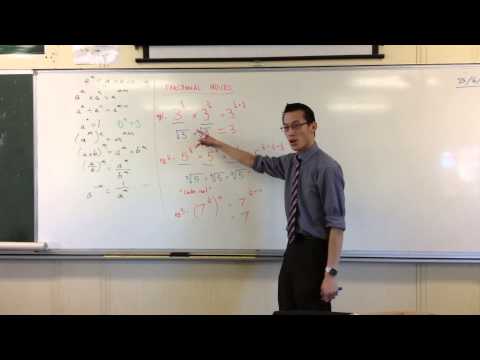
Eddie Woo, “What happens when the power isn't a whole number? (Fractional Indices)”: watch how the meaning of a half power is forced by the rule for multiplying powers with the same base.
Roots
Square roots and cube roots
The square root of a positive number a is the positive number whose square is a. Since 72=49, the square root of 49 is 7, written 49=7
Cube roots undo cubing. Since 43=64, the cube root of 64 is 4, written 364=4
The nth root
Square roots and cube roots are the first two members of a family. The fourth root of 81 is 3, because 34=81; the fifth root of 32 is 2, because 25=32.
The small number n is the index of the root. Odd roots exist for every real number and keep its sign, while even roots exist only for numbers that are zero or positive. The table lists the facts most often used, and knowing them by heart makes exact evaluation much faster.
n
Perfect nth powers
Roots
2
4, 9, 16, 25, 36, 49, 64, 81, 100, 121, 144
144=12
Some numbers appear in more than one row: 64=82=43=26, so 64=8
Exponents of the form 1/n
Why a^(1/2) means the square root
The laws of exponents from subtopic 1.5 were built for whole-number exponents. One of them states that when powers of the same base are multiplied, the exponents are added: am×an=am+n. If this law is to keep working for fractions, a power with exponent 21
a21×a21=a21+21=a1=a.
So a21 is a number which, multiplied by itself, gives a. That is exactly the square root, so for a≥0
an1=na
The power-of-a-power law, (am)n=amn, gives the same result: (an1)n=an1×n=a1=a
Exponents of the form m/n
Two equivalent orders
A general rational exponent nm can be split as n1×m
anm=(an1)m=(na)mandanm=(am)n1=nam
In words, the denominator n is the root and the numerator m is the power. Both orders give the same answer, so the choice is about convenience. Taking the root first keeps the numbers small; raising to the power first produces large intermediate values that are harder to root.
For 3253, taking the fifth root first gives 532=2
Expression
Root first
Power
Value
3253
532=2
A fraction is rooted by rooting its numerator and its denominator separately, as the last row shows. Decimals are often easier as fractions: 0.04=1004=251, so 0.0423=(51)3=1251=0.008
Exponents written as decimals
Formulas often give rational exponents as decimals: 0.5=21, 0.25=41
Using the GDC
Any rational power can be found on a GDC with the power key (^ on most models). The exponent must be entered in brackets, because the calculator follows the order of operations exactly as written.
32^(3/5) gives 8, the intended value.
32^3/5 gives 6553.6, because the GDC calculates 323 first and then divides by 5.
Most GDCs also have an nth-root template, xa, in their maths or template menu, which is useful for roots of high index. When an exact value is needed, the fraction-conversion function turns a decimal answer such as 0.444444… into 94
Negative rational exponents
Combining a reciprocal with a root
A negative exponent means a reciprocal: a−n=an1 (subtopic 1.5, Exponents and introduction to logarithms). The same rule holds for fractional exponents, so a negative rational exponent combines three operations: a reciprocal (from the minus sign), a root (from the denominator) and a power (from the numerator).
a−nm=anm1=(na)m1
The three operations can be done in any order, so the order is chosen to keep the numbers simple. For a fraction, taking the reciprocal first turns it upside down: (ba)−k=(ab)k
A negative exponent never makes the value negative. For a positive base, every power, whatever its exponent, is positive. The negative sign only decides whether the base goes on the top or the bottom of a fraction.
The laws of exponents with rational exponents
The same laws, extended
Because rational exponents were defined to keep the laws of exponents true, every law from subtopic 1.5 can be used unchanged with fractions. For a positive base a (and positive b) and any rational numbers m and n:
Law
Rule
Example with rational exponents
Product
am×an=am+n
521×531=565
Adding and subtracting fractional exponents needs a common denominator: 21+31=63+62=65
Why the base must be positive
The rules in the table hold for every positive base. With a negative base they can give contradictions. The exponent 62 equals 31, yet
(−8)31=3−8=−2while((−8)2)61=6461=2.
Two routes that the laws treat as equal give different answers, so the laws cannot be trusted for negative bases. For this reason expressions with rational exponents are simplified on the assumption that the base is positive (x>0), which is also true in almost every real context: lengths, masses, volumes and times are positive. Single odd roots of negative numbers, such as 3−8=−2
Simplifying numerical expressions
A numerical expression is simplified by writing every number as a power of the same small base, then using the laws on the exponents. Prime factors show the base to choose: 8=23, 16=24, 9=32
Simplifying algebraic expressions
An algebraic expression is simplified in the same way. Roots are first written as powers, numbers and letters are dealt with separately, and the exponents of each letter are combined. The power-of-a-product law applies the exponent to every factor in the bracket, including the number.
Surds
Exact roots and surds
A root such as 16 is a whole number, but most roots are not. The value of 2
Surds are rational exponents in another notation: 5=521
ab=a×bba=ba
Simplifying a surd
A surd is in its simplest form when the number under the root has no square factor other than 1. To simplify, the largest square factor is split off and its root taken outside.
72=36×2=36×2=62
Using a smaller square factor first, such as 72=4×18=218
Surds behave like algebraic terms. Like surds (the same number under the root) can be added and subtracted, just as 5x+3x=8x, while unlike surds cannot be combined. Multiplication uses a×b=ab
Rationalising the denominator
Removing a root from the bottom of a fraction
An answer such as 36 is exact but awkward: dividing by an irrational number is hard to do by hand, and two equal answers may look different. Multiplying the top and bottom of the fraction by the same surd leaves its value unchanged (it is a multiplication by 1) but makes the denominator rational, because a×a=a
36=36×33=363=23
The answer 23 is simpler than 36
Denominators of the form a + √b
When the denominator is a sum or difference such as 3−5, multiplying by 5
3−54=3−54×3+53+5=9−54(3+5)=3+5
Writing expressions in the form px^q
Why the form matters
Many later methods work on single powers of x. The rule for differentiating in subtopic 5.9 and the rule for integrating in subtopic 5.11 both act on terms of the form pxq, and a power model y=axb (a power law) is written the same way. Expressions that contain roots, fractions or brackets must first be rewritten as one power of x
The method
Write every root as a power: x=x21
The constant and the power are handled separately because they behave differently: a constant 5 in the denominator becomes 51 in front, not 5−1 attached to x. Keeping p
x3=3x−21xx6=x236=6x−2353x24=54x−32
Sums in the numerator
A fraction with a sum on top splits into separate fractions, one for each term, because ca+b=ca+cb
xx2+3x=xx2+x3x21=x+3x−21
Formulas from science in the form px^q
The same rewriting turns physical formulas into a form ready for calculus or for comparing powers. The period of a simple pendulum of length L metres is T=2πgL
T=2πg21L21=9.812πL21≈2.01L21
In the form T=pLq, p≈2.01 and q=21
Solving equations with rational exponents
Undoing a rational power
An equation such as x23=27 is solved by raising both sides to the reciprocal power, 32
x23=27⇒x=2732=(327)2=9
The same idea solves xnm=k in general: x=kmn
Kepler's third law
For planets orbiting the Sun, the square of the orbital period is proportional to the cube of the semi-major axis of the orbit (its average distance from the Sun). Measuring the period T in Earth years and the distance a in astronomical units makes the constant equal to 1, because the Earth has T=1 and a=1. So T2=a3
T=a23and, rearranged,a=T32
Mars orbits at about 1.524 AU, so its period is 1.52423≈1.88 years. The observed period is about 687 days, or 687÷365.25≈1.88
Source: Wikipedia, "Kepler's laws of planetary motion" and "Mars" (semi-major axis 1.524 AU, orbital period 687 days), 2026.
Part (c) shows a general feature of power formulas: multiplying the input by k multiplies the output by kq, independent of the starting value. Formulas of the form y=pxq therefore describe scaling very directly.
Graphs of rational powers
The graph of y=xq for x>0 has a shape set by the exponent. The graph of the three functions y=x21
For 0<q<1, such as q=21 or q=43
Between 0 and 1 the order is reversed: x23<x21
Case study: Kleiber's law
An animal's basal metabolic rate (BMR) is the energy it uses each day at rest, just to stay alive. Larger animals use more energy in total, but not in proportion to their mass. Kleiber's law, an empirical rule found by comparing many species, states that
BMR≈70w43 kilocalories per day,
where w is the animal's mass in kilograms. The exponent 43 lies between 0 and 1, so the energy needed rises more slowly than the mass.
Masses that are perfect fourth powers give exact values, since w43=(4w)3
BMR=70×1643=70×23=560 kcal per day.
The table uses masses chosen to give exact values (they are not data for particular species). The last column, the energy per kilogram of body mass, is w70w43=70w−41
Mass w (kg)
4w
BMR =70w43
The graph of Kleiber's law against the line BMR=70w (energy proportional to mass) shows how far apart the two models drift as mass grows.
Interpreting the exponent
The exponent gives the effect of scaling directly. Doubling the mass multiplies the BMR by 243≈1.68, an increase of 68%, not 100%. Multiplying the mass by 16 multiplies the BMR by 1643=8
Limitations of the model
Kleiber's law is an approximation that fits a broad trend across species and does not give the exact rate for any one animal. Individuals of the same mass differ with age, activity, temperature and body composition, and later studies have debated whether the best exponent is exactly 43 or closer to 32. The coefficient 70 also depends on the units chosen: in watts the same law reads
Scaling of similar solids
The same reasoning applies to the surface area A and volume V of similar solids. A cube of side s has V=s3 and A=6s2
A=6(V31)2=6V32
A cube of volume 27 cm3 has A=6×2732=6×9=54 cm2
Exam focus
Rational exponents rarely make a whole question. They appear on HL Papers 1 and 2 as 1–3-mark parts that ask to simplify, express an expression "in the form pxq" or "in the form axn", or find an exact value, and they sit inside calculus questions (rewriting x3
Two features of this question are typical. The "show that" parts require each law of exponents to be applied in a visible line, working forwards from the given formulas, and the "exact" in part (d) rules out a decimal from the GDC.
Calculus questions in subtopics 5.9 and 5.11 often begin with a function such as f(x)=x6
Practice questions
Write down the value of: (a) 12121; (b) 21631
Answers
(a) 11 (b) 6 (c) 41
(a) (3343)2=72=49
Summary
an1=na
Self-check
To do:
I can explain why a21 must equal a
Questions on 1.10
22 exam-style questions on this subtopic, written in the style of the IB papers. The first has its markscheme open. Counted on
Question 1 · AI-0030814 marks
A spherical balloon is inflated by a pump at a constant rate of 60 cm3 s−1. The volume of air in the balloon, in cm3, t seconds after the pump is switched on is V(t)=60t. Assume the balloon is empty at t=0.
The radius, in cm, of a sphere of volume x cm3 is r(x)=(4π3x)31
(a)
Write down the volume of the balloon after 20 seconds.
[1]1 mark
Markscheme (a)
1200 (cm3) A1
[1 mark]
(b)
Find the radius of the balloon after 20 seconds.
[2]2 marks
Markscheme (b)
r(1200)=(4π3×1200)31
Question 2 · AI-0039513 marks
Foresters at a timber company in Finland estimate the volume of wood in a tree, V m3, from the diameter of its trunk, D cm, and its height, H m. They use a model of the form
V=kDpHq,
Question 3 · AI-0039715 marks
A zoologist investigates the relationship between the mass, M kg, of a mammal and its resting heart rate, H beats per minute. Her data are shown in the table.
gives these powers a meaning by linking them to roots, chosen so that every law of exponents still holds. With that meaning in place, roots and powers become one family, and expressions full of square roots, cube roots and fractions can be simplified with the same few rules.
power of their volume. Rewriting expressions in the form
pxq
is also the first step in much of the calculus of subtopics 5.9 and 5.11.
,
3253=8
and
x−21=x1
. None of these rules is in the formula booklet, so they must be learned. The integer laws of exponents are taught in subtopic 1.5, Exponents and introduction to logarithms, and power models in subtopics 2.5 and 2.10.
. The number
−7
also squares to 49, but the symbol
a
always means the positive root, so
49
is 7 and never
−7
. When both roots are needed, as in solving
x2=49
, the answer is written
x=±7
.
. A cube root of a negative number also exists, because a negative number cubed is negative:
(−2)3=−8
, so
3−8=−2
. Square roots of negative numbers are different, since every real number squared is zero or positive, so
−9
is not a real number (complex numbers, which give it a meaning, are the subject of subtopic 1.12).
, is the number whose
n
th power equals
a
; when
n
is even it is taken as the non-negative root and exists only for
a≥0
.
The square root is the case n=2, written a without the small 2; the cube root is n=3.
3
8, 27, 64, 125, 216, 343, 512, 729, 1000
3343=7
4
16, 81, 256, 625, 1296, 10 000
4625=5
5
32, 243, 1024, 3125, 100 000
5243=3
6
64, 729, 4096
664=2
,
364=4
and
664=2
. Spotting a number as a power of a small base (2, 3, 5 or 10) is the key skill for exact work with rational exponents.
must satisfy
the only sensible meaning is
a21=a
. The same argument with three equal factors gives
a31×a31×a31=a1
, so
a31=3a
.
. This is the only definition that keeps the existing laws true, which is why mathematicians adopted it.
; (c)
8141
; (d)
(−32)51
; (e)
0.00131
.
Show the solution
Each exponent n1 is an nth root.
(a) 3621=36=6, because 62=36.
(b) 12531=3125=5
(c) 8141=481=3
(d) The fifth root is an odd root, so a negative base is allowed: (−2)5=−32, so (−32)51=−2
(e) 0.001=10001=(101)3
or as
m×n1
. The power-of-a-power law then gives two ways to read the same number.
; for
a>0
,
anm=(na)m=nam
.
The exponent in 832 is rational: the cube root of 8 is 2, and 22=4.
and then
23=8
. Taking the power first gives
323=32768
, whose fifth root is also 8, but few people know that
32768=85
. By hand, the root-first route is therefore the better choice.
23
8
2732
327=3
32
9
1643
416=2
23
8
10023
100=10
103
1000
(278)32
3278=32
(32)2
94
.
; that expression equals
3235≈323
. The denominator of the exponent is always the root: "the bottom is the root, the top is the power".
,
0.75=43
,
1.5=23
,
0.4=52
. Converting the decimal to a fraction shows which root to take. A decimal such as
0.33
is not the same as
31
, though:
270.33=2.967…
, not 3, so an exponent should be kept as a fraction when it does not terminate.
if the answer is rational.
into both the original expression and the simplified one: the two values must agree.
; (c)
(8116)43
; (d)
0.2523
; (e)
(−27)32
.
Show the solution
In each case the denominator of the exponent gives the root, taken first.
(a) 12532=(3125)2=52=25.
(b) 925=(9)5=35=243
(c) (8116)43=(481416)3=(32)3=278
(d) 0.25=41, so 0.2523=(21)3=81=0.125
(e) The cube root is an odd root, so the negative base is allowed: (−27)32=(3−27)2=(−3)2=9
A GDC check on (c): (16/81)^(3/4) gives 0.296296…, and 278=0.296296…
.
or as
−21x
. The minus sign in an exponent means "take the reciprocal", so
x−21=x1
and
9−21=31
, a positive number. Writing the reciprocal as a fraction first, before any root, avoids the confusion.
; (c)
(6427)−32
; (d)
(321)−0.4
.
Show the solution
(a) 64−31=3641=41.
(b) 1000−32=(31000)21=1021=1001=0.01
(c) The negative exponent turns the fraction upside down first:
(6427)−32=(2764)32=(34)2=916
(d) The decimal exponent is 0.4=52. Turning the fraction upside down gives
(321)−52=3252=(532)2=22=4
Each answer is positive, as every power of a positive base must be.
Quotient
am÷an=am−n
643÷621=641
Power of a power
(am)n=amn
(x32)6=x4
Power of a product
(ab)n=anbn
(4x)21=2x21
Power of a quotient
(ba)n=bnan
(9x)21=3x
Zero exponent
a0=1
(732)0=1
Negative exponent
a−n=an1
x−23=xx1
, which is why
521×531=565
. The laws apply only when the bases are the same. A product such as
221×321
can be combined (as
621
) only because the exponents match, through the power-of-a-product law read backwards.
is
565
, not
561
, because the exponents of a product are
added
; they are multiplied only for a power of a power. A GDC check settles any doubt:
521×531=3.823…=565
.
, are still fine to evaluate on their own. Calculators also differ in how they handle a negative base with a fractional exponent, so the safest method is to evaluate the root of the positive number and attach the sign by hand.
,
27=33
.
; (b)
432721
; (c)
(1631)23×2−21
.
Show the solution
(a) Write both as powers of 2: 8=(23)21=223 and 431=(22)31=232. Then add the exponents:
223×232=269+64=2613
(b) 2721=(33)21=323
341323=346−41=345
(c) 1631=234
22×2−21=223
GDC check for (a): √(8)*4^(1/3) and 2^(13/6) both give 4.4898…
; (b)
x31x21×x43
; (c)
x3×3x2
; (d)
(16x8)−41
; (e)
x21(x23−4x−21)
.
Show the solution
(a) Raise each factor to the power 32:
2732×x6×32×y−3×32=9x4y−2=y29x4
(b) Add the exponents on the top, then subtract the exponent on the bottom, using the common denominator 12:
x126+129−124=x1211
(c) Write the roots as powers: x3=x23
x23×x32=x69+64=x613
(d) The exponent applies to the 16 and to x8: 16−41=21
(16x8)−41=21x−2=2x21
(e) Multiply each term in the bracket by x21, adding exponents:
x21+23−4x21−21=x2−4x0=x2−4
A check on (b) with x=2: 21/320.5×20.75=1.888…
, not
4x21
. By contrast,
4x21
with no bracket means 4 multiplied by
x
, and the 4 stays as it is. The bracket decides which factors the exponent acts on.
is
1.414213562…
, an
irrational number
whose decimal never ends or repeats. Any decimal written for it is an approximation, so exact work keeps it in root form.
and
37
are surds, but
9=3
is not, because it is rational.
and
37=731
. The rules for surds are therefore the laws of exponents in disguise. The power-of-a-product law,
(ab)21=a21b21
, gives the two rules used most often, for
a,b>0
:
, still works but needs a second step,
218=2×32=62
. Listing the square numbers 4, 9, 16, 25, 36, 49, 64, 81, 100 and testing them from the largest down finds the largest factor quickly.
, and the special case
a×a=a
removes a root altogether.
; (b)
48−27
; (c)
12×3
; (d)
(5+1)2
; (e)
(2+3)(2−3)
.
Show the solution
(a) Simplify each surd first, so that they become like surds:
50+18=52+32=82
(b) 48=16×3=43
(c) 12×3=36=6
(d) Expand the bracket as (a+b)2=a2+2ab+b2
(5+1)2=5+25+1=6+25
(e) This is a difference of two squares, (a+b)(a−b)=a2−b2:
(2+3)(2−3)=4−3=1
The surds cancel completely in (e), which is the idea behind rationalising a denominator of the form a+b.
is false. For example,
9+16=25=5
, but
9+16=7
. Roots split over multiplication and division only, because those are the laws of exponents; there is no law for the power of a sum. The same holds for
(x+y)21
, which cannot be simplified.
.
.
, and the two have the same value,
3.464…
In exponent form the same step reads
6×3−21=2×3×3−21=2×321
, which shows that rationalising is the laws of exponents again.
does not clear the root. The difference of two squares does: multiplying
3−5
by
3+5
gives
9−5=4
, with no surd left. The expression
3+5
is called the conjugate of
3−5
: the same two terms with the sign between them changed.
; (c)
7−52
; (d)
2+33
.
Show the solution
(a) Multiply the top and bottom by 5:
515×55=5155=35
(b) Only the 2 needs clearing; the 3 is already rational:
3210×22=6102=352
(c) Multiply by the conjugate 7+5
(7−5)(7+5)2(7+5)=22(7+5)=7+5
(d) Multiply by the conjugate 2−3; the denominator becomes 4−3=1:
13(2−3)=23−3
GDC check for (c): 2/(√(7)-√(5)) and √(7)+√(5) both give 4.8818…
multiplied by a constant, or as a sum of such terms. In
pxq
,
p
is a constant coefficient and
q
is a rational exponent, either of which may be negative or fractional.
,
3x2=x32
.
Expand any bracket raised to a power, raising every factor (numbers included).
Move each power of x out of the denominator by making its exponent negative: xk1=x−k. Numbers in the denominator stay as a fraction in front.
Combine powers of x with the laws of exponents, and multiply the constants into a single p.
If the numerator is a sum, divide each of its terms by the denominator separately, giving a sum of terms pxq.
exact (a fraction or a surd) avoids rounding errors in later work.
; (b)
2x10
; (c)
416x3×x−2
; (d)
(9x)−231
.
Show the solution
(a) Expand the bracket, raising both factors: (2x21)3=8x23. Then
8x8x23=x23−1=x21,p=1,q=21
(b) The root covers the 2 as well as the x: 2x=2x21
2x2110=210x−21=52x−21
after rationalising 210=2102=52
(c) 416x3=1641x43=2x43
2x43×x−2=2x43−48=2x−45
(d) Dividing by a power with a negative exponent is multiplying by the positive power:
(9x)−231=(9x)23=923x23=27x23
A numerical check on (b) with x=2: 410=5
. Each fraction is then written as a single power. The reverse is not true: a sum in the
denominator
cannot be split, so
x+x1
cannot be written as a sum of powers of
x
.
,
x>0
, as a sum of terms of the form
pxq
.
Show the solution
Expand the numerator first: (x+2)2=x2+4x+4. Then divide each term by x21, subtracting 21 from each exponent:
f(x)=x21x2+x214x+x214=x23+4x21+4x−21
Check with x=4: the original gives 236=18, and the new form gives 8+8+2=18
but does not show
p=21
and
q=−1
, and markschemes have withheld the last mark for it. Finish with a line that reads
y=…x…
and, if asked, state
p
and
q
.
seconds, where
g≈9.81 m s−2
is the acceleration due to gravity. Writing the root as a power splits it into a constant and a power of
L
.
. The exponent
21
shows at once that making a pendulum four times as long only doubles its period, since
421=2
. A pendulum with a period of 2 seconds needs
L21=2.006…2
, so
L≈0.994 m
, close to one metre.
. The power-of-a-power law turns the left side into
x1
, because
23×32=1
.
, for
x>0
and
k>0
. When the exponent has an even numerator, such as
x32=4
, negative solutions may also exist (
x=±8
), but in real contexts with positive quantities only the positive solution is kept. A GDC solves such equations directly with its equation solver or by graphing
y=x23
and
y=27
and finding the intersection, which is also a good check on the exact answer.
undoes the exponent when the unknown is the base. When the unknown is the exponent, as in
1.5x=27
, the logarithm is needed instead, which is the subject of subtopic 1.9, Laws of logarithms.
, and taking the square root of both sides gives a rational power.
years, so the law and the observation agree to 3 significant figures.
is the distance from the Sun in astronomical units.
(a) Find the period of an object orbiting at 4 AU. [2]
(b) A hypothetical asteroid takes 5 years to orbit the Sun. Find its distance from the Sun. [3]
(c) Determine the factor by which the period changes when the distance is multiplied by 9. [2]
Show the solution
(a) T=423=(4)3=23=8 years.
(b) Rearrange by raising both sides to the power 32:
a=T32=532=2.924…
The asteroid is about 2.92 AU from the Sun. GDC: 5^(2/3), or solve x1.5=5 with the equation solver. Check: 2.9241.5=5.00.
(c) Replacing a by 9a:
(9a)23=923a23=27a23
The period is multiplied by 27, whatever the starting distance.
,
y=x23
and
y=x−21
shows the three typical cases, all passing through
(1,1)
because
1q=1
for every
q
.
y = x^(1/2)
y = x^(3/2)
y = x^(−1/2)
All three curves pass through (1, 1). An exponent between 0 and 1 grows ever more slowly, an exponent above 1 grows ever faster, and a negative exponent falls towards 0 and rises steeply as x approaches 0.
, the curve increases but bends downwards (concave down): each extra unit of
x
adds less to
y
.
For q>1, such as q=23, the curve increases and bends upwards (concave up): it grows faster than a straight line.
For q<0, such as q=−21, the curve decreases, approaching the x-axis as x grows and rising steeply as x approaches 0.
when
0<x<1
, since raising a number less than 1 to a higher power makes it smaller. These shapes reappear as models in subtopic 2.5, where
y=axn
is a form of
direct variation
, and in subtopic 2.10, where power laws are fitted to data.
. For a 16 kg animal,
416=2
, so
, a negative rational power.
(kcal/day)
BMR per kg =70w−41 (kcal/day)
0.0256
0.4
4.48
175
1
1
70
70
16
2
560
35
81
3
1890
23.3
625
5
8750
14
4096
8
35 840
8.75
BMR = 70w^(3/4)
BMR = 70w (proportional)
Kleiber's law (curve) rises more slowly than a model proportional to mass (line): an 81 kg animal needs 1890 kcal a day, not the 5670 kcal that proportional scaling would give.
: an animal sixteen times heavier needs only eight times the energy. Per kilogram, the requirement falls as
w−41
, so a gram of mouse burns far more energy than a gram of elephant, which helps explain why small mammals eat a large fraction of their body mass each day.
(b) An animal has a BMR of 3000 kcal per day.
Find
its mass. [3]
(c) Show that the BMR per kilogram of body mass can be written as 70w−41. [2]
Show the solution
(a) 4256=4, so 25643=43=64. Then BMR=70×64=4480 kcal per day.
(b) Divide by 70, then raise to the reciprocal power 34:
w43w=703000=42.857…=(42.857…)34=150.0…
The mass is about 150 kg. Keep the unrounded value of 703000 in the GDC; rounding it to 42.9 first still gives 150 here, but early rounding can change the third significant figure in other questions.
(c) Divide the BMR by the mass w=w1 and subtract the exponents:
w170w43=70w43−1=70w−41
which is the required form.
BMR≈3.4w43
. The exponent does not depend on the units, and it fixes how energy needs scale with size.
was chosen so that the laws of exponents keep working; no one observed a "half multiplication". Is a definition chosen for consistency a discovery about numbers, or an invention by mathematicians? Some take the later success of the same definition in describing metabolic rates and planetary orbits as evidence that the choice reflects something real about quantities; others see it only as a convenient convention.
. Eliminating
s
with
s=V31
gives a rational power.
, matching
6×32
from its side of 3 cm. Doubling the volume multiplies the surface area by
232≈1.59
, so larger objects have less surface for each unit of volume, the same effect that makes heat loss per kilogram smaller for large animals.
,
x1
,
xx1
,
3x2
, a surd to simplify, a fraction to rationalise, and three real formulas (Kleiber's law, Kepler's third law and a pendulum period) rewritten in the form
pxq
.
as
3x−21
before differentiating or integrating), power models and log questions. In Paper 3 they appear when a general result has to be rearranged or a formula rewritten in terms of a parameter. A GDC is always available, but exact answers need the root-and-power working written down: a decimal from the calculator does not earn a mark for an exact value.
and
S=4πr2
.
(a) Show thatr=(4π3V)31. [2]
(b) Hence show thatS=(36π)31V32. [3]
(c) The balloon has a volume of 1000 m3. Find its surface area. [2]
(d) The volume of the balloon is doubled. Find the exact factor by which its surface area is multiplied. [2]
(e) Write downS3 in terms of V. [1]
Show the markscheme
(a) r3=4π3VM1
taking the cube root of both sides (or raising to the power 31) A1
r=(4π3V)31
(b) S=4π(4π3V)32
=4π×432π32332V32=431π31332V32
=(4×9×π)31V32=(36π)31V32
Note: the line before the AG line, with the powers of 4, 3 and π combined, must be seen.
(c) S=(36π)31×100032=100(36π)31
=484 m2 (483.597…) A1
(d) Snew=(36π)31(2V)32=232×(36π)31V32
factor =232 (accept 34
Note: award A0 for 1.59 alone, as an exact value is required.
(e) S3=36πV2A1
Total [10]
. When a decimal answer is acceptable, write the expression you entered into the GDC with the exponent in brackets, then give the answer to 3 significant figures. In "show that" questions, never start from the answer and work backwards: substitute the given formulas and simplify towards the result, ending with the given line.
or
f(x)=3xx+1
, and the first step of the solution is to turn it into powers of
x
.
"), and a slip here, such as writing
2x1
as
2x−1
, usually costs the accuracy marks that follow.
; (c)
256−41
. [3]
Find the exact value of: (a) 34332; (b) 0.16−23; (c) (1258)−32. [4]
Simplify732×741÷721, giving your answer as a single power of 7. [2]
Simplify(8x6y−9)32, where x,y>0. [2]
(a) Simplify75−12. (b) Rationalise the denominator of 714. (c) Rationalise the denominator of 4+106. [5]
Express23x5 in the form pxq. [2]
Writeg(x)=x2x3−4x, x>0, as a sum of terms of the form pxq. [3]
Solve2x23=250, where x>0. [3]
The time t seconds for an object dropped from rest to fall h metres is t=9.812h. (a) Writet in the form phq, giving p to 3 significant figures. (b) State the factor by which the time increases when the height is multiplied by 9. (c) Find the height from which an object takes 3 seconds to fall. [5]
In a hypothetical species–area model, the number of plant species S found on an island of area A km2 is S=12A41. Island P has 10,000 times the area of island Q. Find the ratio of the number of species on P to the number on Q, and interpret the result. [3]
(a) t=(9.812)21h21=0.452h21 (0.4515…) (b) 921=3: the time triples. (c) h=29.81×32=44.1 m (44.145).
12A4112(10000A)41=1000041=10. Island P is predicted to have 10 times as many species as Q, although it is 10,000 times as large, so it has far fewer species per square kilometre (10001 as many).
: the denominator of a rational exponent is a root. This meaning is forced by the law
am×an=am+n
.
anm=(na)m=nam: take the root first by hand to keep the numbers small.
a−nm=anm1: a negative exponent is a reciprocal, never a negative value; (ba)−k=(ab)k.
Every law of exponents holds for rational exponents when the base is positive; a power of a product raises every factor, including numbers.
Surds are kept exact: ab=ab, simplify by taking out the largest square factor, and a+b=a+b.
Rationalise with a1=aa, or multiply by the conjugate when the denominator is a±b.
To write an expression as pxq: roots to powers, expand brackets, move powers of x up with negative exponents, combine; split a sum in the numerator term by term.
Solve xnm=k by raising both sides to the power mn; in a formula y=pxq, multiplying x by k multiplies y by kq.
On a GDC, put fractional exponents in brackets, 32^(3/5), and check simplifications by substituting a value.
using the laws of exponents.
To do:
I can find the nth root of a perfect nth power without a calculator.
To do:
I can evaluate anm exactly by taking the root first and then the power.
To do:
I can evaluate a negative rational power of a whole number or a fraction exactly.
To do:
I can convert decimal exponents such as 0.75 and 1.5 into fractions.
To do:
I can enter a rational power into a GDC with the exponent in brackets and check an answer numerically.
To do:
I can combine rational exponents with the product, quotient and power laws, using a common denominator.
To do:
I can raise every factor of a bracket, including the number, to a rational power.
To do:
I can explain why the laws need a positive base.
To do:
I can simplify a surd and add or subtract like surds.
To do:
I can rationalise a denominator of the form a or a±b.
To do:
I can rewrite an expression with roots and fractions in the form pxq, or as a sum of such terms.
To do:
I can solve an equation of the form pxnm=k.
To do:
I can find the scale factor of the output when the input of y=pxq is multiplied by k.
To do:
I can interpret the exponent of a formula such as Kleiber's law in context.
and the surface area of a sphere of radius
x
cm is
S(x)=4πx2
.
(M1)
6.59 (cm) (6.59220…)A1
[2 marks]
(c)
Show that (r∘V)(t)=(π45t)31.
[2]2 marks
Markscheme (c)
(r∘V)(t)=(4π3×60t)31
(d)
The surface area of the balloon after t seconds is (S∘r∘V)(t). Show that this can be written as at32 and find the value of a.
[4]4 marks
Markscheme (d)
(S∘r∘V)(t)=4π((π45t)31)2
(e)
Find an expression for (r∘V)−1(x) and state what it represents in context.
[3]3 marks
Markscheme (e)
x=(π45y)31⇒x3=π45y(M1)
(r∘V)−1(x)=45πx3
the time (in seconds) for the radius of the balloon to reach x cm A1
[3 marks]
(f)
The balloon bursts when its radius reaches 15 cm. Find the time at which the balloon bursts.
[2]2 marks
Markscheme (f)
45π×153(M1)
236 (s) (235.619…)A1
[2 marks]
where k, p and q are constants. Three trees were felled and measured.
Tree
D (cm)
H (m)
V (m3)
1
20
15
0.2086
2
35
22
0.8453
3
50
24
1.776
(a)
Show that log10V=log10k+plog10D+qlog10H.
[2]2 marks
(b)
Use the data for Tree 1 to write down a linear equation in log10k, p and q.
[2]2 marks
(c)
Find the values of p, q and k.
[4]4 marks
(d)
A fourth tree has diameter 28 cm and height 18 m. Use the model to estimate the volume of wood in this tree.
[2]2 marks
(e)
When the fourth tree is felled, its volume is found to be 0.49 m3. Find the percentage error in the estimate from part (d).
[2]2 marks
(f)
State one reason why the model may give a poor estimate for some trees.
 YouTube