Notes on 1.11 Infinite geometric series
Learning objectives
Explain what it means for an infinite series to converge or diverge, using partial sums.
Show that the partial sums of a geometric series approach when .
Calculate the sum to infinity of a geometric series, exactly where possible.
Determine whether the sum to infinity of a geometric series exists, and justify the decision with the common ratio.
Find the values of a parameter for which the sum to infinity exists, by solving .
Find the first term or the common ratio from a given sum to infinity, rejecting any ratio with .
Find the least number of terms for which a partial sum is within a given amount of the sum to infinity, using technology.
Calculate the total distance travelled by a bouncing ball and comment on the validity of the model.
Interpret sums to infinity in contexts such as repeated spending, drug doses and fractals.
Introduction
A geometric series can be added term by term for as long as one likes:
Infinite sums describe processes that repeat forever with each round smaller than the last: a ball that bounces lower and lower, money that is re-spent through an economy, a medicine that is topped up each day while the body removes part of it, a shape that gains ever smaller triangles. In each case the sum to infinity gives the long-term total or ceiling, which is often the most useful single number in the model.
Adding infinitely many terms
Zeno's dichotomy
Zeno's dichotomy paradox, from ancient Greece in the 5th century BCE, claims that a runner can never finish a race. Before reaching the finish, the runner must cover half the distance; then half of what remains; then half of what remains after that, and so on without end. Infinitely many tasks, Zeno claimed, cannot be completed. In modern terms the runner covers
of the course, a geometric series with first term and common ratio . The halving of a unit square shows the same sum as areas: each new rectangle takes half of the area still empty, and the rectangles fill the square ever more completely.
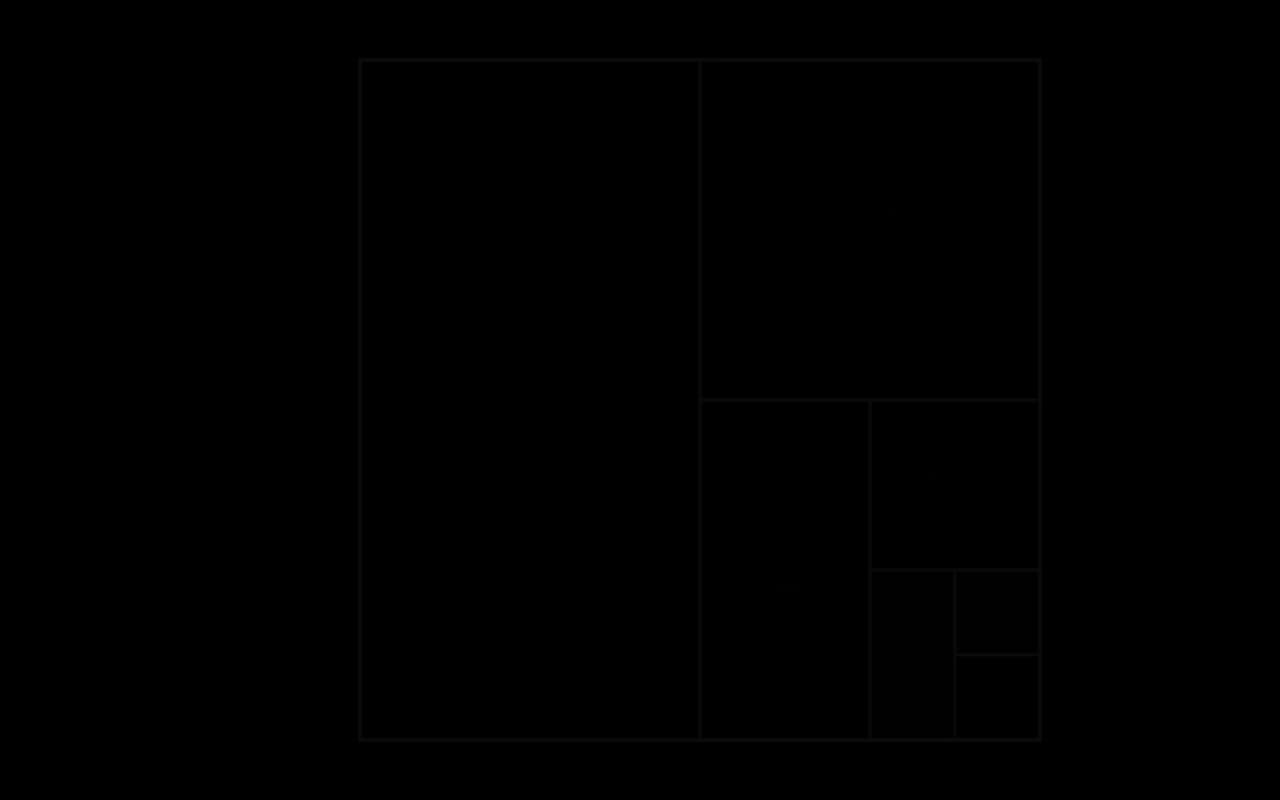
After pieces the covered area is , because the uncovered part halves each time. The uncovered area becomes as small as one likes, smaller than any positive number once
 YouTube
Infinite series and partial sums
An infinite series is written with three dots, or with sigma notation and as the upper limit:
No one can add infinitely many numbers one at a time, so the value of an infinite series is defined through its partial sums , where
1 | 2 | 3 | 4 | 5 | 10 | 20 | |
|---|---|---|---|---|---|---|---|
for |
The two rows behave very differently. The first approaches 1 more closely with every term; the second grows without limit, so no number can be called its sum.
When the partial sums approach no single number, the series has no sum. This happens when they grow without bound, as in , and also when they keep jumping between values, as in
The sum to infinity of a geometric series
Deriving the formula
The sum of the first terms of a geometric series, from subtopic 1.3, is
Only one part of this formula depends on : the power . What happens to as grows therefore depends entirely on what happens to
1 | 2 | 5 | 10 | 20 | 50 | |
|---|---|---|---|---|---|---|
0.5 | 0.25 | 0.031 25 | 0.000 977 | 0.000 000 954 |
When , repeated multiplication by a number smaller than 1 in size makes shrink towards 0, whether is positive or negative; it shrinks slowly when
A second derivation, without , shows why the formula has this shape. Write
Seeing the partial sums converge
The graph shows the partial sums of two series with first term 6: one with , whose sum to infinity is , and one with
With a positive ratio every term is positive, so the partial sums increase steadily towards and never reach it. With a negative ratio the terms alternate in sign, so the partial sums overshoot and undershoot by smaller and smaller amounts. In both cases is a value approached, not a value reached after some finite number of terms.
Recurring decimals
A recurring decimal is an infinite geometric series in disguise, so the sum to infinity converts it to a fraction. The decimal is
with and . The sum is
When the sum exists: the condition |r| < 1
Every possible ratio
The table of powers covers all the cases. Using , the absolute value of , each case can be stated compactly.
Ratio | What happens to the terms | Partial sums | Series |
|---|---|---|---|
shrink towards 0 | approach |
So a geometric series with converges if and only if , which is the same as
Finding the values of a parameter for which the sum exists
When the ratio contains an unknown, the condition becomes an inequality to solve. The absolute value inequality is rewritten as the double inequality , and the same operations are applied to all three parts.
For the series
The sum to infinity exists only for . The end points are excluded: at the ratio is exactly 1, and at it is exactly
Working backwards from a sum to infinity
Finding the first term or the ratio
The formula links three quantities, so any two give the third. Rearranging gives
For a series with and , the ratio is
Two unknowns: setting up two equations
Often is known together with one other fact, so that and are both unknown. The method is to write one equation from each fact, eliminate
When one of the solutions has , it is rejected, because a series with that ratio has no sum to infinity and so cannot have the given sum. The reason for rejecting it belongs in the written solution, next to the value rejected.
How close is close enough
Because a partial sum never reaches when every term is positive, a common task is to find the least number of terms for which exceeds a given value or comes within a given amount of
Case study: the ITF tennis ball bounce test
The test and the model
The International Tennis Federation tests a ball's bounce by dropping it from a height of 254 cm onto concrete. An approved ball must rebound to a height between 135 cm and 147 cm, so each rebound reaches between and
Source: Wikipedia, "Tennis ball" (ITF bounce test: dropped from 254 cm, acceptable rebound 135–147 cm at sea level and 20 °C), 2026.
The total vertical distance travelled by the ball if it bounced forever is not simply a single geometric series. The first drop of 254 cm is travelled once, but every rebound height is travelled twice, once up and once down.

Total distance
The rebound heights form an infinite geometric series with and . Its sum is
In general, a ball dropped from height whose rebounds are a fraction of the previous height travels
Infinitely many bounces in a finite time
The time taken by the bounces is also a geometric series. A ball falling from rest through a height takes
The model therefore predicts infinitely many bounces, all finished within about 5 seconds. This is the same structure as Zeno's dichotomy, with a ball in place of the runner.
Validity of the model
A real ball makes only a limited number of visible bounces before it rolls or rests. The constant ratio is an assumption: at low heights air resistance, the deformation of the ball and the surface change the ratio, and once a bounce is smaller than the ball itself the idea of a "rebound height" stops making sense. Even so, the terms beyond the first ten or so bounces add very little: after 10 rebounds the remaining distance is cm. The sum to infinity is therefore a good estimate of the total distance even though the model's infinitely many bounces are not real.
Further applications
Repeated spending: the multiplier effect
When a government spends money, the people who receive it spend a fraction of it, the marginal propensity to consume (MPC), and save the rest. The money they spend is received by others, who again spend the same fraction, and so on. With an initial spend of $10 million and a hypothetical MPC of 0.8, the rounds of spending are $10 million, $8 million, $6.4 million, …, an infinite geometric series with .
The ratio is called the multiplier: every dollar of initial spending eventually produces five dollars of total spending in this model. Real economies lose part of each round to imports and taxes, which lowers the ratio and so the multiplier, and the rounds take time, so the infinite total is a long-run upper estimate rather than a forecast for one year.
Medicine doses building up to a steady level
A patient takes a dose of a medicine at the same time each day, and by the next dose the body has removed a fixed fraction of what was there. With a hypothetical dose of 200 mg and 40% of the amount remaining after a day, the amount just after the th dose is
a finite geometric series. The amounts just after each dose are 200, 280, 312, 324.8, 329.9, … mg, and they approach the sum to infinity mg. The sum to infinity gives the long-term peak level, which doctors must keep below a harmful level; the speed of approach depends on the fraction remaining.
Fractals: the Koch snowflake
The Koch snowflake starts with an equilateral triangle. At each stage, the middle third of every side is replaced by two sides of a smaller equilateral triangle pointing outwards. The process is repeated forever, creating a fractal, a shape with detail at every scale (subtopic 3.9).

The area is an infinite geometric series. Let the original triangle have area and side . At stage 1, three new triangles are added, each with side and so with area
The perimeter behaves differently. Each stage replaces every side by four sides a third as long, so the perimeter is multiplied by each time:
Source: Wikipedia, "Koch snowflake" (area converges to 8/5 of the original triangle; perimeter infinite), 2026.
Exam focus
Infinite geometric series appear on HL Papers 1 and 2, usually as 2–6-mark parts combined with finite geometric sums from subtopic 1.3 (a term, a finite sum, the least ). The command terms are find, determine whether, justify and show that. The recurring shapes are: finding for a context and comparing it with a target ("will the balloon ever reach…"); finding from
Part (e) shows why early rounding is dangerous. is only 0.4 below the target of 19,008, so a ratio or partial sum rounded too soon can give the wrong integer.
The formula itself is rarely the difficulty. Examiners have reported candidates who did not attempt these questions or did not know the formula, even though it is printed in the formula booklet under the HL section of topic 1.
Practice questions
Find the sum to infinity of the geometric series . [2]
Determine whether the geometric series has a sum to infinity. Justify your answer. [2]
Use an infinite geometric series to
Answers
;
Summary
An infinite series converges if its partial sums approach a finite limit, which is its sum; otherwise it diverges.
For a geometric series,
Self-check
- To do:
I can write the first few partial sums of a series and say whether they appear to converge.
- To do:
I can explain why approaches 0 when and why that gives