1.4 Financial applications of geometric sequences · IB Maths AI | Augment Education
1.4 Financial applications of geometric sequences
Calculate compound interest and depreciation as geometric sequences, use the compound interest formula and the GDC's TVM solver, and find real values and real interest rates when prices rise with inflation.
IB Mathematics: Applications and Interpretation
Part of 1 Number and algebra
SL and HL
Key terms introduced here
Each is in the Maths AI glossary, with every other term in the subject.
Interest that is added to the balance at the end of each compounding period, so that in later periods interest is earned on the original amount and on the interest already added.
The limiting case of compound interest in which interest is added at every instant, so that an amount PV at a nominal annual rate r% grows to PV×ern/100
Notes on 1.4 Financial applications of geometric sequences
44 min readLast reviewed
Learning objectives
Calculate the value of an investment with compound interest, compounded yearly, half-yearly, quarterly or monthly, using the formula or technology.
Explain why compound interest and annual depreciation form geometric sequences, and compare compound interest with simple interest.
Use the GDC's finance (TVM) solver to find a future value, a present value, an interest rate or a number of periods, writing down every entry with the correct sign.
Determine how long an investment takes to reach a target, rounding to a whole number of compounding periods in context.
Calculate the value of an asset that depreciates at a fixed percentage each year, and find the rate or the time from given values.
Calculate the real value of an investment and the real interest rate when there is inflation.
Convert between currencies using an exchange rate within a financial calculation.
Interpret financial results in context and comment on the assumptions behind a compound interest or depreciation model.
Introduction
Savings accounts, loans, pensions and the falling value of cars and machines all change by a percentage of their current value each period. A balance that grows by 4% a year is multiplied by 1.04 every year, and a car that loses 15% of its value a year is multiplied by 0.85, so both follow a geometric sequence. The mathematics of subtopic 1.3, Geometric sequences and series, therefore becomes the mathematics of money: how much an investment will be worth, how much must be invested now to reach a target, how long a target takes, and what the money will really buy once prices have risen.
Financial calculations are almost always done with technology in practice. Banks, businesses and individuals use spreadsheets and financial calculators, and the graphic display calculator (GDC) has a finance solver built for exactly these questions. Using it well means knowing what each entry means and checking that the answer makes sense.
Questions on 1.4
45 exam-style questions on this subtopic, written in the style of the IB papers. The first has its markscheme open. Counted on
Question 1 · AI-000896 marks
Ayesha deposits 6500 Canadian dollars (CAD) in a savings account that pays a nominal annual interest rate of 2.8%, compounded monthly. She makes no further deposits or withdrawals.
(a)
Find the value of her savings after 4 years. Give your answer correct to two decimal places.
[3]3 marks
Markscheme (a)
FV=6500(1+100×122.8)12×4
From the formula booklet
The entries of the mathematics: applications and interpretation formula booklet that 1.4 uses. Each opens in the explained booklet.
The percentage by which a balance actually grows in one year once compounding within the year is included; for a nominal rate r% compounded k times a year it equals ((1+100kr)k−1)×100%.
The percentage increase in the general level of prices over a year, usually measured by the change in the price of a fixed basket of goods and services.
The rate at which the buying power of an investment grows once inflation is taken into account; it is approximately the nominal interest rate minus the inflation rate.
The value of a future amount of money measured in the prices of an earlier time (usually the start of the investment), so that it shows what the money can actually buy.
The rule in a finance solver that money paid out by the person whose point of view is taken is entered as a negative number, and money received by them as a positive number.
A calculator or software tool that links the number of periods, the interest rate, the present value, the regular payment and the future value of an investment or loan, and finds any one of them from the others.
From simple interest to compound interest
Simple interest as a starting point
Interest is the extra money a borrower pays a lender for the use of money. With simple interest, the interest each year is a fixed percentage of the original amount, the principal, and it is never added to the amount that earns interest. A principal of $2,000 at 5% simple interest earns $100 every year, so the balance after n years is 2000+100n. The balances 2,000, 2,100, 2,200, … form an arithmetic sequence with common difference 100, as in subtopic 1.2, Arithmetic sequences and series.
Most savings accounts and loans do not work this way. At the end of each period the interest is added to the balance, and from then on it earns interest of its own.
Interest on interest
Suppose the same $2,000 is invested at 5% a year, with the interest added at the end of each year. In the first year the interest is 5% of $2,000, which is $100. In the second year the interest is 5% of the new balance, $2,100, which is $105. The extra $5 is interest earned on the first year's interest.
The year-by-year balances show the difference between the two kinds of interest. Simple interest adds the same amount each year; compound interest adds a growing amount, because each year's 5% is taken of a larger balance.
End of year
Simple interest balance ($)
Interest added that year, compound ($)
Compound interest balance ($)
0
2000.00
—
2000.00
1
2100.00
100.00
2100.00
2
2200.00
105.00
2205.00
3
2300.00
110.25
2315.25
Compound interest as a geometric sequence
Adding 5% to a balance is the same as multiplying it by 1.05, the growth factor for a 5% increase. Every year the balance is multiplied by the same number, so the balances form a geometric sequence with common ratio r=1.05.
after 1 year: after 2 years: after 3 years: after n years: 2000×1.052000×1.05×1.05=2000×1.0522000×1.053=2315.252000×1.05n
In general, an amount PV invested at r% a year, with the interest added once a year, is worth PV×(1+100r)n after n years. The exponent is the number of times the interest has been added.
There is one small difference between this and the sequence notation of subtopic 1.3. If the starting amount is called u1, then the value after 1 year is u2 and the value after n years is un+1=u1rn. Financial formulas avoid this by counting from the start: "after n years" always means the starting value multiplied by rn.
Comparing the two kinds of growth
Over a few years the two kinds of interest give similar balances. Over decades they are very different, because compound growth is multiplicative. The graph compares $1,000 invested at 8% a year for 30 years with simple and with compound interest.
simple: 1000 + 80t
compound: 1000 × 1.08ᵗ
Simple interest grows by the same $80 each year, a straight line; compound interest grows by 8% of a rising balance, so after 30 years it gives about three times as much.
With simple interest the balance after 30 years is 1000+30×80=$3400. With compound interest it is 1000×1.0830=$10062.66. The balances are really a set of separate points, one per year, because interest is added only at the end of each year; the smooth curve joins them to show the trend. The continuous version of this growth, the exponential growth model f(t)=PV×1.08t, is studied in subtopic 2.5, Modelling with functions.
Present value and future value
Every compound interest problem connects two amounts of money at two different times: the amount at the start and the amount at the end. Finance gives them standard names, which the GDC uses too.
The present value in a savings problem is the same as the principal; "present value" is the name used for it in the compound interest formula and in the finance solver.
With interest added once a year, the two values are linked by one multiplication.
FV=PV×(1+100r)n
Finding a present value
A compound interest question often gives the target and asks for the amount needed now. Because the future value is the present value multiplied by the growth factor n times, the present value is found by dividing by it. Reversing a percentage change means dividing by the multiplier: subtracting a percentage of the final amount takes the percentage of the wrong (larger) value and gives the wrong present value.
Compounding more than once a year
The nominal annual interest rate
Interest rates are quoted as a yearly percentage even when interest is added more often. An account advertised at "6% a year, compounded monthly" adds one twelfth of 6%, which is 0.5%, at the end of each month.
How often the interest is added is the second piece of information every quoted rate needs.
For each period, the interest rate is the nominal annual rate divided by k, and the number of periods in n years is kn. The general formula combines these two adjustments.
The compound interest formula
With k compounding periods a year, the balance is multiplied by 1+100kr at the end of every period. After n years there have been kn periods, so the balance has been multiplied by this growth factor kn times.
FV=PV×(1+100kr)kn
Here FV is the future value, PV the present value, n the number of years, k the number of compounding periods per year and r% the nominal annual rate of interest. The formula is the term of a geometric sequence with first value PV and common ratio 1+100kr, taken kn steps along.
The table shows the effect of compounding more often on $10,000 invested for one year at a nominal annual rate of 6%. The quoted rate is the same in every row, but more frequent compounding adds interest on interest sooner.
Compounding
k
Rate per period
Value after 1 year ($)
Growth over the year
yearly
1
6%
10,600.00
6.000%
half-yearly
2
3%
10,609.00
6.090%
quarterly
4
1.5%
10,613.64
6.136%
monthly
12
0.5%
10,616.78
6.168%
daily
365
about 0.0164%
10,618.31
6.183%
The gains from compounding more often get smaller and smaller: the jump from yearly to half-yearly adds $9, but the jump from monthly to daily adds only about $1.53. The last column is the actual percentage growth over a whole year, which allows accounts with different compounding to be compared fairly.
Using the formula with monthly or quarterly compounding
The formula method needs three things written correctly: the rate per period 100kr, the number of periods kn, and the present value. Writing the substituted formula before calculating keeps a record of the method and makes a keying error easy to find.
The Bank of England's Bank Rate shows how much the rate matters over a few years. It was 0.1% in January 2021, rose in fourteen steps to 5.25% on 3 August 2023, and was cut to 3.75% by 18 December 2025. If £10,000 earned interest at exactly Bank Rate, compounded yearly and unchanged for 5 years, it would grow to £10,050.10 at 0.1%, £12,915.48 at 5.25% and £12,020.99 at 3.75%.
Source: Bank of England, Official Bank Rate history (series IUDBEDR), retrieved October 2026. The savings figures are a hypothetical illustration.
The time value of money (TVM) solver
What the solver does
Every compound interest calculation involves the same quantities: a number of periods, an interest rate, a present value and a future value. A finance solver stores the relationship between them and finds whichever one is missing. The GDC's version is usually called the TVM solver, where TVM stands for "time value of money", the idea that an amount of money now is worth more than the same amount later, because it can earn interest in the meantime.
The solver has seven entries. In compound interest and depreciation problems there are no regular payments, so the payment entry is always 0; subtopic 1.7, Amortization and annuities, uses the same screen with regular payments, counted by the payments per year entry.
Entry
Meaning
In compound interest problems
N
number of periods
total number of compounding periods, or the number of years if P/Y = 1
I%
nominal annual interest rate
the quoted yearly rate, not divided by k (the solver divides it)
PV
present value
the starting amount, negative if the investor pays it in
PMT
regular payment
0
FV
future value
the final amount, with the opposite sign to PV
P/Y
payments per year
sets the unit of N; usually equal to C/Y
C/Y
compounding periods per year
k: 1, 2, 4 or 12
The solver works out the rate per period from I% and C/Y itself, so I% is always the nominal annual rate as quoted. P/Y matters only for what N counts: with P/Y = 12, N is a number of months; with P/Y = 1, N is a number of years. Because there are no payments, both choices give the same answer as long as N is measured in the matching unit.
The sign convention
The solver needs to know which way money is moving. It uses a cash-flow sign convention: from the point of view of one person, money that leaves them is negative and money that comes to them is positive.
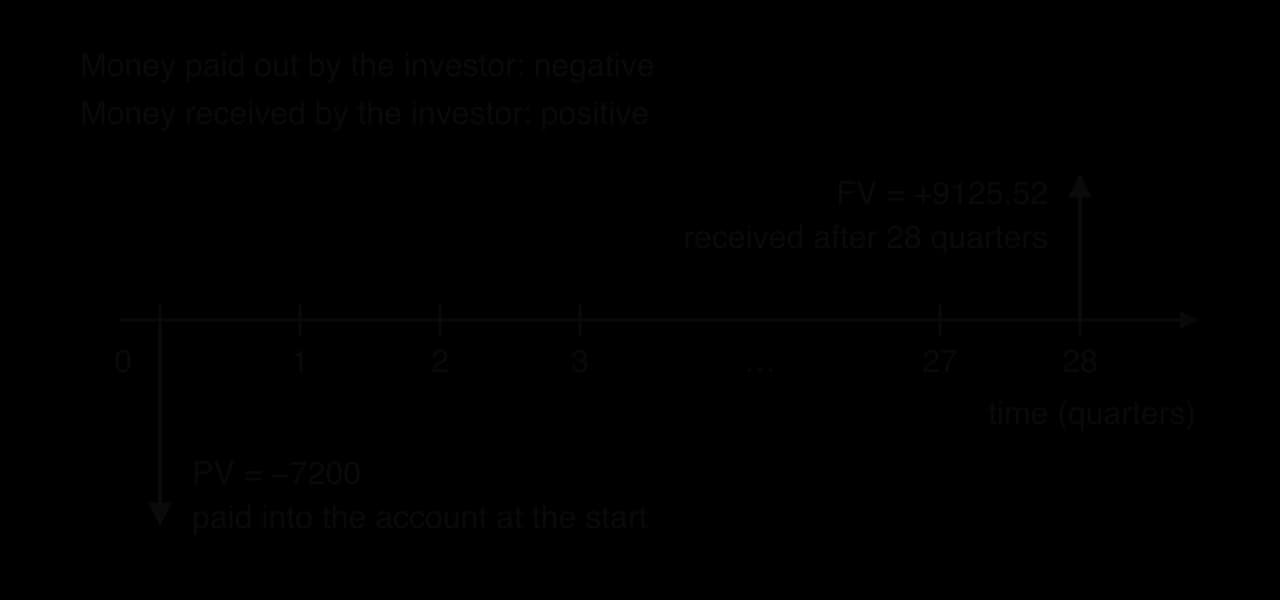
An investor pays money into an account at the start (negative PV) and gets it back with interest at the end (positive FV). A borrower receives money at the start (positive PV) and pays it back later (negative). Either way, PV and FV have opposite signs in a compound interest problem. The time line of an investment of €7,200 at 3.4% compounded quarterly for 7 years shows the two cash flows.
Money leaving the investor points down and is negative; money returning points up and is positive, so PV and FV always have opposite signs.
If both values are entered with the same sign, the solver either shows an error or returns a meaningless answer, because no positive interest rate can turn a payment into a further payment. Final answers are still written as positive amounts of money, because the sign only tells the calculator which way the money moves.
Using the solver step by step
The steps are the same on every model; only the menus differ.
Open the finance solver. On a TI-84 Plus CE: APPS → Finance → TVM Solver. On a Casio fx-CG50: MENU → Financial → COMPND. On a TI-Nspire: a Calculator page, then menu → Finance → Finance Solver.
Enter the six known values, with PMT = 0 and the signs set by the sign convention.
Move to the unknown entry and solve (on a TI-84 Plus CE, place the cursor on it and press ALPHAENTER; on a Casio, press the function key for the unknown).
Write down every entry and the result, then give the answer as a positive amount with the accuracy and currency asked for.
YouTube
Revision Village, “GDC Tips: Finance Solver (TVM Solver) [IB Math AI SL/HL]”: watch how each entry is filled in, and how the signs of PV and FV are chosen.
Solving for the future value
Solving for the present value
When the target is known, FV is entered as a positive amount (money received) and the solver returns a negative PV: the amount the investor must pay in.
Solving for the interest rate
Rearranging the formula for the rate needs a knth root and several further steps, which is slow and easy to get wrong. The solver finds I% directly, as long as PV and FV have opposite signs. Any amount that grows by a stated factor can be entered as PV=−1 and FV equal to that factor, since the starting amount cancels.
Solving for the number of periods
A question such as "how long until the investment exceeds 30,000?" asks for N. The solver usually returns a decimal, which then has to be interpreted. Interest is added only at the end of each compounding period, so the balance stays the same between those moments and jumps when interest is added.
The answer must therefore be a whole number of compounding periods, and it is rounded up: rounding down gives a time at which the target has not yet been reached. When the answer is asked for in months but interest is added quarterly, it must be a multiple of 3.
Formula or solver
Both methods are mathematically the same and give the same answer. The formula makes the geometric structure visible and is quick for a single future value. The solver is faster and safer when the unknown is the rate or the time, and it is the standard method once regular payments appear in subtopic 1.7.
Depreciation
Losing a fixed percentage each year
Cars, computers, machines and phones lose value as they age and wear out. A common model assumes that an asset loses the same percentage of its current value each year. A car that loses 16% a year keeps 84% of its value each year, so its value is multiplied by 0.84, the decay factor, every year.
The values after 0, 1, 2, … years form a geometric sequence with common ratio 1−100r, where r% is the annual rate of depreciation. The compound interest formula, with a minus sign in place of the plus sign and k=1, gives the value after n years.
value after n years=V0×(1−100r)n
Here V0 is the original value. The formula is the compound interest formula with −r in place of r. In the TVM solver the same idea becomes I%=−r with C/Y = 1: a negative interest rate makes the value shrink.
The graph shows a car bought for 32,000 that depreciates at 16% a year. Each year it loses 16% of a smaller value, so the yearly loss shrinks: 5,120 in the first year but about 1,066 in the tenth.
V = 32 000 × 0.84ⁿ
The values form a decreasing geometric sequence: the car first falls below 8000 after 8 years, and the model never reaches zero.
The model has limits. It never gives a value of zero, whereas a real car may be scrapped, and real depreciation is usually steepest in the first year or two and slower later. The exponential decay model in subtopic 2.5 treats the same pattern as a continuous function.
How long until a value falls below a level
The time for a value to fall below a given amount is found with the TVM solver (solving for N with a negative I%), with the GDC's equation solver, or by listing the terms of the sequence. In every method the answer is interpreted as a whole number of years, because the model gives the value once a year.
Finding the rate of depreciation
When the starting and final values are both known, the decay factor comes from a root, exactly as an average growth rate does. If V0 falls to Vn in n years, then V0×mn=Vn, so the yearly multiplier is m=(V0Vn)1/n and the rate of depreciation is (1−m)×100%.
Inflation and real value
Inflation
Prices of goods and services usually rise over time. If the general price level rises by 3% in a year, a basket of shopping that cost 100 at the start of the year costs 103 at the end, and each unit of money buys a little less than before.
Inflation acts like compound interest on prices: with a constant rate of i%, prices after n years are multiplied by (1+100i)n. An investment that grows more slowly than prices loses buying power, even though the number in the account rises.
In 2022, for example, consumer prices in the United Kingdom rose by 7.92%, while the Bank of England's Bank Rate rose from 0.25% to only 3.5% by the end of the year. Even a saver who had earned 3.5% for the whole year would have been able to buy about 4% less with their savings at the end of it than at the start.
Source: World Bank, World Development Indicators, inflation, consumer prices (FP.CPI.TOTL.ZG), 2026; Bank of England, Bank Rate history (IUDBEDR).
Real value
The amount shown in an account is its nominal value: the number of units of money. What matters to a saver is what that money will buy. Measuring a future amount in today's prices gives its real value.
To turn a future nominal value into a real value, divide by the growth factor of prices over the same period. Dividing by (1+100i)n removes the effect of n years of inflation at i%, in the same way that dividing by the interest growth factor gives a present value.
real value=(1+100i)nnominal future value
The real interest rate
It is often simpler to work with a single rate that measures the growth of buying power directly. Over one year, money grows by the factor 1+100r and prices grow by 1+100i, so buying power grows by the ratio of the two.
The exact real rate and its approximation come from the same ratio. Writing the nominal rate as the decimal R=100r and the inflation rate as I=100i:
1+real ratereal rate=1+I1+R=1+I1+R−1=1+IR−I≈R−Iwhen I is small
The exact value is the difference R−I divided by 1+I. When inflation is a few percent, dividing by a number such as 1.02 changes the result very little, so the real rate is close to the simple difference. This approximation, real rate ≈ nominal rate − inflation rate, is the standard method, and the exact ratio is a refinement.
Nominal rate
Inflation
Approximate real rate
Exact real rate
4%
1.5%
2.5%
2.46%
4.8%
2.3%
2.5%
2.44%
5.5%
3.1%
2.4%
2.33%
27.04%
72.31%
−45.27%
−26.27%
The first three rows show that the two methods agree to within about 0.1 percentage points at ordinary rates. The last row, Turkey in 2022, shows the approximation failing badly when inflation is very high.
YouTube
Khan Academy, “Real and nominal return”: watch how a nominal return is adjusted for inflation to find what the money will really buy, and why the subtraction is only approximate.
Three ways to find a real value
The real value of an investment can be found in three equivalent ways. All three are valid, and the first is the simplest when an interest rate and an inflation rate are given.
Approximate real rate: use the real rate (nominal − inflation) as the interest rate in the formula or the TVM solver, and calculate the future value directly.
Deflate the nominal value: calculate the nominal future value with the nominal rate, then divide by (1+100i)n.
Exact real rate: calculate 1+I1+R−1 and use it as the interest rate.
Methods 2 and 3 give the same answer; method 1 gives a slightly different one, because it uses the approximate rate.
Saving for a target in real terms
A target given "in today's money" is a real value. The present value needed is found by working with the real rate throughout, or by first inflating the target to a nominal amount and then discounting it at the nominal rate.
Case study: Saving in Turkey, 2019–2025
Turkey's recent history shows real interest rates swinging between strongly positive and strongly negative values. The table gives the average interest rate paid on bank deposits and the rate of consumer price inflation each year, with the real rate found both ways.
Year
Deposit rate (%)
Inflation (%)
Real rate, nominal − inflation (%)
Real rate, exact (%)
2019
25.41
15.18
10.23
8.88
2020
13.36
12.28
1.08
0.96
2021
20.70
19.60
1.10
0.92
2022
27.04
72.31
−45.27
−26.27
2023
51.33
53.86
−2.53
−1.65
2024
71.04
58.51
12.54
7.91
2025
57.60
34.88
22.72
16.85
Source: World Bank, World Development Indicators: deposit interest rate (FR.INR.DPST) and inflation, consumer prices (FP.CPI.TOTL.ZG), Türkiye, retrieved October 2026. Real rates calculated from the unrounded World Bank values, so the last digit can differ from a calculation with the rounded rates shown.
In 2022 a deposit of 100,000 lira held for a year at 27.04% would have grown to 127,041 lira. Prices rose by a factor of 1.7231, so its real value at the start-of-year prices was
1.723088127040.8≈73729 lira,
a loss of about 26% of its buying power. The subtraction method suggests a loss of 45%, which overstates it badly: when inflation is 72%, dividing by 1+I=1.72 is very different from dividing by 1. In 2020 and 2021, by contrast, both rates were between 12% and 21% and the two methods differ by less than 0.2 percentage points.
The case also shows the limits of the model. The deposit rate is an average over the year, while a saver's own rate depends on the account and on when the money is deposited; inflation is measured with a typical basket that may not match a particular family's spending; and neither rate is constant from year to year. A compound interest model with fixed rates is therefore a simplification for planning, and its results hold only if the rates stay as assumed.
Exchange rates
International investments and purchases need money in another currency. Converting is a multiplication or a division by the exchange rate, and a financial calculation in another currency may need two conversions: one before the money is invested and one after.
When the rate is written "1 A = x B", multiply by x to change A into B, and divide by x to change B into A. A quick check is to ask which currency should give the bigger number: if one unit of A buys 0.92 units of B, an amount in B must be smaller than the same amount in A.
Continuous compounding and the number e
The table of compounding frequencies showed that adding interest more often helps, but by less and less. Taking the idea to its limit, with interest added at every instant, leads to the number e.
Consider 1 unit invested at a nominal rate of 100% for one year, compounded n times. Each period multiplies the balance by 1+n1, so after one year it is (1+n1)n.
Compounding
n
(1+n1)n
yearly
1
2
half-yearly
2
2.25
quarterly
4
2.441…
monthly
12
2.613…
weekly
52
2.692…
daily
365
2.7146…
hourly
8,760
2.71813…
The values increase but level off below 2.72. As n grows without limit they approach Euler's number, e=2.71828…
y = (1 + 1/n)ⁿ
Compounding more often increases the final value, but the values approach e ≈ 2.718 and never pass it.
Jacob Bernoulli came across the constant in 1683 while studying this compound interest problem. It reappears in the natural logarithm (subtopic 1.5) and in exponential models (subtopic 2.5).
Exam focus
Financial applications of geometric sequences appear frequently. On Paper 1 a question of 3–6 marks typically has two parts: a future value with monthly, quarterly or half-yearly compounding, then a present value, a rate, a time or a depreciation. On Paper 2 the subtopic usually opens a longer finance question of 10–16 marks that continues into loans and annuities (subtopic 1.7), sometimes with an exchange rate or an inflation rate. The command terms are mostly calculate and find, with determine for a single required value, justify or state which option is better, and comment on whether a result or assumption is reasonable.
The working that must be written down is the same in every question: either the substituted compound interest formula, or every TVM entry (N, I%, PV, PMT, FV, P/Y, C/Y) with PV and FV of opposite signs. Markschemes accept either method. Accuracy instructions such as "to two decimal places" or "to the nearest whole number" are part of the question: an answer that is not rounded as asked loses its final mark, and a negative final amount of money can lose it too.
Part (c) needs the most care. The solver's 96.04 must be rounded up, because after 96 months the balance (€39,995.47) has not yet passed the target; with quarterly compounding the answer would also have to be a multiple of 3.
Questions on real value test whether inflation has been used at all. Writing the real rate on its own line, and checking that the real value is smaller than the nominal value, protects against the most common error.
Practice questions
Write down the growth factor for one quarter when the nominal annual interest rate is 3.2%, compounded quarterly. [1]
£4,000 is invested for 6 years at 3% a year. Calculate how much more the investment is worth with interest compounded yearly than with simple interest. [3]
12,500 Canadian dollars are invested at a nominal annual interest rate of 4.75%, compounded monthly. Calculate the value of the investment after 10 years, correct to two decimal places. [3]
Find the amount that must be invested now at a nominal annual interest rate of 6.2%, compounded half-yearly, to give $50,000 in 9 years. Give your answer to the nearest dollar. [3]
A phone is bought for $1,200 and depreciates at 30% a year. (a) Calculate its value after 3 years. [2] (b) Find after how many complete years its value first falls below $100. [3]
Find the nominal annual interest rate, compounded monthly, at which 8,000 euros grows to 10,000 euros in 5 years. Give your answer correct to 3 significant figures. [3]
15,000 Singapore dollars are invested at 5.5% a year, compounded yearly, for 8 years. Inflation is 3.1% a year. (a) Calculate the nominal value after 8 years, to the nearest dollar. [2] (b) Using an approximate real interest rate, calculate the real value after 8 years, to the nearest dollar. [3] (c) Find the exact real interest rate, and comment on whether the approximation in (b) is reasonable. [3]
Ravi converts 2,500 British pounds (GBP) into euros at 1 GBP = 1.17 EUR. He invests the euros for 3 years at a nominal annual interest rate of 3%, compounded monthly, then converts the money back at 1 GBP = 1.15 EUR. Find the amount he receives in GBP, to the nearest penny. [4]
9,000 dollars are invested at a nominal annual interest rate of 4.4%, compounded quarterly. Find the minimum number of months after which the investment is worth more than 10,000 dollars. [4]
Account X pays 4.5% a year, compounded yearly. Account Y pays a nominal annual interest rate of 4.42%, compounded monthly. Determine which account gives the greater return on the same deposit over one year. Justify your answer. [3]
After one year, 1 unit becomes 1.045 in X and (1+12004.42)12=1.04511 in Y. Account Y gives the greater return (effective rate 4.51% against 4.50%), although its quoted rate is lower, because monthly compounding adds interest on interest during the year.
Summary
Compound interest adds interest to the balance each period, so the balances form a geometric sequence with common ratio 1+100kr; simple interest gives an arithmetic sequence.
The compound interest formula is FV=PV×(1+100kr)kn: the nominal annual rate is divided by k and the number of years multiplied by k.
A present value is found by dividing a future value by the growth factor; more frequent compounding gives a slightly larger effective annual rate.
The TVM solver links N, I%, PV, PMT, FV, P/Y and C/Y; with no payments, PMT = 0, I% is the nominal annual rate and PV and FV have opposite signs (money paid out is negative).
When solving for time, round up to a whole number of compounding periods (a multiple of 3 months for quarterly compounding).
Depreciation at r% a year gives values V0(1−100r)n
The real interest rate is approximately the nominal rate minus the inflation rate; exactly, it is 1+I1+R−1. The approximation fails at very high rates.
A real value can be found with the real rate, or by dividing the nominal value by (1+100i)n.
Exchange rates convert money before and after an investment; the final result depends on both rates.
Continuous compounding is the limit of compounding ever more often, and (1+n1)n approaches e.
Self-check
To do:
I can explain the difference between simple and compound interest and show why compound interest forms a geometric sequence.
To do:
I can write the growth factor per period for any nominal rate and compounding frequency.
To do:
I can substitute correctly into FV=PV×(1+100kr)kn for yearly, half-yearly, quarterly and monthly compounding.
To do:
I can find a present value by dividing by the growth factor.
To do:
I can compare accounts with different compounding using the value of 1 unit after one year.
To do:
I can enter a compound interest problem in the TVM solver with PMT = 0 and opposite signs for PV and FV.
To do:
I can write two equivalent sets of TVM entries (with N in years or in periods).
To do:
I can solve for the interest rate or the number of periods with the solver.
To do:
I can round a time up to a whole number of compounding periods and give it in the units asked for.
To do:
I can calculate a depreciated value and find when it falls below a given level, showing the bracketing values.
To do:
I can find an annual rate of depreciation from two values.
To do:
I can find a real value by the approximate real rate and by deflating, and explain why they differ.
To do:
I can explain when the approximation "nominal − inflation" is poor.
To do:
I can convert an amount between currencies before and after an investment.
To do:
I can judge whether a financial answer is reasonable and state assumptions of the model.
Note: Award (M1) for substitution into the compound interest formula or for an attempt to use a financial app with at least two entries seen. Award (A1) for a correct substitution or all entries correct.
CAD 7269.39 A1
Note: Answer must be given to 2 d.p.
[3 marks]
(b)
Find the number of complete months it takes for the value of her savings to first exceed 8000 CAD.
Note: Award (M1)(A1)A0 for 89 or 89.1. Accept 7.5 years only if 90 months is also seen.
[3 marks]
Question 2 · AI-000906 marks
Kenji wants to have 2 000 000 Japanese yen (JPY) in an investment account in 6 years' time, to pay for his daughter's first year at university. The account pays a nominal annual interest rate of 1.5%, compounded quarterly.
(a)
Find the amount Kenji must deposit now. Give your answer correct to the nearest yen.
[3]3 marks
(b)
A second bank offers the same nominal annual interest rate, but compounded yearly. Find how much more Kenji would need to deposit now with this second bank to reach the same amount in 6 years.
Marta buys a new electric car for 32 000 euros (EUR). The value of the car depreciates by 14% each year.
(a)
Find the value of the car after 5 years. Give your answer correct to the nearest euro.
[2]2 marks
(b)
Find the percentage of the original value that the car has lost after 5 years.
[2]2 marks
(c)
Marta plans to sell the car at the end of the first year in which its value is less than 10 000 EUR. Find the number of years after which she will sell the car.
 YouTube
 YouTube