Notes on 1.9 Laws of logarithms
Learning objectives
Use the logarithmic identities , , and .
Show that the product, quotient and power laws of logarithms follow from the laws of exponents.
Use the laws of logarithms to expand a logarithm into separate terms and to combine several logarithms into one.
Solve exponential equations by taking logarithms of both sides, and check the answers with technology.
Solve logarithmic equations, rejecting any solution that makes an argument zero or negative.
Rearrange logarithmic models into exponential form and exponential models into logarithmic form.
Explain results on the decibel, pH and Richter scales using the laws of logarithms.
Use logarithms to turn a relationship such as into a linear equation.
Introduction
A logarithm is an exponent, so every law of exponents has a partner law for logarithms. Multiplying two numbers adds their exponents, and so it adds their logarithms; raising a number to a power multiplies its exponent, and so it multiplies its logarithm. These laws turn multiplication into addition and powers into multiplication, which is why logarithms were invented as a calculating tool in the seventeenth century and why they are still used today to solve exponential equations and to straighten curved relationships.
Subtopic 1.5, Exponents and introduction to logarithms, gave the definition and used the GDC to evaluate logarithms and to solve
Logarithms as exponents
Reading a logarithm
The logarithm is the power to which the base must be raised to give . Every law and method for logarithms comes from switching between the two equivalent forms.
The bases used in practice are 10 (the common logarithm, ) and e (the natural logarithm, , whose base is Euler's number ). The laws hold for every allowed base, so they are written with a general base ; in applications the base is almost always 10 or e.
The number inside a logarithm has a name, because the conditions on it matter in every equation.
A logarithm can take any real value, positive, negative or zero, but its argument cannot. Since every power of a positive base is positive, there is no exponent with or . The graph of
Four identities
Four results follow directly from the definition, without any new law. They are used constantly in simplifying expressions and solving equations.
The last two identities say that and undo each other. Applying
The product law
Deriving the law
Take two positive numbers and and write each as a power of the base : let and
By the definition of a logarithm, means
A numerical check makes the law concrete: and add to , which is
Logarithms as a calculating tool
Before electronic calculators, the product law made multiplication fast. To multiply two long numbers, a scientist looked up their logarithms in a printed table, added them, and looked up the number with that logarithm. The slide rule, developed in the 1620s, did the same addition mechanically with two sliding rulers marked on logarithmic scales, where the distance from 1 to each number is proportional to its logarithm.
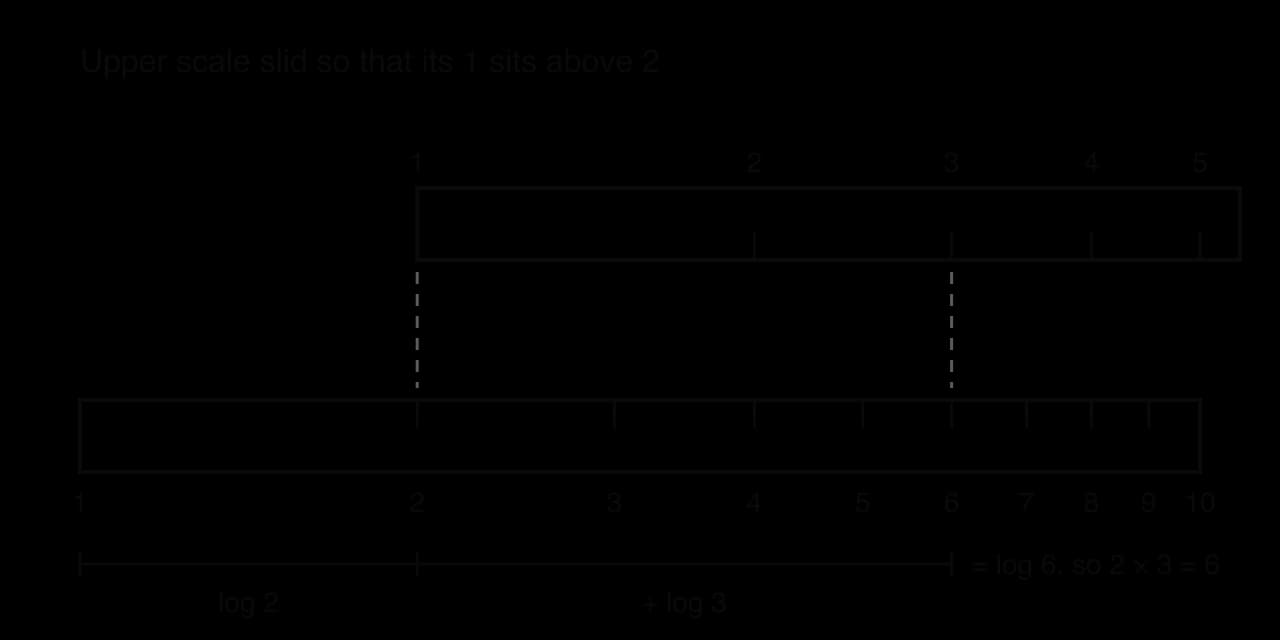
The two sliding scales in the figure show multiplication as addition of lengths. Setting the 1 of the upper scale over 2 and reading under 3 gives 6; the same setting multiplies every number on the upper scale by 2, so 4 sits over 8 and 5 over 10. Engineers used slide rules in this way until handheld scientific calculators replaced them in the 1970s.
The product law and decibels
The level of a sound of intensity on the decibel scale is
Doubling the intensity of any sound adds about 3.01 dB, whatever the starting level. The same argument shows that multiplying the intensity by any factor adds decibels, so a factor of 10 adds exactly 10 dB, as observed numerically in subtopic 1.5.
 YouTube
The quotient law
Deriving the law
The same method with division gives the second law. With and , the quotient law of exponents gives
A special case is the logarithm of a reciprocal. With , the quotient law and give
The quotient law and pH
The pH of a solution is . Subtopic 1.5 found numerically that ten times the hydrogen-ion concentration lowers the pH by 1. The product law shows that this holds for every concentration .
Diluting a solution reverses this. If a solution of a strong acid is diluted with water so that its hydrogen-ion concentration is divided by 10, its new pH is
A second false rule comes from confusing the quotient law with division of the logarithms themselves. The quotient law subtracts; it never divides one logarithm by another.
The power law
Deriving the law
For the third law, write and raise both sides to the power . The power-of-a-power law of exponents gives
The derivation works for any real number , not only positive integers, because the law holds for all real exponents. So
The power law is the reason logarithms solve exponential equations. Taking logarithms of gives , and the power law brings the unknown
The three laws are usually used together, and each is called a law of logarithms (or "log law").
The power law and earthquake energy
On the Richter scale, magnitude is the common logarithm of the amplitude ratio , so each step of 1 multiplies the amplitude by 10. The energy released by an earthquake grows faster than the amplitude: it is proportional to the amplitude raised to the power
Since , this has the form
The answer to (c) explains a rule of thumb used by seismologists: each increase of 0.2 in magnitude roughly doubles the energy released. Although 7.8 is only 30% larger than 6.0 as a number, a magnitude 7.8 earthquake releases hundreds of times as much energy as one of magnitude 6.0.
Using the laws together
Expanding and condensing
The laws can be used in two directions. Expanding writes the logarithm of a product, quotient or power as a sum of simpler logarithms. Condensing (combining) writes a sum or difference of logarithms as a single logarithm, which is the first step in solving most logarithmic equations.
When condensing, use the power law first, to move every coefficient into the argument as an exponent, and then the product and quotient laws. A coefficient must be inside the logarithm before two logarithms can be combined: is
 YouTube
Solving exponential equations
Taking logarithms of both sides
An exponential equation such as can be solved by hand with logarithms. The method has three steps.
Rearrange so that the power stands alone on one side: .
Take the logarithm ( or
The exact answer is and its value is . Using instead of
When the base is e, the natural logarithm removes it in one step, since . This is why natural logarithms appear throughout continuous growth and decay models.
In (b) the bracket is essential: , the whole exponent multiplied by
Finding a parameter in an exponential model
Exponential models or often contain an unknown rate, found from one data point. Logarithms isolate it. The rate can then be used to find a doubling time or a half-life exactly.
Exponential inequalities
Questions about time often ask when a quantity first passes a value, which leads to an inequality such as . Taking logarithms works as for an equation, with one extra point: the logarithm of a number between 0 and 1 is negative, and dividing an inequality by a negative number reverses its direction.
The sign changed from to in the last line because is negative. Taking logarithms itself keeps the direction, because is an increasing function: a larger positive number always has a larger logarithm. The result says that 28 or more steps are needed; checking gives
Inverses of exponential functions
The inverse of an exponential function is a logarithmic function, and the laws are what make the inverse possible to write down. To invert , write
The domain of the inverse comes from the argument of the logarithm: only when , which is also the range of
Solving logarithmic equations
The method and the domain check
When the unknown is inside a logarithm, the equation is a logarithmic equation. The strategy is the reverse of that for exponential equations: combine the logarithms into one, then use the definition to remove it.
Use the laws to write each side as a single logarithm, or as a single logarithm equal to a number.
Remove the logarithm. If , then ; if
The check in step 4 is needed because combining logarithms can widen the set of allowed values. The original expression needs both and
The graph of exists only for and rises steadily, so it meets the line
Rearranging logarithmic models
From logarithmic form to exponential form
Many models are stated with a logarithm, because the relationship is linear on a logarithmic scale. The Gutenberg–Richter law describes how often earthquakes of different sizes occur in a region: if is the mean number of earthquakes per year with magnitude at least , then , where and
With , the definition of a logarithm and the laws of exponents turn the model into exponential form.
This form shows the meaning of the model directly: each increase of 1 in magnitude divides the frequency by 10.
The answer to (c) is given as a decimal, 0.126, rather than left as or , because a model's output is a number with a meaning in context.
From exponential form to a linear relationship
The reverse process, taking logarithms of an exponential or power relationship, turns it into a linear one. For a model , the product and power laws give a straight line in and .
Plotting against gives a straight line with gradient and -intercept . This is the basis of linearising data with semi-log and log-log graphs in subtopic 2.10. The parameters come back by reversing the logarithms:
The same idea turns a relationship with several unknown exponents into a system of linear equations. In chemistry, the rate of a reaction often depends on the concentrations and of two reactants by a rate law
Three experiments, each giving a value of for known and , give three such equations, enough to find the three unknowns. The table gives hypothetical measurements from three such experiments.
Experiment | |||
|---|---|---|---|
1 | 0.2 | 0.1 | 0.002 |
2 | 0.4 | 0.1 | 0.008 |
3 | 0.2 | 0.3 | 0.006 |
Exam focus
The laws of logarithms appear on HL Papers 1 and 2 as parts of 2–6 marks, usually inside a modelling question rather than as pure algebra: rearranging a logarithmic model into exponential form, finding a parameter of an exponential model, or taking logarithms of a power or exponential relationship to make it linear. Paper 3 questions use the same skills when data are linearised. The bases in examinations are 10 and e.
Show that a logarithmic form is equivalent to an exponential form, or that is linear in : each law used should be visible, one step per line, ending exactly at the given result.
Find or solve: a method mark is given for "an appropriate use of a log law", and an accuracy mark for the correct equation without logarithms (for example ).
Write a model in a given form: the answer must be in that form, with the constant evaluated.
Final values from a power of 10 or e are given as decimals or in standard form unless an exact answer is requested; markschemes have rejected answers left as
Part (e) combines the definition of a logarithm with two laws of exponents, and
When an equation has been reduced to a quadratic, solve it by factorising, by the quadratic formula or with the GDC, but then check every root in the original logarithms. Reject inadmissible roots with a reason (" is undefined"); markschemes reward the check.
Practice questions
Find the exact value of and of . [2]
Express
Answers
; .
Summary
Identities from the definition: , ,
Self-check
- To do:
I can state the four logarithmic identities and use them to evaluate expressions exactly.
- To do:
I can derive the product, quotient and power laws from the laws of exponents.
- To do:
I can expand a logarithm of a product, quotient or power into separate terms.
- To do:
I can condense a sum or difference of logarithms into one logarithm, using the power law first.
- To do:
I can recognise and avoid the false rules for ,