Notes on 1.14 Matrices
Learning objectives
State the order of a matrix and write down any element from its row and column.
Calculate sums, differences and scalar multiples of matrices, and use equality of matrices to find unknown elements.
Calculate the product of two matrices by hand and with technology, and determine whether a product is defined.
Explain the properties of matrix multiplication: associativity, distributivity and non-commutativity.
Use the identity matrix and the zero matrix in matrix algebra.
Calculate the determinant and the inverse of a matrix by hand, and of larger square matrices with technology.
Determine when a matrix is singular, including matrices that contain an unknown.
Solve matrix equations such as , and by multiplying by an inverse on the correct side.
Write a system of linear equations in the form and solve it using the inverse matrix.
Use matrices to model and solve practical problems, including encoding and decoding messages.
Introduction
A matrix is a rectangular table of numbers that is treated as a single object. Many practical calculations start from such a table, for example the numbers of each product sold in each shop, the ingredients in each recipe or the coefficients of a set of equations. Matrix algebra gives rules for adding, multiplying and "dividing" whole tables at once, so that a calculation involving hundreds of numbers can be written in one short line and carried out by a GDC in one step.
Matrices reappear in many later HL subtopics. They describe transformations of the plane, the connections in a network, the movement of a population between states and the behaviour of coupled differential equations. Computer graphics, search-engine ranking and economic input–output models all make heavy use of the same few operations: multiplication, the determinant and the inverse.
 YouTube
Matrices, elements and order
What a matrix is
A small bakery sells three products (loaves, rolls and cakes) in two shops. One week's sales can be recorded in a table with one row for each shop and one column for each product. Once everyone agrees what the rows and columns mean, the labels can be dropped and the numbers kept in a bracketed array.
A row of a matrix is a horizontal line of numbers and a column is a vertical line. Rows are counted from the top and columns from the left. In the sales matrix , row 2 holds shop B's sales of all three products, and column 3 holds the sales of cakes in both shops.
Elements and their positions
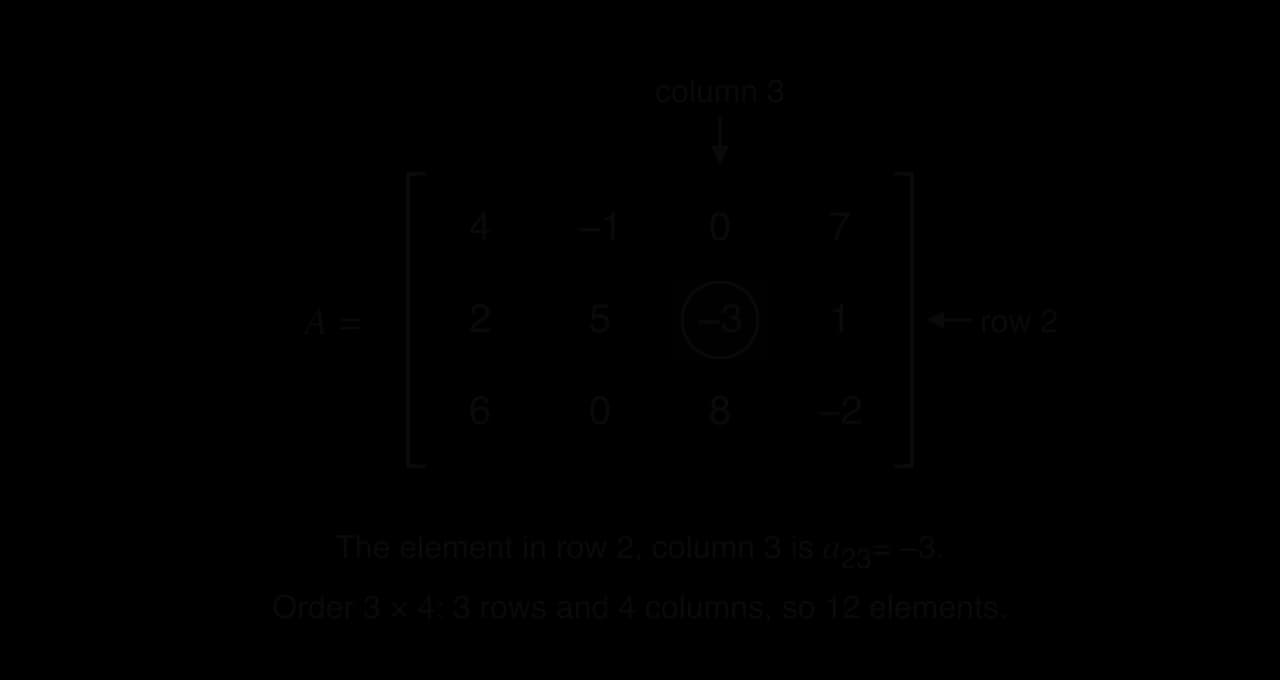
Each number in a matrix has an address given by its row and then its column. The element of in row and column is written , with a lower-case letter matching the matrix's name. The row always comes first, which matches the order in which the size of a matrix is written.
The figure of a matrix shows how a row and a column cross at exactly one element. Reading means "go to row 2, then along to column 3".
The order of a matrix
The size of a matrix is described by the number of rows and the number of columns, in that order. A matrix with rows and columns is an " by " matrix and holds elements.
A matrix with a single column, such as , has order . It is the same object as a column vector and is usually named with a bold lower-case letter, or
Square matrices and the leading diagonal
Matrices with as many rows as columns have special importance, because only they can be raised to powers, have determinants and have inverses.
In a square matrix, the elements run in a line from the top left corner to the bottom right corner.
The algebra of matrices
Equal matrices
Two matrices are equal only when they are identical in every position. Equal size alone is not enough, and neither is containing the same numbers in a different arrangement.
Equality turns one matrix equation into several ordinary equations, one for each position. A matrix equation gives four equations, which is how unknown elements are found.
Addition and subtraction
The bakery's sales for a second week can be stored in a second matrix of the same order. The total over the two weeks is found shop by shop and product by product, so each element of the total is the sum of the two elements in the same position. This is matrix addition.
Subtraction works in the same way, element by element; here it would give the change in sales from the first week to the second. Both operations are defined only when the two matrices have the same order, because otherwise some elements would have no partner. Adding a matrix to a matrix has no meaning.
Because addition of numbers is commutative and associative, so is addition of matrices: and
Multiplying by a scalar
If the bakery raises its sales target by 10% in every shop and for every product, every element of the sales matrix is multiplied by 1.1. Multiplying a matrix by a single number in this way is called scalar multiplication, where a scalar is an ordinary number as opposed to a matrix.
Multiplying by changes the sign of every element and gives , so subtraction can be written as . Scalar multiplication combines with addition in the expected ways:
Matrix algebra with the GDC
A GDC carries out every one of these operations once the matrices have been stored. The procedure is the same in outline on all models.
Open the matrix editor and choose a matrix name, such as A.
Enter the order (rows first, then columns), then type each element.
Return to the main screen and build the expression from the stored names, for example
2[A] − 3[B].
On a TI-84 Plus CE the matrix menu is 2nd x⁻¹ (MATRIX), with EDIT to enter a matrix and NAMES to paste it into a calculation. On a Casio fx-CG50 matrices are entered and used in the Run-Matrix application, and on a TI-Nspire a matrix template is chosen from the template palette.
Matrix multiplication
Why matrices are multiplied row by column
The bakery's prices are $3.50 for a loaf, $2.80 for a roll and $4.20 for a cake. The revenue of shop A is found by multiplying each quantity in row 1 by the matching price and adding.
Shop B's revenue uses row 2 with the same prices: . Writing the prices as a column and pairing each row of the sales matrix with that column gives both revenues at once.
This pairing of a row with a column (multiply matching elements, then add) is the basic step of matrix multiplication. It only makes sense when the row and the column have the same length: here each row has 3 quantities and the column has 3 prices, one for each product.
The row-by-column rule
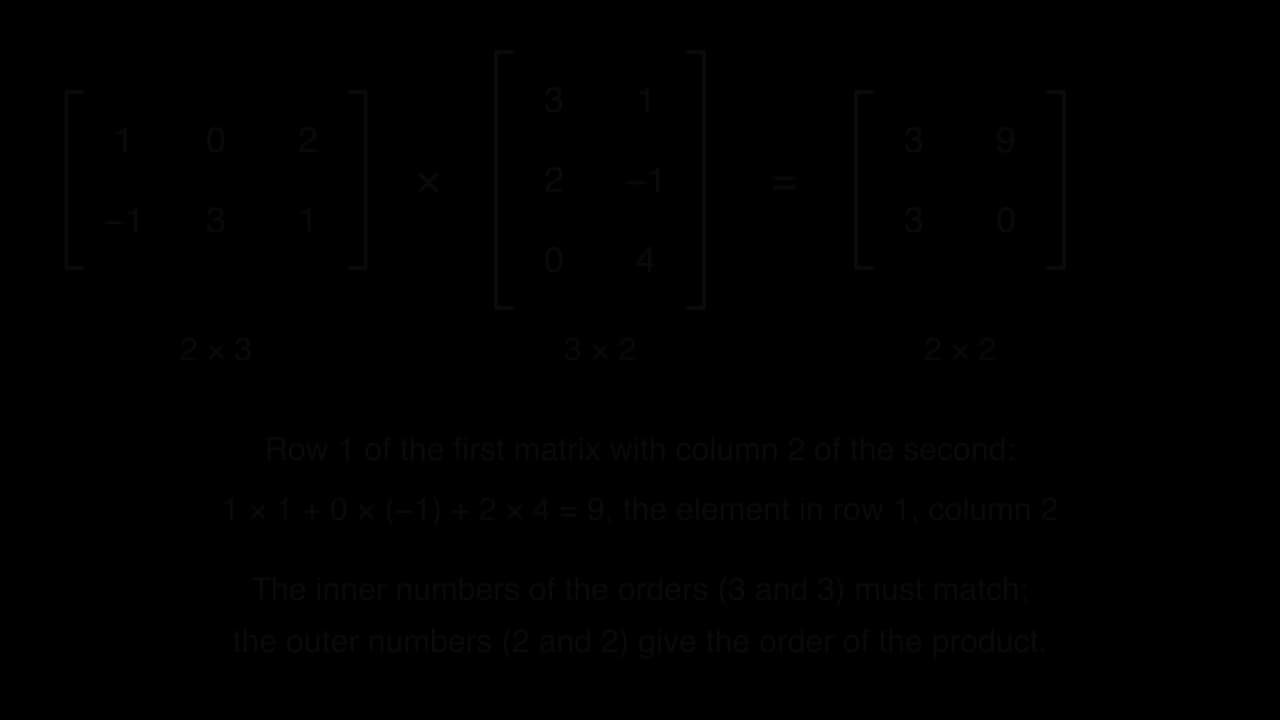
To multiply two matrices and , every row of is paired with every column of . The pairing of row with column gives the element in row
In symbols, the element in row , column of is
The figure works through one element of a matrix multiplied by a matrix. Row 1 of the first matrix is paired with column 2 of the second, and the result fills row 1, column 2 of the product.
When a product is defined
A row of has as many elements as has columns, and a column of has as many elements as has rows. The pairing works only if these are equal, which gives the rule for when a product exists.
The inner numbers must be equal: the number of columns of equals the number of rows of .
The outer numbers give the order of the product: rows (one for each row of ) and columns (one for each column of ).
A matrix times a matrix gives a matrix, but in the reverse order a matrix times a
Powers of a square matrix
For a square matrix , the power means , means , and so on. Powers are defined only for square matrices, because only then does the product of
Large powers, such as , are found with the GDC by typing the stored matrix name followed by the power. Powers of matrices count the walks in a network (subtopic 3.15, adjacency matrices) and give the state of a system after many steps (subtopic 4.19, transition matrices).
Multiplying matrices to solve practical problems
Matrix multiplication is useful whenever a table of quantities is combined with a table of rates. The rule "inner orders match" becomes a check on the meaning: the columns of the first matrix and the rows of the second must describe the same things (here, the same three products in the same order).
The labels of a product's rows and columns follow from the labels of the factors: the rows of are the rows of (shops) and the columns of are the columns of (revenue and cost). Writing these labels beside each matrix before multiplying prevents most errors in setting up a practical problem.
Properties of matrix multiplication
Ordinary multiplication of numbers obeys three familiar laws: order does not matter (), brackets do not matter (), and multiplication spreads over addition (
Non-commutativity
Changing the order of a matrix product usually changes the answer, and sometimes makes the product undefined. For and
The reason is visible in the row-by-column rule. In the rows come from and the columns from ; in the roles swap, so different numbers are paired. In the bakery problem means something (each shop's revenue and cost), while
Because order matters, the words "multiply by " are ambiguous. Pre-multiplying by gives ( written in front), and post-multiplying
Associativity
When three matrices are multiplied, it does not matter which pair is multiplied first, as long as the left-to-right order of the matrices is kept.
A practical example shows why the law holds. A bakery supplies two cafés; the order matrix gives the loaves and croissants each café orders, the recipe matrix gives the kilograms of flour, butter and sugar in each item, and gives the price per kilogram of each ingredient.
There are two sensible routes to each café's ingredient bill, summarised in the table.
Route | First product | Meaning | Then | Result |
|---|---|---|---|---|
Both routes give the same bills, $39.23 and $41.06 to the nearest cent, because both count exactly the same quantities multiplied by exactly the same prices; only the grouping differs. The same argument works for any three matrices, which is why associativity holds in general.
Distributivity
Matrix multiplication spreads over addition, on either side, as long as the side is kept.
Distributivity allows brackets to be expanded, but non-commutativity changes the familiar results. Expanding gives
The middle terms and can only be collected into when and commute. With
Other rules that fail for matrices
Two more facts about numbers do not carry over. A product of two non-zero matrices can be the zero matrix, and so a matrix cannot be "cancelled" from both sides of an equation without care.
With numbers, forces or ; with matrices it does not. Similarly,
The identity and zero matrices
The zero matrix
The number 0 leaves any number unchanged when it is added. The matrix with the same role is the matrix full of zeros.
For any matrix and the zero matrix of the same order, and . Any product with a zero matrix, where defined, is a zero matrix:
The identity matrix
The number 1 leaves any number unchanged when it multiplies it. The matrix with this role must be square, with 1s on the leading diagonal and 0s everywhere else.
The row-by-column rule shows why works. Row of has a single 1 in position , so pairing it with column of simply picks out
A scalar multiple has on the leading diagonal and 0 elsewhere, and . This is why the number in an expression such as
Determinants
The determinant of a 2 × 2 matrix
Every square matrix has a single number attached to it, its determinant, which shows whether the matrix can be inverted. For a matrix the determinant is the product of the leading diagonal minus the product of the other diagonal.
The notation uses straight lines in place of brackets:
What the determinant measures
A matrix can be used to move points: the point is sent to the point whose coordinates are the elements of
The most important case is . Then areas are multiplied by 0, so the whole plane is squashed flat onto a line (or a point). The matrix
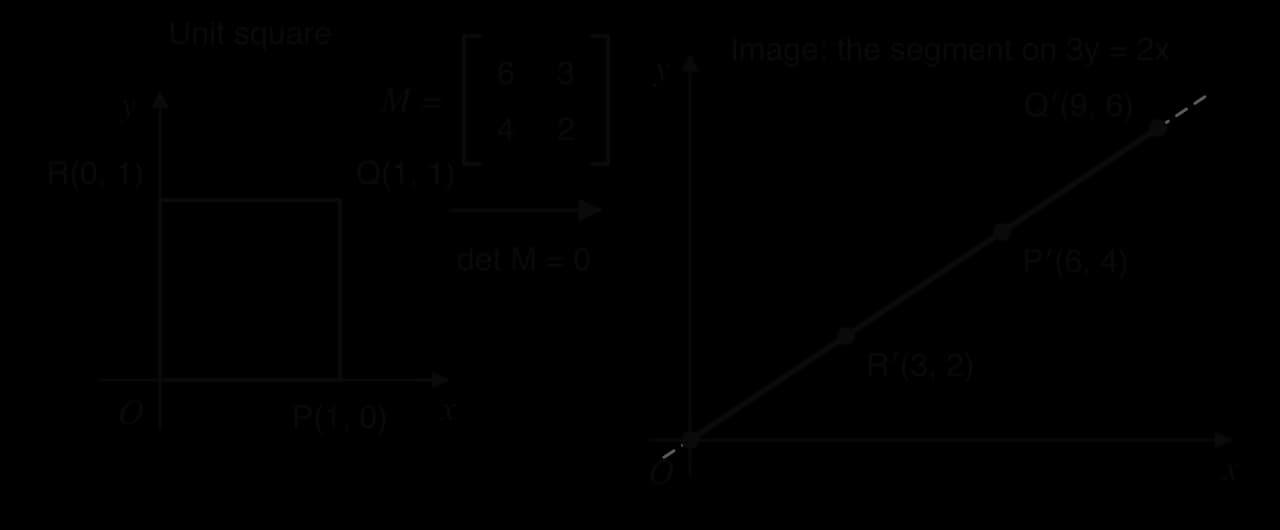
Squashing loses information. Many different points land on the same image point: , and all go to the origin. No rule can send each image point back to a single starting point, so a matrix with determinant 0 cannot be undone. This is the geometric reason why such a matrix has no inverse.
 YouTube
Determinants containing an unknown
When a matrix contains an unknown, setting its determinant equal to a value gives an ordinary equation. The most common question asks when the matrix is singular, meaning its determinant is 0.
Larger determinants and the product rule
Determinants of and larger matrices exist and play the same role. Their hand calculation is long, so they are found with technology. On a TI-84 Plus CE, det( is item 1 in the MATRIX MATH menu, so det([A]) gives the determinant of the stored matrix .
The determinant of a product is the product of the determinants.
For the matrices and
Inverse matrices
The idea of an inverse
There is no division of matrices. Instead, the role of division is played by multiplying by an inverse, just as dividing a number by 5 is the same as multiplying it by , the number that gives 1 when multiplied by 5.
Only square matrices can have inverses, and not all of them do. When an inverse exists it is unique, and it undoes the effect of : if sends to , then sends
The inverse of a 2 × 2 matrix
The formula for the inverse comes from a short calculation. Swapping the leading-diagonal elements of and changing the signs of the other two gives a matrix whose product with
Dividing the swapped matrix by therefore gives exactly , and the same holds with the factors in the other order. This proves the formula and shows why it fails when .
The method in words:
Find . If it is 0, there is no inverse.
Swap the two elements on the leading diagonal.
Change the sign of the other two elements (do not move them).
Multiply the matrix by
Singular and non-singular matrices
The value of the determinant shows whether an inverse exists. A matrix with zero determinant squashes the plane flat and cannot be undone; a matrix with any other determinant can.
The matrix is singular: its rows are multiples of each other (the first row is 1.5 times the second), and the inverse formula would need a division by 0. A
When a GDC is asked to invert a singular matrix it gives an error message (on a TI-84 Plus CE, "ERR: SINGULAR MATRIX") instead of an answer. This message means that the matrix has no inverse, so the calculator is working correctly.
Inverses of larger matrices with the GDC
Inverses of and larger matrices are found with the GDC: store the matrix as , then type the name followed by the key. The display may show long decimals; on a TI-84 Plus CE, MATH → ▶Frac converts them to fractions where possible.
When a GDC inverse has decimals that do not terminate, write each element to 3 significant figures, or as an exact fraction when exact values are needed. For any further calculation, use the stored inverse rather than the rounded values, so that rounding errors do not build up.
Properties of inverses
The inverse of a product reverses the order of the factors.
The order is reversed for the same reason that taking off shoes and socks reverses the order of putting them on: applies first and then (the matrix next to the vector acts first), so undoing it must undo first and then . The check uses associativity:
Three further facts follow directly from the definition. The inverse of the inverse is the original matrix, . The determinant of an inverse is the reciprocal of the determinant,
Solving matrix equations
Pre-multiplying and post-multiplying by an inverse
To solve , both sides are divided by 5. To solve for an unknown matrix , both sides are multiplied by . Because order matters, the inverse must go on the same side of
When is on the right of , the inverse must be placed on the right.
The two answers and are different matrices in general. The table collects the standard cases.
Equation | Step | Solution |
|---|---|---|
pre-multiply by |
Systems of linear equations as Ax = b
Writing a system in matrix form
Subtopic 1.8 solves a system of linear equations with the GDC's equation solver. Matrices give a second method, and also a compact way of writing any linear system. The system
has the same structure as a matrix product: row 1 of paired with the column
The matrix holds the coefficients, one row for each equation and one column for each unknown, in a fixed order. Every equation must first be arranged with the unknowns in the same order on the left and the constant on the right; an unknown missing from an equation has coefficient 0.
Solving with the inverse matrix
If is non-singular, pre-multiplying both sides of by gives the solution directly.
For the system of two equations in and , , so
The solution is , . Each equation of the system is a straight line, and the solution is the point where the two lines meet, as the graph of
The geometry also explains the role of the determinant. When , the rows of are multiples of each other, so the two lines have the same gradient. Parallel lines never meet (no solution), and identical lines meet everywhere (infinitely many solutions); either way there is no unique solution and no inverse to find it with. Any system that can be solved as has a non-singular coefficient matrix, and so it has exactly one solution.
Three or more unknowns with the GDC
A system of three equations in three unknowns gives a coefficient matrix. The method is the same, but and the product come from the GDC. The working to write down is:
the system in the form , with , and written out;
Application: the Leontief input–output model
Wassily Leontief developed input–output analysis, a matrix model of how the industries of an economy depend on each other, and received the Nobel Memorial Prize in Economic Sciences for it in 1973. Each industry uses some of the other industries' output (and some of its own) to make its product, as well as supplying final customers. The model asks how much each industry must produce in total to meet a given final demand.
A small two-sector economy (the numbers are illustrative) has an agriculture sector and a manufacturing sector. Producing $1 of agricultural output uses $0.20 of agricultural goods and $0.40 of manufactured goods; producing $1 of manufactured output uses $0.30 of agricultural goods and $0.10 of manufactured goods. These are the columns of the consumption matrix .
The final demand is $50 million of agricultural goods and $80 million of manufactured goods. If is the total output of each sector, then is used up inside the economy and the rest must equal the demand.
The factorisation uses distributivity and the identity: is written as
The elements of have their own meaning: the first column, and
Coding and decoding messages
Encoding with a key matrix
Matrices can hide a message. The letters are first replaced by numbers (A = 1, B = 2, …, Z = 26), the numbers are arranged in columns of the right length, and the columns are multiplied by a fixed square matrix. Only someone who knows the matrix can reverse the process.
The method was published by the mathematician Lester S. Hill in 1929, and is known as the Hill cipher. Hill's version reduced every number modulo 26 so that the code was again a string of letters; that step is left out here, and the code is a list of whole numbers.
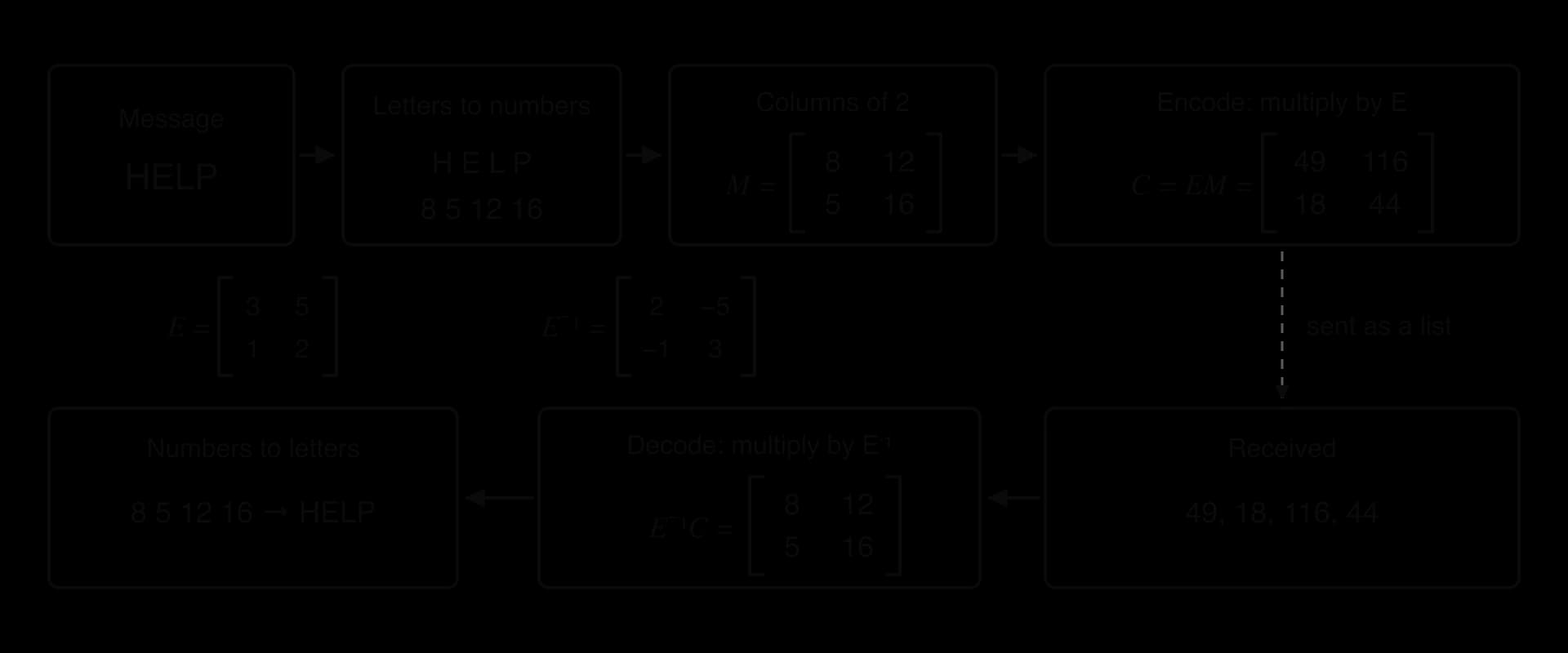
To encode a message with a encoding matrix :
Replace each letter by its number. If the number of letters is odd, add an agreed letter (such as X) at the end.
Write the numbers in order down the columns of a matrix with 2 rows: the first two numbers form column 1, the next two column 2, and so on.
Find . The elements of , read column by column, are the code.
The flow diagram follows the word HELP through encoding with and back again.
Decoding with the inverse
The receiver arranges the code in columns to rebuild and pre-multiplies by .
This short argument uses associativity and the definition of the inverse, and it shows why the encoding matrix must be non-singular: a singular matrix would squash different messages onto the same code, which could not be told apart. Choosing an encoding matrix with determinant 1 or −1 gives an inverse with whole-number elements, which makes decoding by hand easier, though any non-singular matrix works.
The encoding hides the letter pattern. Each code number depends on both letters in its column, so the same letter can turn into different code numbers depending on its neighbour, and a repeated letter need not produce a repeated number. Coding letters in blocks in this way made Hill's method harder to break than replacing each letter by a fixed symbol.
Larger keys and the GDC
A encoding matrix codes the message three letters at a time, and its inverse is found with the GDC. The method does not change: columns of length 3, to encode,
Exam focus
Matrices are examined on HL Papers 1 and 2, often as the first parts of questions on transformations (subtopic 3.9), networks (3.15), Markov chains (4.19) or coupled differential equations (5.17), as well as in questions of their own. Typical short questions ask students to write down a product or an inverse found with the GDC (1–2 marks), find a determinant or a inverse by hand (2–3 marks), find an unknown so that a matrix is singular or two matrices commute (3–4 marks), express from a matrix equation (2 marks), and hence solve a system with
Matrix answers are marked element by element: a markscheme often awards A2 for a fully correct matrix, A1 for one wrong element and A0 for two or more. When the GDC gives the answer, writing down the matrix entered (or the expression such as ) earns the method mark, even if a later element is miscopied.
The commonest error in matrix equations is putting the inverse on the wrong side, and markschemes treat it severely: the method mark is lost and only follow-through accuracy marks can be earned. Before writing the answer to any equation with an unknown matrix, mark which side of the known matrix stands on, and keep the inverse on that side.
Questions about a singular matrix sometimes ask what it does geometrically, as in a recent HL Paper 1 question where a matrix with zero determinant sent every line to the same line through the origin. The key fact is that a singular matrix sends every point to a multiple of one fixed vector, so writing the image of a general point and factorising shows this directly.
Practice questions
The matrix
Answers
Order ; ,
Summary
A matrix of order has rows and columns; is the element in row
Self-check
- To do:
I can write down the order of a matrix and find any element .
- To do:
I can find unknowns from two equal matrices.
- To do:
I can add, subtract and multiply matrices by a scalar, by hand and on my GDC.
- To do:
I can decide whether a product is defined and state its order.
- To do:
I can multiply two matrices by the row-by-column rule.
- To do:
I can set up a matrix product from a practical table and interpret the rows and columns of the answer.
- To do:
I can explain why