Notes on 1.12 Complex numbers
Learning objectives
State the definition of the imaginary unit and simplify square roots of negative numbers and powers of .
Write down the real part, imaginary part and complex conjugate of a complex number in Cartesian form .
Plot complex numbers on an Argand diagram and interpret points on the diagram as complex numbers.
Calculate sums, differences, products and quotients of complex numbers, both by hand and with technology.
Calculate powers of complex numbers in Cartesian form with technology.
Find the modulus and argument of a complex number, choosing the correct quadrant for the argument.
Describe the effect of multiplying by as a rotation on the Argand diagram.
Solve quadratic equations with real coefficients and a negative discriminant, giving the roots as a conjugate pair.
Explain the link between the discriminant of and the graph of
Introduction
The equation has no solution among the real numbers, because the square of every real number is zero or positive. Complex numbers extend the number system with one new number, , whose square is . With this single addition every quadratic equation has solutions, and arithmetic with the new numbers follows the familiar rules of algebra. Complex numbers can be drawn as points in a plane, so they describe positions, turns and stretches as well as amounts.
Electrical engineers describe alternating voltages and currents, such as the 50 Hz mains supply used in much of the world, as complex numbers, and a shape in a plane can be turned by multiplying its complex coordinates. Both applications rest on the Cartesian arithmetic developed here; the electrical application is completed in subtopic 1.13, Polar and Euler form.
 YouTube
The imaginary unit
Square roots of negative numbers
Among the real numbers, a negative number has no square root: and , so no real number squares to . Mathematicians solved this by inventing a new number whose square is
Once exists, the square root of any negative number can be written as a real multiple of . For a positive number ,
Just as every positive number has two square roots, so does : and , because
Powers of i
Repeated multiplication by produces only four different values, because brings the powers back round.
Power |
|---|
Each value comes from the one before it: and
Complex numbers in Cartesian form
Real part and imaginary part
Adding a real number to a real multiple of gives a number such as . Numbers of this kind are closed under the four operations, so adding, subtracting, multiplying or dividing two of them (except dividing by 0) always gives another number of the same kind. They form the complex numbers.
A complex number is usually called (or ), and writing it as a real number plus a real multiple of is its Cartesian form. Subtopic 1.13 introduces two other forms of the same number, so the name matters.
The two real numbers and are given names and symbols of their own.
The coefficient of is named in the same way.
Real numbers and purely imaginary numbers
When , the complex number is simply the real number . Every real number is therefore a complex number with imaginary part zero, and the real numbers sit inside the complex numbers in the same way that the integers sit inside the rational numbers. When and
Equal complex numbers
Two complex numbers are equal only when their real parts are equal and their imaginary parts are equal. A real number can never equal a non-zero multiple of , so the real and imaginary parts cannot make up for each other. One equation between complex numbers therefore gives two equations between real numbers, a fact used often in problem solving.
The Argand diagram
A real number can be shown as a point on a number line. A complex number has two independent parts, so it needs two dimensions: the real part is measured horizontally and the imaginary part vertically. The resulting plane is the complex plane, and a drawing of it is an Argand diagram.
The Argand diagram of six complex numbers shows how every type of number has its own place. Real numbers such as lie on the real axis, purely imaginary numbers such as lie on the imaginary axis, and all other complex numbers lie in one of the four quadrants.

A complex number can also be drawn as an arrow from the origin to its point. In this picture a complex number behaves like a two-dimensional vector , an idea subtopic 1.13 uses to add complex numbers geometrically.
Adding and subtracting complex numbers
Complex numbers are added and subtracted by collecting like terms, exactly as and are added in algebra. The real parts combine with the real parts and the imaginary parts with the imaginary parts.
Multiplying a complex number by a real number multiplies both parts by : . On the Argand diagram this stretches the arrow from the origin by the factor
 YouTube
Multiplying complex numbers
Expanding brackets
Two complex numbers are multiplied by expanding the brackets, as with in algebra, and then replacing by . The
The general result need not be memorised. Expanding the brackets every time is safer and keeps each step visible.
Multiplying by i turns a point through 90°
Multiplying by has a simple geometric meaning. For ,
so the point moves to . This is the effect of a rotation of 90° anticlockwise about the origin: the distance from the origin is unchanged, because
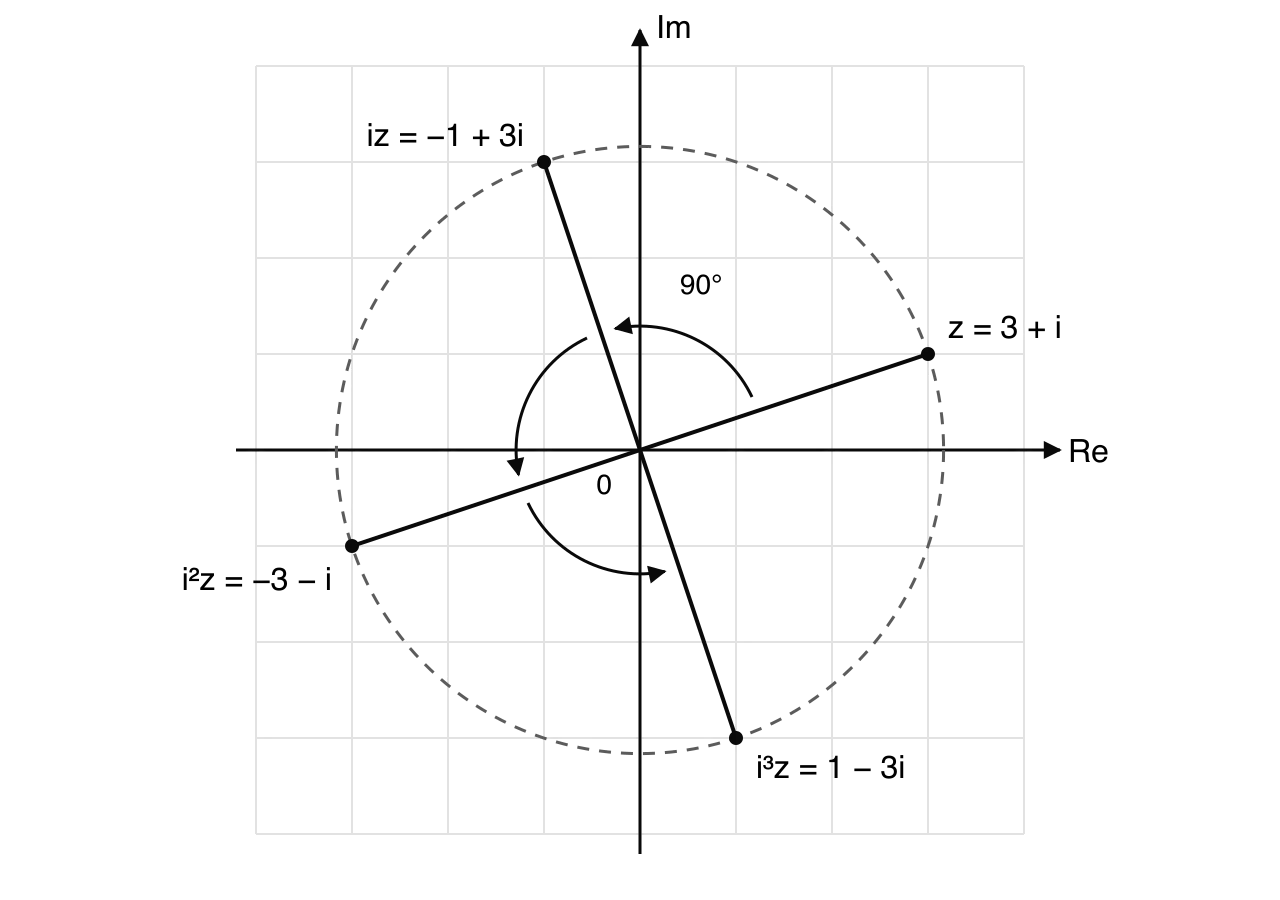
The rotation picture explains the cycle of the powers of : starting from 1 on the real axis, the powers are four quarter turns. The same idea turns a whole two-dimensional shape: multiplying the complex number of each corner by turns the shape through 90° about the origin. Subtopic 3.9, Matrix transformations, describes the same turns with matrices. Subtopic 1.13 shows that multiplying by any complex number is a rotation combined with a stretch.
The complex conjugate
Changing the sign of the imaginary part of a complex number gives its conjugate. On the Argand diagram the conjugate is the reflection of the point in the real axis, as and were in the diagram of six points.
The conjugate is useful because adding or multiplying a number and its conjugate always gives a real result. The sum loses the imaginary parts, and the product is a difference of two squares in which becomes .
The product is always a positive real number (unless ), and it reappears as the square of the modulus. A number whose conjugate equals itself must be real, because
Dividing complex numbers
Multiplying by the conjugate of the denominator
A quotient such as is not yet in Cartesian form, because the denominator is not real. Multiplying the numerator and denominator by the conjugate of the denominator makes the denominator real, since
The steps for dividing by hand are:
Write down the conjugate of the denominator.
Multiply the numerator and the denominator by it.
Expand the numerator, replacing by ; the denominator is
Solving equations with complex coefficients
A linear equation such as is solved exactly as a real one, by dividing both sides by the coefficient of . The division is then carried out with the conjugate. When the unknown appears with its conjugate, as in
Calculating with technology
Setting up the GDC
A GDC can calculate with complex numbers once it is in complex mode. The setting controls whether results are shown in Cartesian form or in a polar form (subtopic 1.13), and it should also be in radian mode, because arguments of complex numbers are measured in radians.
On a TI-84 Plus CE:
MODE, choosea+biandRADIAN. The number is2ndthen.(the decimal point key). The complex functions are underMATH→CMPLX:conj(,real(,imag(,angle(andabs(.On a Casio fx-CG50: in the
Run-Matrixmenu, open SET UP (SHIFTMENU) and setComplex Modetoa+biandAngletoRad. The number isSHIFTthen0, andOPTN→COMPLEXholdsAbs,Arg,Conjg,RePandImP.
Brackets matter when entering a quotient or a power. must be typed as (7+4i)/(2-i), and as
Powers of complex numbers
A power such as can be expanded by hand, but five brackets take time and invite sign errors, so the GDC is the natural tool for powers in Cartesian form. By hand,
Modulus and argument
The modulus
The distance of the point from the origin of the Argand diagram measures the size of the complex number. Pythagoras' theorem in the right-angled triangle with sides and gives this distance.
For a real number the modulus is the familiar absolute value, since
The modulus of a difference measures the distance between two points: is the distance from to on the Argand diagram, because has the horizontal and vertical separations of the two points as its parts. Two further properties,
The argument
The modulus gives the distance of a point from the origin; the argument gives its direction. Together they locate the point, as a distance and a bearing locate a ship.
Adding a full turn, , to an angle gives the same direction, so a complex number has infinitely many arguments: ,
Some questions ask for the argument in the interval instead; the two choices differ by for points below the real axis. The number 0 has no argument, because the origin has no direction.
Finding the argument: the quadrant matters
The right-angled triangle in the diagram of has sides 3 and 4 and hypotenuse 5, so . The acute angle at the origin, between the line and the real axis, comes from the tangent ratio and the inverse tangent:

The reliable method is to sketch the point first, then find the acute angle
Position of | Principal argument |
|---|---|
First quadrant (, |
Exact arguments come from the special triangles: ,
Modulus and argument with technology
The GDC's abs( (modulus) and angle( or Arg (argument) functions take care of the quadrant automatically and return the principal argument, provided the calculator is in radian mode. For , abs(-3+4i) gives 5 and angle(-3+4i) gives . These functions are the quickest check on a hand calculation, but they give decimals: an exact value such as
Complex roots of quadratic equations
The quadratic formula
Every quadratic equation can be solved by completing the square. Dividing by and rearranging gives
and subtracting from both sides gives the formula. Every step is valid for complex numbers too, so the formula still works when is negative, as long as
The discriminant
The expression under the square root decides what kind of roots the equation has, so it has its own name and symbol.
Discriminant | Roots of | Graph of |
|---|
The link with the graph
The real roots of are the -intercepts of the parabola
For the highest parabola, has
The real part of the roots, 1, is the -coordinate of the vertex , because is both the line of symmetry of the parabola and the real part
Conjugate pairs
The in the formula produces two roots that differ only in the sign of . When ,
The pairing works in reverse. If is a root of a quadratic with real coefficients, then is the other root, and the quadratic is a multiple of
The sum of the roots is , twice the real part, and their product is
Solving with technology
The GDC's polynomial root finder (used for real roots in subtopic 1.8) also returns complex roots when the calculator is in complex mode: enter the coefficients , , and the solver lists both roots in form. On a TI-84 Plus CE this is the PlySmlt2 app with a+bi chosen in its mode screen; on a Casio fx-CG50 it is MENU → Equation → POLY with Complex Mode set to a+bi. In real mode some calculators report an error or "no real roots" instead. The solver gives decimals, so exact roots such as
Substituting a complex root back into the equation is a reliable check by hand. For in :
The value of a coefficient can also be chosen to make the roots complex. Requiring gives an inequality for the unknown coefficient.
Exam focus
Complex numbers appear on Papers 1 and 2 (HL), usually as the opening parts of a longer question that moves on to polar and exponential forms (subtopic 1.13), and occasionally in a Paper 3 investigation. Typical command terms are plot, write down, find, express, describe and hence. Recurring shapes are: plotting given numbers on an Argand diagram; arithmetic in Cartesian form; finding a modulus and argument (often exactly); describing a map such as as a rotation and a translation in the right order; and solving a real quadratic with complex roots or finding its coefficients from one root. Individual parts carry 1–4 marks.
The GDC is expected for powers and for checking arithmetic, but working by hand is needed when a question asks for exact answers, for a "show that", or for a method such as division by the conjugate. Write down the expression entered into the GDC, and state the argument in radians.
The markscheme for (b) and (c) accepts a GDC result, but a quotient done by hand shows the method if the final answer contains a slip. In (d), an argument of (from alone) is in the wrong quadrant and earns no accuracy mark.
Questions that say "exact" want surds and multiples of : and
Practice questions
Write down the value of . [1]
For , write down ,
Answers
, so
Summary
The imaginary unit satisfies ; for ,
Self-check
- To do:
I can write the square root of a negative number as a multiple of .
- To do:
I can simplify any power of using the remainder on division by 4.
- To do:
I can write down the real part, imaginary part and conjugate of a complex number, giving the imaginary part as a real number.
- To do:
I can equate real and imaginary parts to find unknowns.
- To do:
I can plot and label complex numbers on an Argand diagram.
- To do:
I can add, subtract and multiply complex numbers by hand, replacing