 YouTube
Round to decimal places and significant figures, choose a sensible accuracy, find upper and lower bounds of rounded values and of results calculated from them, calculate percentage errors, and use estimation to check answers.
Each is in the Maths AI glossary, with every other term in the subject.
The size of the difference between an approximate value and the exact value, , measured in the same units as the quantity.
The distance of a real number from zero on the number line, written
Write down a number rounded to a given number of decimal places or significant figures, and distinguish rounding from truncation.
Determine an appropriate degree of accuracy for an answer from the accuracy of the data and the context.
Explain why rounding intermediate values can change a final answer, and avoid premature rounding with a GDC.
Write down the upper and lower bounds of a rounded measurement, as an inequality.
Calculate the upper and lower bounds of sums, differences, products and quotients of rounded values.
Calculate the absolute error and the percentage error of an approximation, using the exact value in the denominator.
Find the largest possible percentage error of a quantity calculated from rounded measurements.
Estimate the result of a calculation by rounding, and justify whether a calculated result is reasonable in its context.
Almost every number used in applied mathematics is approximate. A length read from a ruler, a time from a stopwatch and a population from a census are each known only to some accuracy, and every calculation that uses them inherits that uncertainty. A measurement that is honestly rounded, together with a clear statement of how accurate it is, is more useful than a long string of digits that are not really known.
Four tools handle that uncertainty: rounding to decimal places and significant figures, the bounds within which a rounded value must lie, the percentage error that measures how far an approximation is from the truth, and estimation, which checks whether an answer is sensible at all. The same ideas reappear whenever a model is compared with data, from the trapezoidal rule in subtopic 5.8 to regression in topic 4.
82 exam-style questions on this subtopic, written in the style of the IB papers. The first has its markscheme open. Counted on
In 2023, the gross domestic product (GDP) of Kestavia was US dollars (USD) and its population was
The entries of the mathematics: applications and interpretation formula booklet that 1.6 uses. Each opens in the explained booklet.
With a free account, Augment remembers where you stopped and what you have practiced.
A value used in place of the exact value of a quantity, such as a rounded number, an estimate or a measurement, written .
The number of digits written after the decimal point; rounding to decimal places keeps digits after the point.
The precision to which a value is given, stated as a number of decimal places, a number of significant figures or a unit of rounding such as the nearest 10 or the nearest cent.
Finding an approximate value of a calculation or quantity, usually by rounding the numbers involved to 1 significant figure, in order to judge whether an exact result is reasonable.
The true or accepted value of a quantity, written , against which an approximation is compared.
The smallest value that a rounded number could have had before it was rounded; for a value rounded to the nearest unit , it is the rounded value minus .
The difference between a measured value and the true value of a quantity, caused by the limited precision of the measuring instrument, rounding of the reading, or the way the measurement is made.
The absolute error of an approximation expressed as a percentage of the exact value, .
Rounding a value in the middle of a calculation and then using the rounded value in later steps, which can make the final answer inaccurate.
Replacing a number by the closest value that has a stated accuracy, such as a given number of decimal places or significant figures.
Shortening a number by removing all digits beyond a chosen position, without rounding; a positive number is never increased by truncation.
The boundary above which a number would no longer round to the recorded value; for a value rounded to the nearest unit , it is the rounded value plus , and the true value is strictly less than it.
YouTubeRounding replaces a number with a simpler one that is close to it. The value of is 3.141 592 653…, an irrational number whose digits never end, so every calculation with uses a rounded version of it: 3.14, 3.1416 or the ten digits a GDC stores. Rounding is a choice about how much detail to keep.
The rule for rounding is the same whatever the accuracy. Find the last digit to be kept, then look at the digit after it: if that digit is 5 or more, increase the last kept digit by 1; if it is 4 or less, leave the last kept digit as it is. The remaining digits are then removed (after the decimal point) or replaced by zeros (before the decimal point). Rounding to the nearest value means the rounded number is never more than half a unit of the last kept digit away from the original.
The accuracy of a rounded number can be measured from the decimal point. Money in dollars, euros or pounds is usually given to 2 decimal places (whole cents or pence), and many measurements are recorded to 1 decimal place.
Rounding to decimal places counts from the decimal point, so it treats all numbers the same way regardless of their size: 2 decimal places means hundredths, whether the number is 0.03 or 30,000.03. That suits quantities measured in a fixed unit, such as money.
Number | 1 d.p. | 2 d.p. | 3 d.p. |
|---|---|---|---|
3.141 592… | 3.1 | 3.14 | 3.142 |
0.040 72 | 0.0 | 0.04 | 0.041 |
7.996 | 8.0 | 8.00 | 7.996 |
125.4549 | 125.5 | 125.45 | 125.455 |
Two rows of the table need care. Rounding 7.996 to 2 decimal places increases the 9 in the hundredths place to 10, which carries into the units: the answer is 8.00, and the two zeros must be written to show that the number is accurate to 2 decimal places. In the last row, rounding to 1 decimal place looks only at the digit 5 in the hundredths place, not at the digits after it, so 125.4549 rounds to 125.5 even though the digits beyond the 5 are small.
Decimal places are a poor measure of accuracy for numbers of very different sizes. A world population of 8,140,897,523 and a cell width of 0.000 012 7 m are better described by keeping the same number of meaningful digits in each, which is what significant figures do. Counting starts at the first non-zero digit, wherever it is.
The rules for which digits count are:
Every non-zero digit is significant.
Zeros between non-zero digits are significant: 4007 has 4 significant figures.
Zeros before the first non-zero digit are not significant; they only place the decimal point: 0.0052 has 2 significant figures.
Zeros at the end of a number after the decimal point are significant, because they would not be written unless they were measured: 2.50 has 3 significant figures.
Zeros at the end of a whole number are ambiguous: 2500 may have 2, 3 or 4 significant figures. Standard form removes the doubt, since clearly has 3.
Number | Significant figures | Reason |
|---|---|---|
382 | 3 | every digit is non-zero |
40.07 | 4 | the zeros lie between non-zero digits |
0.000 63 | 2 | leading zeros only place the point |
6.300 | 4 | final zeros after the point were measured |
52,000 | 2 to 5 | final zeros may only be place holders |
To round to significant figures, count digits from the first non-zero digit and apply the usual rounding rule. For a large number, the dropped digits before the decimal point become zeros so that the size of the number does not change: 58,649 to 2 significant figures is 59,000, not 59.
A second way to shorten a number is truncation, which simply cuts off the unwanted digits without looking at what comes next.
Truncation is used where rounding up would be wrong in the context. A person who is 17 years and 11 months old is 17 years old, not 18: ages are truncated. A calculation that shows 4.7 buses are needed for a school trip must be rounded up to 5, while one that shows a budget pays for 12.8 tickets must be cut down to 12. Choosing between rounding up, rounding down and rounding to the nearest value is part of interpreting an answer in its context.
The main weakness of truncation is that its errors all go the same way. Rounding to the nearest value makes errors of up to half a unit in either direction, which tend to cancel when many rounded values are combined. Truncation of a positive number always makes it smaller, so repeated truncation builds up a steady error, as happened to the Vancouver Stock Exchange index between 1982 and 1983.
A calculated answer cannot be more accurate than the measurements it comes from. If the sides of a rectangle are measured as 4.2 m and 3.7 m, the calculator gives the area as 15.54 m², but the sides are known only to the nearest 0.1 m, so the second decimal place in the area is not reliable. Giving the area as 15.5 m² (3 significant figures) is honest; giving it as 15.540 000 m² suggests an accuracy the measurements never had.
Three guidelines decide an appropriate degree of accuracy:
The data. Give a final answer to about the same number of significant figures as the least accurate data used (3 significant figures is the usual choice when data are given to 3 or more).
The context. Money is given to the nearest cent or the nearest whole unit of currency; people, cars and buses are whole numbers, rounded up or down as the situation requires; an angle measured with a protractor is given to the nearest degree.
The purpose. A builder ordering tiles needs whole packs, rounded up; a scientist reporting a measurement needs the accuracy of the instrument, no more and no less.
Rounding should happen once, at the end. When an intermediate value is rounded and the rounded value is used in the next step, its rounding error is carried forward and can be magnified, especially when two close numbers are subtracted or when a value is multiplied by a large number.
A metal pipe has outer radius 5.13 cm and inner radius 5.07 cm, and its cross-section is the ring between the two circles. Working with full values on the GDC gives a ring area of . Rounding each circle's area to 3 significant figures first gives the wrong answer.
The two areas are both about 81, so a rounding error of up to 0.05 in each one is large compared with their difference of about 2. Subtracting removes most of the size of the two areas while leaving their rounding errors in place, so the error is a much larger fraction of the answer than of either area.
A length recorded as 4.1 cm to 1 decimal place is not exactly 4.1 cm. It could be any length that rounds to 4.1, and every measuring instrument has a limit to how finely it can read. The difference between the recorded value and the true value is a measurement error.
The range of true values consistent with a rounded value is described by its bounds. For 4.1 to 1 decimal place, every number from 4.05 up to (but not including) 4.15 rounds to 4.1.
The lower bound itself rounds to the recorded value, because 5 and above rounds up: 4.05 to 1 decimal place is 4.1. So the lower bound is included in the interval of possible values.
The upper bound 4.15 would itself round up to 4.2, so the true value cannot equal it, although it can be arbitrarily close to it. This gives the inequality
with "less than or equal to" at the lower end and "strictly less than" at the upper end. The number line for shows the interval with a filled dot at the included lower bound and an open dot at the excluded upper bound.
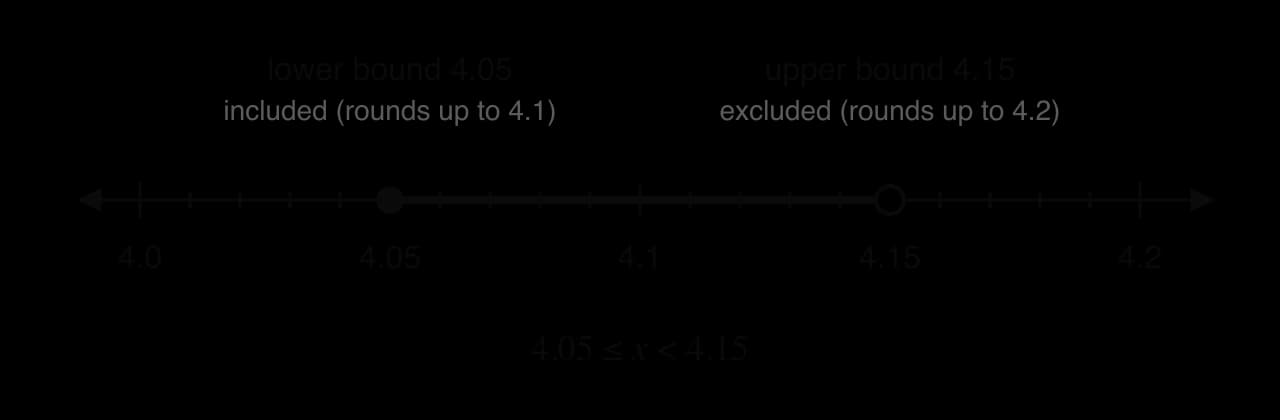
In calculations the upper bound is used as if it were a possible value, because the true value can be as close to it as one wishes. The difference between 4.149 999… and 4.15 is too small to matter, so the upper bound 4.15 is the number written down.
The method is the same for every accuracy:
Identify the unit of rounding: the place value of the last digit kept (0.1 for 1 decimal place, 1 for the nearest whole number, 10 for the nearest 10, and so on).
Halve it.
Subtract the half-unit for the lower bound and add it for the upper bound.
Recorded value | Accuracy | Unit | Bounds |
|---|---|---|---|
4.1 | 1 d.p. | 0.1 | |
73 kg | nearest kg | 1 | |
2 cm | 1 s.f. | 1 | |
30° | 1 s.f. | 10° | |
2400 people | nearest 100 | 100 | (whole numbers) |
6.20 m | 3 s.f. | 0.01 |
The 1-significant-figure rows are the ones most often misjudged. A radius of 2 cm to 1 significant figure is rounded to the nearest whole centimetre, so the half-unit is 0.5 cm. An angle of 30° to 1 significant figure is rounded to the nearest 10°, so the half-unit is 5°, and the angle could be anything from 25° up to 35°. The last row shows the value of writing trailing zeros: 6.20 m says the length is known to the nearest centimetre, while 6.2 m would only say to the nearest 10 cm.
Bounds of counted (discrete) quantities and of truncated values follow different patterns from rounded measurements.
Counts. A crowd of 2400 to the nearest 100 contains a whole number of people, so the bounds are . Both ends are included, because 2449 is a possible count that rounds to 2400.
Truncated values. A person who says they are 17 years old could be any age from exactly 17 up to (but not including) 18: . The recorded value is the lower bound, not the middle of the interval.
When a result is calculated from rounded values, its own bounds are found by choosing the bound of each input that pushes the result as high or as low as possible. The rules follow from asking what makes the result largest.
Calculation | Upper bound of the result | Lower bound of the result |
|---|---|---|
upper + upper | lower + lower | |
upper − lower | lower − upper | |
(positive values) | upper × upper | lower × lower |
(positive values) | upper ÷ lower | lower ÷ upper |
The rules for subtraction and division are the ones that need thought. A difference is largest when the first number is as large as possible and the number subtracted is as small as possible. A quotient is largest when the numerator is large and the denominator is small, because dividing by a smaller number gives a larger result. For more complicated formulas, the same reasoning applies one step at a time: decide whether increasing each input increases or decreases the result.
A function whose output always increases as its input increases maps the bounds of the input straight onto the bounds of the output. The area of a circle, , is such a function for positive . The graph of near shows the interval carried across to the interval of possible areas.
 YouTube
To judge how good an approximation is, it is compared with the value it approximates. The two values need names.
The exact value may be a mathematical constant, a quantity calculated from a formula, a measured value that is accepted as correct, or the true value of something that was estimated. The approximation is always measured against it.
The simplest measure of an approximation's quality is the size of the gap between it and the exact value. The direction of the gap does not matter, only its size, so the absolute value is used.
With the absolute value, the error of an approximation is the same positive number whether the approximation is too large or too small.
An absolute error of 1 cm is excellent when measuring the length of a football pitch and terrible when measuring the width of a coin. The absolute error alone does not say how serious an error is; that needs a comparison with the size of the quantity.
The percentage error expresses the absolute error as a percentage of the exact value. It measures how large the error is compared with the quantity being measured, which is what decides whether an error matters in practice.
Each part of the formula has a reason. The numerator is the error. Dividing by compares the error with the true size of the quantity, which turns it into a fraction of that size and removes the units. The absolute value makes the result positive whether the approximation is too large or too small, and multiplying by 100 turns the fraction into a percentage.
The denominator is always the exact value, because a percentage error describes the error relative to the truth. Dividing by the approximate value would measure the error against a number that is itself wrong, and would give different answers for approximations the same distance above and below the exact value.
Many percentage errors come from a value recorded in a mixed unit, such as hours and minutes, or degrees and minutes. These must be converted to a single unit before any calculation, using the right conversion factor. A journey that takes 3 hours 45 minutes lasts hours, not 3.45 hours.
When a quantity is calculated from rounded measurements, its true value lies somewhere between its lower and upper bounds. If the value calculated from the measurements is recorded as the answer, the largest possible percentage error occurs when the true value is at one of the bounds. Each bound is treated in turn as the exact value , and the larger percentage error is the largest possible one.
For the circle with radius 2.5 cm to 1 decimal place, the recorded area is cm², and the true area lies between 18.857… and 20.428… cm².
The largest possible percentage error in the area is about 4.12%. It comes from the lower bound, because the same absolute error is a larger fraction of a smaller exact value. The radius itself has a largest percentage error of only , so squaring the radius has roughly doubled the percentage error.
A tiny percentage error can still matter when it accumulates or when the quantity is multiplied by something large. On 25 February 1991 a Patriot missile battery at Dhahran, Saudi Arabia, failed to intercept an incoming Scud missile, which struck a barracks and killed 28 US soldiers. The software handled time with a tiny numerical error that grew the longer the system ran; after 100 hours of continuous operation the clock had drifted by about one-third of a second, which at the missile's speed meant tracking about 600 m away from the target.
The percentage error in the time was less than one ten-thousandth of a percent, yet at the speed of an incoming missile it produced a tracking error of hundreds of metres. Rounding errors in software that runs for long periods, or that controls dangerous systems, carry an ethical responsibility as well as a mathematical one.
Source: Wikipedia, “MIM-104 Patriot”, citing the US General Accounting Office report IMTEC-92-26 (1992).
An estimate is a quick approximate answer, found by rounding the numbers in a calculation so that it can be done mentally. Its purpose is to know roughly what answer to expect, so that a GDC result that is wildly wrong (a misplaced decimal point, a wrong key, a wrong unit) is noticed at once.
The usual method is to round every number to 1 significant figure and calculate:
The GDC gives 1.0503…, close to the estimate. If the GDC had shown 10.50 or 0.105, the estimate would show at once that a decimal point had slipped. An estimate needs only the right order of magnitude to serve as a check on the calculation.
Estimation also means checking that a result makes sense in its context, even when the arithmetic is correct. A model or a formula can produce values that are mathematically correct but physically impossible.
Signs. Lengths, areas, volumes, masses and times cannot be negative. A negative solution of an equation for a length is rejected.
Sizes. A person's height is not 17 m, a classroom does not hold 3000 students, and a car does not cost $8.
Whole numbers. A number of people, buses or packs must be an integer, rounded in the direction the context requires.
Units. A result of the wrong order of magnitude often means a unit was not converted, such as cm² treated as m².
Unit errors can be very expensive. NASA's Mars Climate Orbiter was lost in 1999 because one piece of software reported thruster impulse in pound-force seconds while the navigation software expected newton-seconds, so every value was wrong by a factor of 4.45. A reasonableness check on the size of each quantity is one of the simplest defences against such errors.
The Vancouver Stock Exchange started a new share index in January 1982 at a value of 1000. The index was recalculated after every trade, about 3000 times a day, and after each recalculation the new value was truncated to three decimal places instead of being rounded. The truncated value was then used as the starting point for the next update.
Each truncation removed between 0 and 0.000 999… from the index, never added anything, and on average removed about half of 0.001, that is 0.0005. A quick estimate of the effect is:
With roughly 20 trading days in a month, that is about 30 points a month. The actual loss was reported as around 25 points a month, so the estimate has the right order of magnitude. Over the 22 months from January 1982 to November 1983, a loss of 25 points a month adds up to about 550 points.
The error was found and corrected over the weekend of 25–28 November 1983. The index, which had closed on the Friday at 524.811, was recalculated as 1098.892, a difference of 574.081 points.
Quantity | Value |
|---|---|
Reported index (truncated after each trade) | 524.811 |
Corrected index (exact) | 1098.892 |
Absolute error | 574.081 |
Percentage error | 52.2% |
Source: Wikipedia, “Vancouver Stock Exchange” (index history, 1982–1983).
The percentage error of the reported value, with the corrected value as the exact value, is
The reported index was less than half its true value, so it showed a large fall while the corrected index had in fact risen above its starting value of 1000. Each individual truncation was a change of less than a thousandth of a point, far too small to notice. The error came from two features together: every error went in the same direction, and the errors were carried forward and repeated hundreds of thousands of times. Rounding to the nearest value instead would have made errors in both directions, which mostly cancel, and keeping more decimal places would have made each error smaller. The same effect can arise in any calculation repeated many times, such as interest added daily to a bank account.
Approximation and error appear on Paper 1 and Paper 2, often as the last part of a question on another topic: the percentage error of a trapezoidal rule estimate, of a model's prediction, or of a measured value. Typical parts are worth 2–3 marks. The command terms are write down (bounds, a rounded value), calculate and find (percentage error, bounds of a calculated quantity) and justify (whether an answer is reasonable, or which bound gives the largest error).
Write the percentage error formula with the values substituted, including the absolute value signs and the × 100%; the method mark depends on seeing it.
Use the exact value of and other constants from the GDC.
Give answers to the accuracy asked for: "4 significant figures" and "4 decimal places" are different.
For bounds of data given to 1 significant figure, find the unit of rounding before halving it.
Two errors are behind most lost marks on these questions. One is placing the recorded value, not the bound, in the denominator of the percentage error. The other is rounding an intermediate area or volume to 3 significant figures and then using it, so that the final answer is wrong in the third significant figure.
Write down 0.006 718 correct to (a) 2 significant figures; (b) 3 decimal places. [2]
Write down 48,950 correct to 3 significant figures. [1]
The mass of a parcel is 2.7 kg, correct to 1 decimal place. Write down the bounds of its mass as an inequality. [2]
An angle is measured as 40°, correct to 1 significant figure. Write down its upper and lower bounds. [2]
A rectangular garden measures 12 m by 7 m, each to the nearest metre. Calculate the upper and lower bounds of its perimeter. [2]
An object has mass 250 g, to the nearest 10 g, and volume 32 cm³, to the nearest cm³. Calculate the upper bound of its density (mass ÷ volume). [3]
Taking as 3.14, calculate the percentage error compared with the value of on your GDC. [2]
A film lasts 2 hours 15 minutes. A student writes its length as 2.15 hours. Find the percentage error. [3]
Estimate by rounding each number to 1 significant figure. [2]
The side of a square tile is measured as 15 cm, correct to the nearest centimetre. The area is recorded as 225 cm². Find the largest possible percentage error in the recorded area. [4]
(a) 0.0067; (b) 0.007
49,000 (the third significant figure, 9, is followed by 5, so it rounds up and carries; in standard form )
kg
Lower bound 35°, upper bound 45° (1 s.f. means the nearest 10°).
Upper: m; lower: m.
Upper bound = upper mass ÷ lower volume
h;
(the GDC gives 713.3…, the same order of magnitude).
Bounds of side: ; area bounds and cm². Errors:
Round by looking at the digit after the last one kept: 5 or more rounds up. Round once, from the full value.
Decimal places count digits after the decimal point; significant figures count from the first non-zero digit, and leading zeros are never significant.
Truncation cuts digits off without rounding; its errors all go one way and can accumulate.
Give answers to an accuracy justified by the data and sensible in the context; avoid premature rounding by keeping full values in the GDC.
A value rounded to the nearest unit has bounds : lower bound included, upper bound excluded, as in .
For bounds of results: sums use upper + upper; differences use upper − lower; products use upper × upper; quotients use upper ÷ lower (and the reverse for lower bounds).
Percentage error
The largest possible percentage error of a calculated quantity is found by treating each bound in turn as the exact value and taking the larger error.
Estimate by rounding to 1 significant figure, and check every answer is reasonable: signs, sizes, whole numbers and units.
I can round a number to a given number of decimal places, including cases that carry (7.996 → 8.00).
I can count significant figures, including zeros between digits, leading zeros and trailing zeros.
I can round a large number to significant figures, keeping its size with zeros.
I can explain the difference between rounding and truncation and say when each is used.
I can choose an appropriate degree of accuracy for an answer from the data and the context.
I can avoid premature rounding by storing values on my GDC.
I can write the bounds of a rounded value as an inequality with the correct ≤ and <.
I can find bounds for data given to 1 significant figure, such as 2 cm or 30°.
I can find the bounds of a sum, difference, product and quotient of rounded values.
I can calculate absolute error and percentage error with the exact value in the denominator.
I can convert mixed units such as hours and minutes before calculating an error.
I can find the largest possible percentage error of an area or volume calculated from rounded measurements.
I can estimate a calculation by rounding to 1 significant figure.
I can reject answers that are unreasonable in context, such as negative lengths.
Calculate the GDP per person of Kestavia. Give your answer to the nearest dollar.
2 marks
(M1)
(USD) A1
Note: Do not award the final mark if the answer is not given to the nearest dollar.
[2 marks]
Write your answer to part (a) in the form , where and
In the same year, the GDP of the neighbouring country Luvenor was USD.
Calculate how many times greater the GDP of Kestavia was than the GDP of Luvenor.
2 marks
The town of Brennick stores its drinking water in a tank in the shape of a cylinder. The radius of the tank is 42 m and its depth is 18 m.
Calculate the volume of the tank, in m³.
2 marks
Given that 1 m³ 1000 litres, write down the volume of the tank in litres. Give your answer in the form , where and .
2 marks
The town uses litres of water each day. No water enters the tank.
Find the number of complete days that a full tank can supply the town.
2 marks
The radius and the depth of the tank were each measured correct to the nearest metre.
Find the upper bound of the volume of the tank.
3 marks
The lower bound of the volume of the tank is 94 685.6 m³, correct to one decimal place.
Find the largest possible percentage error in using your answer to part (a) as the volume of the tank.
3 marks
During one storm, 12 mm of rain fell on the area that drains into the tank. This area is 3.6 km².
(i) Find the volume of rain, in m³, that fell on this area. Give your answer in the form , where and
A biology student, Ingrid, models a human red blood cell as a cylinder with diameter m and height m.
Calculate the volume of one red blood cell, in m³, according to Ingrid's model. Give your answer in the form , where and
3 marks
An adult has 5.0 litres of blood, and 45% of the volume of the blood is made up of red blood cells. 1 litre m³.
Estimate the number of red blood cells in the adult's body. Give your answer in the form , where
A medical textbook states that the adult has red blood cells.
Taking the textbook value as exact, calculate the percentage error in Ingrid's estimate.
2 marks
Each red blood cell contains haemoglobin molecules.
Using your answer to part (b), find the total number of haemoglobin molecules in the adult's red blood cells.
2 marks
Oxygen is absorbed through the surface of the red blood cells.
Calculate the total surface area of one red blood cell according to Ingrid's model.
3 marks
Real red blood cells are thinner in the middle than at the edge.
State whether Ingrid's model is likely to overestimate or underestimate the volume of one red blood cell.
1 mark
For :
Both are excellent approximations, but is better by more than three orders of magnitude: it agrees with to 6 decimal places. The second answer is written in standard form because it is so small.
2 marks
(USD) A1A1
Note: Award one mark for and one mark for . Follow through from part (a).
[2 marks]
A1
[2 marks]
(ii) Find this volume as a percentage of the volume of the tank found in part (a).
4 marks
3 marks