1.13 Polar and Euler form · IB Maths AI | Augment Education
1.13 Polar and Euler form
Convert complex numbers between Cartesian, polar and exponential forms, multiply, divide and raise them to powers in polar form, interpret them geometrically, and add sinusoids of the same frequency as in AC circuits.
IB Mathematics: Applications and Interpretation
Part of 1 Number and algebra
HL only
Key terms introduced here
Each is in the Maths AI glossary, with every other term in the subject.
An electric current, or the voltage that drives it, that reverses direction periodically and is modelled by a sinusoidal function of time such as V=Acos(ωt+ϕ).
The result that for any integer n, (r(cosθ+isinθ))n=rn(cosnθ+isinnθ), so a power of a complex number has the modulus raised to that power and the argument multiplied by it.
The complex number Aeiϕ that represents the sinusoid Acos(ωt+ϕ) of a known angular frequency ω, with modulus equal to the amplitude and argument equal to the phase angle ϕ.
The form z=r(cosθ+isinθ) of a non-zero complex number, where r=∣z∣>0 is its modulus and θ is an argument of z.
Notes on 1.13 Polar and Euler form
30 min readLast reviewed
Learning objectives
Express a complex number in polar (modulus–argument) form r(cosθ+isinθ)=rcisθ and in exponential form reiθ.
Convert between Cartesian, polar and exponential forms, by hand for exact values and with technology.
Calculate products and quotients of complex numbers in polar or exponential form, giving the argument in the required range.
Calculate integer powers of complex numbers in polar or exponential form.
Describe addition and subtraction of complex numbers as vector addition and subtraction on an Argand diagram.
Describe multiplication by a complex number as a rotation combined with a stretch about the origin.
Find the sum of two sinusoidal functions with the same frequency, in the form Acos(Bt+C), using complex numbers.
Interpret the amplitude and phase of a combined voltage or current in an AC circuit.
Introduction
A complex number can be located on an Argand diagram in two ways: by its horizontal and vertical coordinates, which give the Cartesian form a+bi, or by its distance from the origin and its direction, which give the polar form. In polar form multiplication is simple, because lengths multiply and angles add. Euler's formula then rewrites polar form as a power of e, so complex numbers obey the familiar laws of exponents.
Engineers use these ideas to analyse alternating current. Mains electricity supplies a voltage that rises and falls as a cosine wave 50 or 60 times a second, and engineers represent each such wave by a single complex number that records its size and timing. Adding two waves of the same frequency then becomes adding two complex numbers.
YouTube
Revision Village, “Forms of Complex Numbers (Rectangular, Polar, Euler) [IB Math AI HL]”: watch how one complex number is written in all three forms and how the GDC converts between them.
Polar form
From modulus and argument to polar form
Subtopic 1.12, Complex numbers, described the point z=a+bi by its modulus r=∣z∣ and its argument θ=argz
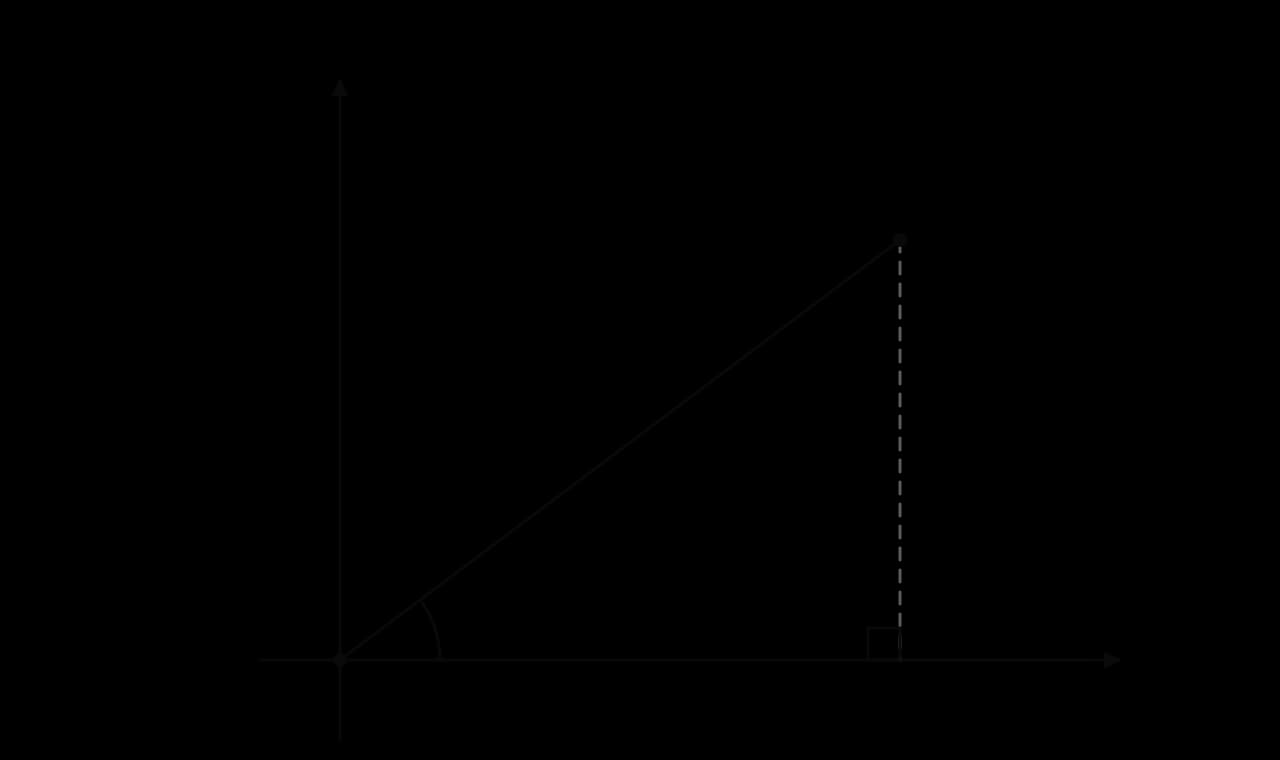
The modulus r and argument θ fix the point: its real part is r cos θ and its imaginary part is r sin θ.
The definitions of sine and cosine on the unit circle extend this to every quadrant, so for any non-zero complex number
Writing cosθ+isinθ in full every time is slow, so it has a short name.
The polar form of a number is not unique, because adding 2π to the argument describes the same direction: 2cis3π and 2cis37π
Converting from Cartesian to polar form
Converting to polar form means finding r and θ, exactly as in subtopic 1.12.
Plot the point roughly to see its quadrant.
Find r=a2+b2.
Converting from polar to Cartesian form
Converting back uses a=rcosθ and b=rsinθ, or simply expands the bracket. Exact values of sine and cosine at multiples of 6π
Euler's formula and exponential form
Why cis θ behaves like a power
Multiplying two numbers of modulus 1 in polar form shows a pattern. Expanding cisα×cisβ and using the compound angle identities cos(α+β)=cosαcosβ−sinαsinβ
So cisα×cisβ=cis(α+β): multiplying adds the angles. This is exactly how powers behave, since xα×xβ=xα+β
A justification of Euler's formula using derivatives
The function f(θ)=cosθ+isinθ has derivative f′(θ)=−sinθ+icosθ
Euler's formula works only with θ in radians. In the derivative argument, the rules dθdsinθ=cosθ and dθdcosθ=−sinθ
YouTube
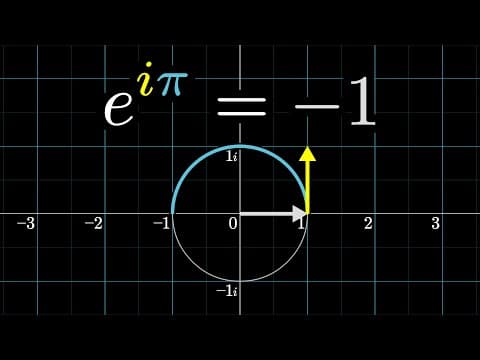
3Blue1Brown, “e^(iπ) in 3.14 minutes, using dynamics”: watch why a point whose velocity is always i times its position moves round the unit circle, which is Euler's formula.
Exponential form
Multiplying Euler's formula by r gives a third way to write a complex number, and the most compact one.
The three forms are three ways of writing the same number, and each suits a different task.
z=a+bi=r(cosθ+isinθ)=rcisθ=reiθ
Form
Written
Best for
Cartesian
a+bi
adding and subtracting; reading off real and imaginary parts
Polar
r(cosθ+isinθ) or rcisθ
Euler's identity
Putting θ=π in Euler's formula gives eiπ=cosπ+isinπ=−1
Converting with technology
The GDC converts between forms directly, provided it is in radian mode and complex mode.
On a TI-84 Plus CE: MODE, choose RADIAN and re^(θi) to show every complex result in exponential form (or a+bi for Cartesian). e□ is 2ndLN, and i is 2nd.. Inside MATH → CMPLX, ▶Polar and ▶Rect convert a single result.
On a Casio fx-CG50: in Run-Matrix, SET UP, set Complex Mode to r∠θ for polar results or a+bi for Cartesian, and Angle to Rad. OPTN → COMPLEX holds ►r∠θ and ►a+bi. The display 5.39∠2.76 means modulus 5.39 and argument 2.76.
Products and quotients in polar form
Multiplying: multiply the moduli, add the arguments
The laws of exponents give the product rule at once.
Two results from subtopic 1.12 follow: ∣zw∣=∣z∣∣w∣, and arg(zw)=argz+argw
Dividing: divide the moduli, subtract the arguments
Division undoes multiplication, so the moduli are divided and the arguments subtracted.
r2eiθ2r1eiθ1=r2r1ei(θ1−θ2)
A special case is the reciprocal reiθ1=r1e−iθ
Powers in polar form
De Moivre's theorem
Repeating the product rule n times multiplies the modulus by itself n times and adds the argument to itself n times. In exponential form this is the law (xm)n=xmn
(reiθ)n=rneinθ,(r(cosθ+isinθ))n=rn(cosnθ+isinnθ)
The result also holds for negative integers. For n=−1 it gives r1e−iθ, the reciprocal found in the division rule, and for n=0
Powers that are real
The argument of zn is nθ, so zn is real when nθ is a multiple of π
On an Argand diagram the powers w,w2,w3,… of a number with modulus greater than 1 lie on a spiral moving outwards, each one turned by the same angle from the last. With modulus exactly 1 the powers stay on the unit circle, and with modulus less than 1 they spiral in towards 0.
The geometry of complex numbers
Addition and subtraction as vectors
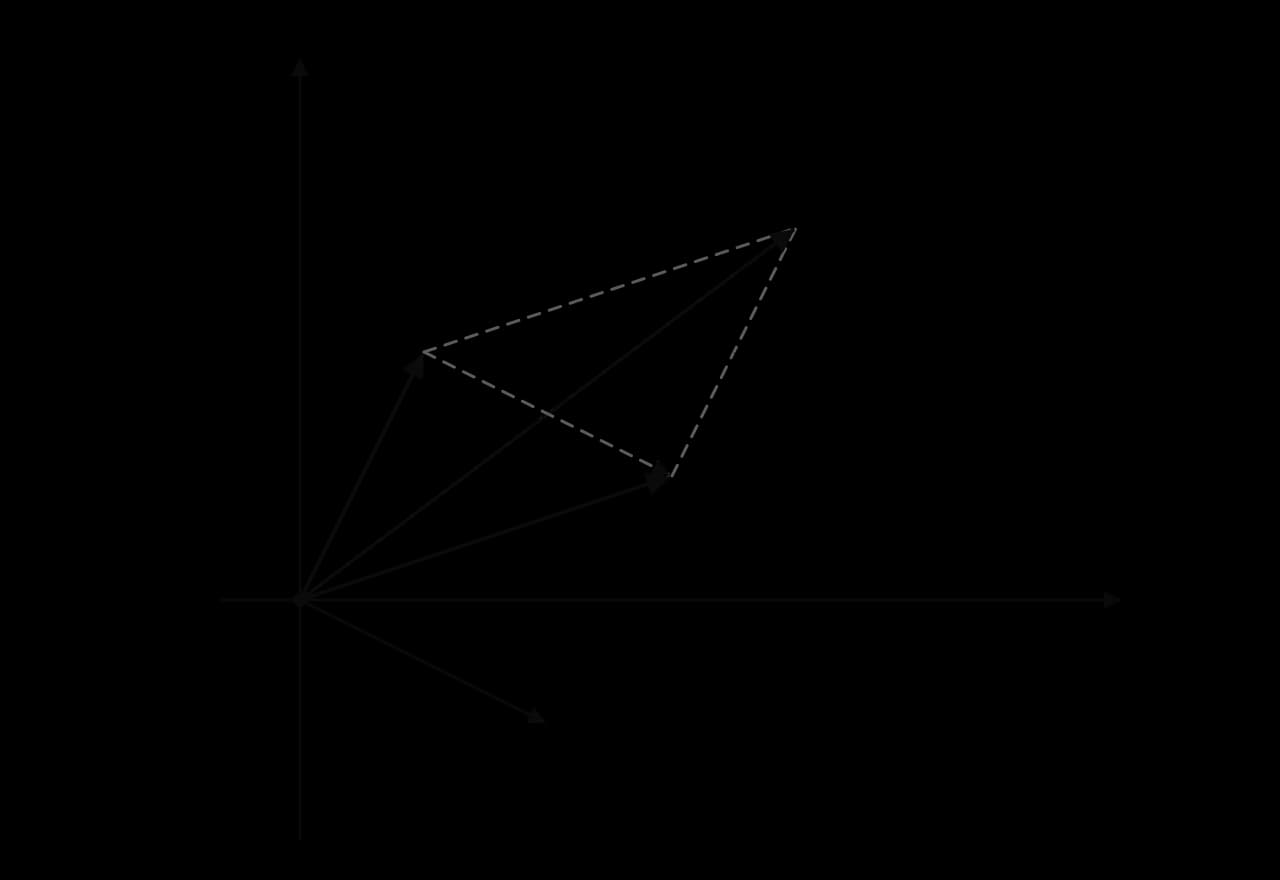
On an Argand diagram a complex number a+bi can be drawn as the arrow from the origin to (a,b), the vector (ab)
The sum z + w is the diagonal of the parallelogram on z and w; the difference z − w is the arrow from w to z, moved to start at 0.
Subtraction works the same way: z−w is the arrow that goes from the tip of w to the tip of z, because w+(z−w)=z
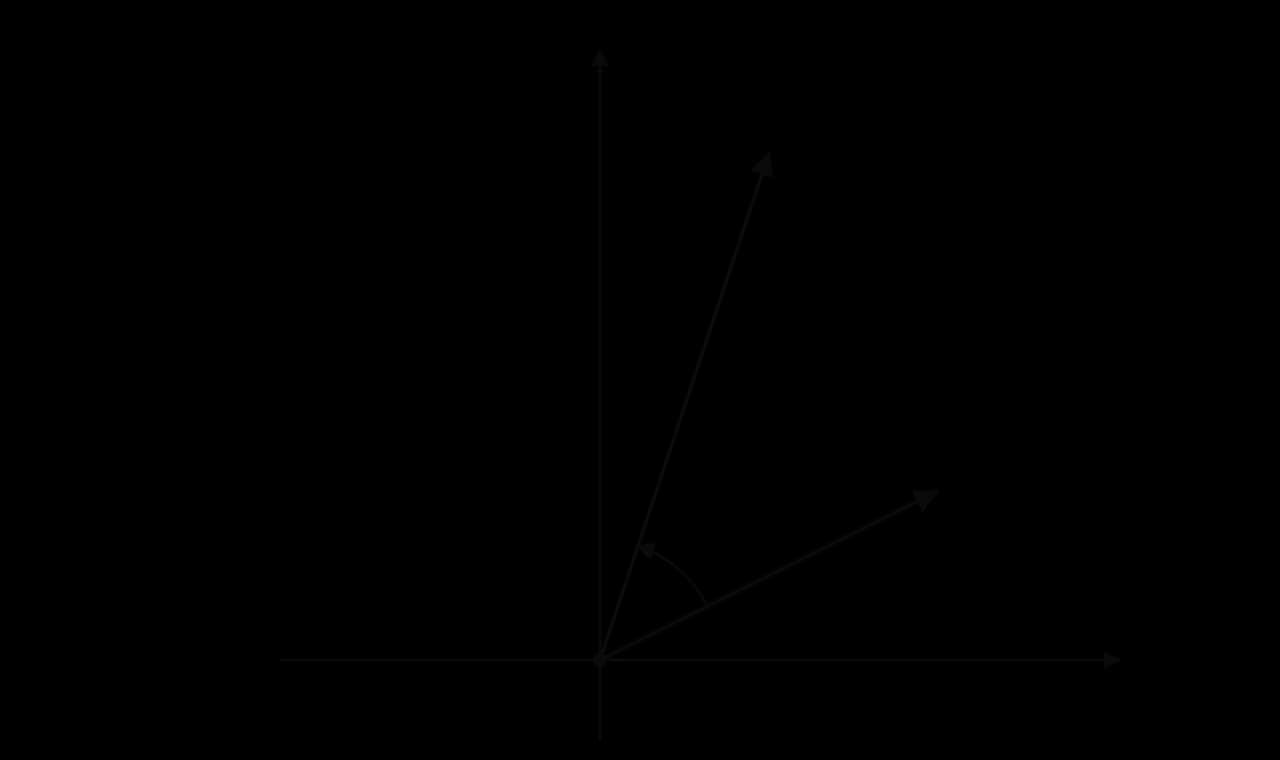
Multiplication as a rotation and a stretch
Multiplying z by w=reiϕ multiplies the modulus of z by r and adds ϕ
Multiplying z = 2 + i by w = 1 + i = √2 e^(iπ/4) turns it through π/4 anticlockwise and stretches its length by √2, from √5 to √10.
The arithmetic agrees with the picture: (2+i)(1+i)=2+2i+i+i2=1+3i
Multiply by
Modulus, argument
Effect on the Argand diagram
a real number k>0
k, 0
stretch by factor k from the origin
−1
Dividing by reiϕ reverses both effects: it rotates through −ϕ and scales by r1. Taking the conjugate is a reflection in the real axis, which is not a rotation at all. Matrix transformations in subtopic 3.9 describe the same rotations and stretches with
Adding sinusoids of the same frequency
Alternating current
A battery pushes current in one direction at a steady voltage. A power station's generator instead produces a voltage that rises and falls smoothly, reversing direction many times each second.
In much of the world the mains supply has a nominal voltage of 230 V at a frequency of 50 Hz (50 complete cycles a second); in North America the usual combination is 120 V at 60 Hz. Mains voltages are quoted as root-mean-square values; the peak of a 230 V supply is 2302≈325 V. The model V=Acos(ωt+ϕ)
The constant ϕ is the phase angle of the wave. Because ωt+ϕ=ω(t+ωϕ)
Waves as real parts of complex numbers
Euler's formula gives ei(ωt+ϕ)=cos(ωt+ϕ)+isin(ωt+ϕ)
Acos(ωt+ϕ)=Re(Aei(ωt+ϕ))=Re(Aeiϕeiωt)
As t increases, Aei(ωt+ϕ) moves round a circle of radius A at a steady rate, and the wave is the horizontal coordinate of that moving point. The fixed complex number Aeiϕ
The key step: the real part of a sum
Taking the real part of a sum gives the same result as adding the real parts, because Re(a+bi+c+di)=a+c. This allows two waves to be combined inside one complex expression.
Re(z1)+Re(z2)=Re(z1+z2)
For two waves of the same angular frequency ω, the common factor eiωt comes out of the sum, leaving a sum of two phasors:
Write each wave as the real part of a complex exponential.
Combine them using Re(z1)+Re(z2)=Re(z1+z2)
The graphs of the two waves and their sum show this directly. All three have the same period, π, and the sum peaks between the peaks of the two parts.
Using technology for the phasor sum
With decimal phase angles the phasor sum is best done on the GDC: enter A1eϕ1i+A2eϕ2i
Sine waves, equivalent forms and cancellation
A sine wave is the imaginary part of the same exponential, because Im(eiθ)=sinθ. Sums of sine waves of the same frequency are therefore found with Im(z1)+Im(z2)=Im(z1+z2)
The form Acos(Bt+C) is not unique. Adding 2π to C changes nothing, and because cos(−x)=cosx
When two waves of equal amplitude are exactly half a cycle out of step, with phase difference π, their phasors are A and Aeiπ=−A, which sum to zero, so the waves cancel completely. Noise-cancelling headphones use this idea, producing a sound wave in antiphase with the unwanted noise so that the two add to almost nothing. With phase difference 0, the phasors point the same way and the amplitudes add, the largest possible result.
Case study: three-phase mains electricity
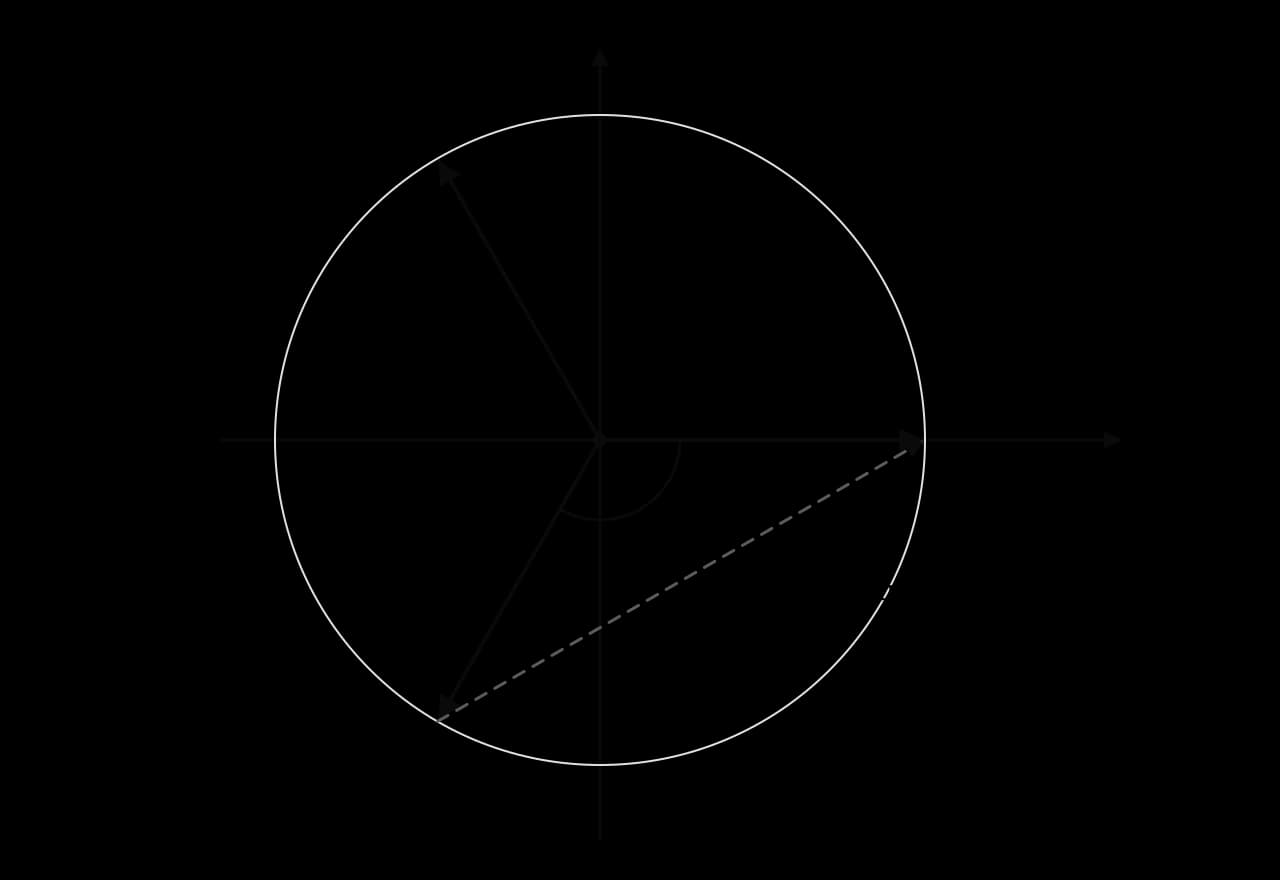
Power stations generate electricity on three wires, or phases, at once. The three voltages have the same amplitude and frequency, but their peaks are separated by a third of a cycle, 32π radians. In countries with a 230 V, 50 Hz supply, each phase measured against the neutral wire has peak voltage 2302≈325
Source: Wikipedia, "Mains electricity" and "Three-phase electric power" (230 V, 50 Hz; phases one-third of a cycle apart), checked 2026.
Each phase has a phasor of modulus 325: 325e0i, 325e−32πi
The three phasors are equally spaced, so they sum to zero; the difference V₁ − V₂ is longer than either phasor by a factor of √3.
The sum of the three phases. Adding the phasors, 325(1+e−32πi+e32πi)=325(1−21−23i−21+23i)=0
The voltage between two phases. An appliance connected between wires 1 and 2, instead of between one wire and neutral, receives V1−V2. Its phasor is
325(1−e−32πi)=325(23+23i)=3253e6πi,
because 23+23i=49+43=3
V1−V2=3253cos(100πt+6π)≈563cos(100πt+6π).
Interpretation. The voltage between two phases is a sinusoid of the same 50 Hz frequency, with amplitude 3 times larger than each phase and a phase angle of 6π
Exam focus
Polar and Euler form is examined on Papers 1 and 2 (HL), often following a 1.12 part in the same question. Typical command terms are express, write down, find, plot, show that, describe and hence. Recurring shapes are: converting a number to reiθ exactly; products, quotients and powers in a stated argument range; the least n for which a power is real; plotting successive powers on an Argand diagram; rotating a point to build a regular shape; and adding two voltages or currents of the same frequency into Acos(Bt+C)
Write down the form you are converting to and the modulus and argument separately, the expression entered into the GDC (for example "6+8e−i=12.3e−0.578i"), and in wave questions the step Re(z1)+Re(z2)=Re(z1+z2)
In (b), a candidate who multiplies Cartesian forms correctly earns the method mark, but the answer must be given in the requested exponential form with the argument in range. In (e), solving 50t−0.503=2π gives a later maximum, not the first one.
When a question says "exact", the angle must be a multiple of π and the modulus a surd: 2e−4πi
Practice questions
Express−3−i in the form reiθ
Answers
r=2; third quadrant, α=6π, θ=−65π
Summary
Polar form z=r(cosθ+isinθ)=rcisθ and exponential form z=reiθ
Self-check
To do:
I can write a complex number in polar and exponential form, with a positive modulus and the principal argument.
To do:
I can convert from polar or exponential form to Cartesian form, exactly for special angles and with decimals otherwise.
To do:
I can recognise when an expression such as −2cisθ or r(cosθ−isinθ) is not in polar form, and correct it.
Questions on 1.13
34 exam-style questions on this subtopic, written in the style of the IB papers. The first has its markscheme open. Counted on
Question 1 · AI-0025014 marks
In a city in the northern hemisphere, the time of sunrise, R, and the time of sunset, S, both in hours after midnight on day t of the year, are modelled by
R(t)=1.4cos(0.0172t+0.3)+6.2
S(t)=1.6cos(0.0172t−2.9)+18.4
where t=1 on 1 January and 1≤t≤365.
(a)
Find the time of sunrise on 1 January according to the model. Give your answer to the nearest minute.
[2]2 marks
Markscheme (a)
R(1)=1.4cos(0.3172)+6.2=7.53015…(M1)
07:32 A1
[2 marks]
(b)(i)
The number of hours of daylight on day t
Question 2 · AI-0027417 marks
Kwame is analysing an alternating current (AC) circuit. The impedance of each part of the circuit is a complex number, measured in ohms (Ω).
Branch A contains a resistor and an inductor in series. The resistor has impedance 6 and the inductor has impedance 8i.
Branch B contains a resistor of impedance 3 in series with a capacitor of impedance −4i.
Impedances in series are added.
Question 3 · AI-0027618 marks
Ana is making a string-art design. She draws an Argand diagram on a wooden board, with 1 unit representing 1 cm, and hammers pins at the points representing the terms of the geometric sequence
u1=8,un+1=run,where r=0.4+0.6i.
From the formula booklet
The entries of the mathematics: applications and interpretation formula booklet that 1.13 uses. Each opens in the explained booklet.
, conversion between these and Cartesian form by hand and with technology, products, quotients and integer powers in polar or exponential form, the geometric interpretation of addition, subtraction and multiplication, and adding sinusoidal functions of the same frequency, as in the phase shift of voltages in AC circuits. Finding roots of complex numbers is not required. Modulus, argument and Argand diagrams are taught in subtopic 1.12.
. The right-angled triangle formed by the point, the origin and the real axis has hypotenuse
r
and angle
θ
at the origin, so its horizontal and vertical sides are
rcosθ
and
rsinθ
.
is its modulus and
θ
is an argument of
z
.
1+i=2(cos4π+isin4π).
are the same number. Unless a question says otherwise, the
principal argument
(
−π<θ≤π
) is used. The modulus must be positive, and the bracket must be exactly
cosθ+isinθ
, with the same angle in both terms and a plus sign between them.
Find the acute angle α=arctanab and adjust it for the quadrant to get θ.
Write z=r(cosθ+isinθ) or rcisθ.
, giving exact values.
(a) 1+3i (b) −2−2i (c) −4 (d) 5i
Show the solution
(a) r=1+3=2. First quadrant, tanα=3, so θ=3π. 2cis3π.
(b) r=4+4=22
(c) −4 lies on the negative real axis: r=4, θ=π. 4cisπ.
(d) 5i lies on the positive imaginary axis: r=5, θ=2π. 5cis2π
and
4π
give exact Cartesian forms; other angles give decimals.
, to 3 significant figures
Show the solution
(a) cos65π=−23 and sin65π=21.
6(−23+21i)=−33+3i
(b) In radian mode, 4cos(−2)=−1.6645… and 4sin(−2)=−3.6371….
The answers are −33+3i and −1.66−3.64i. The second point is in the third quadrant, which matches −π<−2<−2π
, it equals
2cis(3π+π)=2cis(−32π)
. Similarly,
3(cosθ−isinθ)
is not in polar form as written; because
cos(−θ)=cosθ
and
sin(−θ)=−sinθ
, it equals
3cis(−θ)
.
and
sin(α+β)=sinαcosβ+cosαsinβ
gives
. It suggests that
cisθ
is a power with
θ
in the exponent, and the right base turns out to be
e
, with an
i
in the exponent as well.
. Because
i2=−1
, this equals
i(cosθ+isinθ)=if(θ)
. The function
g(θ)=eiθ
has the same property,
g′(θ)=ieiθ=ig(θ)
, by the chain rule. Both functions also start at the same value,
f(0)=cos0+isin0=1=e0=g(0)
. Two functions that obey the same rule of change
dθdy=iy
from the same starting value are the same function, so
f(θ)=g(θ)
for every
θ
. Differential equations of this kind, solved by separation of variables, are studied in subtopic 5.14, Setting up differential equations.
hold only in
radians
, and the same is true of the formula built on them.
(in radians) is an argument; it is also called the Euler form.
and negative real when it is an odd multiple. This turns questions about powers into simple equations for
n
.
and
w3
in exponential form. [2]
(b) Find the least positive integer n for which wn is a negative real number, and write down the value of wn. [3]
(c) Let z=3cis65π. Findz4 in the form rcisθ, −π<θ≤π. [2]
Show the solution
(a) w2=4e3πi and w3=8e2πi(=8i)A1A1
(b) wn is a negative real number when 6nπ=π (or an odd multiple of π
least n=6A1; w6=64eiπ=−64A1
(c) z4=81cis620π=81cis310π
310π−4π=−32π
. Adding complex numbers adds the real parts and the imaginary parts separately, which is exactly how vectors are added component by component. The sum
z+w
is therefore the diagonal of the parallelogram with sides
z
and
w
, or equivalently the result of placing the arrow for
w
at the tip of the arrow for
z
.
. The parallelogram of
z=3+i
and
w=1+2i
shows this arrow both from
w
to
z
and moved to start at the origin, where it ends at
2−i
. Its length
∣z−w∣=5
is the distance between the two points.
to its argument. Geometrically, the point
z
is turned through the angle
ϕ
about the origin (anticlockwise when
ϕ>0
) and its distance from the origin is scaled by the factor
r
: a
rotation
combined with a stretch, or enlargement, centred on the origin.
, and
∣1+3i∣=10=2×5
. Special cases are worth knowing.
1, π
half turn about the origin
i
1, 2π
rotation 90° anticlockwise
eiϕ
1, ϕ
rotation through ϕ, no stretch
reiϕ
r, ϕ
rotation through ϕ and stretch by factor r
2×2
matrices.
and
z1e−32πi
. [2]
(b) Find the other two vertices in Cartesian form, to 3 significant figures. [3]
Show the solution
(a) The vertices of an equilateral triangle centred at the origin are equally far from the origin and equally spaced in angle, 32π apart R1. Multiplying by e±32πi (modulus 1) rotates z1 by ±32π about the origin without changing its distance R1.
(b) With the GDC in radian mode: (4+2i)e^(2πi/3)(M1)
z2=−3.73+2.46iA1, and (4+2i)e^(-2πi/3) gives z3=−0.268−4.46i
Check: z1+z2+z3=0, as it must for a triangle centred at the origin, and all three have modulus
is a
sinusoidal function
with
amplitude
A
and a constant
ω
that sets how fast the wave repeats.
.
A 50 Hz supply has ω=2π×50=100π≈314 radians per second.
, it moves the graph
ωϕ
units to the left along the time axis, a
phase shift
of
−ωϕ
, and it measures how far one wave leads or lags another. Two voltages of the same frequency but different phase angles reach their peaks at different times, so their sum is not simply the sum of their amplitudes.
, so the cosine wave is the real part of a complex exponential.
holds everything that distinguishes one wave from another of the same frequency: its amplitude and its phase.
.
The voltage 325cos(100πt−0.5) has phasor 325e−0.5i.
. The sum of two sinusoids of the same frequency is therefore another sinusoid with the
same frequency
; its amplitude
R
is the modulus of the sum of the phasors, and its phase angle
Φ
is the argument.
and factor out
eiωt
.
Add the phasors A1eiϕ1+A2eiϕ2 (by hand or with the GDC) and write the result as ReiΦ.
Take the real part: Rcos(ωt+Φ).
in the form
Acos(Bt+C)
, and
write down
the maximum value of
V
.
Show the solution
Write each term as a real part and combine.
V=Re(3e2ti+4e(2t+2π)i)=Re(e2ti(3+4e2πi))
Since e2πi=i, the phasor sum is 3+4i
V=Re(e2ti×5e0.927i)=5cos(2t+0.927)
V=5cos(2t+0.927), and the maximum value is 5. The combined amplitude is 5, less than 3+4=7, because the two waves peak at different times.
3cos 2t
4cos(2t + π/2)
sum = 5cos(2t + 0.927)
The two waves and their sum share the period π; the sum is a single cosine wave of amplitude 5, smaller than 3 + 4 because the peaks do not coincide.
in radian mode and read the modulus and argument, or convert with
▶Polar
. The working to write down is the combined real-part expression, the phasor sum entered and its modulus and argument.
.
(a) Find an expression for the total voltage V=V1+V2 in the form Acos(Bt+C). [4]
(b) Hence write down the maximum total voltage. [1]
(b) The maximum of cos is 1, so the maximum voltage is 12.3 V(12.3235…)A1.
, which puts both waves inside one complex expression with the common factor
eiωt
. The amplitudes add to 14 only when the phase angles are equal.
. Alternatively,
sinx=cos(x−2π)
turns every sine into a cosine.
in the form
Asin(2t+C)
.
Show the solution
Use imaginary parts in place of real parts.
y=Im(e2ti(4+3e3πi))
GDC: 4+3e3πi=6.0827…e0.44131…i
y=Im(6.08e(2t+0.441)i)=6.08sin(2t+0.441)
y=6.08sin(2t+0.441), an amplitude of exactly 37
and
−cosx=cos(x+π)
, the same wave can be written with
B
negative or
A
negative:
5cos(2t+0.927)
,
5cos(−2t−0.927)
and
−5cos(2t−2.21)
are all equal. The usual choice has
A>0
,
B>0
and
−π<C≤π
.
together. Equivalent forms (such as
C
differing by
2π
) are accepted, but the final answer must be a real expression, not a complex one.
V and angular frequency
100π
rad s⁻¹:
V₁
V₂
V₃
The three phases of a 230 V, 50 Hz supply over two cycles (40 ms): equal waves whose peaks are a third of a cycle (6.7 ms) apart. Source: Wikipedia, 2026.
and
325e32πi
. On an Argand diagram they are three arrows of equal length,
32π
apart, like the vertices of an equilateral triangle.
. So
V1+V2+V3=0
at every instant: when the three phases share a balanced load, the currents in the shared return (neutral) wire cancel, which is one reason the three-phase system is efficient.
and
arctan3/23/2=arctan31=6π
. Therefore
. In the root-mean-square values that suppliers quote,
230×3≈398
V, which is the "400 V" of the standard 230/400 V supply used for heavy equipment such as industrial motors. The model assumes perfectly balanced phases and pure cosine waves; real supplies drift slightly in voltage and frequency, and the nominal 400 V is a rounded standard rather than the exact value
398
V.
in all three forms, then show
z2
,
z3
and
z1
as points with their moduli and arguments. Underneath, add a four-line "recipe card" for adding
A1cos(ωt+ϕ1)+A2cos(ωt+ϕ2)
, with the Re step highlighted.
. Parts are worth 1–5 marks, and a complete question 5–15 marks.
.
in the form
a+bi
, giving exact values. [2]
(b) Findw2 and w4 in the form reiθ, where r>0 and −π<θ≤π. [3]
(c) Describe the geometric transformation that maps the point z to the point wz on an Argand diagram. [2]
Two AC voltage sources of the same frequency are connected in a circuit. The voltages, in volts, are V1=12cos(50t) and V2=9cos(50t−1.2), where t is the time in seconds.
(d) Find the total voltage V=V1+V2 in the form Acos(Bt+C). [4]
(e) Hence write down the maximum total voltage, and find the first time t>0 at which it occurs. [3]
Show the markscheme
(a) 4(cos(−3π)+isin(−3π))(M1)
=2−23iA1
(b) w2=16e−32πiA1
w4=256e−34πi(M1)
=256e32πiA1
Note: award A0 for 256e−34πi, which is outside the range.
(c) rotation by 3π (60°) clockwise about the origin A1
and a stretch (enlargement) with scale factor 4, centre the origin A1
, are easiest with technology: evaluate each point numerically (or convert to Cartesian form) before plotting, and label each plotted point.
, not
1.41e−0.785i
. An argument of
47π
for the same number is usually accepted unless the range
−π<θ≤π
is stated.
, with
−π<θ≤π
, giving exact values. [3]
Write5cis(−6π) in the form a+bi, exactly. [2]
Use technology to write 7−3i in exponential form, and 2.5e−2.2i in Cartesian form, to 3 significant figures. [4]
Let z1=6cis32π and z2=3cis(−2π). Findz1z2 and z2z1 in the form rcisθ, −π<θ≤π. [4]
Use De Moivre's theorem to find (1−i)8 and (1−i)−4. [4]
Let u=e8πi. Find the least positive integer n for which un=1, and the least for which un=i. [3]
The point z=3−i is rotated anticlockwise about the origin through 2π and then enlarged by scale factor 2 from the origin. Find the image as a complex number in Cartesian form. [3]
Express5cos(4t)+12cos(4t+2π) in the form Acos(4t+C). [4]
Two currents in an AC circuit are I1=15cos(60t) and I2=10cos(60t−2). (a) Find the total current in the form Acos(60t+C). (b) Write down the maximum total current. [5]
Show that2sint+2sin(t+32π)=2sin(t+3π), and interpret the result in terms of amplitudes. [5]
un=e8nπi. un=1 when 8nπ=2π: n=16. un=i when 8nπ=2π: n=4.
Multiply by 2e2πi=2i: 2i(3−i)=2+6i.
Phasor sum 5+12i=13e1.18i, so 13cos(4t+1.18).
(a) GDC: 15+10e−2i=14.1e−0.698i, so I=14.1cos(60t−0.698). (b) 14.1.
Imaginary parts: 2+2e32πi=2−1+3i=1+3i=2e3πi, so the sum is Im(2e(t+3π)i)=2sin(t+3π). Two waves of amplitude 2 that are a third of a cycle apart add to a wave of amplitude 2 only, not 4.
, with
r=∣z∣>0
and
θ=argz
in radians;
a=rcosθ
,
b=rsinθ
.
Euler's formula eiθ=cosθ+isinθ; with θ=π it gives Euler's identity eiπ+1=0.
Products: multiply the moduli, add the arguments. Quotients: divide the moduli, subtract the arguments. Adjust the final argument by multiples of 2π into the required range.
De Moivre's theorem: (reiθ)n=rneinθ for integer n; zn is real when nθ is a multiple of π.
Addition and subtraction of complex numbers are vector addition and subtraction; ∣z−w∣ is the distance between the points.
Multiplying by reiϕ rotates a point through ϕ about the origin and stretches it by factor r.
A sinusoid Acos(ωt+ϕ)=Re(Aeiϕeiωt), with phasor Aeiϕ.
Two sinusoids of the same frequency add to one sinusoid of that frequency: use Re(z1)+Re(z2)=Re(z1+z2); the amplitude is the modulus and the phase angle the argument of the phasor sum.
To do:
I can state Euler's formula and Euler's identity.
To do:
I can set my GDC to radian and polar (or exponential) mode and convert between forms.
To do:
I can multiply and divide complex numbers in polar or exponential form and bring the argument into the required range.
To do:
I can use De Moivre's theorem to find integer powers, including negative powers.
To do:
I can find the least n for which zn is real, positive real or purely imaginary.
To do:
I can draw the sum and difference of two complex numbers as vectors on an Argand diagram.
To do:
I can describe multiplication by reiϕ as a rotation and a stretch, and use it to find vertices of a regular shape.
To do:
I can write a cosine (or sine) wave as the real (or imaginary) part of a complex exponential and identify its phasor.
To do:
I can add two sinusoids of the same frequency into the form Acos(Bt+C), showing the Re step and the GDC phasor sum.
To do:
I can interpret the amplitude and phase angle of a combined voltage or current, including when waves cancel.
is
D(t)=S(t)−R(t)
.
Write 1.6cos(0.0172t−2.9) and 1.4cos(0.0172t+0.3) in the form Re(pei(0.0172t+q)).
[1]1 mark
Markscheme (b)(i)
Re(1.6ei(0.0172t−2.9)) and Re(1.4ei(0.0172t+0.3))A1
[1 mark]
(b)(ii)
Hence, or otherwise, write D(t) in the form acos(0.0172t+b)+c, where a>0 and −π<b≤π.
[5]5 marks
Markscheme (b)(ii)
METHOD 1
D(t)=Re(e0.0172ti(1.6e−2.9i−1.4e0.3i))+18.4−6.2
(c)
Find the day of the year with the most hours of daylight, and the number of hours of daylight on that day.
[3]3 marks
Markscheme (c)
0.0172t−2.87274…=0OR maximum of D on a sketch (M1)
day 167A1
15.2 (hours) (15.1987…) A1
[3 marks]
(d)
Find the number of days in the year on which there are more than 14 hours of daylight.
[3]3 marks
Markscheme (d)
D(t)=14OR sketch with the line D=14(M1)
t=113.12… and t=220.91…(A1)
days 114 to 220, so 107 (days) A1
Note: Accept 107 or 108.
[3 marks]
(a)
Write down the impedance, ZA, of branch A and the impedance, ZB, of branch B.
[2]2 marks
(b)
Find the modulus and argument of ZA.
[3]3 marks
(c)
Branches A and B are connected in parallel. The total impedance, Z, of the circuit is given by
Z=ZA+ZBZAZB.
(d)
Write Z in the form a+bi, where a,b∈R.
[2]2 marks
(e)
The voltage, V, the current, I, and the impedance, Z, are related by V=IZ. The supply voltage is V=120
(f)
Find ∣I∣ and argI.
[3]3 marks
(g)
The current leads the voltage if argI>argV and lags the voltage if argI<argV. State, giving a reason, whether the current leads or lags the voltage in Kwame's circuit.
 YouTube
 YouTube