1.1 Scientific notation · IB Maths AI | Augment Education
1.1 Scientific notation
Write very large and very small numbers in standard form, convert to and from ordinary numbers, multiply, divide, add and subtract in standard form by hand and with a GDC, and compare quantities by order of magnitude.
IB Mathematics: Applications and Interpretation
Part of 1 Number and algebra
SL and HL
Key terms introduced here
Each is in the Maths AI glossary, with every other term in the subject.
The way a calculator or computer displays a number in standard form, with the letter E (or a small ×10) standing for "times ten to the power", as in 2.88E4 for 2.88×10⁴
Notes on 1.1 Scientific notation
32 min readLast reviewed
Learning objectives
State which number sets (natural numbers, integers, rational, irrational and real numbers) a given number belongs to.
Write down a number in standard form a×10k, where 1≤a<10
Questions on 1.1
40 exam-style questions on this subtopic, written in the style of the IB papers. The first has its markscheme open. Counted on
Question 1 · AI-001316 marks
The mean distance from the Earth to the Sun is 149 600 000 km. Light travels at a speed of 299 792 km s⁻¹.
(a)
Write down the distance from the Earth to the Sun in the form a×10k, where 1≤a<10
Carry on with 1.1 in Augment
With a free account, Augment remembers where you stopped and what you have practiced.
The power of ten that describes the size of a quantity, usually the exponent k when the quantity is written in standard form a×10k; two quantities differ by n orders of magnitude when one is about 10n times the other.
A unit of the International System of Units, the internationally agreed system of measurement whose base units include the metre (length), the kilogram (mass) and the second (time).
A way of writing a number as a×10k, where 1≤a<10 and k is an integer.
and
k
is an integer, and convert a number in standard form back to an ordinary number.
Calculate products and quotients of numbers in standard form, by hand using powers of ten and with a GDC.
Calculate sums and differences of numbers in standard form.
Calculate conversions between SI units, including units of area and volume, and give the result in standard form.
Find a result from a GDC and rewrite calculator notation such as 2.88E4 in the correct form 2.88×10⁴.
Determine the order of magnitude of a quantity and compare two quantities by orders of magnitude.
Introduction
The distance from the Sun to the Earth is about 150,000,000,000 metres, and a single water molecule is about 0.0000000003 metres across. Numbers like these are hard to read, easy to copy wrongly and slow to calculate with, because most of their digits are zeros that only show the position of the decimal point. Standard form replaces those zeros with a power of ten, so that 1.50×10¹¹ and 3×10⁻¹⁰ show at a glance both the digits that matter and the size of the number.
Scientists, engineers, economists and computer designers all work with quantities that span many powers of ten: national budgets in trillions of dollars, cell sizes in micrometres, data storage in terabytes. Standard form is the common language for all of them, and it is also how a graphic display calculator handles numbers that are too long for its screen.
YouTube
Revision Village, “Scientific Notation [IB Math AI SL/HL]”: converting to and from standard form and calculating with it on a GDC, set out the way IB questions expect.
The number sets
Every number used in this course belongs to one or more standard sets. The sets are named with special capital letters, and each larger set contains the smaller ones inside it. Knowing which set a number belongs to matters in practice: a count of people must be a natural number, a temperature can be a negative integer, and a length such as the diagonal of a unit square cannot be written as a fraction at all.
Subtracting one natural number from another can give a result that is not a natural number, such as 3−5=−2. Including the negatives of the natural numbers gives the integers, which are enough for any addition, subtraction or multiplication of whole numbers.
Dividing one integer by another usually leaves the integers: 7÷2=3.5. Numbers that can be written as one integer divided by another form the rational numbers. Every terminating decimal is rational (0.75=43), and so is every recurring decimal (0.333…=31).
Some numbers cannot be written as a fraction of two integers. The diagonal of a square with side 1 has length 2=1.41421356…, and the ratio of a circle's circumference to its diameter is π=3.14159265…. Their decimal expansions never end and never settle into a repeating pattern.
Together, the rational and irrational numbers fill the whole number line with no gaps. Every length, mass, time or amount of money that can be measured is a real number.
The nested diagram of the number sets shows each set sitting inside the next: every natural number is an integer, every integer is rational, and every rational number is real. The irrational numbers are the real numbers left over outside Q.
Each number set sits inside the next. A number belongs to every set that contains its own box, so 47 is natural, an integer, rational and real; the irrational numbers lie in ℝ but outside ℚ.
Standard form
Powers of ten and place value
In the decimal system each place is worth ten times the place to its right. Multiplying by 10 moves every digit one place to the left (or, equivalently, moves the decimal point one place to the right), and dividing by 10 moves the decimal point one place to the left. Repeated multiplication by 10 is written with an exponent: 103=10×10×10=1000.
Power of ten
Ordinary number
SI prefix
109
1,000,000,000
giga (G)
106
1,000,000
mega (M)
103
1000
kilo (k)
100
1
none
10−2
0.01
centi (c)
10−3
0.001
milli (m)
10−6
0.000 001
micro (μ)
10−9
0.000 000 001
nano (n)
Negative powers continue the pattern downwards. Each step down the table divides by 10, so 100=1, 10−1=101 and 10−3=10001. A negative exponent therefore means a small positive number, not a negative number: 10−3=0.001. The reasons are set out with the laws of exponents in subtopic 1.5.
Writing a number in standard form
Any positive number can be written as a number between 1 and 10 multiplied by a power of ten. The number between 1 and 10 holds the significant digits, and the power of ten fixes the size of the number.
The two parts of the form have names. The power of ten is the exponent k, and the number in front is the mantissa.
The condition 1≤a<10 makes the form unique. The number 28,800 could be written 28.8×10³, 2.88×10⁴ or 0.288×10⁵, and all three are equal, but only 2.88×10⁴ is in standard form. Because every number has exactly one standard form, two numbers can be compared by looking first at the exponents, then at the mantissas.
The method for large numbers
Place the decimal point after the first non-zero digit to form the mantissa a.
Count how many places the decimal point has moved to the left to get there. That count is k.
Write a×10k, dropping zeros at the end of a that only held places.
For 4,070,000 the decimal point sits after the last zero. Moving it six places to the left gives 4.070000, so 4070000=4.07×10⁶. The justification is that 4.07×10⁶ means 4.07 multiplied by 10 six times, which moves the decimal point six places back to the right.
The method for small numbers
For a number between 0 and 1, the decimal point has to move to the right to reach the first non-zero digit, and the exponent is negative.
0.0000523=5.23×10⁻⁵
The decimal point moves five places to the right, from 0.0000523 to 5.23, so k=−5. As a check, 5.23×10−5=5.23÷100000=0.0000523.
Numbers given in words or with prefixes
News reports and data tables often write large numbers with words: "149.6 million kilometres", "US$2.3 trillion", "8.1 billion people". Each word is a power of ten (million =106, billion =109, trillion =1012), so the number can be written as a product and then adjusted to standard form.
149.6 million=149.6×106=1.496×102×106=1.496×10⁸
The mantissa 149.6 is too large, so it is written as 1.496×10², and the two powers of ten combine by adding exponents.
Converting back to an ordinary number
Converting from standard form reverses the process. A positive exponent k moves the decimal point k places to the right, filling empty places with zeros; a negative exponent moves it ∣k∣ places to the left.
3.8×105=3800006.1×10−4=0.00061
For 6.1×10⁻⁴, the decimal point moves four places to the left: 6.1 → 0.61 → 0.061 → 0.0061 → 0.00061. Counting the zeros after the decimal point gives a quick check: there are three zeros before the 6, one fewer than the 4 in the exponent, because the first move only takes the point to just before the 6.
Significant figures and the mantissa
The mantissa holds all the digits that carry information about a number's precision. Zeros that only mark the position of the decimal point disappear into the power of ten, which is one reason standard form is used for measurements.
In standard form the number of significant figures is the number of digits in the mantissa. A measurement written as 2.50×10³ m has three significant figures, which says it was measured to the nearest 10 m; 2.5×10³ m has two, which says only to the nearest 100 m. Standard form removes the ambiguity of a number such as 2500, where the zeros may or may not be significant. The full rules for counting significant figures, for rounding and for choosing an accuracy are taught in subtopic 1.6, Approximation and error.
Unless a context says otherwise, a final answer in standard form has its mantissa given to 3 significant figures, as in 1.50×10¹¹. Rounding the mantissa never changes the exponent, except when it rounds up to 10: 9.997×10⁴ to 3 significant figures is 10.0×10⁴, which must then be rewritten as 1.00×10⁵.
Calculating in standard form
Multiplying and dividing
Multiplication and division in standard form use two facts about powers of the same base. Multiplying 10m by 10n is multiplying 10 by itself m times and then n more times, so the exponents add. Dividing cancels n of the tens, so the exponents subtract.
10m×10n10m÷10n=10m+n=10m−n
Because multiplication can be done in any order, the mantissas and the powers of ten can be dealt with separately and then combined. The method is:
Multiply (or divide) the mantissas.
Add (or subtract) the exponents.
Adjust the result so that the mantissa lies between 1 and 10.
(4×105)×(6×107)=(4×6)×105+7=24×1012=2.4×10¹³
The product of the mantissas, 24, is too large, so it becomes 2.4×101 and the exponent rises by 1. Division can give a mantissa that is too small instead:
6×10−23×104=63×104−(−2)=0.5×106=5×10⁵
Subtracting a negative exponent adds: 4−(−2)=6. The mantissa 0.5 becomes 5×10⁻¹, and the exponent falls by 1.
Source: the astronomical unit was fixed at exactly 149,597,870,700 m by the International Astronomical Union in 2012; the speed of light is exact by the SI definition of the metre (BIPM).
Adding and subtracting
Addition and subtraction do not have a shortcut like adding exponents, because 105+104 is not a single power of ten. Two numbers can be added directly only when they are multiplied by the same power of ten, in the same way that 3 hundreds plus 4 hundreds is 7 hundreds. The method is:
Rewrite one number so that both have the same power of ten (usually the larger power).
Add or subtract the numbers in front.
Adjust the result to standard form.
3.2×10⁵+4.6×104=3.2×10⁵+0.46×105=3.66×10⁵
An alternative that always works is to convert both numbers to ordinary numbers, add, and convert back: 320000+46000=366000=3.66×10⁵. When the exponents are far apart, the smaller number may make almost no difference. Adding 4.6×10⁴ to 3.2×10¹² gives 3.200000046×10¹², which is still 3.20×10¹² to 3 significant figures.
Calculating with a GDC
For anything beyond simple mantissas, the GDC does the arithmetic. Numbers in standard form are entered with the calculator's power-of-ten key: on a TI-84 Plus CE it is 2nd, (printed EE), and on a Casio fx-CG50 it is ×10^x. Entering 2.5E-3 this way is safer than typing 2.5×10^-3 by hand, because the calculator treats the whole entry as one number and there is no risk of the order of operations splitting it, for example in a division.
A GDC switches to this display automatically when a number is too large or too small for the screen, and it can be set to show every answer in standard form (on most models, a Sci setting in the mode menu). Whatever the display, the written answer must be rewritten in mathematical notation:
GDC display
Written answer
2.88E4
2.88×10⁴
6.309573445E-5
6.31×10⁻⁵ (3 s.f.)
1.18350166E14
1.18×10¹⁴ (3 s.f.)
5.2E30
5.2×1030
The full GDC value should be kept in the calculator's memory (with Ans or a stored variable) and only the final answer rounded. Rounding the mantissa of an intermediate result to 3 significant figures and then using the rounded value can change the third figure of the answer, an example of premature rounding.
Units and standard form
SI units and prefixes
Measurements in science and in this course use one agreed set of units, so that a length measured in Tokyo means the same as one measured in Toronto.
Prefixes such as kilo, milli and micro are powers of ten, so converting between them is multiplying or dividing by a power of ten, which standard form handles neatly. A distance of 3.4 km is 3.4×10³ m; a cell 12 μm across is 12×10−6=1.2×10⁻⁵ m.
Converting units of area and volume
Units of area and volume need special care. A square of side 1 m is 100 cm by 100 cm, so it contains 100×100=104 square centimetres, not 100. A cube of side 1 m contains 1003=106 cubic centimetres.
The conversion factor for length is squared for area and cubed for volume, because an area has two lengths multiplied together and a volume has three. The same idea gives 1 km2=(103)2 m2=106 m2 and 1 litre=1000 cm3=10−3 m3.
Very small quantities: the Avogadro constant
Chemistry counts atoms and molecules, which are so small that any visible amount of a substance contains an enormous number of them. Chemists count them in moles, and the number of particles in one mole is a fixed constant.
Since the 2019 redefinition of the SI units, the Avogadro constant has had an exact defined value. It links the very large (the number of molecules in a glass of water) to the very small (the size of one molecule), and standard form makes both calculations short.
Orders of magnitude
When two quantities are very different in size, they are usually compared by the number of powers of ten that separate them. The exponent in standard form gives this immediately.
Two quantities with the same exponent are of the same order of magnitude even if one is several times the other (2×10⁶ and 9×10⁶). Some scientists round to the nearest power of ten instead, treating 9×10⁶ as being of order 107, so the comparison is a rough one by design. It still shows at once whether two quantities are similar in size, a few powers of ten apart or very far apart.
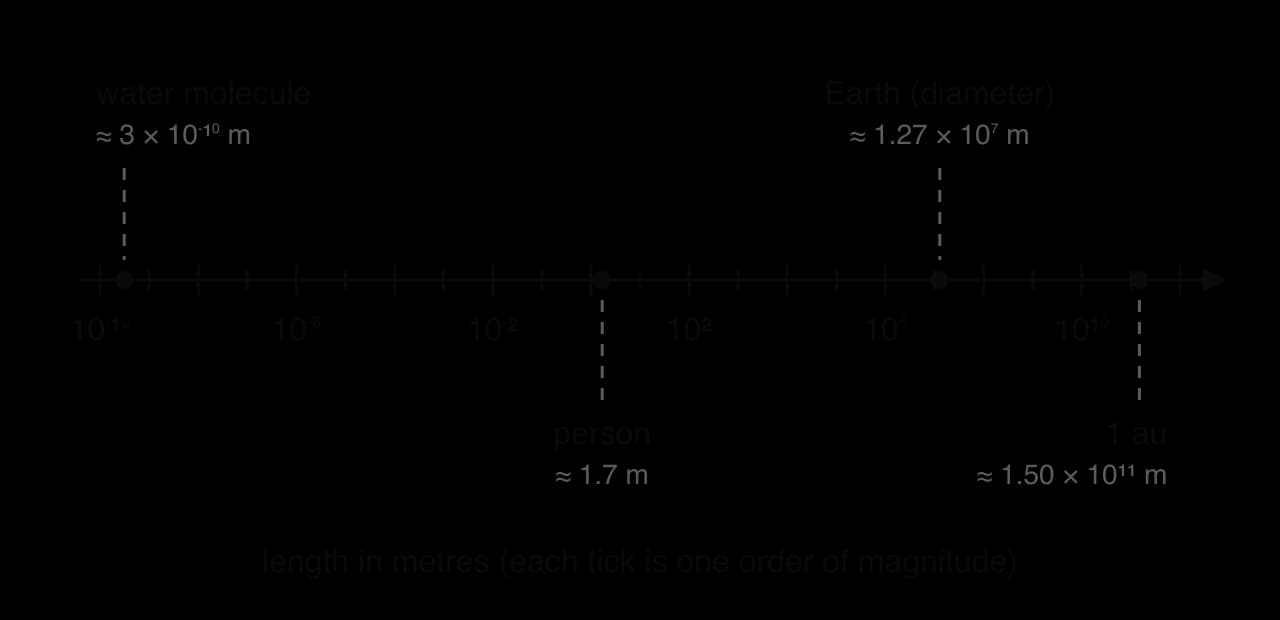
The scale of lengths places four real objects on a line where each step is one order of magnitude, so equal distances along the line represent equal ratios. On an ordinary linear scale reaching 1.5×10¹¹ m, the molecule, the person and even the Earth would all be squeezed into the first ten-thousandth of the line.
On a powers-of-ten scale, a water molecule, a person, the Earth and the Earth–Sun distance all fit on one line; about 21 orders of magnitude separate the smallest from the largest. Earth's mean radius 6371 km; 1 au as defined by the IAU, 2012.
The order-of-magnitude difference between two quantities is found by dividing them and reading the exponent of the result. The Earth–Sun distance divided by the Earth's diameter is
1.274×1071.496×1011=1.17×10⁴
so the Earth–Sun distance is about four orders of magnitude larger: more than eleven thousand Earths would fit side by side between the Earth and the Sun. Comparing quantities that differ by many orders of magnitude on a graph needs a logarithmic scale, introduced in subtopic 1.5.
Naming very large numbers
Some very large numbers have their own names. The best-known are two invented for fun, which are still used to give a feeling for size.
A googol is far larger than any count of physical objects in daily life, but in standard form it is simply 1×10100. The googolplex is far larger again, too large to be written out in full.
A googolplex in ordinary form would need a googol of zeros, more digits than could ever be written down, yet its definition in powers of ten fits on one line. Writing numbers with powers of ten keeps the size of a number in its exponent, which stays short even when the number itself is enormous.
YouTube
Numberphile, “Googol and Googolplex”: how large these two numbers really are, and why a googolplex cannot be written out in full.
Case study: world GDP per person
Gross domestic product (GDP) measures the total value of goods and services an economy produces in a year. The World Bank publishes world GDP and world population every year, and both are numbers far too large to handle comfortably in ordinary form.
Quantity (2024)
Ordinary number
Standard form (3 s.f.)
World GDP (current US$)
111,669,432,109,121
1.12×10¹⁴
World population
8,140,897,523
8.14×10⁹
Source: World Bank, World Development Indicators (NY.GDP.MKTP.CD and SP.POP.TOTL), retrieved 2026.
GDP per person is GDP divided by population. By hand, the mantissas and the powers of ten can be divided separately, which gives a quick estimate:
World GDP per person in 2024 was about US$13,700. The estimate from the rounded values, $13,760, differs in the third significant figure, because each input had been rounded to 3 significant figures before dividing. Keeping the full values until the last step avoids this loss of accuracy.
The figure needs careful interpretation. It is an average over the whole world, so it hides enormous differences between countries and within them: a country with GDP per person ten times the world average is one order of magnitude above it. It is also measured in US dollars at market exchange rates, which do not account for prices being much lower in some countries than in others, so it describes living standards only roughly.
Exam focus
Standard form usually appears as one part of a longer question, very often the last part of a calculation ("give your answer in the form a×10k, where 1≤a<10 and k∈Z"), for 1–3 marks on Paper 1 or Paper 2. It is combined with areas and volumes (subtopic 3.1), unit conversions, pH and other logarithmic formulas (subtopic 1.5), and time, speed and distance. The command terms are write down (no working needed: a direct conversion), calculate and find (show the calculation entered). Nothing on standard form is in the formula booklet: the form a×10k with 1≤a<10, the rules 10m×10n=10m+n and 10m÷10n=10m−n, and the area and volume conversion factors must all be known.
Write the unrounded answer before converting it to standard form.
Give the mantissa to 3 significant figures unless told otherwise.
Convert all lengths to the same unit before multiplying, and convert areas and volumes with the squared or cubed factor.
Never leave calculator notation in an answer.
Most marks lost on these parts come from unit conversions: multiplying by 100 instead of 106 to change m3 to cm3, or forgetting to change cm² to m² before using a price per square metre.
Practice questions
Write 0.000 073 6 in the form a×10k, where 1≤a<10 and k∈Z. [1]
Write down7.05×106 as an ordinary number. [1]
Explain why 24.5×10⁶ is not in standard form, and write it correctly. [2]
Calculate(5.2×108)×(3.0×10−3), giving your answer in standard form. [2]
Calculate1.6×1094.8×105, giving your answer in standard form. [2]
Calculate6.4×107+3.9×10⁶, giving your answer in standard form. [2]
A GDC displays the answer 3.0471E-6. Write down this number in standard form correct to 3 significant figures. [1]
A storage drive holds 2×1012 bytes. Each photograph uses 3.5×106 bytes. Find the greatest number of photographs the drive can hold. [3]
A year of 365.25 days is used to define the light-year. Taking the speed of light as 3.00×10⁸ m s−1, calculate the distance light travels in this year, in metres, in standard form. [3]
A rectangular solar panel measures 1.7 m by 1.1 m. Find its area in cm2, in the form a×10k, where 1≤a<10
Answers
7.36×10⁻⁵
7,050,000
The mantissa 24.5 is not between 1 and 10. 24.5×106=2.45×101×106=2.45×10⁷.
(5.2×3.0)×108−3=15.6×105=1.56×10⁶
1.64.8×105−9=3×10⁻⁴
6.4×10⁷+0.39×107=6.79×10⁷
3.05×10⁻⁶
3.5×1062×1012=571428.57…; a part-photograph cannot be stored, so round
Seconds in the year: 365.25×24×60×60=31557600=3.15576×10⁷. Distance
1.7×1.1=1.87 m2; 1.87×104 cm2
Summary
The number sets nest: N⊂Z⊂Q⊂R; irrational numbers are the real numbers that are not rational.
Standard form is a×10k with 1≤a<10 and k∈Z; numbers below 1 have a negative exponent.
To multiply or divide, combine the mantissas and add or subtract the exponents, using 10m×10n=10m+n and 10m÷10n=10m−n
To add or subtract, first rewrite the numbers with the same power of ten (or convert to ordinary numbers).
In standard form, the significant figures are the digits of the mantissa; give 3 significant figures unless told otherwise.
Calculator notation (2.88E4) is never a written answer; write 2.88×10⁴.
Area conversions use the length factor squared (1 m2=104 cm2) and volume conversions the length factor cubed (1 m3=106 cm3
The order of magnitude is the power of ten; two quantities differ by n orders of magnitude when their ratio is about 10n.
Self-check
To do:
I can say which of N, Z, Q and R a number belongs to, and recognise an irrational number.
To do:
I can write a large number such as 52,600,000 in standard form.
To do:
I can write a small number such as 0.000 408 in standard form with the correct negative exponent.
To do:
I can rewrite numbers such as 36.5×10⁻⁴ or 0.82×10⁹ so the mantissa is between 1 and 10.
To do:
I can convert numbers written with "million", "billion" or SI prefixes into standard form.
To do:
I can convert a number in standard form back to an ordinary number.
To do:
I can multiply and divide numbers in standard form by hand.
To do:
I can add and subtract numbers in standard form by matching the powers of ten.
To do:
I can enter standard form on my GDC with the power-of-ten key.
To do:
I can rewrite calculator notation as a×10k with a 3 significant figure mantissa.
To do:
I can convert units of length, area and volume using powers of ten.
To do:
I can find how many orders of magnitude apart two quantities are.
To do:
I can write the unrounded answer before converting it to standard form.
and
k∈Z
.
[2]2 marks
Markscheme (a)
1.496×10⁸ (km) A1A1
Note: Award one mark for 1.496 and one mark for 108. Award no marks for answers in calculator notation such as 1.496E8, or for a non-standard form such as 14.96×10⁷.
[2 marks]
(b)
Write down the speed of light correct to three significant figures, in the form a×10k, where 1≤a<10 and k∈Z.
[2]2 marks
Markscheme (b)
3.00×10⁵ (km s⁻¹) A1A1
Note: Award one mark for 3.00 and one mark for 105. Accept 3×10⁵
(c)
Calculate the time, in minutes, that light takes to travel from the Sun to the Earth.
[2]2 marks
Markscheme (c)
299792149600000(=499.012… s)(M1)
8.32 (minutes) (8.31687…)A1
Note: Accept 8.31 from use of 3.00×10⁵. Award the method mark only for an answer of 499 seconds not converted to minutes.
[2 marks]
Question 2 · AI-001325 marks
A particular influenza virus particle has a diameter of 0.000 000 12 metres.
(a)
Write down the diameter of the virus particle in the form a×10k, where 1≤a<10 and k∈Z.
[2]2 marks
(b)
Mateo imagines placing these virus particles in a straight line, touching each other, across a fingernail of width 2.5 cm.
Calculate the number of virus particles needed. Give your answer in the form a×10k, where 1≤a<10 and k∈Z
 YouTube

 YouTube