1.3 Geometric sequences and series · IB Maths AI | Augment Education
1.3 Geometric sequences and series
Recognise geometric sequences, find the common ratio, any term and the sum of the first n terms, use sigma notation, and model growth, decay, salaries, disease and bouncing balls with technology.
IB Mathematics: Applications and Interpretation
Part of 1 Number and algebra
SL and HL
Key terms introduced here
Each is in the Maths AI glossary, with every other term in the subject.
The number between 0 and 1 by which a quantity is multiplied in each time period when it decreases by a fixed percentage; for a decrease of p% it equals 1−100p.
The number greater than 1 by which a quantity is multiplied in each time period when it increases by a fixed percentage; for an increase of p% it equals 1+100p.
The change in a quantity expressed as a percentage of its original value, original valuenew value−original value×100%, positive for an increase and negative for a decrease.
.
Find the first term and the common ratio from two given terms.
Determine the least value of n for which a term or a sum passes a given value, using a GDC table, solver or graph.
Calculate the sum of the first n terms of a geometric sequence, by formula and with technology.
Use sigma notation to write and evaluate the sum of a geometric series.
Interpret half-life and doubling time as geometric sequences with ratio 21 or 2.
Compare arithmetic and geometric models of the same situation and justify which one fits.
Apply geometric sequences and series to salaries, population growth, the spread of disease and bouncing balls, and comment on the limitations of each model.
Introduction
A geometric sequence is a list of numbers in which each term is the previous one multiplied by the same number. Wherever a quantity changes by a fixed percentage rather than a fixed amount, a geometric sequence appears: a salary that rises by 3% every year, a town that grows by 2% a year, a drug that loses half its concentration every six hours, a ball that rebounds to 55% of its previous height. Adding up the terms gives a geometric series, which answers questions such as "how much will be earned in total over fifteen years?" or "how far has the ball travelled?".
Repeated multiplication grows (or shrinks) far faster than repeated addition, so geometric models describe compound interest, epidemics and computing power, and explain why doubling a grain of wheat on each square of a chessboard produces more wheat than the world grows in a thousand years.
YouTube
Revision Village, “Geometric Sequences & Series [IB Math AI SL/HL]”: watch how the common ratio is found from two terms and how the GDC handles the n th term and the sum.
Geometric sequences and the common ratio
A sequence is an ordered list of numbers, and each number in it is a term. In subtopic 1.2, Arithmetic sequences and series, each term was found by adding a fixed number to the term before. A geometric sequence instead multiplies by a fixed number at every step.
Sequence
How each term is made
Type
3, 7, 11, 15, 19, …
add 4
arithmetic
3, 6, 12, 24, 48, …
multiply by 2
geometric
160, 80, 40, 20, 10, …
multiply by 21
geometric
2, −6, 18, −54, 162, …
multiply by −3
geometric
1, 4, 9, 16, 25, …
neither (square numbers)
neither
The fixed multiplier has its own name and symbol. Because every term is the previous term times r, dividing any term by the term before it gives r back.
r=u1u2=u2u3=u3u4=⋯=unun+1
The order of the division matters: the later term goes on top. Dividing the earlier term by the later one gives r1 instead of r, the ratio of the sequence read backwards.
Testing whether a sequence is geometric
A sequence is geometric only if every ratio of consecutive terms is the same. Checking the first two terms is not enough, since many sequences share the same first ratio and then behave differently. The test therefore has three steps.
Divide each term by the term before it: u1u2,u2u3,u3u4,…
If all the ratios are equal, the sequence is geometric and that value is r.
If the ratios differ, the sequence is not geometric (it may still be arithmetic, which is tested with differences instead).
How the value of r shapes the sequence
The size and sign of r decide how the terms behave. With a positive first term, a ratio greater than 1 makes the terms grow, and a ratio between 0 and 1 makes them shrink towards zero without ever reaching it. A negative ratio makes the terms alternate between positive and negative.
Value of r
Behaviour of the terms (with u1>0)
Example
r>1
increase, faster and faster
4, 6, 9, 13.5, … (r=1.5)
r=1
stay constant
7, 7, 7, 7, …
0<r<1
decrease towards 0
81, 27, 9, 3, … (r=31)
−1<r<0
alternate in sign, shrinking towards 0
16, −8, 4, −2, … (r=−0.5)
r<−1
alternate in sign, growing in size
1, −3, 9, −27, … (r=−3)
Two values are excluded. If r=0, every term after the first is zero and the idea of a ratio breaks down, since the next ratio would need division by zero. A first term of zero is excluded for the same reason. The case r=1 is allowed but rarely interesting: the sequence is constant, and it is the one geometric sequence that is also arithmetic (with common difference 0).
Percentage change, growth factors and decay factors
Most geometric sequences in applications come from a quantity that changes by the same percentage each time period. A rise of 4% means the new value is 100% + 4% = 104% of the old value, which is the old value multiplied by 1.04. Repeating the same percentage change multiplies by the same number every time, so the values form a geometric sequence.
A fixed percentage increase turns into a common ratio greater than 1, called a growth factor.
A fixed percentage decrease leaves less than 100% of the value, so the ratio lies between 0 and 1.
r=1+100p(increase of p%)r=1−100p(decrease of p%)
Both rules follow directly from the meaning of a percentage. The growth and decay factors are the common ratios that appear in exponential growth and exponential decay in subtopic 2.5, Modelling with functions: a geometric sequence is the step-by-step, whole-number version of an exponential model.
Change per period
Common ratio r
Type
increase of 3%
1.03
growth factor
increase of 1.2%
1.012
growth factor
increase of 100% (doubling)
2
growth factor
decrease of 7%
0.93
decay factor
decrease of 50% (halving)
0.5
decay factor
decrease of 0.4%
0.996
decay factor
The nth term of a geometric sequence
Finding the 30th term by multiplying by r twenty-nine times is slow. A formula for the general term follows from writing out how each term is built from the first.
The power of r is always one less than the term number. The first term has had no multiplications, the second term one, the third term two, and so on, so the nth term has had n−1 multiplications by r. The same counting gave un=u1+(n−1)d for arithmetic sequences: there, n−1 additions of d; here, n−1 multiplications by r.
un=u1rn−1
Graphs of geometric sequences
Plotting the terms un against n shows the shape of a geometric sequence. Because n only takes whole-number values, the graph is a set of separate points, not a continuous curve. For an arithmetic sequence the points lie on a straight line; for a geometric sequence with r>1 they lie on a curve that bends upwards ever more steeply, the shape of an exponential function.
The graph of two salary offers compares an arithmetic and a geometric sequence directly. Offer A starts at $45,000 and rises by a fixed $2,000 each year; offer B starts lower, at $42,000, but rises by 5% each year.
A: u_n = 45 000 + 2000(n − 1)
B: u_n = 42 000 × 1.05ⁿ⁻¹
The arithmetic offer's points lie on a straight line; the geometric offer's points lie on an upward-bending curve that overtakes the line in year 8.
The arithmetic offer adds the same $2,000 every year, so its points rise in equal steps. The geometric offer adds 5% of an ever larger salary, so its steps grow: about $2,100 in the first year and over $5,000 by the twentieth. However large the head start of an arithmetic sequence, a geometric sequence with r>1 and positive terms always overtakes it eventually.
Finding the first term and the common ratio from two terms
Many problems give two terms that are not next to each other and ask for u1 and r. Writing each term in the form u1rn−1 gives two equations. Dividing one by the other cancels u1 and leaves a power of r, whose exponent is the gap between the two term numbers.
ukum=u1rk−1u1rm−1=rm−k
The value of r then comes from taking the appropriate root, and u1 from substituting back into either equation.
When the gap between the term numbers is even, the power of r is even, and the equation has two real solutions, one positive and one negative. Both give a valid geometric sequence unless the context rules one out.
Counting from zero or from one
In applications, the first term often belongs to "year 0" (the starting value, before any change) rather than "year 1". The formula un=u1rn−1 assumes the first term is u1. If the starting value is called u0 instead, the value after n changes is
un=u0rn
because n changes have happened by then. Both forms describe the same sequence; they only label the terms differently. What matters is to decide, before any calculation, which year (or bounce, or day) each term number refers to, and to write it down.
Finding when a sequence passes a given value
Many problems ask for the first term that is greater (or less) than some value: the first year a population exceeds 25,000, the first day a dose falls below 0.1 mg, the number of bounces above 10 cm. The unknown is now n, which sits in the exponent of u1rn−1. There are three standard technology methods, and all three should end with an integer answer that makes sense in the context.
Using a table of values
Enter the general term as a function on the GDC, for example Y1=900×0.8(X−1), and open the table, starting at X=1 with step 1. Scroll to the place where the values cross the given value, and read off the two terms either side. These two values are the bracketing pair, and writing both of them down shows the crossing has been located. On a TI-84 Plus CE the table is 2ndGRAPH (TABLE) after entering the function in Y=; on a Casio fx-CG50 it is MENU → Table.
Using the equation solver
Enter the equation u1rn−1=k in the GDC's numerical solver (TI-84 Plus CE: MATH → Numeric Solver; Casio fx-CG50: MENU → Equation → SOLVER) and solve for n. The solver returns a decimal, which is then rounded up to the next integer. The equation that was solved, the decimal value and the integer answer are all written down, so that the method can be followed.
Using a graph and an intersection
Graph y=u1rx−1 and the horizontal line y=k, and find their intersection. The x-coordinate of the intersection is the same decimal the solver gives. A labelled sketch of the curve, the line and the intersection records the method on paper.
y = 900 × 0.8ˣ⁻¹
The terms of 900, 720, 576, … fall below the line y = 50 between n = 13 and n = 14; the curve crosses it at n ≈ 13.95, so the first term below 50 is the 14th.
The graph of the sequence 900, 720, 576, … shows all three methods at once. The table gives the bracketing pair u13≈61.8 and u14≈49.5; the solver and the intersection give n≈13.95. All three methods identify the 14th term as the first below 50.
Half-life and doubling time
Two special ratios appear so often that their time periods have names. When a quantity halves in each period, its values form a geometric sequence with r=21; when it doubles, r=2.
The fraction of a quantity left after n half-lives is therefore a geometric sequence with first term 1 and ratio 21.
fraction remaining after n half-lives=(21)n
Carbon-14 and radiocarbon dating
Living organisms take in carbon, including a small, steady proportion of the radioactive isotope carbon-14. After death no new carbon is absorbed, and the carbon-14 already present decays with a half-life of about 5700 years. Measuring the fraction that remains therefore gives the time since death.
Half-lives passed, n
0
1
2
3
4
5
6
Years since death
0
5,700
11,400
17,100
22,800
28,500
34,200
Fraction of carbon-14 left
1
0.5
0.25
0.125
0.0625
0.03125
0.015625
Source of half-life: 5700 ± 30 years, NUBASE2020 evaluation (Kondev et al., 2021), via Wikipedia "Carbon-14", 2026.
The fractions in the carbon-14 table fall quickly at first and then ever more slowly in absolute terms, although each step removes the same proportion. After six half-lives (about 34,000 years) less than 2% remains, which is why radiocarbon dating becomes unreliable for material older than about 50,000 years: there is too little carbon-14 left to measure accurately.
fraction = 0.5ⁿ
Each half-life of carbon-14 (5700 years) halves the fraction left, so the points form a geometric sequence with ratio 0.5. Half-life: NUBASE2020.
The graph of the fraction of carbon-14 remaining joins the sequence points with a smooth curve because decay goes on continuously between the whole numbers of half-lives. The points themselves are the geometric sequence; the curve is the exponential model of subtopic 2.5.
When the fraction left is not an exact power of 21, the number of half-lives is found with the GDC solver. For example, if 20% remains, solving 0.5n=0.2 gives n=2.32 half-lives, about 2.32×5700≈13200 years. Here n is not a whole number, because decay is continuous; the calculation treats the sequence as an exponential function, as subtopic 2.5 does.
Doubling time
Growth by a constant factor has a matching idea: the time for the quantity to double.
Moore's law is a well-known example. In 1975 the engineer Gordon Moore revised his forecast for the number of transistors on a computer chip to a doubling every two years, and the industry followed close to that pace for decades. Taking the two-year period as one step, transistor counts form a geometric sequence with r=2, and the count after n doublings is u0×2n. After 20 years (ten doublings) the count is 210=1024 times larger, and after 40 years (twenty doublings) 220≈1.05 million times larger. Choosing the doubling time as the step is what makes the ratio a simple 2.
Source: Wikipedia "Moore's law", 2026.
Geometric series: the sum of the first n terms
A series is the sum of the terms of a sequence, and the sum of the first n terms is the partial sum Sn. When the terms come from a geometric sequence, the sum is a geometric series.
Deriving the formula
The arithmetic series formula came from pairing terms. For a geometric series a different trick works: multiply the whole sum by r, then subtract. Almost every term cancels, because multiplying by r shifts each term one place along.
Every term from u1r to u1rn−1 appears in both lines and disappears in the subtraction, leaving only the last term of rSn and the first term of Sn. Dividing by r−1 is allowed only when r=1, which is why the formula carries that condition.
YouTube
Eddie Woo, “Deriving Formula for Sum of a Geometric Progression”: follow how multiplying the series by r and subtracting makes almost every term cancel.
Multiplying the top and bottom of the fraction by −1 gives an equivalent form. Both are in the formula booklet.
Sn=r−1u1(rn−1)=1−ru1(1−rn),r=1
The two forms always give the same answer. The first is tidier when r>1 (numerator and denominator are both positive) and the second when 0<r<1, but either can be used for any r=1. If r=1 every term equals u1, and the sum is simply Sn=nu1.
Eddie Woo's derivation in the video follows exactly these steps, with a concrete series written out before the general one.
With a ratio between 0 and 1 the picture reverses. Each new term is smaller than the last, so the sum still increases but by less and less each time, and the later terms add almost nothing. The second form of the formula keeps the numerator and the denominator positive in this case.
The wheat and the chessboard
A legend about the invention of chess, first recorded in 1256 by the historian Ibn Khallikan, tells of an inventor who asked to be paid in wheat: one grain on the first square of the chessboard, two on the second, four on the third, doubling on each of the 64 squares. The ruler agreed, thinking it a modest request. The grains on the squares form a geometric sequence with u1=1 and r=2, and the total is a geometric series.
S64=2−11×(264−1)=264−1=18446744073709551615
That is about 1.84×10¹⁹ grains. The last square alone holds 263≈9.22×10¹⁸ grains, just over half the total, which is a feature of every series with r=2. Estimated at about 1.2×10¹² tonnes, this is over 1,400 times the world's annual wheat production.
Source: Wikipedia "Wheat and chessboard problem", 2026 (mass estimate and production comparison).
Finding n, u₁ or r from a sum
The sum formula connects four quantities: Sn, u1, r and n. Given three of them, the fourth can be found. When u1 is unknown, the equation is linear and can be rearranged by hand. When n is unknown, it sits in an exponent and the GDC is used, exactly as for a single term: a table of the sums, the solver, or a graph.
When the first term is the unknown, the equation is solved by rearranging. For example, if r=3 and the sum of the first six terms is 1456, then 3−1u1(36−1)=1456, so 364u1=1456 and u1=4.
Sigma notation for geometric series
Sigma notation, introduced in subtopic 1.2, writes a sum compactly by giving the general term and the first and last values of a counter. For a geometric series, the general term is u1rk−1 (or a rearranged equivalent).
Sn=k=1∑nu1rk−1=u1+u1r+u1r2+⋯+u1rn−1
To evaluate a sum written in sigma notation with the formula, identify three things from the notation: the first term (substitute the starting value of k), the common ratio (the base of the power of k), and the number of terms (last value − first value + 1).
Sum
First term
Ratio
Number of terms
Value
∑k=164×3k−1
4
3
6
1456
∑k=1840×0.5k−1
40
0.5
8
79.6875
∑k=3105×2k
5×23=40
∑k=042×10k
2
10
5
22,222
The third row shows why the starting value matters. The counter starts at k=3, so the first term is 5×23=40, not 5×21; and there are 10−3+1=8 terms. Then S8=2−140(28−1)=40×255=10200.
Sums with the GDC
The GDC evaluates a sigma sum directly, without needing u1, r or n to be identified first. On a TI-84 Plus CE, sum(seq( builds the list of terms and adds them: sum(seq(5*2^K, K, 3, 10)) gives 10,200 (both commands are in the 2ndSTAT (LIST) menu, under MATH and OPS). Many models, including the TI-84 Plus CE and the Casio fx-CG50, also have a Σ template in which the general term and the limits are typed as they are written.
Arithmetic or geometric: choosing and comparing models
Many applied problems place an arithmetic sequence and a geometric sequence side by side, or ask which model fits some data. The test is the same as for identifying a single sequence: constant differences point to an arithmetic sequence, constant ratios to a geometric one.
A geometric sequence with r>1 and positive terms eventually overtakes any increasing arithmetic sequence, because its steps keep growing while the arithmetic steps stay the same. Totals take longer to overtake than the terms themselves, since the arithmetic sequence's early lead has to be made up first.
Applications of geometric sequences and series
Geometric sequences model any situation in which a quantity is multiplied by the same factor at each step: growth and decay of populations, prices, salaries, infections, drug concentrations and bounce heights. Each application uses the same three tools (the common ratio, the nth term and the sum) and adds one more step: interpreting the result in context and judging whether a constant ratio is a reasonable assumption.
Salary increase and decrease
Pay that rises by a fixed percentage each year forms a geometric sequence with a growth factor greater than 1, as in the examples of the employee on $42,000 and of offer B. A salary can also fall by a fixed percentage, for example when commission-based earnings shrink as a market declines, or when a part-time contract is cut back each year; the ratio is then a decay factor such as 0.96 for a 4% decrease. The same formulas apply in both cases: un for the salary in a given year, Sn for total earnings. Compound interest on savings and the depreciation of an asset follow the same pattern, and subtopic 1.4, Financial applications of geometric sequences, treats them in full with the GDC's finance solver.
Population growth
A population that grows by the same percentage each year has values that form a geometric sequence, as in the town example (18,400 people, 2.5% a year). The model is useful for predictions a few years ahead, but its main assumption, a constant growth rate, rarely holds for long: birth rates, migration and the supply of housing, food and jobs all change. Predicting far beyond the data, a form of extrapolation, multiplies any error in r many times over, so long-range predictions from a geometric model should be treated with caution.
The spread of disease
In the early stage of an outbreak, before many people are immune and before any measures are taken, each infected person passes the infection on to roughly the same number of others. If every case leads, on average, to R new cases in the next "generation" of infection, the number of new cases in each generation forms a geometric sequence with common ratio R, and the total number of cases is a geometric series.
The disease example shows both the speed of geometric growth and the limits of the model. A ratio of 3 makes the totals grow very fast, which is why early action in an outbreak matters; but the same model, extended far enough, predicts more cases than there are people. Real geometric growth models all meet a limitation of this kind once the resource they depend on (susceptible people, space, food) starts to run out.
Bouncing balls
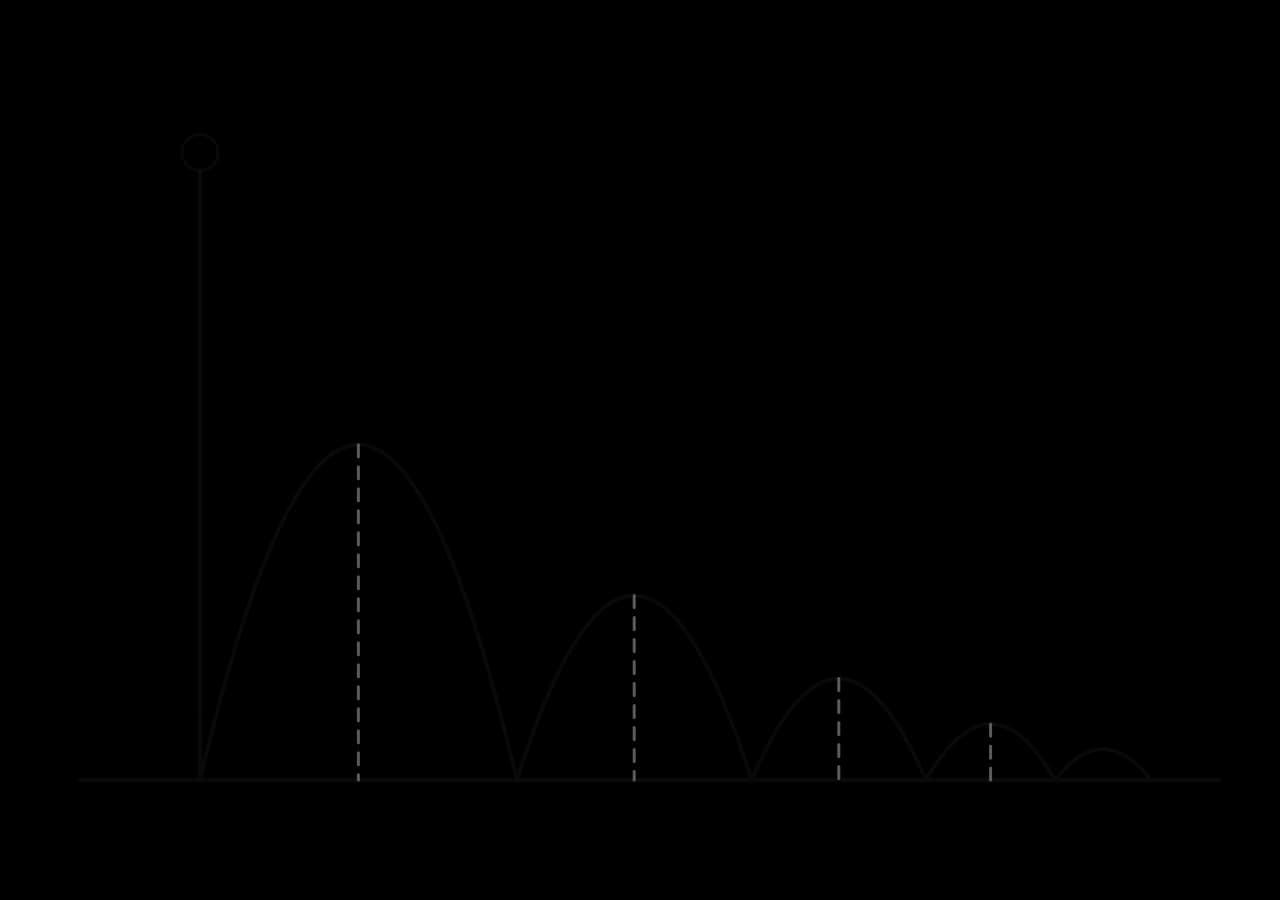
When a ball is dropped, each bounce reaches a fixed proportion of the height of the one before, so the maximum heights form a geometric sequence with a decay factor. Tennis balls are tested in exactly this way: a ball is dropped from 254 cm onto concrete, and it passes the test if it rebounds to between 135 cm and 147 cm. The rebound ratio of an acceptable ball is therefore between 254135≈0.53 and 254147≈0.58.
Source: International Tennis Federation test conditions, via Wikipedia "Tennis ball", 2026.
With a rebound ratio of 0.55, each maximum height is 55% of the one before. Every height after the drop is travelled twice, once up and once down.
The diagram of a tennis ball with rebound ratio 0.55 shows two features that decide most bouncing-ball problems. First, the height after the nth bounce is 254×0.55n, with n counting bounces, because the ball has been multiplied by 0.55 once for each bounce; this is the "counting from zero" form, with the drop height as u0. Second, the ball travels each rebound height twice (up, then down again), but the original drop only once.
Case study: UK consumer prices, 2021–2025
When prices rise by a percentage each year, the price level forms a sequence in which each value is the previous one multiplied by 1+100inflation. If the inflation rate stayed constant, the price levels would form a geometric sequence. Real inflation varies from year to year, which makes UK consumer prices a good test of how well a constant-ratio model describes real data.
Year
2021
2022
2023
2024
2025
Inflation during the year (%)
–
7.92
6.79
3.27
3.88
Ratio to previous year
–
1.0792
1.0679
1.0327
1.0388
Price level (2021 = 100)
100
107.92
115.25
119.02
123.63
Constant-ratio model (2021 = 100)
100
105.45
111.19
117.25
123.63
Source: World Bank, World Development Indicators, consumer price inflation for the United Kingdom (FP.CPI.TOTL.ZG), 2026. Price levels and model values calculated from these rates.
Each price level comes from multiplying the previous one by that year's ratio: 100×1.0792=107.92, then 107.92×1.0679=115.25, and so on. The ratios are not constant (they range from 1.033 to 1.079), so the price levels are not a geometric sequence. Over the four years, prices rose by a total factor of 100123.63=1.2363.
The constant ratio r that gives the same total change over four years satisfies r4=1.2363, so
r=1.236341=1.0545 (4 d.p.)
an average inflation rate of about 5.45% a year. The constant-ratio model Pn=100×1.0545n, with n years after 2021, reproduces the start and end values exactly by design.
model: P = 100 × 1.0545ⁿ
The actual UK price levels rise above the constant 5.45% model in 2022–2024, because inflation was high early in the period and lower later. Source: World Bank, 2026.
The graph of the price levels against the constant-ratio model shows where the model fails. In 2022 and 2023 actual prices were well above the model, by 2.47 and 4.06 index points, because inflation was much higher than average in those years; in 2024 and 2025 inflation was below average and the gap narrowed to 1.77 points and then to zero. A constant-ratio model gives the total change correctly but smooths out the shape of the period: a household whose wages rose by a steady 5.45% a year would have fallen behind prices in 2022, 2023 and 2024 and caught up only in 2025.
The case study also shows the limitation of using the average rate to predict. Extending the model to 2030 gives 100×1.05459≈161, but that assumes the average of four unusual years will continue, which the much lower ratios in 2024 and 2025 suggest it will not. Subtopic 1.4 uses inflation rates to find the real value of money.
Exam focus
Geometric sequences and series appear on Paper 1 as short questions of 4–7 marks and on Paper 2 as the opening parts of a longer question, often set alongside an arithmetic sequence in the same context (two savings plans, two job offers, a fixed versus a percentage increase). The command terms are write down (the common ratio, a term from a list: little or no working), find and calculate (a term, a sum, u1 and r from two terms: show the substitution), show that (a given height or term: work forwards and state the given value at the end), determine (the first year or the least n: one definite integer), and justify, comment or suggest (whether a model is appropriate: a reason linked to the context).
The question shapes that recur are:
r from consecutive terms or from a percentage change, then a later term;
u1 and r from two non-consecutive terms, for example slices or layers whose sizes are known only for two positions, so that r3 or r4 appears;
the least n for which a term or a sum passes a value, with the integer answer;
a sum written in sigma notation, evaluated and then interpreted;
a bouncing ball, with a term, a count of bounces above a height, and a total distance up and down;
a comparison of an arithmetic and a geometric model, ending with a comment on the model's limitations.
For the GDC working, write down u1 and r, then the equation or sum you entered (with the numbers substituted), then the decimal value from the solver or the bracketing pair from a table, then the final answer in context.
The last part of the bike-share question depends on a quick extra calculation: 12000×1.0620≈38486>37500, so the model breaks down in month 21. Comments that only say "the model is unrealistic" without a reason tied to the situation earn no marks.
Questions on "the number of times after the first bounce" or "the first year after 2019" test the labelling of terms as much as the formula. Before writing un, decide which term is u1 (or u0), and write the decision down in a short line such as "n=1 is 2020".
Practice questions
Write down the common ratio of the geometric sequence 81, 54, 36, … [1]
A quantity decreases by 4.5% each year. Write down the common ratio of the sequence of its yearly values. [1]
A geometric sequence has u1=6 and r=1.5. Findu9. [2]
The second term of a geometric sequence is 24 and the fifth term is 3. Find (a) the common ratio, (b) the first term, (c) the sum of the first 8 terms. [6]
Calculate∑k=1123×1.2k−1. [2]
A teacher's salary is £31,000 in her first year and rises by 2.8% each year. Find (a) her salary in year 6, (b) her total earnings over the first 10 years, (c) the first year in which her salary exceeds £40,000. [7]
A language school has 2,400 students in its first year. The number of students falls by 6% each year. Determine the first year in which the school has fewer than 1,500 students. [3]
For the geometric sequence 4, 12, 36, …, find the least value of n for which Sn>1000000. [3]
A ball is dropped from a height of 3.2 m. After each bounce it rises to 70% of its previous maximum height. (a) Find the number of bounces after which the maximum height is greater than 50 cm. (b) Find the total vertical distance travelled until the ball hits the ground for the 5th time. (c) Suggest one reason why the model is not realistic after many bounces. [6]
Plan A saves $200 in the first month and $50 more each month after that. Plan B saves $100 in the first month and 10% more each month after that. Find the first month in which plan B saves more than plan A in that month, and explain why plan B must eventually save more each month whatever the starting amounts. [5]
(a) 320×0.7n=50 gives n=5.20; the 5th bounce reaches 53.8 cm and the 6th 37.6 cm, so 5 bounces. (b) 320+2×1−0.7224(1−0.74)=1454.78…
Am=200+50(m−1), Bm=100×1.1m−1
Summary
A geometric sequence multiplies each term by the same non-zero common ratio r=unun+1; always divide a later term by an earlier one.
A percentage increase of p% gives a growth factor r=1+100p; a decrease gives a decay factor r=1−100p
The nth term is un=u1rn−1; with the starting value as u0
Two terms um and uk give rm−k=ukum
The least n for which a term or sum passes a value comes from a GDC table (write the bracketing pair), the solver or a graph, and is the integer above the decimal solution.
The sum of the first n terms is Sn=r−1u1(rn−1)=1−ru1(1−rn)
In sigma notation ∑k=ab, the first term comes from k=a and there are b−a+1
Half-life and doubling time are the periods of geometric sequences with r=21 and r=2.
Constant differences mean an arithmetic model, constant ratios a geometric one; geometric growth eventually overtakes arithmetic growth.
Every geometric model assumes a constant ratio; comments on its limitations must refer to the context.
Self-check
To do:
I can test whether a sequence is geometric by checking that all ratios of consecutive terms are equal.
To do:
I can find the common ratio by dividing a later term by the term before it.
To do:
I can convert a percentage increase or decrease into a growth or decay factor.
To do:
I can find any term with un=u1rn−1 and explain why the power is n−1.
To do:
I can find u1 and r from two non-consecutive terms, including both roots of an even power.
To do:
I can decide whether the starting value is u0 or u1 and label years or bounces correctly.
To do:
I can find the least n for which a term passes a value using a table, the solver or a graph, and give an integer answer.
To do:
I can write down the bracketing pair of terms when I use a GDC table.
To do:
I can use half-life and doubling time to find the amount remaining or the time taken.
To do:
I can derive the formula for Sn by multiplying by r and subtracting.
To do:
I can calculate Sn with either form of the formula and with the GDC.
To do:
I can find the number of terms, the first term and the value of a sum written in sigma notation.
To do:
I can compare an arithmetic and a geometric model, for single terms and for totals.
To do:
I can calculate the total vertical distance travelled by a bouncing ball, counting each rebound twice.
To do:
I can comment on the limitations of a geometric model with a reason linked to the context.
A1
(ii) 39000(1.05)n−1A1
[2 marks]
(b)
Find the first year in which the salary for Job B is greater than the salary for Job A.
[3]3 marks
Markscheme (b)
39000(1.05)n−1>42000+1800(n−1)OR table of values OR graphs with intersection marked (M1)
year 7: A = 52 800, B = 52 263.73; year 8: A = 54 600, B = 54 876.92 (A1)
year 8 A1
Note: Award (A1) for an intersection at n=7.68… seen. Do not award the final A1 for n=7.
[3 marks]
(c)
State one reason why Leilani might still choose Job A.
[1]1 mark
Markscheme (c)
Job A pays more for each of the first 7 years OR Job A has the greater total earnings over the first few years OR she may not stay for more than 7 years R1
Note: Accept any sensible reason that refers to the salaries.
[1 mark]
Question 2 · AI-00087HL only · 7 marks
The first term of a geometric sequence of complex numbers is u1=10 and the common ratio is r=0.3+0.4i.
(a)
Find u2 and u3, giving your answers in the form a+bi.
[2]2 marks
(b)
Show that ∣u1∣, ∣u2∣, ∣u3∣
(c)
Find the smallest value of n for which ∣un∣<0.01.
Marta buys a new electric car for 32 000 euros (EUR). The value of the car depreciates by 14% each year.
(a)
Find the value of the car after 5 years. Give your answer correct to the nearest euro.
[2]2 marks
(b)
Find the percentage of the original value that the car has lost after 5 years.
[2]2 marks
(c)
Marta plans to sell the car at the end of the first year in which its value is less than 10 000 EUR. Find the number of years after which she will sell the car.
. (The differences 4, 6, 8 are not constant either, so it is not arithmetic.)
,
12−24=−2
. The sequence is geometric with
r=−2
. A negative ratio makes the signs alternate.
, giving 6, 12, 24, 48, …
, giving −6, 12, −24, 48, …
. In a context where every term must be positive (a population, a price), only
r=2
would be accepted, and the reason should be stated.
. Both bracketing values must be shown.
, the solution is
n=13.41
, so
n=14
, which is again 2037.
2
8
10,200
.
A1
r−1u1(rn−1)
.
(M1)
A1
(M1)A1
people in total.
and
S8=13120
. The total first exceeds 10,000 by the end of the
8th generation
.
. Their sum is a geometric series with
u1=139.7
,
r=0.55
,
n=3
:
(A1)
(M1)
. (b)
u1=0.524=48
. (c)
S8=1−0.548(1−0.58)=95.625≈95.6
. (c)
31000×1.028n−1=40000
gives
n=10.23
;
u10=£39746.58
,
u11=£40859.48
, so
year 11
.
,
u9≈1463
, so
year 9
.
;
S11=354292
,
S12=1062880
, so
n=12
.
cm
≈14.5
m. (c) For example: the ball loses energy differently at small heights, air resistance and spin change the ratio, and the model predicts bounces of microscopic height that never happen.
. A table gives
A30=1650>B30=1586.31
and
A31=1700<B31=1744.94
, so
month 31
. Plan B's monthly increase is 10% of a growing amount, so it keeps getting larger and eventually exceeds the fixed $50 increase of plan A; once B's increases exceed $50 a month, B gains on A every month and must overtake it.
.
, the value after
n
steps is
u0rn
.
; an even power has two real roots,
±
, unless the context excludes one.
for
r=1
, and
Sn=nu1
when
r=1
.
terms; the GDC evaluates the sum directly.
are the first three terms of a geometric sequence with common ratio
 YouTube
 YouTube