4.4 Education
Education in Chinese-speaking places, from the double reduction policy in Shenzhen to Malaysia’s Chinese independent schools, Taiwan’s portfolios and Singapore’s PSLE: the debates, the words and how to write about school pressure.
- IB Mandarin B
- Part of 4 Social organization
- SL and HL
Notes on 4.4 Education
An education system decides more than what is taught. It decides how students are sorted, when, and by what, and families arrange their children’s weeks around that decision. In mainland China the sorting has long rested on test scores, and in July 2021 the government moved to cut the homework and private tutoring that the competition had produced.
A column in 《放学后》, the paper of a school media club in Shenzhen, looks back on that change from the final year of high school.
The summer the tutoring center closed
The column opens on a closed door. The tutoring center below the writer’s apartment has shut, with “一张通知” (paragraph 1: a notice) on the door, and her mother “看了很久” (looked at it for a long time) and said nothing at home. The writer does not say what her mother felt. The reader learns the reason only in the next sentence, with 后来我才知道 (only later did I learn).
The reason is the double reduction policy (“双减”政策), which the writer sums up in one line: schools must cut homework, and “周末和假期也不能再上学科补习班了” (paragraph 1: there can be no more subject tutoring classes on weekends and holidays). 学科 (school subject) matters here, because the rules targeted tutoring in subjects such as mathematics and English, not music or sport. The guidance from the general offices of the Party’s Central Committee and the State Council appeared on 24 July 2021.
Paragraph 2 shows what the policy changed in one family. The writer lists her old weekend as a timetable, mathematics on Saturday morning, English in the afternoon, calligraphy on Sunday, and then sets it against “两个完整的周末” (paragraph 2: two whole weekend days). She fills them with basketball and walks up Wutong Mountain with her father. The school’s after-school service (课后服务) now runs until half past five, and most homework is finished before she goes home.
后来我才note 1知道,那年七月,国家出台了note 2“双减”政策……
可是,妈妈并没有note 3放心。她说:“别人家的孩子都在偷偷补课note 4,我们不补,就会落后note 5。”
“双减”到底note 6减了什么?……可是压力并没有消失,只是晚来了几年note 7。
才. Only (later): the writer understood the closed door long after the event.
出台. To issue, introduce (a policy). The usual verb for a government policy that comes into force: 出台政策, 出台规定.
并没有. Not at all, contrary to what one might expect. 并 strengthens a negative that corrects an assumption: the reader might expect the mother to be relieved.
偷偷补课. To take extra lessons in secret. 偷偷 (secretly) means the tutoring continued out of sight.
落后. To fall behind, the fear that keeps the competition going.
到底. In a question, “really, after all”: the writer has asked herself this before and wants a true answer.
只是晚来了几年. It only arrived a few years later. 只是 narrows the claim: the pressure was delayed, not removed.
The third paragraph turns with 可是 (but) to what did not change. The mother’s words state the logic of the whole competition in two short clauses, “我们不补,就会落后” (paragraph 3: without tutoring, the child falls behind). In the second year of junior high she hires a teacher to come to the house twice a week “陪我写作业” (to keep me company while I do homework). The quotation marks show that the writer knows the phrase is a cover for tutoring. She adds that many classmates’ families did the same.
The column ends with a balanced judgment. The writer grants what the policy gave, “这是真的” (paragraph 4: this is true), three years of free weekends, before naming what it could not do. Her last paragraph states a condition, “只要升学还是只看一个分数,家长就很难真正放心” (paragraph 5: as long as moving up a level still depends only on one score, parents will find it hard to stop worrying). The structure 只要……就…… makes the parents’ worry a consequence of the system, not a fault of her mother.
Try it
Why does the writer say 我不怪妈妈,也不怪学校 (I don’t blame my mother, or the school) just before her final judgment?
It clears two easy targets out of the way. Her mother and the school each acted reasonably in their place; the cause she names next is the system of moving up by one score, 只要升学还是只看一个分数. Refusing to blame people makes the criticism of the system sound fair rather than angry.
An alternative built by a community
In some places the alternative to the state’s schools is not tutoring but a whole system run by a community. In Malaysia, Chinese-medium secondary schools that refused to become national schools in the early 1960s have run on their own ever since. An interview on 《星洲青年》, the youth page of a Chinese-language daily in Kuala Lumpur, asks a final-year student why she studies in one.
The interview opens with an editor’s note, 编者按, which gives readers the facts before the conversation. A Chinese independent school (独中) “不属于国家教育体系,没有政府拨款” (paragraph 1: does not belong to the national education system and receives no government funding). Its money comes “主要来自学费和华人社会的捐款” (mainly from fees and donations from the Chinese community). The note then gives the scale: about 75,000 students, close to one in five Chinese secondary students in the country.
Pei Xin’s first answer gives two reasons, one from her family and one from the school. Her father, himself a graduate, says “华文是我们的根” (paragraph 3: Chinese is our root). The school teaches most subjects in Chinese, but also Malay and English, so its students leave able to use three languages. Then comes her own doubt, introduced by the spoken 说实话 (to be honest): the fees are higher than at a national school, and she felt them as “一种负担” (a burden) on her family.
在独中,大部分科目用华文教,可是我们也要学马来文和英文,所以note 1毕业的时候三种语言都能用。
跟note 2我在新闻里看到的中国大陆高考比起来note 2,我们的压力好像没有那么集中note 3。学校除了note 4考试以外note 4,也很重视社团活动。
政府到现在还没有正式承认note 5统考……可是官员也说,这并不等于note 6承认统考。
所以. So: the three languages are the result of the school’s choice of what to teach.
跟……比起来. Compared with…: a comparison that names its reference point first. Here it is a student’s view from outside, through the news.
好像没有那么集中. Seems less concentrated. 好像 keeps the claim modest; 集中 (concentrated) suggests the pressure is spread over years, not gathered into one exam.
除了……以外,也……. Besides…, also…: tests are kept and clubs are added alongside them.
承认. To recognize officially (a qualification), as well as to admit. The whole debate about the UEC turns on this word.
并不等于. Is not at all the same as. 并 corrects an assumption the reader might make: a new pathway is not recognition.
The second answer explains the school’s own examination. The Unified Examination Certificate (统考, the UEC) began in 1975 and is run by Dong Zong (董总), the association of the schools’ boards. Pei Xin compares its pressure with the gaokao, which she knows only “在新闻里” (paragraph 5: from the news), and finds it less concentrated. Her school also values clubs: she plays in the Chinese orchestra, which performs in the community each year to raise money for the school.
The third answer states the debate in plain facts. The federal government has not recognized the UEC, so its holders cannot usually apply to most public universities or join the civil service. The state governments of Sarawak and Sabah recognize it, and many universities abroad accept it. Pei Xin reports both sides of the latest change accurately: a new route into public universities opened in May 2026, but officials said it “并不等于承认统考” (paragraph 7: is not the same as recognizing the UEC).
Two answers to the pressure of one score
The two texts describe two answers to one pressure. In Shenzhen the state removed one part of the competition, tutoring for profit, and the column judges that the pressure was only delayed. In Kuala Lumpur families built a separate system with its own examination and paid for it themselves. There the student finds the pressure “没有那么集中” (less concentrated), at the cost of fees and a certificate her own government does not recognize.
只要升学还是只看一个分数,家长就很难真正放心。
“双减”那年,我上初一, paragraph 5
The Shenzhen writer’s condition explains why the Kuala Lumpur school matters to its families. Both texts treat a school as more than a place to pass exams: for one writer it is the basketball team the free weekends allowed, for the other the orchestra and three languages. And both writers end by looking beyond themselves, one asking readers what the policy left them, the other naming “当年一起捐钱办学的那些人” (paragraph 9: the people who gave money together, years ago, to run the school).
The register of each text follows its form. The Shenzhen column is a student writing to students, so it is personal and reflective, uses 我 throughout and ends with a question to readers. The Kuala Lumpur interview has two voices: the editor’s note and the reporter’s questions are in neutral written Chinese, while Pei Xin answers in a spoken register, with 说实话, 不过 and 对 to agree. The interview also uses Malaysian terms, 华小 (Chinese-medium primary school), 国民中学 (national secondary school) and 砂拉越 (Sarawak), without explaining them, because its readers live with them.
Try it
In paragraph 9, Pei Xin says that her chances depend on 不只是我自己,还有…… (herself and also others). How does this sentence link education to community?
She credits the people who donated, years ago, to run the school. The sentence turns her education from a private achievement into something a community built and paid for, which is why her father hopes she will come back and 在华人社区里做点事 (do something in the Chinese community).
Ideas to discuss
The two model texts raise the questions people argue about when they discuss education in Chinese-speaking places. Did the double reduction policy relieve students or move the pressure elsewhere? Can a system that sorts students by one exam become less stressful without changing the exam? And who should decide which school, and which language, a child studies in?
The double reduction policy: relief or displacement?
The policy was aimed at a tutoring market that had grown huge, and by its own measures it worked. A review of the research in the journal ECNU Review of Education found that tutoring institutions in school subjects fell from about 124,000 to about 9,000. It also found that over 75 percent of urban schools offered after-school services, and that 97.3 percent of parents surveyed were satisfied. The same review reported significant falls in students’ depression and anxiety (Chen and Lin, July 2024). Homework was capped: none written in the first two grades, at most an hour a day later in primary school and an hour and a half in junior high.
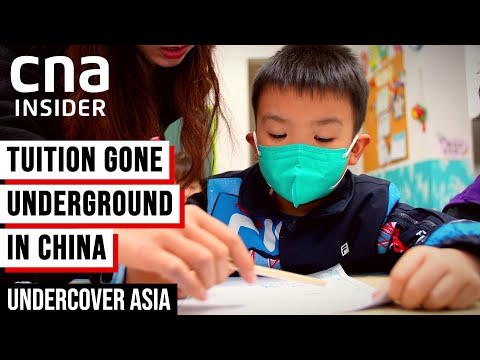
The review also records the costs. More than 90 percent of teachers reported longer working hours, since the after-school services fell to them. The review also notes gaps in resources between regions for the varied activities the policy promised. And some families, like the Shenzhen writer’s, turned to tutoring at home or in secret, which is more expensive and less visible. A documentary from CNA, a Singapore broadcaster, asks whether the ban has passed the stress test.
 YouTube
Supporters of the policy point to the figures and to weekends like the Shenzhen writer’s. Critics argue that it treated a symptom. As long as the gaokao and the exam at the end of junior high decide so much, families will pay for an advantage in one form or another. The column’s own verdict, “压力并没有消失,只是晚来了几年” (paragraph 4: the pressure has not disappeared, it has only come a few years later), is close to the critics’ view without rejecting the policy.
Can a one-score system become less stressful?
The gaokao is usually discussed as a single June exam, but its effect reaches back through every year of school. Teachers and families plan backwards from it, and a school that does not teach toward it risks its students’ results. Critics in China have long called this exam-oriented education (应试教育) and set it against 素质教育 (education for all-round quality), which official policy has promoted since the 1990s. The difficulty is that a single score is also seen as fair, because it is the same for everyone.
Other Chinese-speaking systems have tried to soften the sorting without abolishing tests, and the diagram sets four systems side by side by age. Since 2022, Taiwan’s universities have weighed an electronic learning portfolio of three years of high school work alongside the General Scholastic Ability Test, part of the curriculum reform that began in 2019. Critics worry that the portfolio simply becomes a second thing to coach. Singapore replaced the fine-grained scores of its primary school leaving exam with eight broad achievement levels in 2021, so that 29 possible totals replaced more than 200, to reduce competition over single marks.

The photograph shows a junior high classroom in Yunlin County, Taiwan, in 2013, before those reforms. On the board the students have written 我一定會成功 (I will certainly succeed) in traditional characters. A sentence like this is a common sight in Chinese-speaking classrooms in the months before an exam, and it can be read either as encouragement or as a sign of how much rides on one result.

Which school, and which language?
In Malaysia the choice of school is also a choice of language and community. Most Chinese Malaysian children go to Chinese-medium primary schools, and at secondary level families choose between national schools, which teach in Malay, and the independent schools, which teach mainly in Chinese and charge fees. In 2026 the education ministry told parliament that 75,144 Chinese students, 19.4 percent of all Chinese secondary students, were in schools that teach toward the UEC (Malay Mail, 16 July 2026). Supporters see the schools as a community’s right to educate in its own language; opponents, including some Malay groups, argue that recognizing the UEC would weaken a national system meant to unite the country’s communities.
The debate is about recognition as much as teaching. Without federal recognition, a UEC holder’s routes into public universities and the civil service are narrow, which is why Pei Xin plans to study in Taiwan. The interview reports the May 2026 change precisely, and a student writing on this subject should be as careful: a new pathway, officials said, is not recognition.
Weighing relief against fairness (HL)
At HL, a question such as whether reducing pressure should come before keeping selection fair is weighed rather than answered with one view. Written Chinese has the connectives: 不可否认 (it cannot be denied) grants a point, 但与此同时 (but at the same time) brings in the cost, 换言之 (in other words) restates the problem in sharper terms, and 因此 draws the conclusion. Together, the two texts give material for a paragraph such as this one.
不可否认note 1,“双减”让深圳那位学生在初中多了三年可以打篮球的周末;但与此同时note 2,补习并没有真正消失,而是搬进了家里,变得更贵、更难看见。换言之note 3,只要升学还是只看一个分数,减轻负担就很难只靠减少作业。吉隆坡的独中则note 4说明了另一种可能:考试仍然存在,但学校同样重视社团和语言。因此note 5,真正的问题不是要不要考试,而是一个分数能决定多少。
不可否认. It cannot be denied: a written-style concession that grants the policy its clearest result.
但与此同时. But at the same time: the cost of the same policy, from the same text.
换言之. In other words: it restates the Shenzhen writer’s condition as a general claim.
则. On the other hand, whereas: a written-style word that sets the second text against the first in the same sentence pattern.
因此 + 不是……而是……. The conclusion reframes the question from whether to test at all to how much one score decides.
The paragraph grants a result, names its cost, restates the problem and ends with a reframed question rather than a slogan. The same frame works for a question about tutoring, about school language policy or about entrance exams in another country.
Words and phrases
The words that matter most for education name the parts of a school system and the pressure inside it. 作业 (homework), 补习班 (tutoring class) and 课后服务 (after-school service) name a student’s week; 升学 (to move up to the next level of school) and 分数 (score) name what decides it; 压力 (pressure), 落后 (to fall behind) and 负担 (burden) name what families feel. The Kuala Lumpur interview adds the vocabulary of a school’s status, 拨款, 承认 and 文凭, which any discussion of qualifications needs.
Word or phrase | Meaning in context | Text and paragraph |
|---|---|---|
补习班 | a tutoring class (outside school) | Shenzhen column, 1 |
出台 | to issue, introduce (a policy) | Shenzhen column, 1 |
政策 | a policy | Shenzhen column, 1 |
学科 | a school subject | Shenzhen column, 1 |
完整 | whole, complete | Shenzhen column, 2 |
课后服务 | after-school service (supervised activities and homework at school) | Shenzhen column, 2 |
放心 | to be at ease, stop worrying | Shenzhen column, 3 |
偷偷 | secretly | Shenzhen column, 3 |
补课 | to take extra lessons | Shenzhen column, 3 |
落后 | to fall behind | Shenzhen column, 3 |
消失 | to disappear | Shenzhen column, 4 |
升学 | to move up to the next level of school | Shenzhen column, 5 |
分数 | a score, a mark | Shenzhen column, 5 |
教育体系 | an education system | KL interview, 1 |
拨款 | funding (from a government) | KL interview, 1 |
捐款 | a donation; to donate money | KL interview, 1 |
华小 | a Chinese-medium primary school (Malaysia) | KL interview, 2 |
国民中学 | a national secondary school (Malaysia) | KL interview, 2 |
根 | root (of identity) | KL interview, 3 |
学费 | school fees | KL interview, 3 |
负担 | a burden | KL interview, 3 |
统考 | the UEC, the independent schools’ examination | KL interview, 5 |
重视 | to value, attach importance to | KL interview, 5 |
社团活动 | club activities | KL interview, 5 |
筹款 | to raise money | KL interview, 5 |
承认 | to recognize officially | KL interview, 7 |
公务员 | a civil servant | KL interview, 7 |
等于 | to be the same as, equal | KL interview, 7 |
办学 | to run a school | KL interview, 9 |
Some of these words are easy to confuse. 补课 is to take extra lessons; 补习班 is the class or the business that offers them. 升学 is moving up a stage, while 毕业 is finishing one. 承认 means both to admit a fault and to recognize a qualification officially, so 政府承认统考 is about status, not guilt.
Say it yourself
These frames help you describe your school week, compare systems, explain a cause and argue about a policy. They move from simple description to concession, condition and proposal.
Frame | What it does |
|---|---|
我每天/每个周末要……,…… | Describes a routine of study |
以前……,……以后,…… | Contrasts life before and after a change |
跟……比起来,……没有那么…… | Compares two systems or schools |
……不但……,而且…… | Adds a second effect to the first |
……并没有……,只是…… | Corrects an assumption and narrows a claim |
……到底……了什么? | Asks a real question about a result |
虽然……,但是…… | Concedes, then disagrees |
只要……还……,……就很难…… | Names the condition that keeps a problem alive |
与其……,不如…… | Prefers one policy to another |
真正的问题不是……,而是…… | Reframes a debate |
A short paragraph that uses several of them, for a school magazine:
以前note 1我每个周末都要上三个补习班,上了高中以后note 1,学校要求我们每周参加一次社团活动。跟note 2初中比起来note 2,我的压力没有那么note 2大了,但是note 3考试并没有note 3减少,只是note 3换了一种形式。只要note 4大学还note 4只看考试成绩,学生就很难note 4真正轻松。
以前……以后. The change over time that the paragraph is about.
跟……比起来……没有那么. A comparison with a clear reference point, as in the Kuala Lumpur interview.
但是……并没有……只是. Corrects the assumption that the pressure is gone and narrows the claim, as the Shenzhen column does.
只要……还……就很难. The condition that explains why the problem continues: the writer’s own judgment.
Improving a paragraph
A weak paragraph on school pressure complains and stops. The stronger version names a place and a policy, grants what it achieved and explains what it could not change.
学生的压力太大了。作业太多,考试太多。学校应该减少作业。我很累。note 1
2021年,中国大陆出台了“双减”政策,减少了义务教育阶段学生的作业和校外补习。note 2虽然很多学生因此多了周末的时间,但是只要升学还是只看一个分数,家长的担心就不会真正消失。note 3因此,我认为与其只减少作业,不如让大学录取也看学生的社团活动和平时的表现。note 4
Weak. Short complaints with 太 and a feeling (我很累). Nothing tells a reader where, when or why.
Facts first. A date, a place and the policy’s two aims in one sentence.
Concession and condition. 虽然……但是 grants the result; 只要……就 explains why the worry remains.
A proposal. 因此 and 与其……不如 offer a change a reader can judge, close to what Taiwan did with its learning portfolio.
Applying it in Paper 1 and the oral
A Paper 1 task on education gives you a situation, a purpose and an audience. You might be asked to write to your principal about the amount of homework. Other tasks ask for an article for the school magazine on whether tutoring should be limited, or the write-up of an interview with a student from another school system. The formal letter needs 您, a stated purpose and a polite request; the article argues with a concession and a view; the interview needs an introduction and labeled turns, as the Kuala Lumpur page shows.
The commonest way to lose marks with education is to write a general complaint about pressure that could describe any school anywhere. The two model texts work because each has a year, a place and a policy, and each grants something to the other side. An article that names one real policy and judges it fairly reads as developed, and it suits the readers of a school magazine, who live the same week.
Try it
A student’s interview write-up is just a list: 问:你几岁?答:十七岁。问:你喜欢学校吗?答:喜欢。 What is missing, judging by the Kuala Lumpur interview?
It has no editor’s note to say who is interviewed and why, and the questions do not build on the answers. The Kuala Lumpur interview opens with 编者按 giving facts and scale, and each question follows from the last answer (fees lead to pressure, pressure to recognition, recognition to plans). The answers are also developed, with reasons and examples, in the interviewee’s own voice.
The pages on the formal letter, the article and the interview take these conventions further, and the grammar page on linking pairs practices 虽然……但是…… and 只要……就……. Rites of passage reads the gaokao as a coming of age, and The working world follows students into jobs. The page on the conversation in the individual oral shows how to talk about one’s own school without a script.
Self-check
- To do:
I can describe a school week and a school system with 作业, 补习班, 课后服务, 升学 and 分数.
- To do:
I can explain what the double reduction policy changed and what it did not, with figures.
- To do:
I can compare the Shenzhen column and the Kuala Lumpur interview in content and register.
- To do:
I can explain how Taiwan, Singapore and Malaysia’s independent schools sort students differently from the gaokao.
- To do:
I can correct an assumption with 并没有……只是…… and name a condition with 只要……就…….
- To do:
I can weigh relief against fairness with 不可否认, 换言之 and 因此 (HL).
- To do:
I can plan a formal letter, an article or an interview about school for Paper 1.
Key terms
Each is also in the Social organization glossary for IB Mandarin B, beside the other terms of its topic.
- after-school service
Supervised activities, clubs and homework time that mainland primary and junior high schools offer at the end of the school day. Its expansion under the double reduction policy was meant to replace private tutoring and to help working parents.
- Chinese independent school
A privately funded secondary school in Malaysia that teaches mainly in Chinese, outside the national education system and without government funding. Supported by fees and community donations, these schools are a central institution of Chinese Malaysian communities.
- double reduction policy
The mainland policy of July 2021 that reduces homework and off-campus tutoring for students in compulsory education, the first nine years of school. It limits written homework by grade, stops subject tutoring on weekends and holidays, and asks schools to provide after-school services.
- exam-oriented education
A usually critical description of schooling organized mainly around preparing students for high-stakes examinations, so that what is tested crowds out what is not. In Chinese debates it is set against education for all-round quality (素质教育).
- Unified Examination Certificate
The examination taken by students of Malaysia's Chinese independent schools, set since 1975 by the schools' own association. Whether the federal government should recognize it for public universities and the civil service is a long-running political debate.
More in 4 Social organization
The whole topic is on its own page.
- 4.1Social relationships
- 4.2Community
- 4.3Social engagement
- 4.4EducationThis page
- 4.5The working world
- 4.6Law and order
Carry on with 4.4 Education in Augment
With a free account, Augment remembers where you stopped in the notes and which questions you have marked.