4.1 Social relationships
How relationships are changing in Chinese-speaking places, from a cousin questioned at a Chengdu birthday dinner to a Xi’an column on bride price: marriage, pressure to marry, activity partners and the law.
- IB Mandarin B
- Part of 4 Social organization
- SL and HL
Notes on 4.1 Social relationships
In Chinese-speaking places the question of whom to marry, and when, has long been a family matter as well as a personal one. Today many young adults marry later or not at all, while parents and relatives still expect a wedding, and the gap often shows at family meals. A student column from a Chengdu school magazine describes one such meal, a grandmother’s eightieth birthday.
A birthday dinner in Chengdu
The column opens with a scene its readers know well: more than twenty relatives around three tables in a hot pot restaurant. Before the food has all arrived, an aunt turns to the writer’s cousin with two questions, “今年二十八了吧?有对象了没有?” (paragraph 1: twenty-eight this year, isn’t it? any partner yet?). 对象 here means a boyfriend or girlfriend with marriage in view, and the question about age before it shows why it is being asked. The table goes quiet, “一下子安静了”, because everyone knows what kind of question it is.
Repeated questions of this kind have a name in Chinese, 催婚, from 催 (to hurry someone) and 婚 (marriage). In English the idea is pressure to marry: parents and relatives urging an unmarried adult to find a partner, especially at festivals and family gatherings. The aunt’s next line shows the usual form it takes. She grants the cousin’s reason, “工作再忙,也要考虑个人问题嘛” (however busy work is, there is still one’s personal life to think about), and proposes a meeting with a colleague’s son, a 相亲 (a meeting arranged to see whether two people might marry).
大姨马上说:“工作再忙,也要note 1考虑个人问题note 2嘛note 3!我同事的儿子条件不错note 4,下个星期你们见一面note 5吧。”表姐没有说好,也没有说不好,只是给大姨夹了一块毛肚。
再……也……. However…, still…: 再 + adjective sets a condition as extreme as possible, and 也 says the result does not change. 工作再忙也要…… means no amount of work is an excuse.
个人问题. Literally “personal problem”: a polite family phrase for whether someone has a partner and plans to marry.
嘛. A particle that presents something as obvious. It makes the aunt’s advice sound like common sense.
条件不错. His “conditions” are good: job, income, housing and family background, the things a 相亲 compares first.
见一面. To meet once: 一面 makes the meeting sound small and harmless, which is how a 相亲 is usually proposed.
The cousin answers without words. She neither agrees nor refuses, “没有说好,也没有说不好”, and simply puts a piece of tripe, 毛肚, in her aunt’s bowl. Serving food to an elder is a gesture of respect at a Chinese table, so the action is polite and also ends the conversation. Hot pot and 毛肚 also place the column firmly in Chengdu, where both are local favorites.
Paragraph 3 gives the cousin’s own view, away from the table. She admits the questions annoy her, “说不烦是假的” (to say it doesn’t bother me would be a lie), but explains them kindly: her relatives care about her, “只是她们关心人的方式跟我们不一样” (it is just that their way of caring is different from ours). The pattern 跟……不一样 compares without judging. Then she lists the people in her life: a hiking partner, a partner for meals after work, and university roommates on video calls.
The partners she names are called 搭子, from 搭 (to join, to team up). In English the term is an activity partner: someone to do one particular thing with, such as eating out or hiking, with no wider commitment. 饭搭子 is a partner for meals. The quotation marks around “搭子” in the column show that the writer treats it as a new, slightly informal word. The cousin uses these partners to answer the aunt’s worry: she is single but not alone, “一点儿也不孤单” (not lonely at all).
The writer’s reflection in paragraph 4 sets the two generations side by side with 在……看来 (in the view of…). For the grandmother’s generation, living alone “是很可怜的” (is pitiful); for the cousin, marrying the wrong person “才更可怕” (is the more frightening thing). 才 stresses that the cousin’s fear is the greater one. The writer then refuses to take sides, “两代人都没有错” (neither generation is wrong), and gives a reason that explains both: they grew up in different worlds. That last sentence turns a family quarrel into a fact about social change.
在奶奶那一代人看来note 1,一个人过日子是很可怜的;可是在表姐看来note 1,跟一个不合适的人结婚,才note 2更可怕。两代人都没有错,只是note 3他们长大的世界太不一样了。
在……看来. In the view of…: attributes a judgment to a person or group. Used twice, it presents two views without the writer taking either.
才. Here it stresses the second claim: marrying the wrong person, not living alone, is the thing to fear.
只是. It is only that…: softens a disagreement by giving a reason that excuses both sides.
The column ends with a small surprise. The cousin agrees to the 相亲 after all, “就当是多认识一个朋友吧” (just treat it as meeting one more friend). The phrase 就当是 (just treat it as) lets her accept the aunt’s plan on her own terms. The ending shows one common way of handling a family’s expectations: a polite compromise that keeps the peace and leaves the decision with the cousin.
Try it
The column never says that the aunt is wrong. Find two places where the writer or the cousin is fair to the older generation, and explain the effect.
The cousin says her relatives 是关心我 (do it because they care about me) and that only their way of caring differs (paragraph 3). The writer says 两代人都没有错 (neither generation is wrong, paragraph 4). Being fair to the aunt makes the cousin’s own view more convincing to readers of every age, and keeps the column a reflection rather than a complaint.
A column on bride price from Xi’an
The Chengdu column shows the question of marriage inside one family. An opinion column from a Xi’an city newspaper looks at one of its costs across a whole society: the money a groom’s family is expected to give the bride’s family at an engagement.
The column begins with a single case, as opinion columns often do. The writer’s old classmate announces that his engagement has “谈崩了” (paragraph 1: broken down in negotiation), because his family could not pay the 彩礼 the bride’s family asked for. The sentence that follows carries the column’s feeling: after four years together the couple “输给了一个数字” (lost to a number). The last sentence of the paragraph widens the case to a pattern in “陕西和其他一些省份的农村” (the countryside of Shaanxi and some other provinces).
Paragraph 2 defines the custom fairly before criticizing it. Bride price, 彩礼, is “男方送给女方家的礼物” (a gift from the groom’s side to the bride’s family) that shows “诚意和尊重” (sincerity and respect), and many families see it as “给女儿的一份保障” (a form of security for a daughter). The turn comes with 然而: in some places the sum now runs to “十几万甚至几十万元” (more than a hundred thousand, even several hundred thousand yuan), several years of a rural family’s income. The writer’s judgment is in the paragraph’s last sentence: the gift has changed from “一份心意” (a token of feeling) into a competition over face.
然而近些年来,在一些地方,彩礼动辄note 1十几万甚至note 2几十万元,相当于note 3一个普通农村家庭好几年的收入。……彩礼于是note 4从note 5一份心意,变成了note 5一场比面子的竞赛。
动辄. Easily, at every turn: a written-style word that makes a large figure sound routine, and so shows disapproval.
甚至. Even: raises the figure one step further.
相当于. Is equivalent to: turns an abstract sum into something readers can measure, years of income.
于是. Thus, and so: a written-style link from the situation to its result.
从……变成了……. From… it has turned into…: names a change in what something means.
Paragraph 3 moves from the custom to the national picture with a figure: “2024年全国办理结婚登记约610万对” (about 6.1 million couples registered their marriages nationwide in 2024), down 20.5 percent on the year before. The writer is careful not to blame bride price alone. Housing, work pressure and the cost of raising children all make young people “犹豫” (hesitate), and bride price “不是唯一的原因” (is not the only reason) but “一块石头” (a stone) weighing on rural young men in particular.
Paragraph 4 reports the law in the neutral register of news, and paragraph 5 returns to the writer’s opinion with 在我看来 (in my view). Some people want the government to set a maximum sum; the writer prefers families talking to each other, expressed in the pattern 与其……不如…… (rather than…, it is better to…). The last paragraph ends with a conditional sentence that returns to the opening story.
如果一个数字就能让相爱四年的人分开,那么我们失去的,就不只是一场婚礼了。
彩礼,不该成为婚姻的门槛, paragraph 6
Set beside the Chengdu column, the Xi’an piece changes both scale and register. The school column records one family’s conversation in plain written Chinese close to speech, and its writer takes no side. The newspaper column argues a position to adult readers, uses written-style words (动辄, 于是, 然而, 借……索取) and supports its view with a national figure and a court ruling. Both come back at the end to people: a cousin who agrees to one meeting, a couple of four years who could part over a number.
Ideas to discuss
The two texts show marriage as a family conversation and as a public cost. Behind them are questions that newspapers, governments and young people argue about in mainland China and beyond. Why are fewer people marrying? Should the law step into a family custom such as bride price? And what is happening to friendship when people live far from family and work long hours?
Why are fewer people marrying?
The fall in marriages on the mainland is steep. Registrations peaked at about 13.47 million in 2013 and have fallen in most years since, with a short rise in 2023 as weddings postponed during the pandemic took place. In 2024 there were about 6.1 million, while divorces rose slightly to 2.62 million, according to the Ministry of Civil Affairs.


The chart shows the scale of the change: the number of marriages in 2024 was less than half the number in 2013. The 2023 bar, higher than the bars on either side, is a reminder that a single year can mislead, and that a trend is read across several years. The fall matters to the government because births on the mainland are closely tied to marriage, and births have also fallen sharply.
The reasons people give fall into a few groups. The first is cost: housing in large cities, the 彩礼 the Xi’an column describes, and the expense of raising and educating a child. The second is time, since long working hours leave little room for meeting people, as the Chengdu cousin’s overtime suggests. The third is changed expectations. Many young women in particular are better educated than their mothers were and set a higher bar for a partner, while many young men in rural areas find it hard to marry at all. Officials encourage marriage and births, and some local governments offer help with weddings or childcare; young people interviewed by media such as CNA often answer that support would have to change the conditions, not just the message.
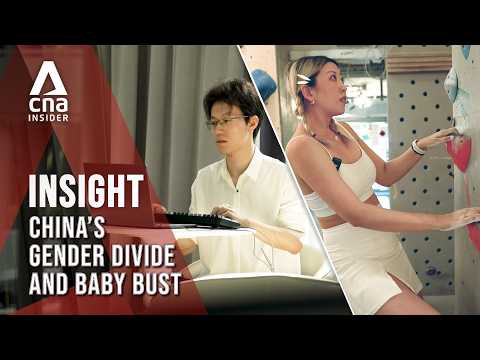 YouTube
Parents have answers of their own. In the marriage market of People’s Park in Shanghai, parents of unmarried adults gather at weekends to look for partners for their children.

The photograph shows how such a market works. Parents sit beside open umbrellas, and on each umbrella lies a sheet listing a son’s or daughter’s age, height, education, job and sometimes salary, the 条件 (conditions) that the Chengdu aunt praised in her colleague’s son. Parents compare sheets and exchange telephone numbers, often without their children knowing. To some visitors the market shows parents’ devotion, and to others it shows marriage treated as a deal between families; both readings are common in Chinese commentary on it.
Should the law step into a family custom?
Bride price is the clearest case on the mainland of the state stepping into a custom that families once settled among themselves. Disputes over it reach the courts when an engagement ends, a marriage breaks down soon after the wedding, or a family borrows money it cannot repay. In January 2024 the Supreme People’s Court published a judicial interpretation on bride-price disputes, and it came into force on 1 February 2024.
The rules separate a gift from a demand. When money or goods have been demanded in the name of marriage, the court supports a claim to have them returned. When a couple has registered the marriage and lived together for a long time, the court generally does not order a return. Between these two cases, as when a couple lived together only briefly after receiving a large sum, the court decides case by case. It weighs whether the couple registered, how long they lived together, whether they have children, which side was at fault, and the income level where the giving family lives. Small gifts on birthdays and festivals do not count as bride price at all.
Situation | What the court generally does |
|---|---|
Money or goods demanded in the name of marriage | supports a claim to return them |
Marriage registered and a long time living together | does not order a return |
Short time together after a large gift | decides case by case, weighing several factors |
Small gifts at birthdays and festivals | not counted as bride price |
Source: Supreme People’s Court interpretation on betrothal gift disputes, in force 1 February 2024, as reported by China Daily (19 January 2024). |
Commentators reported by China Daily described sums of up to 300,000 yuan in the wealthier east and about 200,000 yuan in the west, equal to several years of income. Lawyers quoted in the same report supported the rules. One, Xu Qiuli, said that some grooms and their families had been bankrupted or left in debt by a high bride price. Another, Chen Wei, said that seeking money in the name of marriage goes against the freedom to marry. The Xi’an column agrees with the court and goes further than it: the writer wants families to talk before any dispute begins.
The opposing positions are not only about money. Supporters of the custom, many of them parents of daughters, see bride price as respect and as protection, since a bride traditionally moves into her husband’s family and gives up some of her own family’s support. Some argue that the problem is the size of the sum, not the custom, so a fair amount agreed between families is acceptable. Critics answer that any price attached to a bride treats marriage as a transaction, and that high sums fall hardest on poor rural families. Proposals to set a legal maximum divide even the critics, because a fixed number cannot fit both a village and a city.
Is friendship changing?
The Chengdu cousin is single but surrounded by people: a hiking partner, a meal partner and old roommates on video. Her partners belong to a trend that China Daily reported in April 2023. The word 搭子 became common that year on social media, where young people posted notices looking for someone to eat, travel, study or exercise with. The idea is a friendship with clear limits: partners share one activity, keep their private lives to themselves, split costs evenly and can end the arrangement at any time.
People disagree about what the trend means. Supporters say it suits young adults who have moved to a new city for work, have little free time and do not want the obligations of close friendship. They add that it gets people out of their rooms and into company. Critics worry that friendships divided into separate activities are shallow, and that a meal partner cannot replace a friend who helps when things go wrong. The cousin of the column seems to keep both: activity partners for weekends, and university roommates for her 心事 (worries she keeps to herself).
The question reaches beyond the mainland. In Taiwan, Hong Kong and Singapore, too, many young people live far from family, work long hours and marry late, and loneliness among young adults is discussed in all of them. What counts as a close relationship, and who a person can rely on, is a question each generation answers again.
Weighing custom and law (HL)
At HL a question such as whether the state should regulate bride price calls for a judgment between two values: the freedom of families to keep their customs, and the protection of people harmed by them. Written-style connectives give the structure: 一方面……另一方面…… sets out both values, 诚然 grants the first, 然而 turns, and 由此可见 concludes. The verb 干预 (to intervene) names what the state does.
一方面note 1,彩礼是许多地方延续了很久的习俗,代表着对女方家庭的尊重;另一方面note 1,高额彩礼让一些农村家庭负债累累,甚至让相爱的人无法结婚。诚然note 2,法律不应该随意干预note 3家庭的私事,然而note 4,当一种习俗已经让人“借婚姻索取财物”,它就不再只是私事了。由此可见note 5,法律的作用不是取消彩礼,而是给它划出一条底线。
一方面……另一方面……. On the one hand… on the other: the custom’s meaning against its cost, set out evenly.
诚然. Admittedly: grants the strongest point of those who oppose state action.
干预. To intervene: the formal verb for a government or court acting in private matters.
然而. However: the turn, built on the court’s own phrase 借婚姻索取财物 (demanding property in the name of marriage).
由此可见. From this it can be seen: the conclusion, that law sets a lower limit (底线) on a custom rather than abolishing it.
The paragraph earns its conclusion by finding a point where the two values meet. It accepts that families keep their customs, then shows where a custom becomes something else, and ends with a role for the law that respects both: a line below which a custom cannot go.
Words and phrases
The words that matter most for this topic name relationships and the pressures on them. Family words are precise in Chinese: 大姨 is a mother’s elder sister and 表姐 an older female cousin on the mother’s side or a father’s sister’s side, where English says only “aunt” and “cousin”. A second group belongs to dating and marriage: 对象, 相亲, 恋爱, 订婚, 结婚登记. A third names feelings and attitudes: 烦, 孤单, 可怜, 关心, 面子. The bride-price column adds the written-style words an opinion piece needs, such as 动辄, 相当于 and 于是.
Word or phrase | Meaning in context | Text and paragraph |
|---|---|---|
大姨 | aunt (mother’s elder sister) | Birthday column, 1 |
表姐 | older female cousin | Birthday column, 1 |
对象 | boyfriend or girlfriend, a partner with marriage in view | Birthday column, 1 |
加班 | to work overtime | Birthday column, 2 |
个人问题 | one’s personal life (whether one has a partner) | Birthday column, 2 |
条件 | a person’s “conditions”: job, income, family, housing | Birthday column, 2 |
见一面 | to meet once | Birthday column, 2 |
烦 | annoyed, fed up | Birthday column, 3 |
关心 | to care about | Birthday column, 3 |
孤单 | lonely, alone | Birthday column, 3 |
搭子 / 饭搭子 | activity partner / meal partner | Birthday column, 3 |
心事 | something on one’s mind, a private worry | Birthday column, 3 |
过日子 | to live one’s life day to day | Birthday column, 4 |
可怜 | pitiful, to be pitied | Birthday column, 4 |
合适 | suitable, right (for someone) | Birthday column, 4 |
答应 | to agree to, to say yes | Birthday column, 5 |
订婚 | to become engaged | Bride-price column, 1 |
彩礼 | bride price | Bride-price column, 1 |
谈恋爱 | to be in a romantic relationship, to date | Bride-price column, 1 |
诚意 | sincerity | Bride-price column, 2 |
保障 | security, a guarantee | Bride-price column, 2 |
动辄 | easily, at every turn (written style) | Bride-price column, 2 |
相当于 | to be equivalent to | Bride-price column, 2 |
娶媳妇 | to take a wife (of a man or his family) | Bride-price column, 2 |
面子 | face, social standing | Bride-price column, 2 |
门槛 | threshold, barrier to entry | Bride-price column, 3 |
结婚登记 | marriage registration | Bride-price column, 3 |
纠纷 | dispute | Bride-price column, 4 |
观念 | ideas, attitudes | Bride-price column, 5 |
一刀切 | one rule for all cases (literally “one cut”) | Bride-price column, 5 |
Two pairs here are worth separating. 孤单 describes being alone and feeling it, in everyday speech, while 孤独 is the more literary and deeper loneliness of a person cut off from others; the cousin says 不孤单 because she means she has company. 面子 appears in 比面子 (competing over face), the same concept met with face in the topic on beliefs and values. Here it explains why a family may ask for a large bride price even when it does not need the money.
Say it yourself
These frames help you describe your relationships, compare generations and give a fair view on marriage and friendship. They go from simple to complex.
Frame | What it does |
|---|---|
我跟……的关系很好/一般,因为…… | Describes a relationship with a reason |
每次……的时候,……总是问我…… | Describes a repeated situation |
……再……,也…… | Says that a condition changes nothing |
我知道……是关心我,只是…… | Is fair to someone before disagreeing |
在……看来,……;可是在……看来,…… | Sets two generations’ views side by side |
……跟……不一样,……更看重…… | Compares values |
对我来说,……不是……,而是…… | Gives your own definition |
与其……,不如…… | Proposes a better way |
……当然不是唯一的原因,却是…… | Weighs one cause among several |
如果……,那么……就不只是……了 | Ends on a consequence |
A short paragraph that uses the frames, as a student might write it for a school blog on family gatherings:
每次note 1过年回老家的时候note 1,亲戚们总是note 1问我考试考了多少分。我知道note 2他们是关心我,只是note 2这样的问题让我很有压力。在note 3爷爷奶奶看来note 3,成绩代表一个人的未来;可是在note 3我看来note 3,成绩只是一部分。与其note 4每次都问分数,不如note 4问问我最近在做什么、开心不开心。
每次……的时候,……总是……. Sets up a situation that happens again and again.
我知道……是关心我,只是……. Fair to the relatives first, then the writer’s difficulty.
在……看来;可是在……看来. Two generations’ views balanced on a semicolon.
与其……不如……. Ends on a concrete proposal rather than a complaint.
Improving a paragraph
A weak paragraph on marriage pressure blames one side and speaks in absolutes. The stronger version keeps the writer’s view but is fair, specific and reasoned.
中国的父母都很喜欢催婚,这很不好。note 1年轻人应该自己决定,父母不应该管。note 2
在不少家庭里,长辈常常在节日的饭桌上催年轻人结婚note 3。他们这样做,是因为在他们看来,成家才算真正长大。note 4然而note 5,年轻人面对的房价和工作压力,跟父母那一代人完全不同。因此note 6,我认为两代人与其note 6在饭桌上争论,不如note 6找个时间好好聊一聊各自的担心。
Weak: a stereotype. 中国的父母都 claims that all parents in a country behave the same way, which is untrue and unfair.
Weak: an order with no reason. 不应该管 rejects the other side without explaining either view.
Stronger: limited and specific. 在不少家庭里 (in many families) and a real setting, the festival dinner table.
Stronger: the other side’s reason. Explains the parents’ view in their own terms before answering it.
Stronger: 然而. The turn, with a concrete difference between generations.
Stronger: 因此 and 与其……不如……. A conclusion that follows and a proposal both sides could accept.
The stronger paragraph is no less personal, but every sentence can be defended. It describes some families rather than a whole country, and it gives parents a reason before disagreeing with them.
Applying it in Paper 1
A Paper 1 task on social relationships often asks you to respond to a family or social pressure, or to advise someone. You might write a letter to a cousin who is being pushed to marry, or an article for a youth magazine on whether bride price should be limited. Other tasks ask for a blog post about a friendship that survived a move, or a speech for a school assembly on what makes a good friend. The text types that fit include a personal letter or email, an article, an opinion column, a blog post and a speech.
The commonest way to lose marks on a task about relationships is to turn advice into a lecture: a list of general statements about marriage in China that never speaks to the person who asked for help. A letter that says 结婚是很重要的事 and 父母都是为了你好 four times answers no one. The model texts work because each stays with particular people, a cousin at a birthday dinner and a classmate who lost his engagement.
Try it
Your teacher asks in the conversation: 你觉得年轻人应该听父母的意见找对象吗? Answer in two or three sentences with a concession and a reason.
One possible answer: 我觉得父母的意见可以参考,因为他们比我们更有经验,也是关心我们。不过,结婚是自己一辈子的事,最后还是应该自己决定。比如我表姐就去见了一面,但是她说要不要继续,由她自己决定。
The pages on the personal letter and email, the opinion column and the speech take these frames into whole texts. The page on comparisons gives 跟……不一样 and 比 in full, and the page on written-style Chinese gives 动辄, 于是 and 由此可见. Beliefs and values follows the same families to filial piety and care for older parents, and Community turns from family to neighbors.
Self-check
- To do:
I can describe my family and friendships with precise family words and with 对象, 搭子 and 关心.
- To do:
I can explain why fewer young people in mainland China are marrying, with figures and reasons.
- To do:
I can explain what bride price is and what the 2024 court rules changed.
- To do:
I can discuss whether activity partners are a new kind of friendship or a weaker one.
- To do:
I can present two generations’ views fairly with 在……看来 and 只是.
- To do:
I can weigh custom against law at HL with 一方面……另一方面…… and 由此可见.
- To do:
I can plan a personal letter that advises a relative, with the reader present in every paragraph.
Key terms
Each is also in the Social organization glossary for IB Mandarin B, beside the other terms of its topic.
- Activity partner
A partner for one particular activity, such as eating out, hiking or studying, with no wider commitment, often found online. The word spread among young people in mainland China in 2023 as a new, lighter form of friendship.
- Bride price
Money or gifts given by a groom's family to the bride's family when a couple becomes engaged. Its rising size in some places, and whether it should be limited, is a public debate in mainland China.
- Pressure to marry
Repeated urging by parents and relatives that an unmarried adult find a partner and marry, often at family gatherings and festivals. It shows the gap between generations' ideas of when and why people should marry.
More in 4 Social organization
The whole topic is on its own page.
- 4.1Social relationshipsThis page
- 4.2Community
- 4.3Social engagement
- 4.4Education
- 4.5The working world
- 4.6Law and order
Carry on with 4.1 Social relationships in Augment
With a free account, Augment remembers where you stopped in the notes and which questions you have marked.