4.1 Identity
Identity as a way of reading: how works build selves from names, voices, memory, doubles and the gaze of others, read through McKay, Wilde, Stevenson and Du Bois, and how identity gives an essay its axis.
- IB English A: Literature
- Part of 4 Central concepts
- SL and HL
Notes on 4.1 Identity
Identity, as a way of reading, asks three questions of a work: who is this self, how is it made, and who has the power to define it? A character, a speaker or a narrator exists only in words, so every self in literature is built from choices: a name, a voice, a body, a place, a memory, the way others look at it. “The Tropics in New York”, by the Jamaican-born poet Claude McKay, finds a whole self in a shop window.
A self made from memory and place
The poem’s first stanza contains no person at all. It is a list of fruit (“Bananas ripe and green, and ginger-root, / Cocoa in pods and alligator pears”, lines 1–2) with no main verb, as flat as a price card. Only line 4 gives the list a point of view, and it is not a New York one: the fruit is “Fit for the highest prize at parish fairs”. The standard that judges these goods belongs to rural Jamaica, where the parish is the unit of local life. Before the speaker has said “I”, the poem has shown where the speaker’s values come from.
The second stanza moves the self from the street into memory. The fruit is “Set in the window, bringing memories” (line 5), and the glass of a shop window stands between the speaker and everything it shows. What it brings back is a landscape in religious terms, with “mystical blue skies / In benediction over nun-like hills” (lines 7–8). Home is not described as a place on a map. It is remembered as something holy, which tells the reader more about the speaker’s attachment than about Jamaica.
Only in the last stanza does the “I” arrive, and it arrives through the body. “My eyes grew dim” (line 9), a “wave of longing” sweeps through the body (line 10), and the speaker is “hungry for the old, familiar ways” (line 11). The hunger is literal and figurative at once, since the cause is a window full of food. The last line, “I turned aside and bowed my head and wept”, turns the speaker away from the New York street and bows the head as if in prayer. The poem never names Jamaica, and New York appears only in its title. The self it builds is defined by a distance: it is a person in one place whose identity lives in another.
Read through identity, McKay’s poem is about more than homesickness. It shows a self being assembled from three materials: memory, which supplies the hills and the dawns; place, which supplies the cold street and the window; and the senses, which turn memory into a physical event. The three questions get three answers. This self is a migrant. It is made by the gap between what the eyes see and what the body remembers. And, in this poem, nobody else defines it, because no other person appears.
What builds a literary self
The diagram sets out six materials from which works build selves, divided into two groups. The upper three are built from within: memory, place and the body. McKay’s poem uses all three and nothing else. The lower three are built in public, among other people: a name given or chosen, a voice heard by others, and the gaze of those who look at the self and decide what it is. A work that leans on the lower row usually puts identity under pressure, because public materials can be imposed, stolen or faked.


Names, documents and performance
McKay’s speaker is alone with a memory. Oscar Wilde’s The Importance of Being Earnest (first performed in London in 1895) puts identity in the most public place possible: a drawing room full of people who judge. The hero, Jack Worthing, wants to marry Gwendolen Fairfax. In this scene from Act I her mother, Lady Bracknell, interviews him as a suitor.
Lady Bracknell treats a man as a set of entries. She sits with “note-book and pencil” (line 2) and explains that Jack is “not down on my list of eligible young men” (line 4), but that she is “quite ready to enter your name”. The questions that follow are the categories of a social register: habits, age, income, property, address, politics and, last of all, parents. Jack’s identity, in this room, is whatever her notebook can hold.
The comedy comes from the way each answer is judged by a rule that turns ordinary values upside down. Smoking is approved because “A man should always have an occupation of some kind” (line 6). Land is worse than investments because it “gives one position, and prevents one from keeping it up” (line 14). The address, 149 Belgrave Square, is on “The unfashionable side” (line 22), and when Jack asks whether she means “the fashion, or the side” (line 23) she answers “Both, if necessary” (line 24). A social identity that can be fixed by moving a street is plainly a matter of convention, not nature. The play makes the audience laugh at a system that the audience itself lived by.
Born in a handbag
The last question in the extract, “Are your parents living?” (line 26), is the one Jack cannot answer. He was found as a baby in a handbag in the cloak-room at Victoria Station, and Lady Bracknell receives the news with two words, “A hand-bag?” Her advice and her verdict follow:
I would strongly advise you, Mr. Worthing, to try and acquire some relations as soon as possible, and to make a definite effort to produce at any rate one parent, of either sex, before the season is quite over. […] You can hardly imagine that I and Lord Bracknell would dream of allowing our only daughter—a girl brought up with the utmost care—to marry into a cloak-room, and form an alliance with a parcel?
Oscar Wilde, The Importance of Being Earnest, Act I
Relations, in this speech, are things to “acquire” and “produce”, like the documents a clerk asks for, and Jack himself becomes “a parcel” left in a cloak-room. A man with money, a house and a political party is still nobody without a documented birth. In the world of the play, identity is a matter of papers.
Wilde follows that idea to its end. In Act III the handbag is recognized, Jack turns out to be the son of a general, and he searches the Army Lists, the printed register of officers, for his father’s Christian name. It is “Ernest John”. Jack has been lying about his name for the whole play, and the lie turns out to be true. It prompts his remark: “it is a terrible thing for a man to find out suddenly that all his life he has been speaking nothing but the truth.” A book, not a person, finally tells Jack who he is.
Second selves and the self as performance
The plot depends on two invented selves. Jack uses one name in the country and another in town, and his friend Algernon Moncrieff has a second life of his own. Algernon explains both in Act I:
You have invented a very useful younger brother called Ernest, in order that you may be able to come up to town as often as you like. I have invented an invaluable permanent invalid called Bunbury, in order that I may be able to go down into the country whenever I choose.
Oscar Wilde, The Importance of Being Earnest, Act I
The two sentences are built in parallel, as if inventing a person were as ordinary as buying a ticket. The play calls this practice “Bunburying”. In Act II Algernon arrives at Jack’s country house pretending to be Jack’s wicked brother Ernest, so that two men are claiming the same name at once. The diagram sets out who uses which name, where, and who falls in love with the name rather than the man.


Both women love the name before the man. Gwendolen tells Jack that her ideal “has always been to love some one of the name of Ernest. There is something in that name that inspires absolute confidence.” The joke works because Ernest sounds like earnest, a word for sincerity, and sincerity is what neither man has. Wilde’s subtitle, A Trivial Comedy for Serious People, sets the same trap. A name is supposed to point to a fixed, true self, and in this play it points only to other names.
Identity as something done
Twentieth-century critics gave this comic idea a serious form. In Gender Trouble (1990) the philosopher Judith Butler argued that gender is not an inner truth that behavior expresses. It is produced by behavior: by acts, gestures and words repeated until they seem natural. Butler’s term for this is performativity. Applied more widely, it suggests that any identity may be made by the repeated performance of a role, so that there is no hidden “real” self behind the performance. Jack’s respectability fits this account well, since it is made of calling cards, a cigarette case and the right answers to a notebook.
The literary scholar Stephen Greenblatt described an earlier version of the same process in Renaissance Self-Fashioning (1980). He showed writers of sixteenth-century England, from Thomas More to Shakespeare, shaping a public self through language and conduct, always within the limits set by church, court and family. Self-fashioning stresses the effort and the risk of making a self; performativity stresses that the self is never finished. Both readings ask a question of a work that a reader might otherwise not ask: what roles does this character play, for whom, and what happens when the performance fails?
The strongest objection to reading every self as a performance comes from works like McKay’s. Grief that bends a man over a shop window is not a role played for anyone, since the speaker turns aside from the street to weep. Some parts of a self feel given rather than made: a birthplace, a body, a memory. A careful reading of identity keeps both possibilities open, and asks which one a particular work dramatizes. Earnest is unusual in staging the performed self so completely that even its happy ending is a coincidence of names.
A queer reading of Bunburying
When Algernon discovers that Jack leads two lives, he greets him as a fellow member of a secret society:
Besides, now that I know you to be a confirmed Bunburyist I naturally want to talk to you about Bunburying. I want to tell you the rules.
Oscar Wilde, The Importance of Being Earnest, Act I
A queer reading reads a work for desire and identity outside heterosexual norms, including what a text hides or says in code. Wilde lived a double life of his own: he was married, with two sons, and had relationships with men at a time when sex between men was a crime in Britain. Earnest opened on 14 February 1895. Within weeks Wilde was on trial, and in May he was imprisoned for gross indecency. The theater removed his name from the playbills before the run closed.
Read with that history in mind, Bunburying looks like a coded picture of a secret life. A man needs an invented reason to disappear, and a friend recognizes the habit at once and offers to explain “the rules”, as if the double life were a club with members. The reading is persuasive because the play keeps returning to concealment and to the danger of being found out. It remains one reading among several. On its surface the comedy ends in three engagements between men and women, and many productions play it as pure comedy of manners, a satire on a class that values form over feeling.
Doubles and divided selves
Wilde’s second selves are invented for convenience and dropped when the plot is solved. Some works build a second self that cannot be dropped, because it is part of the first. Robert Louis Stevenson’s Strange Case of Dr Jekyll and Mr Hyde (1886) withholds its explanation until its last two chapters, where Jekyll’s own written statement tells how a respectable doctor made a drug that released a second, violent self. Jekyll states his discovery as a general law:
that man is not truly one, but truly two.
Robert Louis Stevenson, Strange Case of Dr Jekyll and Mr Hyde (1886), “Henry Jekyll’s Full Statement of the Case”
The sentence turns a horror story into a claim about every reader. Its balance (“not truly one, but truly two”) sounds like a scientific finding, and Jekyll adds that later investigators may find a self made of even more parts. Hyde is smaller and younger than Jekyll, because, Jekyll explains, the evil side of his nature had been less used. Hyde is therefore a part of the self that has been denied a life and now takes one. The book’s structure supports that reading. For eight chapters the lawyer Utterson and his friends see two different men, and only the last two chapters, Dr Lanyon’s narrative and Jekyll’s statement, show that they were one.
A figure of this kind is a doppelgänger, from the German for “double-goer”. Fyodor Dostoevsky’s short novel The Double (1846) gives the idea a different form. A timid civil servant, Golyadkin, meets a man with his own name and face who is everything he is not, charming and successful, and who gradually takes over his life. Stevenson’s double expresses what the self has hidden. Dostoevsky’s double expresses what the self has failed to become, and the novel leaves open whether the second Golyadkin is real or a product of the first one’s breakdown.
Selves defined by others
Jekyll divides himself. Many works show a self divided from outside, by people with the power to name and judge it. The clearest statement of this experience in English prose comes from a sociologist and essayist, not a novelist. In The Souls of Black Folk (1903), W. E. B. Du Bois described what it was to be Black in the United States at the start of the twentieth century:
It is a peculiar sensation, this double-consciousness, this sense of always looking at one’s self through the eyes of others, of measuring one’s soul by the tape of a world that looks on in amused contempt and pity. One ever feels his twoness,—an American, a Negro; two souls, two thoughts, two unreconciled strivings; two warring ideals in one dark body, whose dogged strength alone keeps it from being torn asunder.
W. E. B. Du Bois, The Souls of Black Folk (1903), chapter I, “Of Our Spiritual Strivings”
The image at the center of the passage is a tailor’s tape. The soul is measured “by the tape of a world” that has already decided what it will find, so the self sees itself as a measurement taken by others. The phrase “amused contempt and pity” names three attitudes, none of them respect. Du Bois’s “twoness” is not Jekyll’s, because neither half is evil: “an American, a Negro” are two true identities that a racist society refuses to let a person hold together. The repeated “two souls, two thoughts” sets them side by side in the sentence as they are forced apart in life. Du Bois uses “Negro”, the respectful term of his time; it is quoted here as he wrote it.
Double consciousness has become a frame for reading many literary selves, especially in works of migration and empire. It sheds light back on McKay’s poem, whose speaker is never seen by anyone in New York and yet weeps over a window. Du Bois would describe that speaker as a self split between a place that does not see him and a home that cannot see him either.
Naming and the gaze
Literature often shows the moment when an outside view becomes an inside one. In Jean Rhys’s Wide Sargasso Sea (1966), the Creole heiress Antoinette Cosway is married to an English husband who begins to call her Bertha, a name she has never had and does not accept. The new name prepares her for the role she is given in Jane Eyre: the madwoman locked in an attic under another name. How Rhys rewrites Brontë’s novel is a question about transformation; as a matter of identity, the renaming shows a husband replacing a person with a character he can control.
Frantz Fanon, a psychiatrist from Martinique, described the same process from the inside in Black Skin, White Masks (1952; English translation by Charles Lam Markmann, 1967). In its best-known scene a white child on a train points at him and, frightened, calls out to its mother about the Black man. Fanon writes that in that moment he felt himself fixed as an object, defined from outside by a stock of stories about race that he had no part in making. The scene is non-fiction, but it gives literary critics a precise account of the gaze: a look that tells a person what they are before they have spoken.
More than one identity at once
Most characters are defined by several identities at once, and the combination matters. The legal scholar Kimberlé Crenshaw introduced the term intersectionality in 1989 to describe how race and gender, among other identities, combine to produce experiences that neither explains alone. Her example was Black women, whose claims against discrimination fell between laws written for women and laws written for Black people.
Zora Neale Hurston’s Their Eyes Were Watching God (1937) shows the idea at work in fiction. Janie Crawford is a Black woman in the American South, and her second husband, Joe Starks, becomes the mayor of the all-Black town of Eatonville. As the mayor’s wife she is raised above the townspeople by class. As a woman she is forbidden to join the storytelling on the store porch. And the novel shows her life shaped by the race and history of her grandmother, who was born into slavery. No single identity explains why Janie is silenced on that porch. Reading her through intersectionality shows how race, gender and class combine to put her in the one position where she can be admired and not heard.
The self as material: confessional poetry
Every work so far builds a self at a distance from its writer: McKay’s speaker, Wilde’s Jack, Stevenson’s doctor. In the late 1950s a group of American poets narrowed that distance on purpose. Robert Lowell’s Life Studies (1959) wrote about his parents, his marriage and his time in a psychiatric hospital in the first person. The critic M. L. Rosenthal, reviewing the book in 1959, called this kind of writing “confessional”, and the label stuck to Lowell, Anne Sexton, W. D. Snodgrass and, most famously, Sylvia Plath.
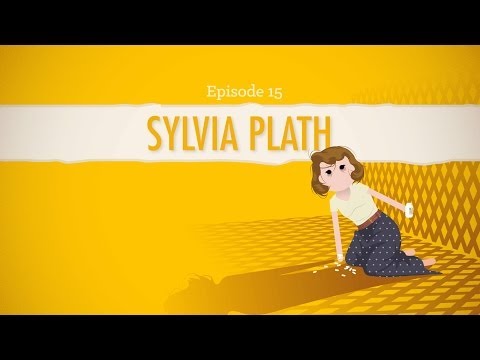
Confessional poetry takes private life as its material: illness, marriage, family conflict, depression, the wish to die. Plath’s Ariel, published in 1965, two years after her death, is its best-known collection. In “Lady Lazarus” the speaker describes her attempts at suicide as a kind of show:
Dying
Is an art, like everything else.Sylvia Plath, “Lady Lazarus”, Ariel (1965)
The lines are often read as Plath speaking about herself, and the facts of her life make that reading tempting. Yet the lines are built as a performance. The line break after “Dying” leaves the word alone for a moment, so that the second line arrives as a cool, almost boastful correction. Calling death “an art” turns the speaker into an artist with an audience, and the poem goes on to address a crowd that pays to watch. The most private material in the poem is shaped into a public role, the process that Butler’s term performativity describes.
The distinction matters most where it is hardest to keep. The chapter on narrative voice separates the speaker from the poet and introduces the persona, the mask a poet speaks through; confessional poetry is the case that tests that separation, because it presents itself as having no mask at all. Rosenthal praised Lowell for removing the mask. Plath’s lines suggest the opposite view: the bare face is itself a style, with its line breaks, its timing and its imagined crowd, chosen and revised like any other. Both views can be argued from the poems, and an essay that weighs them shows more than one that simply assumes the speaker is the poet.
 YouTube
The reader’s identity
Identity works on both sides of the page. A reader brings an age, a culture, a gender, a language and a history to a text, and these shape what the reader sees. McKay’s fourth line is a clear case:
Fit for the highest prize at parish fairs,
Claude McKay, “The Tropics in New York”, line 4
A reader who grew up in rural Jamaica, or anywhere with agricultural shows, may recognize the judging of produce at once, and feel the pride and the homesickness in it. A reader from a large city may pass over the line as a decorative detail, and read the first stanza as an exotic display. Neither reader is wrong to start where they are. The second reader, though, has to do more work to see that line 4 gives the speaker’s values a home, and the poem rewards that work.
The same is true of characters. A student who has moved countries may read McKay’s last line as a memory of their own. A student who has been judged by a list of qualifications may side with Jack against Lady Bracknell more warmly than one who has done the judging. Such responses become part of an interpretation when they are joined to the text’s choices, as the chapter on how literature affects readers argues. Reading through identity includes noticing one’s own position, and asking what a reader in a different position would see.
Try it
A reader in 1895 London and a reader today both laugh at Lady Bracknell’s interview. What might each be laughing at, and what does the difference show about the reader’s identity?
A London audience of 1895 would recognize the interview as an exaggeration of something real: mothers did keep lists of eligible men, and income, land and address did decide marriages. They laugh at their own class seen in a distorting mirror. A reader today may laugh at the strangeness of a world in which a street number can ruin a proposal. The first laughter is satire recognized from inside; the second is closer to wonder at a lost culture. The text is the same, but the readers’ identities decide whether the joke feels like a criticism of them or of somebody else.
Identity across the three areas of exploration
Identity runs through all three areas of exploration. In readers, writers and texts, it is a question about method: how a voice, a name or a point of view builds a self, as McKay’s three stanzas build a migrant out of fruit, memory and tears. The concept turns attention from what a character is like to how the work has made the character appear that way.
In time and space, identity depends on context. What counts as respectable in Lady Bracknell’s London, or what it meant to be Black and American when Du Bois wrote, cannot be read off the page without some knowledge of the period. Translation adds another layer: a self built in one language has to be rebuilt in another, and a name, a dialect or a form of address may not survive the journey.
In intertextuality, identity is something later works contest. Rhys gives the woman in Brontë’s attic her own name and history, and many modern works answer an older one by telling its story from the side of a character it had silenced. Read together, such a pair makes clear that a literary identity can be rewritten, and that the choice of who speaks is a choice about whose identity counts.
How identity pairs with other concepts
Identity overlaps most with representation, which asks who has the right to depict whom: Du Bois’s “eyes of others” and Fanon’s child on the train are both questions of representation as much as of identity. It pairs with transformation where a self changes, as Jack’s does when a list of officers gives him a name, or where it breaks apart, as Jekyll’s does. It also meets culture, since much of a self is inherited from a group, as McKay’s parish fairs show. Using two concepts together often sharpens an argument: an essay can show how a work represents a self and then how that self changes.
Writing about identity
The commonest weakness in writing about identity is to treat it as a theme that a work simply contains. “The theme of identity is important in the play” is true of almost every play, and it says nothing about how this one works. A strong sentence names a choice the writer made, quotes it, and says what kind of self it builds. The pair that follows makes the same point about The Importance of Being Earnest.
Weak: Identity is a very important theme in The Importance of Being Earnest because Jack has two identities.note 1 This shows that people in the Victorian era were not always who they seemed.note 2
Strong: Lady Bracknell interviews Jack with “note-book and pencil” in hand, so his identity becomes a list of entries that she can approve or strike out.note 3 When he cannot name his parents, money and an address count for nothing, and the play reduces a self to a document: a man found in a handbag can only “form an alliance with a parcel”.note 4 The Army Lists that finally name him complete the joke, since a register, not a person, decides who Jack is.note 5
Theme without method. “A very important theme” is a judgment with no evidence, and “two identities” describes the plot rather than the writing.
History instead of the play. The sentence moves away from the text to a claim about a whole era, which the play cannot prove.
Choice, quotation, effect. The stage property and the quoted words show how the scene builds identity as a list.
Developing the claim. The second sentence pushes the idea further with a second quotation, and states its effect precisely.
Connecting two moments. Linking the notebook in Act I to the Army Lists in Act III turns a reading of one scene into a reading of the whole play.
The strong version never uses the word identity as its subject. It writes about a notebook, a handbag and a register, and lets the concept organize what it notices. The same method works for any self in any work: the objects, names, words and looks through which the work builds that self are the evidence to find and analyze.
Applying it in the HL essay
The HL essay asks for a line of inquiry into one work, explored in 1,200 to 1,500 words. Identity is one of the commonest starting points, and one of the commonest traps, because “identity in Earnest” is a topic, not a line of inquiry. A topic names an area; a line of inquiry asks how the work does something within it, so that the essay has a question to answer and a method to analyze.
The narrowing usually takes three steps. A topic (“identity in Earnest”) becomes a feature (“names and documents in Earnest”). The feature then becomes a question about method and effect: “How does Wilde use names, registers and documents to present identity as a social fiction in The Importance of Being Earnest?” That question tells the reader which scenes the essay will read (the interview, the handbag, the Army Lists, the two Ernests), and it leaves room for an argument, since the ending can be read as either confirming or mocking the idea that names tell the truth.
A model opening for that essay states the line of inquiry as an argument, names the evidence it will use and takes a position that a reader could dispute.
In The Importance of Being Earnest, Wilde builds identity from paper.note 1 Lady Bracknell’s notebook, the calling cards that name Jack “Ernest”, the handbag and the Army Lists all decide who a man is before he speaks.note 2 This essay argues that the play presents identity as a social fiction, and that its happy ending, in which a lie becomes true by accident, exposes the fiction rather than resolving it.note 3
A claim, not a topic. The first sentence states an argument about method in one short sentence.
The evidence named in advance. Listing the four documents tells the examiner how the essay will develop.
An arguable thesis. The second half of the thesis takes a position on the ending that a reader could dispute.
Identity also gives axes to the other components. A Paper 2 question about characters divided against themselves, or about outsiders, can be answered by comparing two works’ methods: Stevenson’s withheld statement against Dostoevsky’s unreliable doubling, for example. In the individual oral, identity usually belongs to the field of culture, identity and community. A global issue such as how migrants keep a self alive in a city that does not see them could join McKay’s poem to a work in translation, with one extract from each.
Identity leads directly to representation, which asks who has the power to depict a self and what the depiction leaves out, and to transformation, which follows selves as they change, break apart or are rewritten by later works.
Self-check
- To do:
I can explain identity as three questions a reader asks: who is this self, how is it made, and who defines it.
- To do:
I can show how McKay’s “The Tropics in New York” builds a self from memory, place and the senses.
- To do:
I can analyze how The Importance of Being Earnest presents identity through names, documents and performance.
- To do:
I can explain performativity, self-fashioning, the doppelgänger, double consciousness and intersectionality, each with an example.
- To do:
I can keep the speaker of a confessional poem separate from the poet, and say why the distinction matters.
- To do:
I can reflect on how my own identity shapes what I see in a text.
- To do:
I can turn identity from a theme word into a line of inquiry that names a method.
Key terms
Each is also in the Central concepts glossary for IB English A Lit, beside the other terms of its topic.
- Confessional poetry
Poetry, chiefly American and from the late 1950s onward, that takes the poet’s private life as open material: illness, family, marriage, despair. Its speaker sounds like the poet but remains a constructed voice.
- Doppelgänger
A character who is the double of another, sharing a face, a name or a life, and who usually embodies what the first self hides, lacks or fears.
- Identity
The sense of who a person or group is. As a concept for reading, it is how a work constructs a self for a character, speaker or narrator, and how that self is shaped by names, voice, memory, place and the views of others.
- Intersectionality
The way identities such as race, gender and class combine and interact, so that a person’s experience cannot be explained by any one of them alone. The term was introduced by Kimberlé Crenshaw in 1989.
- Performativity
The idea that an identity is produced by acts, gestures and words repeated until they seem natural, rather than expressed from a fixed inner self. Judith Butler developed it for gender in 1990.
- Queer reading
A way of reading a work for desire and identity outside heterosexual norms, including what the text hides, codes or leaves unsaid. It is one interpretive lens among others and must be supported from the text.
- Self-fashioning
The making of a public self through language and conduct, within the limits set by the powers around a person. The term comes from Stephen Greenblatt’s study of sixteenth-century English writers (1980).
Practice questions on 4.1 Identity
Augment’s own questions, written in the style of IB exam papers. Here is how a few of them start.
Practice all 33 questions on 4.1 Identity
Free with an account. Write your answer, open the markscheme beside it and mark yourself. Augment keeps the ones you got wrong for another go.
More in 4 Central concepts
The whole topic is on its own page.
- 4.1IdentityThis page
- 4.2Culture
- 4.3Creativity
- 4.4Communication
- 4.5Perspective
- 4.6Transformation
- 4.7Representation
Carry on with 4.1 Identity in Augment
With a free account, Augment remembers where you stopped in the notes and which questions you have marked.