3.4 How valid is the notion of a classic text?
What makes a text a classic, who builds a canon and how canons are challenged, tested on an essay, a poem, a print, a speech and a novella, with a judgment on how valid the notion is.
- IB English A: Language and Literature
- Part of 3 Intertextuality: connecting texts
- SL and HL
Notes on 3.4 How valid is the notion of a classic text?
A classic is a text that keeps being reread, by particular readers, for particular reasons. The notion is valid as a description of that history of rereading. It is weak as a claim that a text’s value is fixed or timeless, because lists of classics are made by people and institutions, and they can be challenged and remade. The opening of Virginia Woolf’s essay “Street Haunting”, first printed in an American magazine in October 1927, is now widely reprinted.
What keeps a text in use
Read nearly a century after it was printed, “Street Haunting” still works in many places. The essay’s pretext is a small joke: nobody “has ever felt passionately towards a lead pencil” (paragraph 1), yet a pencil will do as “an excuse for walking half across London between tea and dinner”. Its central experience is one that most city dwellers recognize, the relief of becoming a stranger in a crowd. Woolf describes the walker who will “shed the self our friends know us by and become part of that vast republican army of anonymous trampers” (paragraph 2). The sentence turns a private feeling into a shared one, and its plural we invites any reader into the army.
Other parts of the essay belong firmly to 1927. The foxhunter and the golfer of its opening analogy assume a reader who knows country sports. The brown ring on the carpet is a joke about David Lloyd George, the former British prime minister, which needs a footnote for most readers today. The “sinister old woman” in Mantua (paragraph 2) is seen from the outside, as an English traveler might see her, and the walker in paragraph 3 notices the “poverty and shabbiness” of passers-by from a comfortable distance. A classic carries its dated parts with it, and rereading notices them as clearly as it notices what still holds.
The Italian novelist Italo Calvino gave one well-known definition in an essay first published in the Italian magazine L’Espresso on 28 June 1981, later translated as “Why Read the Classics?”. Among fourteen short definitions, one has become a common saying: “A classic is a book that has never finished saying what it has to say.” The definition says nothing about age, fame or difficulty. It describes a relationship between a text and those who return to it, in which each visit finds something the last one missed.
“Street Haunting” supports the definition in an unexpected way. The essay describes its own kind of attention as shallow: “The eye is not a miner, not a diver, not a seeker after buried treasure” (paragraph 3). A second reading of the essay does exactly what the eye refuses to do. The repeated not begins to sound defensive, and the image of “an enormous eye” floating along the surface invites the question of what the walker prefers not to see. The essay keeps saying more than it says it is saying, which is one sign of a text that sustains rereading.
The distinction matters because the two can separate. A novel can be reread for a century outside any course, and a text can sit in a school canon long after readers have stopped choosing it for themselves.
Grounds for literary merit
Arguments that a text deserves its place usually rest on its literary merit, and four grounds recur. Complexity is the first: a text that holds more than one meaning at once, as Woolf’s “enormous eye” (paragraph 3) does, rewards a second reading. Craft is the second: the precision of choices at the level of the sentence. Influence is the third: whether later writers learned from the text. Rereadability, the fourth, is in a sense the result of the other three.
Craft is the easiest of the four to show. One sentence in paragraph 2 describes how a single night in Italy stayed in the essayist’s memory:
The moment was stabilized, stamped like a coin indelibly, among a million that slipped by imperceptibly.
Virginia Woolf, “Street Haunting”, paragraph 2
The simile of the coin explains how memory works: of a million moments, one is pressed hard enough to keep its shape, and the rest wear away. The sentence also performs its meaning in sound. The two long adverbs, indelibly and imperceptibly, end its two halves with the same rhythm, so that the kept moment and the lost ones are weighed against each other. An argument for the essay’s merit can point to sentences like this one, where the claim and the way it is made fit closely.
How a canon is made
The word canon comes from the Greek kanōn, a measuring rod or rule. It was first used for the list of books that a church accepted as scripture, and the religious sense still colors the literary one: a canon is a list with authority behind it. Texts do not enter it by themselves; they are chosen, kept and taught through canon formation, which has several agents. Publishers decide what stays in print, and series such as Penguin Classics, started in 1946, give a text the look of permanence. Anthologies such as The Norton Anthology of English Literature, first published in 1962, decide what a whole generation of students reads. Schools, national curricula, prizes and critics all add their weight.
“Street Haunting” shows the process at work on one text. It first appeared in The Yale Review (October 1927), a quarterly magazine read by an educated American public. In 1930 a San Francisco press printed it as a small book in 500 signed copies, an edition for collectors rather than readers. After Woolf’s death in 1941, a version of the essay with a number of differences was collected in The Death of the Moth and Other Essays (1942), and the collected essays kept it in print. Today it is sold on its own as a slim paperback by more than one publisher and appears in anthologies of the essay and of writing about cities. Each step moved it from the readership of one magazine toward a permanent place on a list.
The diagram sets out that movement as a cycle. A text is published, read and discussed, taught, reprinted and reused, and then meets new readers who start the cycle again. A classic is a text that keeps completing the turn. At three points in the cycle a text can also leave it: when readers ignore it, when courses drop it, or when it goes out of print. Most texts leave after the first turn, and many classics have left and returned.


The cycle explains why canons look natural to those inside them. The texts in a student’s anthology are largely the texts the teacher met, because the cycle has already selected them. The chapter on representation shows the same mechanism in a single image: the nine novelists on the WPA reading poster, all from the nineteenth century, were what an American public library of around 1940 meant by “the books”. A canon presents a selection as if it were simply the best that exists.
Try it
Woolf’s simile of the coin, “stamped like a coin indelibly, among a million that slipped by imperceptibly” (paragraph 2), describes how one memory survives. How could the same sentence describe canon formation?
Of the millions of texts published in any period, only a few are stamped hard enough by institutions (publishers, anthologies, courses) to keep their shape, while the rest wear away and are forgotten. The simile also suggests that the stamping is partly chance: the essayist does not choose which night in Mantua her memory keeps. A canon, read through the coin, is a record of what happened to be kept as well as of what deserved to be.
One poem, more than one canon
Canons are plural. A national literature, a language, a movement and a form can each have its own, and one text can belong to several at once, read differently in each. Claude McKay’s “The Tropics in New York”, the poem of a shop window full of island fruit that brings a Jamaican-born speaker in New York to tears, opens with an act of judgment that any canon would recognize:
Bananas ripe and green, and ginger-root,
Cocoa in pods and alligator pears,
And tangerines and mangoes and grape fruit,
Fit for the highest prize at parish fairs,Claude McKay, “The Tropics in New York”, lines 1–4
Line 4 measures the fruit against a standard. The speaker does not call it beautiful or perfect; he calls it “Fit for the highest prize at parish fairs”, a judgment made by the rules of an agricultural show in a Jamaican parish. The standard is local, shared and specific, and in a New York street only the speaker can apply it. Canons work in the same way. They rank texts by a community’s idea of the best, and a text can win the highest prize in one community and go unnoticed in another.
McKay’s own reputation shows this happening. Born in Jamaica in 1889 (some sources say 1890), he published two collections of poems in Jamaican Creole in 1912, Songs of Jamaica and Constab Ballads, before he left for the United States. Harlem Shadows (1922), the collection that prints this poem, is usually counted among the first books of the Harlem Renaissance, the flowering of African American writing and art centered on Harlem in the 1920s. Anthologies of African American literature have kept him in that canon ever since. In 1977 Jamaica named him its national poet and awarded him the Order of Jamaica, placing the same writer at the start of a Caribbean canon.
Each canon reads the poem from a different line. An anthology of the Harlem Renaissance places it in the story of migration to Northern cities, and the title’s “New York” leads. A Caribbean reading begins from “parish fairs” and “nun-like hills” (line 8), a remembered island seen with the precision of someone who knew it. A third canon, that of the English lyric, notices that the poem’s three quatrains of rhymed iambic pentameter are among the most traditional forms in English verse. The words are the same in all three canons, while the line that leads each reading differs.
A canon still being written
McKay’s place is also a reminder that a canon is never finished. A novel he wrote in 1941, Amiable with Big Teeth, was found in an archive in 2009 and published in 2017. A novella written around 1933, Romance in Marseille, was published in 2020. Readers in the 2020s have more of McKay to read than any reader in his lifetime had, and the new books change how the poems are placed. Canon formation runs backward as well as forward: the present keeps choosing what the past will be remembered for.
Classics outside literature
Literature is not the only field with classics. Prints, photographs, posters, speeches and advertisements become reference points too, and a non-literary classic is often made faster and more visibly than a literary one, because its status depends so openly on being copied. Katsushika Hokusai’s Under the Wave off Kanagawa, usually called The Great Wave, is one of the clearest cases.

The print shows a wave rising across most of the picture, deep blue with white foam that breaks into curling fingers at its crest. Three long, narrow boats lie under it, their rowers bent low over the oars. Far away in the trough between the waves sits Mount Fuji, snow-capped and tiny, so that the mountain looks like one more wave. A rectangular cartouche at the top left gives the title of the series, Thirty-six Views of Mount Fuji. The composition places the viewer low in the water with the boats, looking up at the wave about to fall.
The Great Wave was made in the early 1830s as a woodblock print for a popular market, one of a series sold by an Edo publisher. Estimates suggest that up to about 8,000 impressions were printed from its blocks. It was a work of popular culture in the full sense: commercially produced, cheap enough to buy and meant for many people. After Japan opened to wider trade in the 1860s, prints like it reached Europe, where artists and collectors admired them. In 1905 the composer Claude Debussy asked for the image on the cover of the first edition of his orchestral score La Mer.
The print’s later life made it an iconic image, a picture so widely reused that it stands for far more than its subject. It has been redrawn by artists, printed on clothing and posters, and imitated in a phone emoji, and in 2024 it appeared on a new Japanese banknote. Each reuse depends on viewers recognizing the original, and each makes it more recognizable. The same reproduction that once made the print cheap now makes it a classic. What sustains the cycle is the composition itself: a single curve that reads at any size, from a museum wall to a phone screen, and a mountain made small by water.
Photographs follow the same path. Joe Rosenthal took his photograph of six servicemen raising a flag on Mount Suribachi, on the island of Iwo Jima, on 23 February 1945. It won the Pulitzer Prize for photography that year and became the model for the Marine Corps War Memorial near Washington. It has since been copied on stamps and posters and parodied in countless cartoons. A parody only works when its audience knows the original, so every parody is evidence that the original has become a classic of the culture.
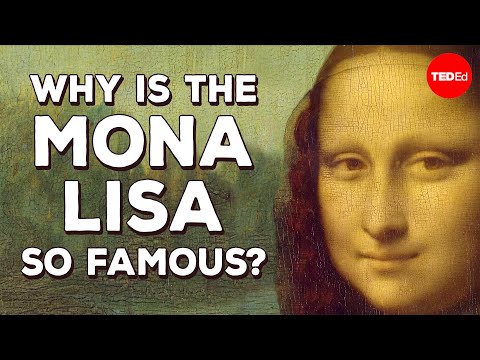
Painting has its own famous example of a reputation built by circulation. In a TED-Ed lesson, the art historian Noah Charney explains how the Mona Lisa rose from a respected painting to the most famous one in the world. Much of that rise came from events outside the painting, including its theft from the Louvre in 1911.
 YouTube
A speech kept by a calendar
Some non-literary texts become classics because the occasion that produced them comes round again. Frederick Douglass gave his Fourth of July oration in Rochester, New York, on 5 July 1852, and its central question is tied to the date:
What, to the American slave, is your 4th of July?
Frederick Douglass, Oration, Delivered in Corinthian Hall, Rochester, July 5th, 1852, paragraph 5
The question names a holiday that returns every year, so the speech has a reason to be reread every year. A humanities council in Massachusetts now supports public readings of the oration around the Fourth of July each year, including one on Boston Common. Members of the public take turns reading it aloud and then discuss it, joining a practice that had existed in Black communities for much longer. A speech that once addressed one hall now has an annual audience. Its classic status is held in place by ritual as well as by its rhetoric, and the possessive pronoun of its central question is spoken each year by people who must decide whether it includes them.
A classic challenged
A classic can be challenged as well as celebrated, and the most famous challenge in modern criticism shows what such a challenge can and cannot do. Joseph Conrad’s Heart of Darkness was first published in Blackwood’s Magazine in 1899 and as a book in 1902. Its narrator, Marlow, tells of a journey up a river in the Congo Free State to find Kurtz, a European ivory trader. Halfway through the novella the steamer passes villages on the bank:
The prehistoric man was cursing us, praying to us, welcoming us—who could tell? We were cut off from the comprehension of our surroundings; we glided past like phantoms, wondering and secretly appalled, as sane men would be before an enthusiastic outbreak in a madhouse.
Joseph Conrad, Heart of Darkness (1902), part II
The passage gives the people on the bank no words of their own. They are “The prehistoric man”, a single figure from the past, and the three verbs offer three opposite meanings for what they do, settled by none. The simile of the madhouse then makes the Europeans “sane men” and the villagers an “outbreak”. Everything is seen from the deck, and the people seen are made part of the landscape.
In February 1975 the Nigerian novelist Chinua Achebe gave a lecture at the University of Massachusetts Amherst, published in 1977 in The Massachusetts Review as “An Image of Africa: Racism in Conrad’s Heart of Darkness”. Achebe argued that the novella presents Africa as “the other world”, a setting for a European’s inner crisis whose people are denied full humanity. In the published version he called Conrad “a thoroughgoing racist”. He then asked whether a novel that strips part of the human race of its humanity can be called a great work of art, and answered that it cannot.
The replies were immediate and continue today. The British critic Cedric Watts replied in “‘A Bloody Racist’: About Achebe’s View of Conrad” (The Yearbook of English Studies, 1983). He argued that by the standards of its time the novella is strongly anti-imperialist and critical of racial prejudice, and that Achebe’s attack misreads a writer whose sympathies lay with the victims of empire. On this view Marlow’s horror belongs to a narrator the novella examines rather than shares. The Palestinian American critic Edward Said took a middle position in Culture and Imperialism (1993): Conrad saw the cruelty of empire clearly, but could not imagine Africans outside it.
The challenge did not remove Heart of Darkness from the canon. It changed how the novella is read and taught. Critical editions now regularly print Achebe’s essay beside Conrad’s text, and many courses read the novella with Achebe’s own Things Fall Apart (1958). A classic that survives a challenge is a different classic afterward: its passages on the riverbank are now read as evidence in an argument, and a student cannot read them innocently again.
Try it
Return to the quoted passage. Which single word would a reader who agrees with Watts point to, and which would a reader who agrees with Achebe point to?
A reader on Watts’s side might point to “secretly appalled”: the Europeans’ horror is shown as their own feeling, and secretly suggests something they would not admit, which invites judgment of them. A reader on Achebe’s side might point to “madhouse”: the simile places the Africans outside reason and the Europeans inside it, and nothing in the passage corrects that placement. The disagreement is about whether the narration holds such words at a distance or speaks through them.
Where readers disagree
The debate about classics turns on what a canon is for. One position treats it as shared heritage. The American critic Harold Bloom, in The Western Canon (1994), defended a list of writers from Dante to Beckett chosen, he argued, for aesthetic strength alone: originality, mastery of language and the power to shape later writers. Critics who wanted the canon opened on political grounds he grouped together as a “School of Resentment”. On Bloom’s view a canon matters because it preserves the best writing, and opening it to texts chosen for their representation of a group lowers the standard for everyone. The chapter on culture sets out an older form of this view, Matthew Arnold’s idea of culture as the best that has been thought and said.
The opposing position treats the canon as a record of exclusion. Achebe’s lecture is one form of it: a classic can carry a damaging image of a whole people under the cover of its merit. Another form is sociological. The American critic John Guillory set it out in Cultural Capital: The Problem of Literary Canon Formation (1993). He argued that the important question is less which texts are on the list than who is taught to read them, since schools distribute the cultural capital that literary reading represents. On this view a canon is an institution of education, and its fairness depends on who has access to it.
Calvino’s essay suggests a third position. Besides the classics that schools assign, he writes of the classics each reader finds alone, the books that become a reader’s own by arriving at the right moment. On this view the notion of a classic is valid but personal, and no institution can finally settle it.
McKay’s line about the island fruit holds the whole debate in small:
Fit for the highest prize at parish fairs,
Claude McKay, “The Tropics in New York”, line 4
Bloom’s position defends the prize: some fruit is finer than other fruit, and experienced judges can tell the difference. Achebe’s and Guillory’s positions ask who sits on the panel and which parish is holding the fair. The line needs both questions to make sense, since the prize is real and the standard is local.
Each position explains something the others miss. Bloom is right that some texts reward rereading far more than others, and that craft can be shown in a sentence such as Woolf’s coin. Achebe and Guillory are right that the list of such texts has been drawn by particular people, and that a classic’s merit does not protect its picture of the world from judgment. The judgment here is that the notion of a classic is valid as a description and as a test, and weak as a verdict. As a description, it records which texts have kept being reread. As a test, it asks what in a text sustains return. It fails only when it is used to close the list, or to place a text’s view of the world beyond question.
Writing about a classic
A paragraph about classic status needs evidence from the text, just as any analysis does. The paragraph that follows was written by a student on The Great Wave, a non-literary text, in answer to the question of why the print became a classic.
The Great Wave became a classic through the very reproduction it was made for, and its composition explains why it survives copying better than most images.note 1 The print was a commercial woodblock, issued in thousands of impressions for buyers who could not afford paintings, so it was designed from the start to be repeated.note 2 Its design depends on one shape: a curving blue wave with clawed white foam that fills most of the picture and still reads clearly when it is reduced to the size of a stamp or an emoji. Mount Fuji, the subject named in the series title, sits tiny in the trough between the waves, so the viewer finds the mountain only after the wave.note 3 Each later copy, from Debussy’s score in 1905 to a banknote in 2024, depended on that recognizable curve. Each copy also made it more recognizable, until the image stood less for a view of Fuji than for the sea itself.note 4
Claim with a cause. The first sentence states what made the print a classic and promises to explain it through the image.
Context as evidence. The circumstances of production are given in one sentence, because they explain the print’s later life.
The text itself. Precise description of the composition does the work that quotation does for a written text.
History as result. The reuses are presented as consequences of the design, and the last clause names how the print’s meaning changed.
The paragraph never praises the print. It explains a history by pointing to features a viewer can check, which is what separates an argument about a classic from an advertisement for it. A weaker paragraph about Woolf’s essay shows the difference.
Weak: “Street Haunting” is a timeless classic that is still relevant today because Woolf is one of the greatest writers of the twentieth century and the essay is beautifully written.note 1
Strong: “Street Haunting” is still reread because its central image, the walker reduced to “an enormous eye” (paragraph 3), describes the anonymity of the city in a way that has not dated, while its jokes about Lloyd George and its view of the “poverty and shabbiness” of passers-by have.note 2
Praise in place of evidence. “Timeless”, “still relevant” and “beautifully written” could describe any famous text; the sentence quotes nothing and argues nothing.
What holds and what has dated. The rewrite quotes the essay, names the feature that sustains rereading, and admits what a modern reader stumbles on, which makes the claim more credible.
Applying it in Paper 2
Paper 2 asks for a comparison of two literary works studied, and one of them may well be a work with classic status, read beside a recent one. A question that asks how works present people or places seen from outside can open both a classic and the work that answers it. A comparison of Heart of Darkness and Things Fall Apart might begin: “Conrad keeps the villagers on the riverbank wordless, seen from a steamer’s deck as “The prehistoric man”. Achebe gives the same continent a community that argues, judges and tells its own stories.” Marks are most often lost by writing about a work’s reputation or its author instead of its methods, or by repeating a critic’s verdict without testing it on the text.
Writing about a classic in any component goes more smoothly when the work is treated as a text like any other, read closely in its own words, with its status kept as context rather than as a reason.
The question of what happens when a later text answers a classic, as Achebe’s novel answers Conrad’s, leads to the area question on how comparison and interpretation can be transformative, and to the concept of transformation. The value of art and who decides it is also the starting point of the global issue of art, creativity and the imagination.
Self-check
- To do:
I can define a classic and a canon, and explain how they differ.
- To do:
I can explain how publishers, anthologies, schools and critics form a canon, using one text’s history.
- To do:
I can argue for a text’s literary merit with evidence of its complexity, craft, influence or rereadability.
- To do:
I can show how one text can belong to more than one canon and be read differently in each.
- To do:
I can explain how a print, a photograph or a speech becomes a classic of popular culture.
- To do:
I can set out a challenge to a classic and the replies to it, and reach my own judgment.
- To do:
I can write about classic status by pointing to features of the text rather than praising it.
Key terms
Each is also in the Intertextuality: connecting texts glossary for IB English A Lang & Lit, beside the other terms of its topic.
- Canon
A canon is a body of texts that a community, such as a school system, a profession or a nation, treats as essential reading. It carries authority, so the texts in it are taught, reprinted and used as standards for judging others.
- Canon formation
Canon formation is the process by which publishers, anthologies, schools, critics and prizes select some texts to keep in print and to teach, while others are forgotten. It explains how a canon comes to look natural to the readers inside it.
- Classic
A classic is a text that keeps being reread and valued across generations, so that each new period finds something in it to return to. Calling a text a classic describes its history of rereading, not only its quality.
- Iconic image
An iconic image is a picture so widely reproduced and reused that it stands for a whole event, idea or period. Its status comes from circulation as much as from the picture itself, and it is often copied, quoted and parodied.
- Literary merit
Literary merit is the value claimed for a text on the grounds of its writing, usually its complexity, its craft, its influence on later writers and its power to reward rereading. Readers argue for it with evidence from the text rather than assuming it.
- Popular culture
Popular culture is the culture of widely shared, commercially produced and everyday texts, such as songs, films, prints, advertisements and memes, as distinct from culture that institutions treat as high art. Some of its texts later become classics.
Practice questions on 3.4 How valid is the notion of a classic text?
Augment’s own questions, written in the style of IB exam papers. Here is how a few of them start.
Practice all 13 questions on 3.4 How valid is the notion of a classic text?
Free with an account. Write your answer, open the markscheme beside it and mark yourself. Augment keeps the ones you got wrong for another go.
3.4 How valid is the notion of a classic text? questions by paper, with 6 in full
More in 3 Intertextuality: connecting texts
The whole topic is on its own page.
- 3.1How do texts adhere to and deviate from conventions associated with literary forms or text types?
- 3.2How do conventions and systems of reference evolve over time?
- 3.3In what ways can diverse texts share points of similarity?
- 3.4How valid is the notion of a classic text?This page
- 3.5How can texts offer multiple perspectives of a single issue, topic or theme?
- 3.6In what ways can comparison and interpretation be transformative?
Carry on with 3.4 How valid is the notion of a classic text? in Augment
With a free account, Augment remembers where you stopped in the notes and which questions you have marked.