3.1 How do texts adhere to and deviate from conventions associated with literary forms or text types?
How texts keep and break the conventions of their types and forms: a column’s one departure, an advertisement that says do not buy, the villanelle, the prose poem, metafiction, and whether strong texts master or break conventions.
- IB English A: Language and Literature
- Part of 3 Intertextuality: connecting texts
- SL and HL
Notes on 3.1 How do texts adhere to and deviate from conventions associated with literary forms or text types?
Every text is written inside a set of expectations that it shares with other texts of its kind, and most of its features keep those expectations. Meaning gathers at the points where a text departs from them, because a departure stands out only against features that are kept. “Keep the Saturday ferry”, the Off the Wharf column in The Port Ellery Tide, a weekly newspaper in Nova Scotia, keeps the conventions of its type in eleven of its thirteen paragraphs and, in two of them, does something columns rarely do.
Conventions as a contract with the reader
Anyone who has read a few newspaper columns knows what to expect before reading a word of this one. Its title, “Keep the Saturday ferry”, is an imperative that states the whole position. Its first sentence is about the writer, not the ferry: “I have taken the Saturday ferry for eleven winters” (paragraph 1). Then come the council’s proposal (paragraph 2), a fair word for the other side (“$212,000 is real money in a district our size”, paragraph 3) and a reply that opens on “But” (paragraph 4). Each of these features is a convention of the opinion column, recognized without being announced.
Conventions exist because they save work on both sides. A first-person anecdote at the top of a newspaper page signals at once that this is opinion, not news, so the facts that follow are read as a case being made. The “But” of paragraph 4 signals that the concession is over and the argument has begun. The writer, in turn, does not have to explain how the text is organized, and can spend every sentence on the ferry. Conventions signal purpose as well as shape: a columnist who opened with a table of passenger figures would sound like the council report the column is arguing against.
The diagram sets out the column paragraph by paragraph. Eleven of its thirteen paragraphs keep a convention of the type, from the personal credential and the concession to the appeal to come to the hearing. The last paragraph returns to the first, as columns often do: “Eleven winters is not a long time on this shore” (paragraph 13). The two paragraphs marked in orange do something different, and the next section but one reads them. Seen whole, the column is a conventional text with one unconventional stretch, which is the usual shape of a text that departs from its type.


Fiction and film have conventions as firm as those of a newspaper, gathered under the name of a genre. The TED-Ed lesson that follows sets out the conventions of the dystopia, from the controlled society to the character who begins to doubt it. It shows writers using a shared pattern to criticize their own times, which works only because audiences already know the pattern well enough to see it bent.
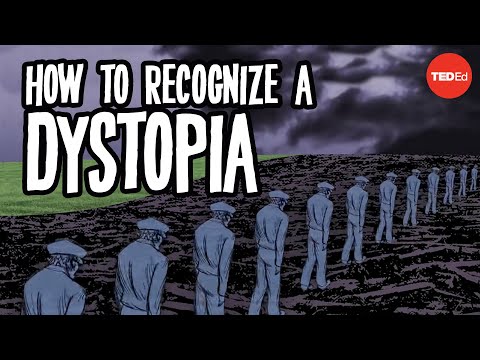 YouTube
House style: one publication’s conventions
Some conventions belong to a single publication rather than to a whole type. The column gives the date of the hearing as “Tuesday, Nov. 5, at 7 p.m.” (paragraph 12): an abbreviated month, a period after it, the time in lower case. It sets the ferry’s name in italics, Ellery Belle (paragraph 2), and spells “councillors” (paragraph 11) the Canadian way. These choices are the newspaper’s house style, applied to everything it prints, whoever writes it. House style makes dozens of writers sound like one paper.
The blog post of a family oyster-omelette stall in Penang, Malaysia, follows a different house style for the same kind of information. It announces its reopening for “this Thursday, 4 September” (paragraph 5) and says the stall will “start at 6pm”. Neither text is more correct. Each date marks the text as belonging to its source, a North American newspaper in one case and a Malaysian family blog in the other. House style is rarely noticed, which is exactly its purpose; it becomes visible only when two sources are set side by side.
House style also shows how small a convention can be and still carry meaning. A weekly paper that writes “Nov. 5” sounds settled and institutional, the voice of a publication that has printed hundreds of notices of hearings. The column borrows that voice in paragraph 12 at the moment it needs to sound practical, and the abbreviation helps the call to come and “fill” the fire hall read like a public notice rather than a plea.
The column’s one departure
The two paragraphs marked in the diagram change the column’s method. Up to paragraph 5 the writer argues from experience and reasoning, as columnists do. Paragraph 6 quotes the council report’s phrase, “shift discretionary travel to weekdays”, and then announces a different kind of evidence:
I went down to the slip last Saturday to see what discretionary looks like.
. . .
She asked me to print that it is not discretionary. I have.“Keep the Saturday ferry”, paragraphs 6 and 7
Going to look is a reporter’s method, not a columnist’s. Paragraph 7 then reads like a news report from the wharf: named people, a count (“the four island teenagers”), an exact age (“Marjorie Langille, who is 91”) and a place (“Water Street”). The column has borrowed the conventions of reportage, the eyewitness account that makes its case by what the writer saw. Its evidence changes in kind. Instead of answering the report’s average with an argument, the column answers it with a list of people the average contains.
The last two sentences of paragraph 7 depart further. A columnist normally owns the opinion on the page, and a reporter normally chooses which of a source’s words to quote. Here the source gives the order, “She asked me to print that it is not discretionary”, and the writer reports obeying it in two words, “I have.” The column steps aside for one of the people it speaks for. Her refusal of the report’s word arrives in her own terms, and the columnist becomes the printer of it.
The change matters most at the column’s close. A column is one person’s view, and a council can dismiss one person. By letting an islander dictate a sentence, the column turns its opinion into the island’s, which prepares the close: paragraph 13 moves from “I would like eleven more” to a plural promise to “keep filling it”. The departure works because everything around it is conventional. In a column that wandered from method to method, a quoted instruction would be one more oddity; in this one it is the moment the voice changes hands.
Whether a feature counts as a departure depends on who is reading. A regular reader of local weeklies may know columnists who report from the wharf every week, and for that reader paragraphs 6 and 7 would be conventional. Conventions are shared knowledge, and readers share them unevenly, so a claim that a text departs from its type is always a claim about what its audience expected. The safest evidence is the text’s own pattern: the ferry column itself sets up the column’s method for five paragraphs before it changes.
Subversion: an advertisement against buying
On Black Friday, 25 November 2011, the busiest shopping day of the American year, the outdoor clothing company Patagonia ran a full-page advertisement in The New York Times. It was headed by four words in capitals:
DON’T BUY THIS JACKET
Advertisement in The New York Times, 25 November 2011, headline
Under the headline was a photograph of one of the company’s own fleece jackets, and under the photograph a block of body copy setting out what the jacket had cost the environment to make. The copy asked readers to buy less, to repair what they owned and to pass on what they no longer used, and it pointed them to a pledge the company had launched to the same end.
Every convention of a retail advertisement is in place. There is the headline in large type, the product photographed alone against a plain ground, the brand name and the copy below, all placed on the day of the year with the most shoppers. The imperative of the headline is conventional too, since advertisements give instructions. Only its direction is reversed. The form that exists to make people buy is used to tell them not to, which is subversion: a convention turned against its usual purpose.
The subversion has a limit, and the advertisement itself shows it. Its logo still sits on the page, its jacket is still beautifully photographed, and anyone who turns the page with a warmer view of the company has been advertised to. The text can be read as subverting advertising or as perfecting it, depending on whether an advertisement’s purpose is taken to be selling one jacket or building trust in a brand. Both readings rest on the same features. A conventional form tends to reclaim the texts that subvert it, and that is the strongest reason to describe exactly what a subversion keeps.
A strict form: the villanelle
Literary forms have conventions too, and some forms have rules strict enough to be counted. The villanelle is the strictest in common use in English. It has nineteen lines in six stanzas, five of three lines and a last of four, and it allows only two rhyme sounds in the whole poem. Its first and third lines return in turn as the last line of each stanza, and they meet as the closing pair. The diagram sets out the pattern.


A form this strict can seem to leave nothing to choose, yet the choice of the form is already a meaning. Elizabeth Bishop’s “One Art”, first published in The New Yorker in 1976, is a villanelle about losing things. Its first line, which becomes its first refrain, makes a calm claim:
The art of losing isn’t hard to master;
Elizabeth Bishop, “One Art” (1976), line 1
The form makes the speaker say this again and again, and each return sounds less like a fact and more like a lesson she is trying to learn. Between the refrains the losses grow, from door keys and a wasted hour to a mother’s watch, houses, cities and a continent, and finally a loved person. The second refrain ends every time on the word “disaster”, which the claim insists losing is not. Repetition is the villanelle’s convention; in this poem it becomes the sound of someone holding herself together.
A strict form makes the smallest departure audible. In the last stanza the first refrain changes its wording slightly, and the speaker breaks into her own line with a command in brackets, which reads as the speaker ordering herself to write down the word she has been avoiding. In a free-verse poem neither change would be noticed. In a villanelle, where the same words have returned on schedule for fifteen lines, both register as the moment the self-control fails. The poem adheres to its form so closely that its one deviation carries its meaning.
The same form, another purpose
A form’s conventions do not fix its tone. Dylan Thomas’s “Do not go gentle into that good night” (1951), probably the best-known villanelle in English, uses the same returning lines to urge a dying father to fight. Bishop’s refrains try to make loss sound ordinary; Thomas’s refuse to let death be ordinary. The convention of return serves control in one poem and protest in the other, which suggests that a form offers a pattern of emphasis rather than a feeling.
Leaving verse: the prose poem
A text can depart from the conventions of a whole form and still be read inside it. In 1912 a book of poems published in London was expected to hold lines of verse, usually with meter and rhyme. Rabindranath Tagore’s Gitanjali, his own English versions of his Bengali songs, offered paragraphs instead. Poem 27, a night prayer for light, has no line breaks, no rhyme and no meter:
Misery knocks at thy door, and her message is that thy lord is wakeful, and he calls thee to the love-tryst through the darkness of night.
The sky is overcast with clouds and the rain is ceaseless. I know not what this is that stirs in me,—I know not its meaning.Rabindranath Tagore, Gitanjali 27 (1912), paragraphs 3–4
The chapter on poetry reads what the prose poem gains and loses without the line. The question here is what the departure kept. Every convention of prayer is still in place: the address to an absent lord, the petition, the confession of not knowing (“I know not its meaning”), and a cry that returns at the end. The poem leaves the conventions of English verse and keeps the conventions of devotion. It may also take up a third set, since paragraphs of this length, each beginning a new clause of feeling, resemble the verses of the Psalms in the English Bible, which Tagore’s readers knew well.
That is why the departure did not read as a failure to write poetry. Tagore’s English audience could hear, in place of the form he had left out, devotional writing it already honored, and perhaps the scriptural verse paragraph. The case shows how departures usually work in literature as well as in journalism. A text leaves one set of conventions by entering another, and its meaning comes from the meeting: in Gitanjali, the private song of a Bengali poet reaches English readers in the sound of devotional writing they already knew.
Try it
Poem 27 opens “Light, oh where is the light?” and its last paragraph opens “Light, oh where is the light!” Which convention of verse does this repetition keep, even though the poem has given up the line?
It keeps the refrain, the convention of returning to the same words at intervals. Verse usually marks a refrain by its position at the end of a stanza; the prose poem marks it by position in its first and last paragraphs. The one change, from a question mark to an exclamation mark, makes the return carry the poem’s development: the question has become a cry.
Fiction that shows its conventions
Most fiction keeps its conventions out of sight. A novel’s pages hold words, its narrator describes what the characters look like, and its story moves forward in order, and none of this is noticed until a book refuses it. Laurence Sterne’s The Life and Opinions of Tristram Shandy, Gentleman, published in nine volumes between 1759 and 1767, refuses almost all of it. When the kindly parson Yorick dies in the first volume, the narrator gives his epitaph, borrowed from Hamlet:
Alas, poor YORICK!
Laurence Sterne, Tristram Shandy, volume 1, chapter 12 (1759)
In the first edition the next leaf is printed solid black on both sides. The black page mourns Yorick in a way no sentence could, and it also exposes something usually hidden: a page of a novel is a printed object, and the printer can put anything on it. Later volumes go further. A marbled page appears as “motley emblem of my work!” When a character’s beauty is to be described, the narrator hands the job to the reader instead: “Sit down, Sir, paint her to your own mind”, with a blank page left for the purpose. Fiction that draws attention to how it is made, and to the conventions that usually hide the making, is metafiction.
The narrator explains his method too. Instead of moving forward, the book keeps breaking off into digression. The narrator defends the habit in the first volume: “Digressions, incontestably, are the sunshine;——they are the life, the soul of reading!” A novel that comments on its own lack of order turns its form into its subject. The term metafiction itself is usually credited to the American novelist William H. Gass, who used it in 1970, two centuries later, of writers of his own time who did the same, but Tristram Shandy suggests that the impulse is as old as the novel.
Self-reference outside fiction
Non-literary texts can point at their own conventions in smaller ways. The ferry column reports its own printing: “She asked me to print that it is not discretionary. I have.” For a moment the column becomes the subject of the column, a reminder that what is on the page was chosen by someone. The advertisement that said “DON’T BUY THIS JACKET” works the same way on a larger scale, since an advertisement about the harm of buying is partly an advertisement about advertising. Self-reference is a departure that makes the convention itself visible.
How to analyze a deviation
The examples so far share a method that can be applied to any text. Name the convention the text is working with, using evidence that it is a convention (other texts of the type, or the text’s own pattern). Show the exact place where the text keeps or leaves it, in quoted words. Then explain the effect: what the departure brings into view that the convention would have hidden. The ferry column’s last two paragraphs are a good test, because they look like a departure and are not quite one:
Come and fill it. For one evening, at least, nobody will call it under-used.
“Keep the Saturday ferry”, paragraph 12
The worked example ends on a judgment that many essays avoid: the column is conventional at its close, and good at it. Recognizing a convention used well is as much a part of reading as spotting a departure, and it is often the more accurate claim.
Where readers disagree: mastery or rupture
Critics since the Romantic period have divided over whether strong writing comes from breaking conventions or from mastering them. One position holds that conventions harden into habits that block real expression. William Wordsworth’s Preface to the second edition of Lyrical Ballads (1800) called the poems an experiment. They would use “a selection of the real language of men in a state of vivid sensation”, and promised readers “little of what is usually called poetic diction”. The poetic diction he rejected was the stock language of eighteenth-century verse, a convention he thought had cut poetry off from feeling.
The Russian formalist critic Viktor Shklovsky gave this position a theory in 1917: art exists to make the familiar strange again, a process the chapter on how texts unsettle readers calls defamiliarization. On this view conventions wear out, and the writer’s task is to break them before they stop being noticed. Each generation’s new forms become the next generation’s conventions, to be broken in turn.
The opposite position holds that no writer can depart from what they have not mastered, and that meaning comes from a work’s place among earlier works. T. S. Eliot’s essay “Tradition and the Individual Talent” (1919) put it most sharply:
No poet, no artist of any art, has his complete meaning alone. His significance, his appreciation is the appreciation of his relation to the dead poets and artists.
T. S. Eliot, “Tradition and the Individual Talent” (1919), in The Sacred Wood (London: Methuen, 1920)
Eliot did not argue for copying. In the same essay he grants that “novelty is better than repetition”, and he says that a real new work alters the whole order of works before it. His claim is that a departure means something only in relation to what it departs from. Wordsworth’s own practice supports him, since his poems against poetic diction still used meter and stanzas, and many of them rhymed: the conventions an audience of 1800 needed in order to recognize them as poems.
Bishop’s poem and the ferry column suggest that the choice is a false one. Bishop’s villanelle departs from its form only in its last stanza, and the departure is felt because she has mastered the form for fifteen lines. The ferry column departs for two paragraphs, and the departure works because the other eleven are conventional. The most defensible judgment is that mastery and departure are one skill seen from two sides. A text that breaks every convention offers nothing to measure the break against, and a text that breaks none offers nothing to notice.
Writing about conventions and departures
A paragraph about conventions makes a claim about what the text does with its type, names the conventions it keeps only as far as the claim needs, and spends most of its words on the place where the text departs. The paragraph that follows, as a strong student might write it, answers the question of how the ferry column uses and bends the conventions of the opinion column.
For most of its length the ferry column is a textbook opinion column, and its conventions are what make its one departure persuasive.note 1 It begins with the writer’s credential, “eleven winters” of Saturday crossings (paragraph 1), concedes that “$212,000 is real money” (paragraph 3) and turns with “But” to the report’s own figures (paragraph 4).note 2 In paragraphs 6 and 7 it abandons argument for reportage: the writer goes “down to the slip” to see what “discretionary” looks like, and answers the council’s average with named people, from four teenagers to a 91-year-old on her way to the hairdresser.note 3 The column then lets that woman write its verdict, printing her instruction that her trip “is not discretionary” and adding only “I have.”, so that the opinion on the page stops being one columnist’s and becomes the island’s.note 4
A claim about the type. The topic sentence links the conventions to the departure, so the paragraph has an argument rather than a list.
Conventions in one sentence. Three conventions are named with a short quotation each, enough to establish the pattern the departure breaks.
The departure named precisely. The paragraph says which convention is left and which is borrowed (reportage), and shows the change in the kind of evidence.
Effect. The last sentence explains what the departure does to the column’s authority, which is the point a list of features could never reach.
The paragraph quotes the column in every sentence, but most of its words go to two paragraphs out of thirteen, because that is where the meaning is. The commonest weakness in writing about conventions is the reverse: a full inventory of conventions and a single word, “unconventional”, for the departure. The pair that follows sets that weakness beside its repair, on the advertisement of 25 November 2011.
Weak: The advertisement is very unconventional because it tells people not to buy the jacket, which is the opposite of what ads normally do.note 1 This makes it stand out and grab the reader’s attention.note 2
Strong: The advertisement keeps every convention of a retail page, the headline, the product shot, the copy and the logo, so that its imperative, “DON’T BUY THIS JACKET”, is read in the place where readers expect to be told to buy.note 3 The clash between form and instruction is the message: on the year’s biggest shopping day, a page built to sell is used to argue against buying, although the logo beneath it still sells the brand that is arguing.note 4
A label for an analysis. “Unconventional” names the feature without saying which convention is broken or how; “very” adds nothing.
An effect any text could have. Standing out and grabbing attention would describe any striking advertisement.
What is kept, then what is reversed. The strong version makes clear that the subversion depends on the conventions being intact.
Effect and limit together. The last sentence states what the clash means and notes the logo that complicates it, a mark of judgment.
Applying it in Paper 1
Paper 1 sets an unseen non-literary text, and its type is usually recognizable at a glance: an advertisement, a column, a leaflet, a blog post, a speech. A guiding question may ask how a text uses the features of its type to reach its audience, or how its structure persuades. In either case the conventions are the frame, not the answer. The analysis begins where the text uses a convention in a particular way, or leaves it.
A model sentence on an unseen column might read: “Until its sixth paragraph the column follows the usual route of concession and rebuttal; then the writer stops arguing and starts reporting, so that people answer the council’s abstraction.” The commonest way to lose marks is to spend the first half of an essay listing the conventions of the type, each with a quotation and no effect, before reaching anything specific to the text.
How conventions themselves change, so that today’s departure becomes tomorrow’s rule and the letter becomes the email and the post, is the next question in the area of Intertextuality. The opinion column, the poem and the parody, a text built on another text’s conventions, each take the idea further on their own pages.
Self-check
- To do:
I can define convention and house style and explain why texts of one kind share conventions.
- To do:
I can identify the conventions an opinion column keeps and the place where the ferry column departs from them.
- To do:
I can distinguish a departure from a subversion, using an advertisement as evidence.
- To do:
I can explain how a strict form such as the villanelle makes a small departure carry meaning.
- To do:
I can explain what a prose poem keeps and leaves, and what metafiction shows about the conventions of fiction.
- To do:
I can set out the argument between breaking and mastering conventions, with a critic for each side, and reach a judgment.
- To do:
I can write a paragraph that names a convention, quotes the departure and explains its effect.
Key terms
Each is also in the Intertextuality: connecting texts glossary for IB English A Lang & Lit, beside the other terms of its topic.
- Convention
A convention is a feature that texts of one kind are expected to share, which readers recognize without being told. Conventions tell a reader what kind of text is in hand and how to read it, so a departure from one is usually noticed.
- House style
House style is the set of conventions one publication or organization applies to everything it prints, covering matters such as how it writes dates, numbers, titles and spellings. It makes many writers sound like one source and marks a text as belonging to that source.
- Metafiction
Metafiction is fiction that draws attention to its own status as fiction, by showing how it is made, addressing the reader about the book in hand or breaking the conventions that normally hide the writing. It turns the conventions of storytelling into part of the subject.
- Subversion
Subversion is the use of a convention against its usual purpose, so that the familiar form carries a message it normally works to prevent. It depends on the reader recognizing the convention first, since the effect comes from the clash between what the form promises and what the text does with it.
- Villanelle
A villanelle is a fixed poetic form of nineteen lines, five three-line stanzas and a closing four-line stanza, built on only two rhymes. Two lines from the first stanza return in turn as refrains and meet as the last two lines, so the form keeps circling back to the same words.
Practice questions on 3.1 How do texts adhere to and deviate from conventions associated with literary forms or text types?
Augment’s own questions, written in the style of IB exam papers. Here is how a few of them start.

Practice all 13 questions on 3.1 How do texts adhere to and deviate from conventions associated with literary forms or text types?
Free with an account. Write your answer, open the markscheme beside it and mark yourself. Augment keeps the ones you got wrong for another go.
More in 3 Intertextuality: connecting texts
The whole topic is on its own page.
- 3.1How do texts adhere to and deviate from conventions associated with literary forms or text types?This page
- 3.2How do conventions and systems of reference evolve over time?
- 3.3In what ways can diverse texts share points of similarity?
- 3.4How valid is the notion of a classic text?
- 3.5How can texts offer multiple perspectives of a single issue, topic or theme?
- 3.6In what ways can comparison and interpretation be transformative?
Carry on with 3.1 How do texts adhere to and deviate from conventions associated with literary forms or text types? in Augment
With a free account, Augment remembers where you stopped in the notes and which questions you have marked.