C4.1 Populations and communities questions for IB Biology
42 questions on Populations and communities, written by Augment in the style of IB exam papers. Six of them are below in full, to answer on paper.
- IB Biology
- Part of C Interaction and interdependence
- SL and HL
Questions by paper and level
SL and HL questions are for students at either level. HL only questions cover what only HL students study.
| Paper | SL and HL | HL only | All |
|---|---|---|---|
| Paper 1A | 20 | 0 | 20 |
| Paper 1B | 5 | 0 | 5 |
| Paper 2 | 16 | 1 | 17 |
| Every paper | 41 | 1 | 42 |
Counted on
Questions to try
Written by Augment in the style of IB exams, not past papers. Answer them on paper, then check each one against its markscheme with a free account.
Two groups of the common frog, Rana temporaria, live in ponds about 30 km apart. Which observation would show that they are separate populations?
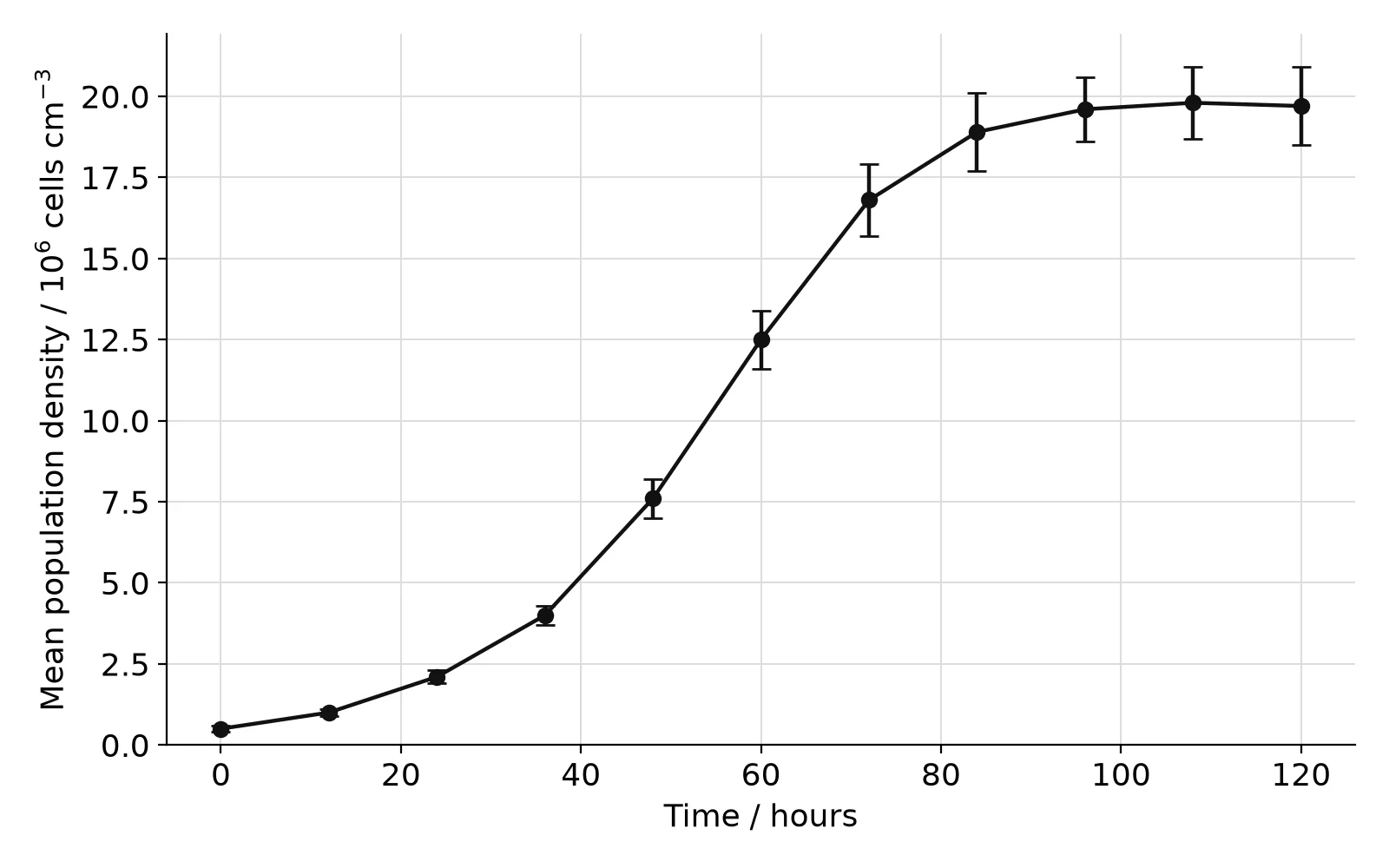
Students investigated the growth of a population of yeast (Saccharomyces cerevisiae). A small number of yeast cells were added to each of three flasks containing 100 cm3 of 5 % glucose solution, kept at 25 °C. Every 12 hours a sample was taken from each flask and the cells were counted with a haemocytometer (a counting chamber viewed under a microscope). The graph shows the mean population density; error bars show ± one standard deviation.
- (a)
Estimate the maximum population density that the flasks could sustain.
1 mark
- (b)
Calculate the mean rate of increase in population density between 24 hours and 48 hours.
2 marks
- (c)
Explain why the population grew exponentially during the first 48 hours.
2 marks
- (d)
A student plotted the mean population density on a logarithmic scale against time on a linear scale. Describe how this graph could be used to test whether the growth fitted the model of exponential growth.
2 marks
- (e)
Suggest two reasons why the population stopped increasing after about 96 hours.
2 marks
Interactions between species shape the communities in which they live.
- (a)
Outline how predator–prey relationships can control the size of animal populations, using a named example.
4 marks
- (b)
Distinguish between the fundamental niche and the realized niche of a species.
4 marks
- (c)
Explain how competition between species can result in competitive exclusion, and how interspecific competition can be investigated.
7 marks
Why do ecologists usually estimate the size of a population by random sampling rather than counting every individual?
Students estimated the population of dandelions (Taraxacum officinale) in two areas of a school grounds: a mown lawn of area 600 m2 and an unmown field. Ten 1 m2 quadrats were placed at random positions in each area and the number of dandelion plants in each quadrat was counted.
Quadrat | Number of dandelions in mown lawn | Number of dandelions in unmown field |
|---|---|---|
1 | 6 | 1 |
2 | 9 | 0 |
3 | 4 | 3 |
4 | 7 | 2 |
5 | 8 | 0 |
6 | 5 | 1 |
7 | 10 | 4 |
8 | 6 | 0 |
9 | 7 | 2 |
10 | 8 | 1 |
Mean | 1.4 | |
Standard deviation | 1.8 | 1.3 |
- (a)
Outline how the students could have placed the quadrats at random positions.
2 marks
- (b)
Calculate the mean number of dandelions per quadrat in the mown lawn.
1 mark
- (c)
Estimate the population size of dandelions in the mown lawn.
1 mark
- (d)
State what the standard deviation of the mean shows.
1 mark
- (e)
Explain why the estimate in (c) is unlikely to be exactly equal to the true number of dandelions in the lawn, and suggest how the estimate could be improved.
2 marks
Scientific claims must be supported by evidence.
- (a)
Describe the evidence for evolution provided by homologous structures, using the pentadactyl limb as an example.
4 marks
- (b)
Explain how resource competition can allow an invasive species to replace an endemic species.
4 marks
- (c)
Evaluate the evidence that the Earth is experiencing a biodiversity crisis.
7 marks
Practice all 42 in Augment
Free with an account. Every question has its markscheme, and Augment keeps the ones you got wrong so you can come back to them.
More questions in Interaction and interdependence
- C1.1Enzymes and metabolism
- C1.2Cell respiration
- C1.3Photosynthesis
- C2.1Chemical signallingHL only
- C2.2Neural signalling
- C3.1Integration of body systems
- C3.2Defence against disease
- C4.1Populations and communitiesThis page
- C4.2Transfers of energy and matter
Check your answers in Augment
A free account opens all 42 questions on Populations and communities with their markschemes, and keeps a record of what you have marked.