C2.2 Neural signalling questions for IB Biology
42 questions on Neural signalling, written by Augment in the style of IB exam papers. Six of them are below in full, to answer on paper.
- IB Biology
- Part of C Interaction and interdependence
- SL and HL
Questions by paper and level
SL and HL questions are for students at either level. HL only questions cover what only HL students study.
| Paper | SL and HL | HL only | All |
|---|---|---|---|
| Paper 1A | 9 | 11 | 20 |
| Paper 1B | 3 | 2 | 5 |
| Paper 2 | 5 | 12 | 17 |
| Every paper | 17 | 25 | 42 |
Counted on
Questions to try
Written by Augment in the style of IB exams, not past papers. Answer them on paper, then check each one against its markscheme with a free account.
Which statement describes the structure of a typical motor neuron?
Researchers investigated the relationship between axon diameter and the speed of nerve impulses in non-myelinated axons. Single axons were dissected from eight species of marine invertebrate, including the giant axon of a squid. Each axon was kept in seawater at 18 °C, stimulated at one end, and the time taken for the impulse to reach a recording electrode a known distance away was used to calculate the conduction speed. The graph shows the mean conduction speed for each axon.
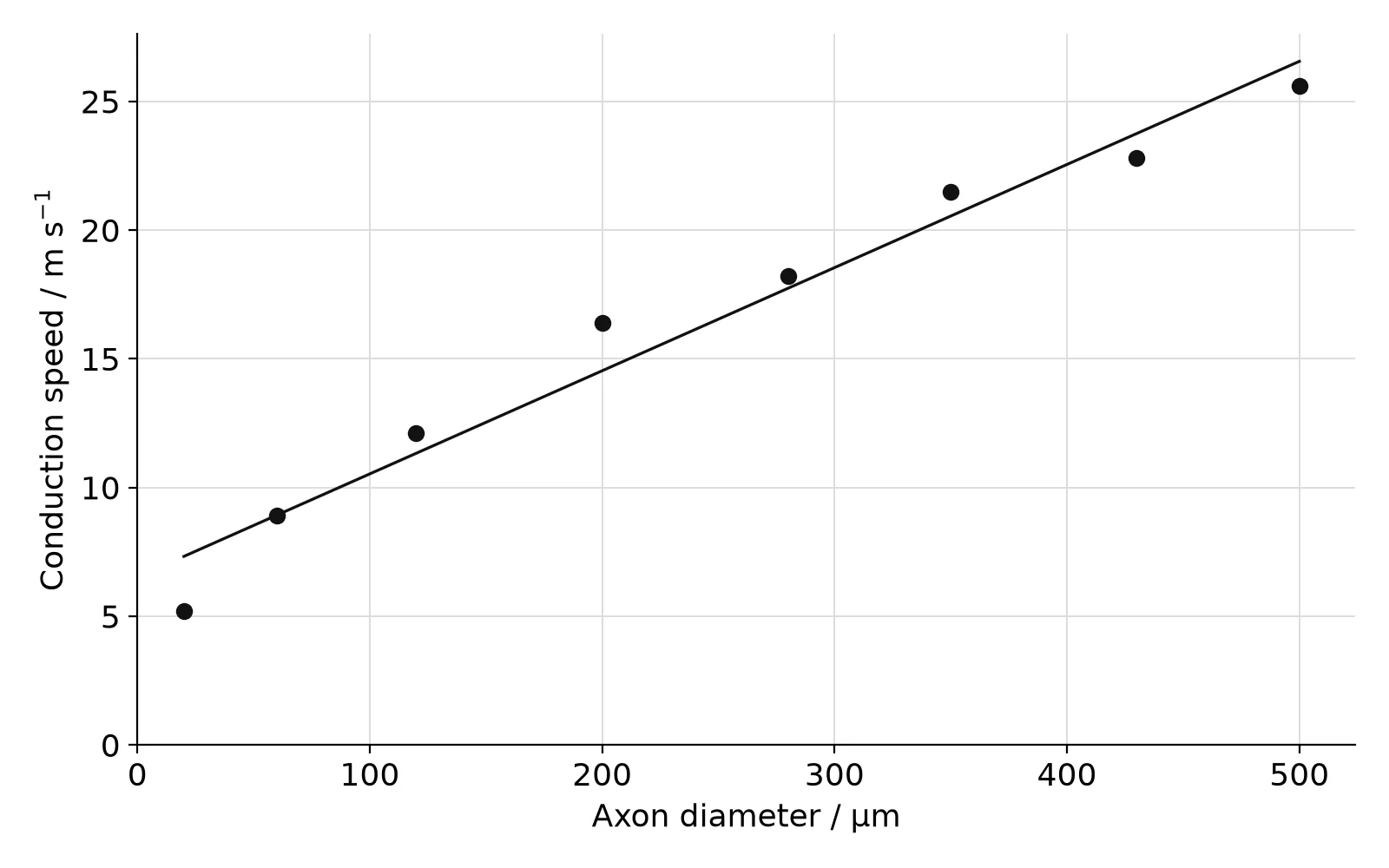
The correlation coefficient (r) for these data is 0.98.
- (a)
State one variable that was controlled in this investigation.
1 mark
- (b)
Calculate the coefficient of determination (R2) and outline what it shows about these data.
2 marks
- (c)
Describe the relationship between axon diameter and conduction speed shown in the graph.
2 marks
- (d)
A student concluded that a wider axon causes a faster nerve impulse. Outline why a correlation alone does not show this.
1 mark
- (e)
Myelinated axons in mammals with a diameter of 10 μm conduct impulses at about 50 m s-1. Using the data, outline how the conduction speed of these axons differs from that of the non-myelinated axons, and suggest one advantage of myelination for a vertebrate.
2 marks
The table shows estimates of the number of motor neurons supplying three human skeletal muscles and the number of muscle fibres in each muscle.
Muscle | Number of motor neurons | Number of muscle fibres | Mean number of fibres per motor unit |
|---|---|---|---|
muscle that moves the eyeball | 2 970 | 27 000 | 9 |
muscle that moves the index finger | 120 | 40 800 | 340 |
calf muscle that raises the heel | 580 | 1 040 000 |
- (a)
Calculate the mean number of fibres per motor unit in the calf muscle.
1 mark
- (b)
State the name of the junction between a motor neuron and a muscle fibre.
1 mark
- (c)
Suggest, using the data, why the muscle that moves the eyeball has small motor units.
2 marks
- (d)
Explain how the force of contraction of the calf muscle can be varied.
2 marks
- (e)
Describe the events at a neuromuscular junction that lead to depolarization of the muscle fibre membrane.
3 marks
How does the sodium–potassium pump help to establish the resting potential of a neuron?
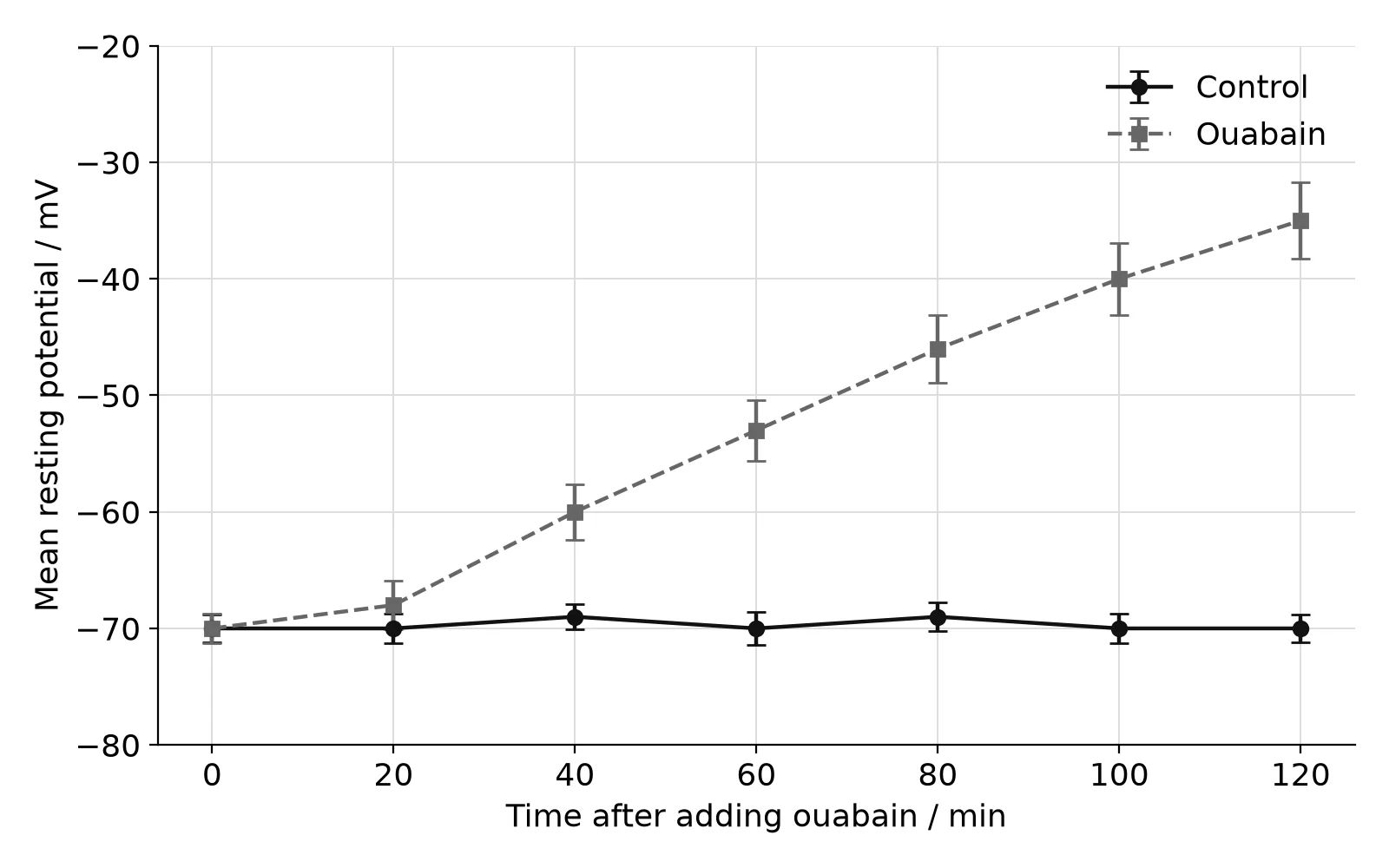
Ouabain is a chemical that binds to sodium–potassium pumps and stops them working. Students used data from an experiment on isolated crab (Carcinus maenas) nerve fibres. Five fibres were kept in an oxygenated saline solution with ouabain added at time 0, and five control fibres were kept in the same solution without ouabain. The resting potential of each fibre was recorded every 20 minutes using a microelectrode. The graph shows the mean resting potential ± standard deviation.
- (a)
State the dependent variable in this experiment.
1 mark
- (b)
The mean resting potential of the fibres treated with ouabain changed from −70 mV to −35 mV over 120 minutes. Calculate the percentage decrease in the size of the resting potential.
1 mark
- (c)
Using the error bars, discuss whether ouabain had a significant effect on the resting potential after 20 minutes and after 120 minutes.
2 marks
- (d)
Explain why the resting potential of the fibres treated with ouabain became less negative gradually rather than immediately.
3 marks
- (e)
Suggest why the saline solution was oxygenated for both groups of fibres.
1 mark
Movement in animals depends on the coordinated action of nerves, muscles and bones.
- (a)
Outline how an action potential is propagated along an axon.
4 marks
- (b)
Explain how skeletal muscle fibres contract, using the sliding filament model.
7 marks
- (c)
Describe the structure of the human hip joint.
4 marks
Practice all 42 in Augment
Free with an account. Every question has its markscheme, and Augment keeps the ones you got wrong so you can come back to them.
More questions in Interaction and interdependence
- C1.1Enzymes and metabolism
- C1.2Cell respiration
- C1.3Photosynthesis
- C2.1Chemical signallingHL only
- C2.2Neural signallingThis page
- C3.1Integration of body systems
- C3.2Defence against disease
- C4.1Populations and communities
- C4.2Transfers of energy and matter
Check your answers in Augment
A free account opens all 42 questions on Neural signalling with their markschemes, and keeps a record of what you have marked.