C3.2 Defence against disease questions for IB Biology
44 questions on Defence against disease, written by Augment in the style of IB exam papers. Six of them are below in full, to answer on paper.
- IB Biology
- Part of C Interaction and interdependence
- SL and HL
Questions by paper and level
SL and HL questions are for students at either level. HL only questions cover what only HL students study.
| Paper | SL and HL | HL only | All |
|---|---|---|---|
| Paper 1A | 20 | 1 | 21 |
| Paper 1B | 5 | 1 | 6 |
| Paper 2 | 13 | 4 | 17 |
| Every paper | 38 | 6 | 44 |
Counted on
Questions to try
Written by Augment in the style of IB exams, not past papers. Answer them on paper, then check each one against its markscheme with a free account.
Why is a new influenza vaccine produced every year?
Researchers injected human blood serum into rabbits, which produced antibodies against the human serum proteins. Serum containing these antibodies was then mixed with serum from humans and from six other primate species. The antibodies bind to proteins with a similar shape, forming a precipitate. The mass of precipitate was measured and expressed as a percentage of the mass formed with human serum. Each test was repeated five times.
Species | Mean precipitate / % of human value | Standard deviation / % |
|---|---|---|
Human | 100 | 0 |
Chimpanzee | 95 | 4 |
Gorilla | 93 | 5 |
Orangutan | 82 | 4 |
Baboon | 71 | 6 |
Spider monkey | 58 | 5 |
Lemur | 37 | 6 |
- (a)
Suggest why the results are expressed as a percentage of the value for human serum.
1 mark
- (b)
Calculate the percentage decrease in precipitate from chimpanzee serum to baboon serum.
1 mark
- (c)
Explain why less precipitate formed with serum from species more distantly related to humans.
2 marks
- (d)
Evaluate the conclusion that chimpanzees are more closely related to humans than gorillas are.
2 marks
- (e)
Suggest two reasons why comparing amino acid sequences is better evidence for constructing clades than this method.
2 marks
Mouse macrophages were allowed to engulf bacteria by phagocytosis. The pH inside the phagocytic vacuoles was measured using a pH-sensitive fluorescent dye bound to the bacteria.
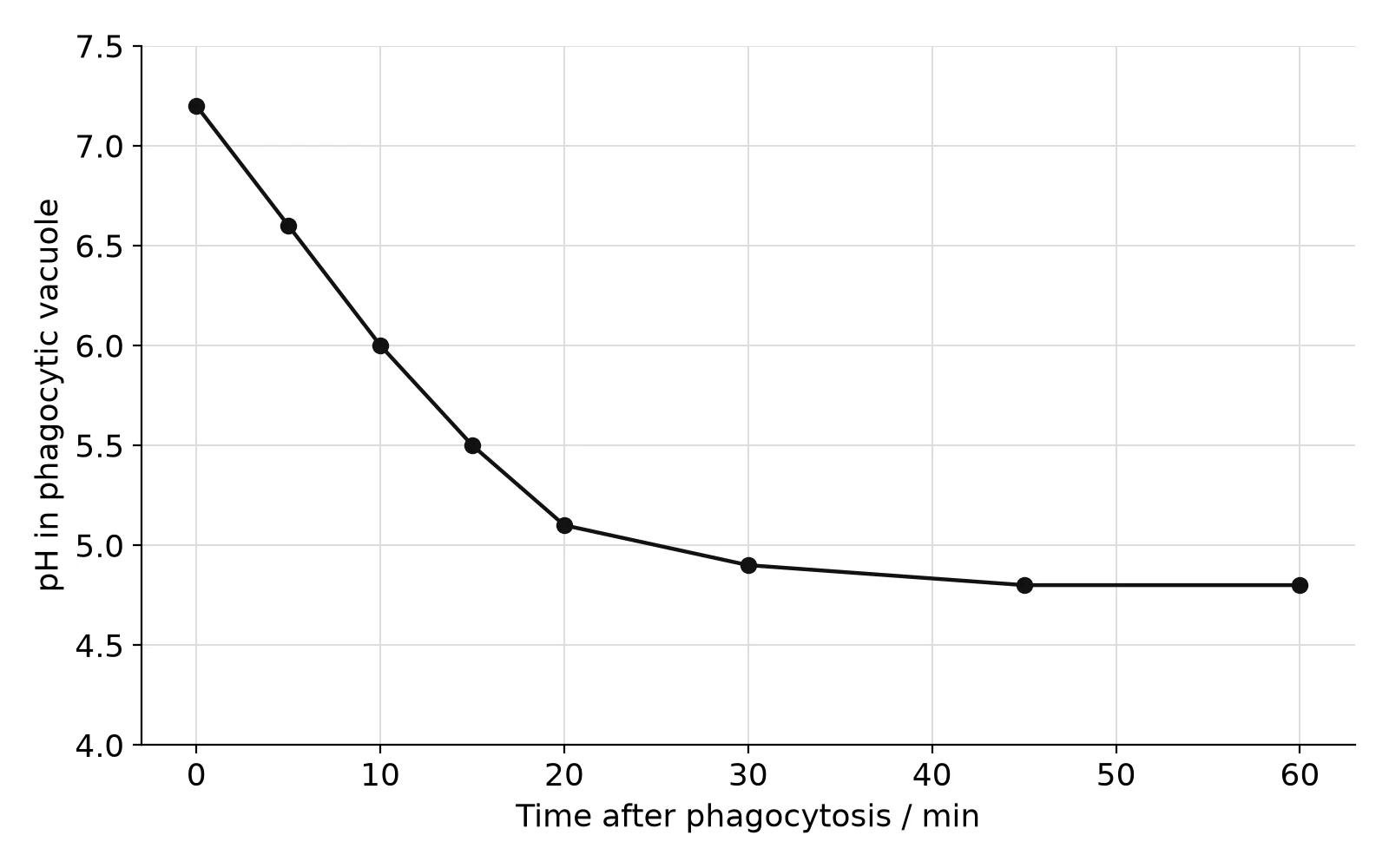
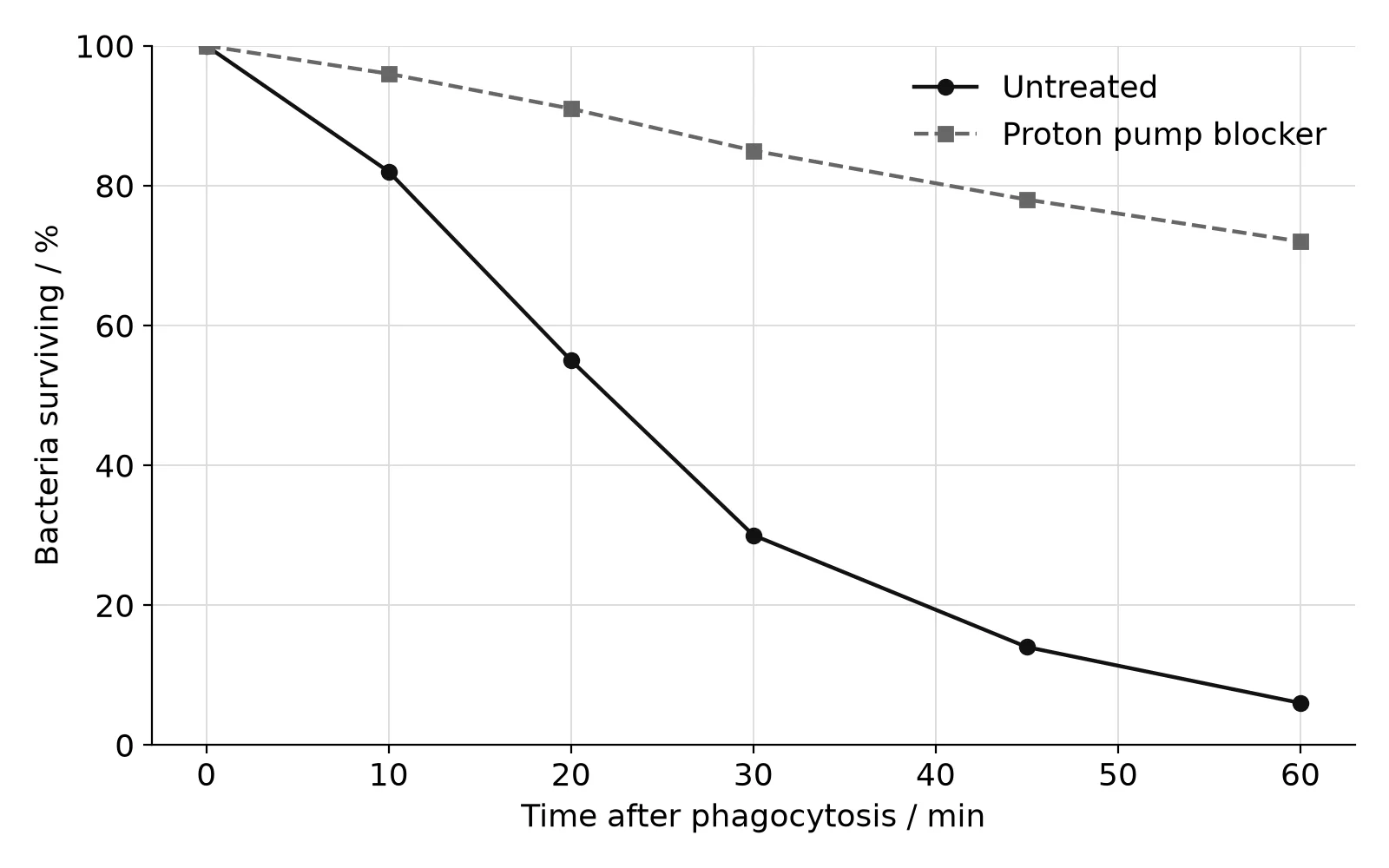
In a second experiment, the percentage of engulfed bacteria still alive was measured in untreated macrophages and in macrophages treated with a drug that blocks the proton pumps in lysosome and vacuole membranes. In treated macrophages the pH in the vacuoles stayed above 6.5.
- (a)
State the pH in the phagocytic vacuoles 15 minutes after phagocytosis.
1 mark
- (b)
Calculate the difference between the percentage of bacteria surviving in untreated and treated macrophages at 60 minutes.
1 mark
- (c)
Describe the changes in pH in the phagocytic vacuoles.
2 marks
- (d)
Using both graphs, deduce the relationship between the pH of the vacuole and the killing of bacteria.
2 marks
- (e)
Suggest why lysosomes fuse with the phagocytic vacuole rather than releasing their enzymes into the cytoplasm.
2 marks
Which group of organisms has no members that are known to cause disease in humans?
Students investigated the effect of the concentration of the antibiotic streptomycin on the growth of the non-pathogenic bacterium Bacillus subtilis. Paper discs 6 mm in diameter were soaked in streptomycin solutions of different concentrations, or in sterile distilled water, and placed on agar plates that had been spread evenly with the bacteria. The plates were sealed and incubated at 25 °C for 48 hours. The diameter of the clear zone around each disc, where no bacteria grew, was then measured. Each concentration was tested on five plates.
Streptomycin concentration / µg cm-3 | Plate 1 / mm | Plate 2 / mm | Plate 3 / mm | Plate 4 / mm | Plate 5 / mm | Mean diameter of clear zone / mm |
|---|---|---|---|---|---|---|
0 (water) | 6 | 6 | 6 | 6 | 6 | 6.0 |
10 | 9 | 10 | 8 | 9 | 10 | 9.2 |
25 | 13 | 12 | 14 | 11 | 13 | 12.6 |
50 | 16 | 17 | 15 | 17 | 16 | |
100 | 19 | 21 | 18 | 20 | 19 | 19.4 |
200 | 21 | 22 | 20 | 23 | 22 | 21.6 |
- (a)
State the independent variable in this investigation.
1 mark
- (b)
Calculate the mean diameter of the clear zone for 50 µg cm-3 of streptomycin.
1 mark
- (c)
Suggest the purpose of the discs soaked in sterile distilled water.
1 mark
- (d)
Describe the effect of streptomycin concentration on the diameter of the clear zone.
2 marks
- (e)
State one variable, other than temperature, that should be kept constant between plates.
1 mark
- (f)
Streptomycin binds to 70S ribosomes. Explain why it can be used to treat bacterial infections in humans without harming the patient's cells.
2 marks
Eukaryotic cells are divided into compartments by membranes.
- (a)
Describe the structure of the plasma membrane according to the fluid mosaic model.
4 marks
- (b)
Explain the advantages of compartmentalization in eukaryotic cells.
7 marks
- (c)
Outline how phagocytes help to control infections.
4 marks
Practice all 44 in Augment
Free with an account. Every question has its markscheme, and Augment keeps the ones you got wrong so you can come back to them.
More questions in Interaction and interdependence
- C1.1Enzymes and metabolism
- C1.2Cell respiration
- C1.3Photosynthesis
- C2.1Chemical signallingHL only
- C2.2Neural signalling
- C3.1Integration of body systems
- C3.2Defence against diseaseThis page
- C4.1Populations and communities
- C4.2Transfers of energy and matter
Check your answers in Augment
A free account opens all 44 questions on Defence against disease with their markschemes, and keeps a record of what you have marked.